Lax’aire Dosage Calculator For Dogs
Based on the official Lax’aire product label directions for dogs
Lax’aire Dosage For Dogs is an over-the-counter laxative and lubricant ointment for dogs. The label directs owners to give a ½-inch to 2-inch ribbon of ointment, 2–3 times per week. This tool scales the recommended ribbon length within that labeled range based on your dog’s weight, and does not replace veterinary advice.
Recommended Lax’aire Dosage
- Give by mouth, directly off your finger or from the tube.
- Contains liquid petrolatum, cod liver oil, soybean oil, and peptonized iron in a palatable base.
If your dog pup has been having some trouble with occasional constipation or hairballs, you’ve likely stumbled upon Lax’aire, a non-obtrusive, oil-based laxative ointment that’s been a staple at pet stores for years. The big problem is not that of locating the product. It is about knowing how much to give your size dog, how frequently, and how to do it without making an educated guess.
This guide is the Lax’aire dosage for dogs official label dose, translated to weight for ease in applying to your dog, and includes answers to the safety questions that most owners have, but for which they seldom obtain clear responses.
Quick Answer: Owners are told on the label to administer Lax’aire ointment, ½ inch to 2 inches of ribbon, by mouth, 2 to 3 times per week to dogs. The label doesn’t specify a dose for each weight class — smaller dogs typically will use the lower end of the range, larger dogs the higher end, and this guide will help you determine where your dog falls on the spectrum.
What is Lax’aire Dosage For Dogs?
Laxaire dosage for dogs is the manufacturer’s recommendation for this over-the-counter (OTC) laxative and lubricant ointment: ½ inch to 2 inch strip is administered orally 2 to 3 times a week. The amount depends on the size of the dog; smaller dogs will need less and larger dogs will need more, up to the 2-inch maximum.
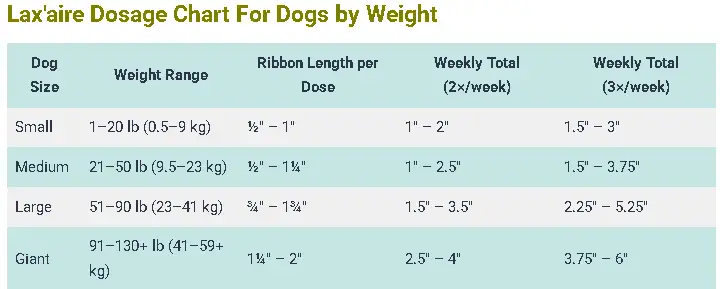
Lax’aire Dosage Chart For Dogs by Weight
The dosage reference table is shown below and is based on the prescribed dosage for a particular dog that is proportional to the dog’s weight, based on the Lax’aire label (½”-2″ ribbon, 2-3 times per week).
| Dog Size | Weight Range | Ribbon Length per Dose | Weekly Total (2×/week) | Weekly Total (3×/week) |
|---|---|---|---|---|
| Small | 1–20 lb (0.5–9 kg) | ½” – 1″ | 1″ – 2″ | 1.5″ – 3″ |
| Medium | 21–50 lb (9.5–23 kg) | ½” – 1¼” | 1″ – 2.5″ | 1.5″ – 3.75″ |
| Large | 51–90 lb (23–41 kg) | ¾” – 1¾” | 1.5″ – 3.5″ | 2.25″ – 5.25″ |
| Giant | 91–130+ lb (41–59+ kg) | 1¼” – 2″ | 2.5″ – 4″ | 3.75″ – 6″ |
Notes:
- Ribbon length is measured as squeezed from the tube, not a precise volume dose.
- 2″ is the label’s hard maximum per dose regardless of the dog’s size.
- Frequency stays at 2–3 times per week per the label — it does not increase with size.
- This weight-to-ribbon scaling is a reasonable interpolation within the manufacturer’s approved range, not an official per-weight breakdown from the label itself — always confirm with a veterinarian, especially for puppies, seniors, pregnant/nursing dogs, or dogs with health conditions.
What Is Lax’aire?
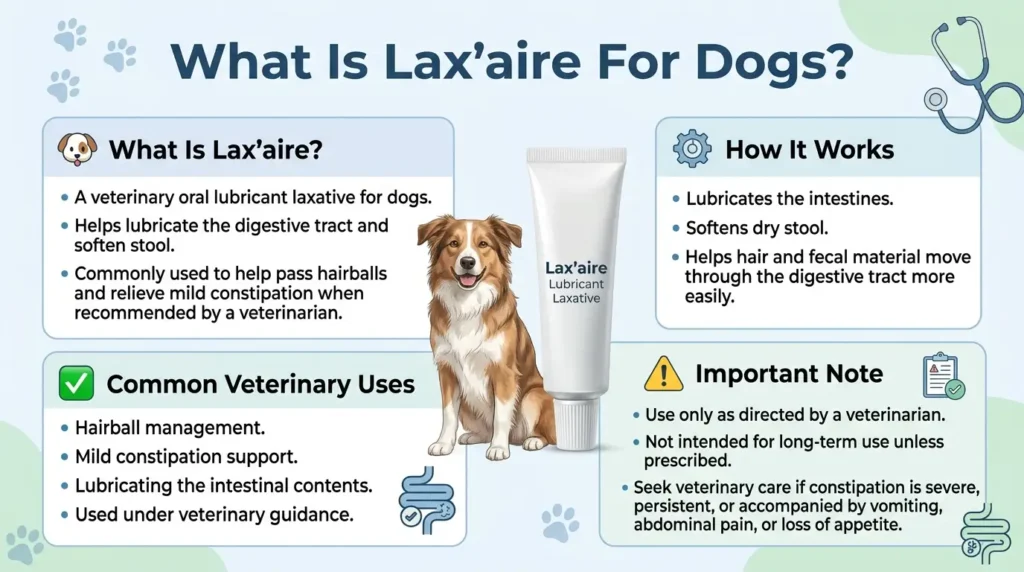
Laxaire medication is an over-the-counter laxative/lubricant ointment for both dogs and cats. This is to alleviate constipation, which may happen at times, and to make it easier for hairballs to move through the digestive tract, but not for an underlying medical condition.
What’s Inside Lax’aire
According to the product label, Lax’aire contains:
- Lubricants like liquid petrolatum to aid the passage of stool and hair through the intestine
- Cod liver oil
- Soybean oil
- Peptonized iron, in a palatable base formulated for taste appeal There’s no prescription drugs in the formula
it’s a lubricant-based formula, which is one of the reasons why the label states a range of doses and not a dosage per pound.
Why Is Lax’aire Used for Dogs?
Lax’aire medicine contains petrolatum, which is what’s used for dogs (and cats) as it keeps the stools soft so they can pass through them more easily in a mild constipation. It also makes it easier for hairballs to pass through its digestive system, thus preventing hair from accumulating in that area.
Laxaire is easy to administer and its highly palatable formula entices pets to take the dose by licking and prompting them to eat the rest of the dose.
Key Benefits of Lax’aire for Dogs
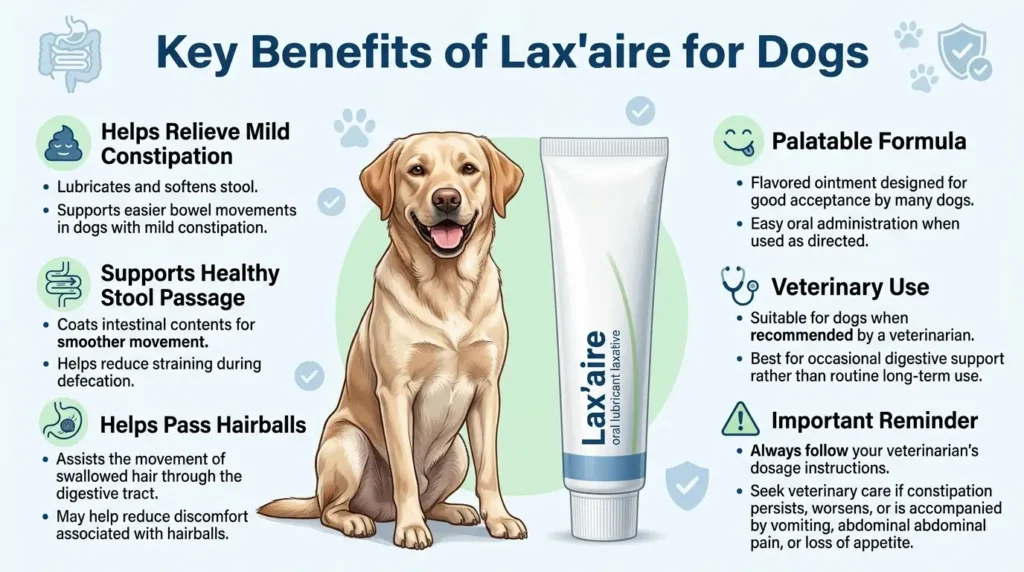
The main advantages of Lax’aire for Dogs Gentle Relief & Easy Digestive Support:
- Pleasant Laxative and Digestive Aid: A delicious ointment that helps to soothe and relax digestion, while also providing a gentle laxative effect to alleviate constipation and hairball irritability.
- Hairball Treatment: Lubricating formula to help hairballs pass through the digestive tract without stress — ideal for acute treatment or maintenance.
- Pet-Friendly Taste: High taste, readily accepted and easy to give to pet.
- Supports Healthy Digestion: Filled with the vital vitamins, fatty acids and iron for healthy digestion
- Easy to Use: In a convenient, squeezable tube — dispense a ribbon ointment and let your pet do the rest!
Lax’aire Dosage for Dogs (Official Label Directions)
Directions: Dose at a rate of 30ml for every 10kg of body weight.
Just what the manufacturer’s label states for dogs:
Administer ½-2″ ribbon of ointment, orally, 2-3 times weekly.
There is no other official guidance. There are two standouts:


Paid Links - As an Amazon Associate, I earn from qualifying purchases.
- It is a range not a number — the label allows owners to make space for their own judgement of what is appropriate for their dog’s size.
- It does not list weight specific dosage guidelines — some drugs are quite precise about how much per pound of dog, but not Lax’aire, which has one dosage range for all types of dogs, from Chihuahua to Mastiff.
That’s normal for a product like this — as a lubricant-type laxative rather than a drug with a narrow safety margin, the label allows for owner judgment within a wide, low-risk range. When you want a number though, “use your judgment” isn’t particularly satisfying. This is where a weight-based chart comes in handy.
How Often to Give Your Dog Lax’aire
Label permits 2 to 3 times per week, not everyday. There are two reasons why this is important:
- If given more often that indicated it may interfere with fat soluble vitamin (A, D, E, K) absorption as frequent use of oil laxatives over long periods can decrease the absorption of these vitamins.
- If you need to use a laxative every few days for weeks at a time, it is likely there is a problem, such as diet, hydration, obstruction, or medical condition – that won’t be resolved by using Lax’aide alone.
When it starts to be a habit to keep your dog going just to help him go, it’s time to see your vet to help you determine the correct dosage.
How to Give Lax’aire to Your Dog
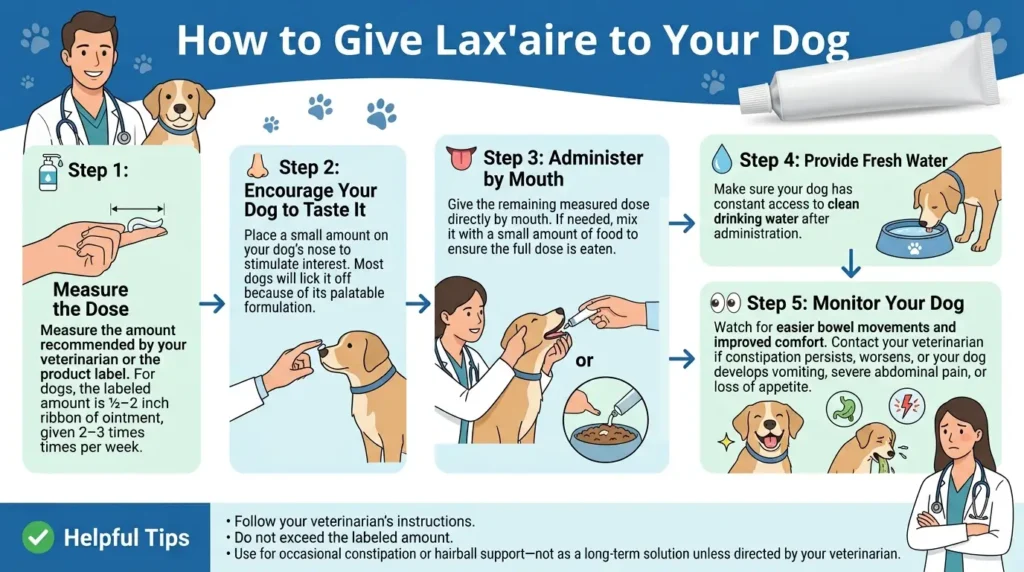
Most dogs will accept Laxaire due to the fact that it is palatable. A very simple administration tip from the label is to:
- First dab a bit on your dog’s nose or paw. This will make them curious and lick a little, making the remainder of the dose easier to administer.
- Offer the full ribbon directly from the tube, or off your finger. Once they have tasted it, most dogs won’t object to it being licked off.
- It is not put into food or rubbed onto the skin, but is left as a mouth given ointment.
If your dog won’t eat it, don’t try to push it in the food (which can mess with actual quantity given) or force it upon him. If the dose is refused it is a signal to attempt it again at the next dose time or contact your veterinarian if the refusal persists.
Is Lax’aire Safe for Dogs?
If used according to the label (right ribbon length and no more than 2–3 times a week), Lax’ire is generally considered a low risk over the counter laxative which many vets are familiar with. But, generally low-risk does not equal risk-free for all dogs; a few groups need extra care.
Puppies, Senior Dogs & Dogs with Health Conditions
The directions on the label are not specific to these groups and this is why they need a vet’s advice before beginning:
- Puppies have smaller, more sensitive digestive systems and dosing information for adult dogs may not apply.
- The metabolism of older dogs may be different, and they are more susceptible to underlying ailments (kidney, liver or GI issues), which can affect the response to any laxative.
- Pregnant or nursing dogs should only be given any laxative under veterinary supervision.
- A laxative, such as Lax’aire, should not be administered without a veterinary’s approval, as a lubricant laxative may exacerbate a bowel obstruction, in particular.
Can a Dog Get Too Much Lax’aire?
The primary problem dogs get from this product will be if their ribbon is visibly longer than 2 inches or if the product is administered more often than every 2–3 days. The two most frequent adverse effects of overdose of an oil laxative such as this are diarrhea or loose stools, and, if used for a long time, decreased absorption of fat-soluble vitamins.
If your dog has ingested a lot more than the recommended dosage, or if you notice your dog is continuing to run scooters, vomit or act lethargic, don’t wait to see if it gets better; see your veterinarian or an animal poison control hotline ASAP.
Lax’aire vs. Other Dog Laxatives
| Feature | Lax’aire | Plain Petroleum Jelly / Vaseline | Prescription Laxatives (vet-prescribed) |
|---|---|---|---|
| Active approach | Lubricant + palatable base | Lubricant only | Varies (stimulant, osmotic, etc.) |
| Formulated for dogs to eat willingly | Yes | No — not designed to be palatable | Yes |
| Dosage precision | Range-based (label) | Not standardized | Precise, vet-directed |
| Best for | Occasional constipation, hairballs | Not recommended as a substitute | Diagnosed or recurring constipation |
| Available without a prescription | Yes | Yes | No |
Lax’aire dosage for dogs isn’t just petroleum jelly designed to be taken; in fact, one of its strengths is that it’s made to be taken on a regular basis and willfully consumed. If your dog is constipated frequently or every day, a veterinarian-prescribed treatment is more likely to be suitable than multiple OTC treatments.
When to Call Your Vet Instead
Lax’aire is designed to treat occasional problems – not replace veterinary treatment. If you see any of the following, contact your veterinarian:
- No bowel movement for over 48 hours after complete dosage of Lax’aire.
- Little or no stool (poop) output with straining.
- Vomiting, loss of appetite or obvious pain or discomfort
- Rectal bleeding (blood in poop)
- Hard or bulged tummy
- The repeated use of Lax’aire, week after week, to maintain normal bowel movements in your dog.
All of these can be indicative of a problem that may not be what Laxaire has been designed to treat, and waiting may allow a minor trouble to escalate to a more serious one.
Common Mistakes to Avoid
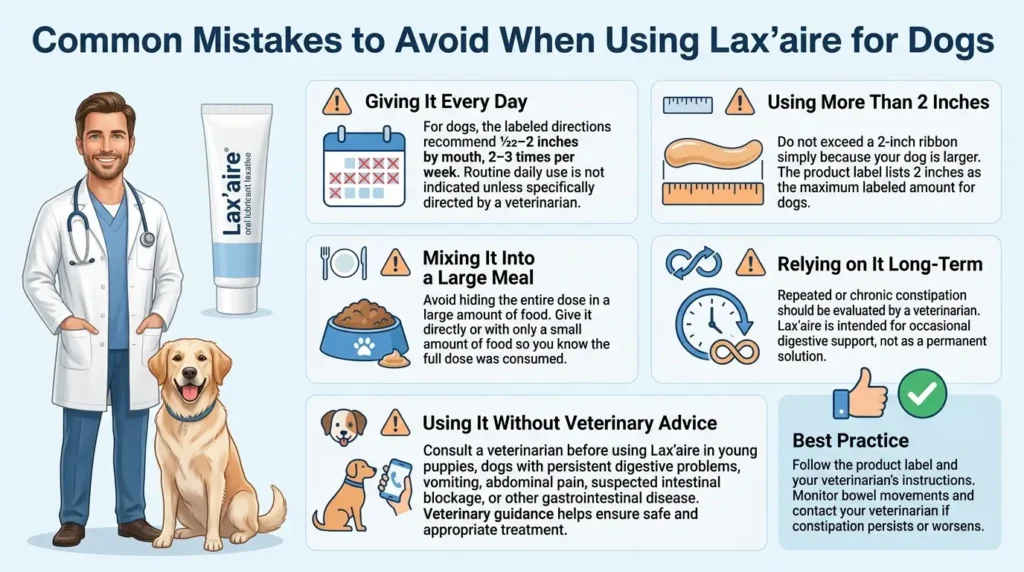
- Giving it daily. The label recommends up to 2–3 times per week — this is the maximum; daily use is not indicated.
- Over 2 inches, since “a larger dog probably needs more. The maximum height of the label is 2 inches no matter of what size the label is.
- Concealing it in a large quantity of food. This will make it difficult to determine how much your dog ate.
- As a long-term solution. If this happens repeatedly, it may be a problem that actually has a cause that you should investigate with your veterinarian.
- Administration to puppies or dogs with known GI problems without consulting a veterinarian.
You May Also Like to Read:
- KBroVet Dosage For Dogs: Calculator, Chart & Safe Guide
- Iverhart Max Dosage For Dogs: Calculator, Chart & Safe Guide
FAQs
How much Lax’aire dose do I give my dog?
Label states to give ½”-2″ ribbon of ointment by mouth 2-3 times weekly. Smaller dogs will be at the bottom, larger dogs will be at the top.
How often can I give my dog Lax’aire?
No more than 2 to 3 times per week, per the label. Not meant for every day usage.
Is it safe to use Lax’aire with puppies?
Label does not give puppy dosing rates, consult your veterinarian before administering to puppies.
What if I give my dog too much of the Lax’aire?
Yes — exceeding the ribbon length or frequency indicated on the label may lead to loose stool or diarrhea and overuse may interfere with absorption of fat-soluble vitamins. Contact your vet if you’re concerned your dog had too much.
How long does Lax’aire take to work in dogs?
There is no definite time period listed on the label. Call the vet if your dog doesn’t start showing signs of relief during the time frame indicated on the label, or if your dog has not defecated within 48 hours.
What materials are used to make Lax’aire from?
Liquid petrolatum, cod liver oil, soybean oil and peptonized iron in a palatable base according to label instruction.
Is it safe to give Lax’aire to my cat as well?
Laxaire is labeled for dogs and cats, but is given to dogs a different way than cats; don’t give dogs the cat dosage or cats the dog dosage.
Does Lax’aire need to be given with food?
No — it is made to be administered via the mouth, usually from the tube or on the finger and not added to food.
What if my dog won’t eat Lax’aire?
Follow label directions to encourage them to investigate by dipping a little on their nose or paw. If they persist in doing so, consult your veterinarian for other options.
Is Laxaire a prescription drug?
No, it can be purchased without a doctor’s prescription.
Does Can Lax’aire make up for veterinarian visits due to constipation?
For mild occasional cases only. If constipation persists or gets worse or is painful, veterinary evaluation is required, not more OTC doses.
Does Lax’aire have a weight restriction to use?
The label does not mention it, but if the dog is very small (less than 5 lb) or very large or giant, you may want to double-check with your vet, as the range on the label may not have been created with those extremes in mind.
Is Can Lax’air dog hairball medicine?
Yes — the lubricant base helps to ensure that the hairballs can pass through the digestive track more easily as well as help to relieve constipation.
Key Takeaways
- Standard dosage: ½-inch to 2-inch ribbon of ointment, given by mouth
- Frequency: 2 to 3 times per week — not daily
- Dosage by size: Smaller dogs typically need less of the range; larger dogs need closer to the full 2 inches
- Maximum: Never exceed a 2-inch ribbon per dose, regardless of dog size
- No official per-pound chart: The label gives one range for all dogs — sizing within it is an estimate, not a fixed manufacturer breakdown
- Not for daily use: Frequent overuse may affect absorption of fat-soluble vitamins
- Extra caution needed for: puppies, senior dogs, pregnant/nursing dogs, and dogs with existing GI conditions — check with a vet first
- Not a long-term fix: Repeated need for laxatives signals an underlying issue worth a vet visit
Final Thoughts
Once you know the real number, use Laxaire’s dosage for dogs as follows: ½” to 2″ of ribbon, 2 to 3 times weekly, depending on the size of the dog, but the smaller the dog, the lower the number, and vice versa. Owners don’t get fooled by the numbers — they don’t know where their dog falls in the spectrum or when a dog with constipation is no longer a mild case.
Follow the guidelines on the chart above as a guideline and remember to always follow the label’s instructions for the number of times per day you can use the medication; if symptoms return or get worse, call your veterinarian for advice, but don’t take more medication.