Oclacitinib (Apoquel) Dosage Calculator For Dogs By Weight
Based on 0.18–0.27 mg/lb (0.4–0.6 mg/kg)
Twice Daily (Every 12h)
Once Daily (Every 24h)
© medsdog.com
Oclacitinib Dosage For Dogs is most widely recognized in Medication that is prescription-only veterinary drug, Apoquel® dosage for dogs, which treats allergic itchiness and inflammation in dogs. It is a synthetic Janus Kinase (JAK) inhibitor, specifically designed to target JAK-1 and JAK-3 signaling pathways that play a key role in allergic and inflammatory responses.
Chronic itching, skin irritation and recurrent ear infections are common symptoms of canine allergies, particularly seasonal or environmental allergies. In some dogs, these conditions may be year round and require long-term control. Because avoiding environmental allergens is not always feasible, oclacitinib has been a proven veterinary option for tackling symptoms at their source, instead of just covering them up.


Paid Links - As an Amazon Associate, I earn from qualifying purchases.
Apoquel® is different from other, older treatments because it inhibits specific cytokines associated with itch and inflammation, such as IL-2, IL-4, IL-6, IL-13, and the key itch-inducing cytokine (IL-31). This is a specifically focused mechanism and within hours many dogs improve and within 24 hours many dogs have a significant reduction in itch. The effects are short-lived (12-24 hours) and require regular daily administration.
Oclacitinib is clinically tested at several veterinary research institutes in the United States and FDA approved for use in dogs 12 months of age and older and has proven to be very effective and safe for the management of allergic dermatitis. Sells only by prescription from a veterinarian, it is available in varying strengths of tablets (3.6 mg, 5.4 mg, 16 mg) depending on the size of the dog.
It may also be used as a short-term or long-term therapy, and is on the whole quite tolerable, with less gastrointestinal side effects than some of the other immunosuppressive drugs.
Disclaimer: This guide is for informational purposes only and is not a substitute for professional veterinary advice.
Always consult your veterinarian before giving Oclacitinib or any medication to your dog.
Key Takeaways
- Oclacitinib (Apoquel®) for dogs is a prescription-only medicine that treats itchy, inflamed skin in dogs with allergy (particularly airborne allergens).
- It is a Janus kinase inhibitor that inhibits pathways of cytokines responsible for itching and inflammatory reactions.
- It works by blocking the immune system's signals that cause itching, as opposed to just covering it up.
- It's not a corticosteroid or antihistamine, but it can relieve itching and inflammation like those drugs do.
- It has been used widely in veterinary medicine and has been shown to work in clinical studies at several veterinary colleges in the U.S.
- Apoquel® is FDA approved and can only be used in dogs by a licensed veterinarian.
- Commonly used as a short and long term treatment for allergic skin disease in dogs.
- It is generally well tolerated and has less long term side effects than treatments with steroid drugs.
- One potential side effect of this treatment is that some dogs may be more likely to develop skin infections.
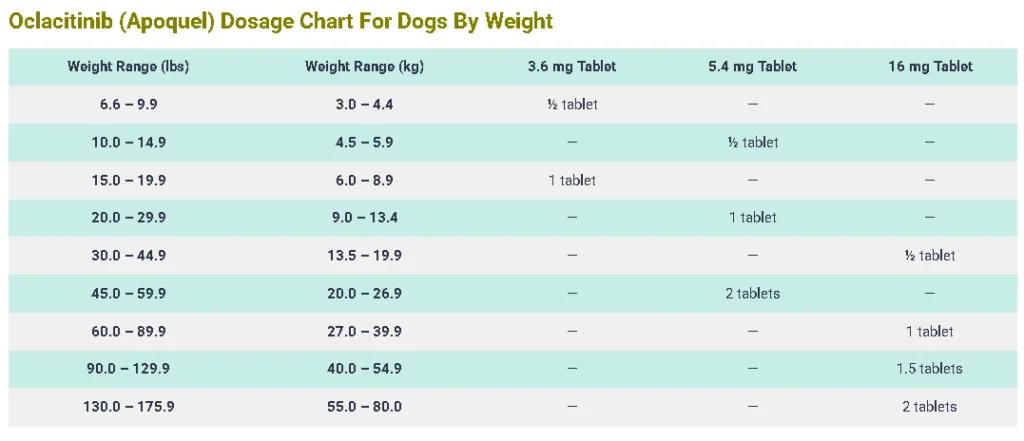
Oclacitinib (Apoquel) Dosage Chart For Dogs By Weight
This table follows the official Zoetis (Apoquel) manufacturer guidelines, providing the standard dosage for both weight units and the specific tablet strengths required.
| Weight Range (lbs) | Weight Range (kg) | 3.6 mg Tablet | 5.4 mg Tablet | 16 mg Tablet |
|---|---|---|---|---|
| 6.6 – 9.9 | 3.0 – 4.4 | ½ tablet | — | — |
| 10.0 – 14.9 | 4.5 – 5.9 | — | ½ tablet | — |
| 15.0 – 19.9 | 6.0 – 8.9 | 1 tablet | — | — |
| 20.0 – 29.9 | 9.0 – 13.4 | — | 1 tablet | — |
| 30.0 – 44.9 | 13.5 – 19.9 | — | — | ½ tablet |
| 45.0 – 59.9 | 20.0 – 26.9 | — | 2 tablets | — |
| 60.0 – 89.9 | 27.0 – 39.9 | — | — | 1 tablet |
| 90.0 – 129.9 | 40.0 – 54.9 | — | — | 1.5 tablets |
| 130.0 – 175.9 | 55.0 – 80.0 | — | — | 2 tablets |
Dosing Frequency & Administration
- Loading Phase (Days 1–14): Administer the dose twice daily (every 12 hours).
- Maintenance Phase (Day 15 onwards): Administer the dose once daily (every 24 hours).
- Method: Can be given with or without food.
Critical Safety Limits
- Age: Only for dogs 12 months of age or older.
- Minimum Weight: Not for dogs under 6.6 lbs (3 kg).
- Health Status: Do not use in dogs with serious infections or a history of cancer (malignant neoplasia).
- Hygiene: Wash hands immediately after handling the tablets.
What Is Oclacitinib (Apoquel)?
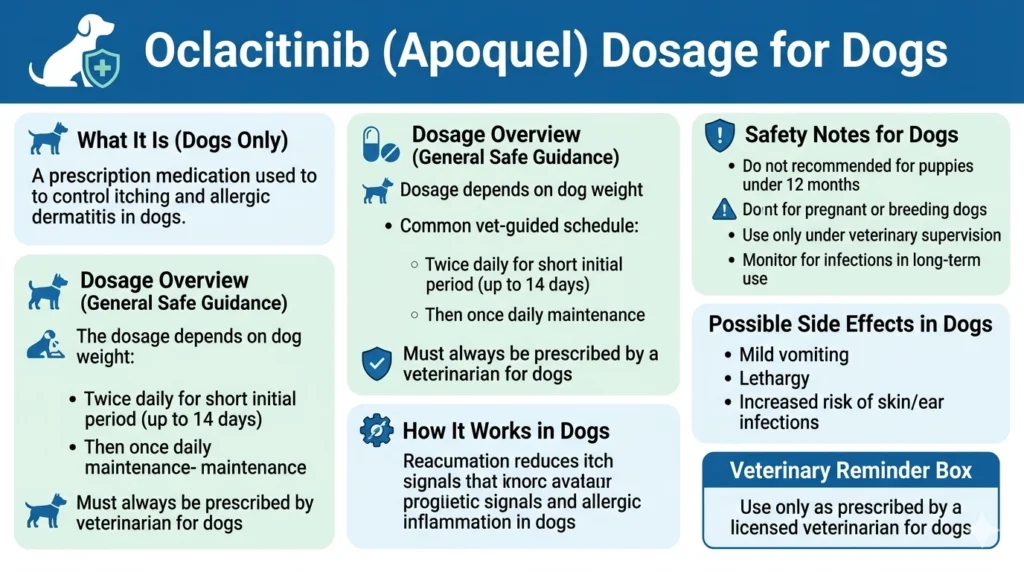
Oclacitinib (brand name Apoquel®) is an FDA approved, prescription only oral medication for dogs, which is used to control itching and inflammation associated with allergic skin conditions like allergic dermatitis, atopic dermatitis (eczema), flea allergy, food allergy and contact allergy. It can be used in dogs 12 months or older, 6.6 lbs (3 kg) or more.
Oclacitinib blocks the activity of cytokines (such as IL-2, IL-4, IL-6, IL-13, and IL-31) that cause itching and inflammation. It doesn't just treat the symptoms – it treats itch from the source by inhibiting overactive immune reactions.
It is one of its major advantages that it works fast, and itch relief can be felt within 4 hours and the effective control is generally obtained in 24 hours. Generally, the effects last for 12 to 24 hours, and thus daily use is necessary to achieve a constant relief.
Oclacitinib Dosage for dogs is not in the same class of medication as a corticosteroid, antihistamine, cyclosporine, or Cytopoint and tends to have fewer side effects long-term, such as a low percentage of gastrointestinal upset. It offers equivalent efficacy to the corticosteroid, and enhances tolerability in many dogs.
Oclacitinib for pets is well established in veterinary medicine and has a number of clinical studies completed at various veterinary colleges in the United States. Can only be obtained with a prescription from a licensed veterinarian and is made available in 3.6 mg, 5.4 mg, and 16 mg tablet strengths.
Its primary use is for dogs, though occasionally used off-label in other diseases, or for cats, but not FDA reviewed in these applications and should only be used with strict veterinary supervision.
In summary, Apoquel® (oclacitinib) is a rapid, targeted treatment that can effectively control allergic itch and enhance the quality of life for dogs with chronic skin allergies.
How Is Oclacitinib Used in Dogs?
Oclacitinib (Apoquel®) for pets is a prescription-only oral drug for dogs to treat itching and inflammation associated with allergic skin diseases, particularly atopic dermatitis (atopy) and allergic reactions to airborne allergens. It is approved by FDA for use in dogs 12 months old and older and is often used in the treatment of acute allergic reactions and chronic allergic skin disease.
It is taken orally and has a specific schedule for administration. Generally, it is given twice a day initially to rapidly suppress the itching and then once a day with veterinary guidance for long-term management. The length of treatment and frequency of doses will vary according to the condition of the dog and their response to the treatment.
Key usage details:
- By mouth (tablet, chewable tablet)
- Repeat dose: every 12 hours for up to 14 days
- Maintenance dose: 1 dose every 24 hours
- May be used as a short-term remedy or to control allergic reactions on a longer term basis.
- Must be administered as directed by a licensed veterinarian
Oclacitinib medication for dogs comes in three different strengths of tablets, one of which is a pork liver flavored chewable. Tablets have a score to facilitate easier splitting when doses need to be adjusted. While the incidence of pork allergy in dogs is rare (2% of dogs), it is still important to think about when selecting chewable.


Paid Links - As an Amazon Associate, I earn from qualifying purchases.
Important considerations:
- Vets' dosing guidelines should always be followed carefully.
- Tell the vet if other medicines, supplements or herbs are being used
- Never cease or alter dosage without veterinary advice
- It is primarily indicated for allergic dermatitis, but in some cases may be used for other types of dermatitis, which is off-label use.
What Are the Benefits of Oclacitinib in Dogs?
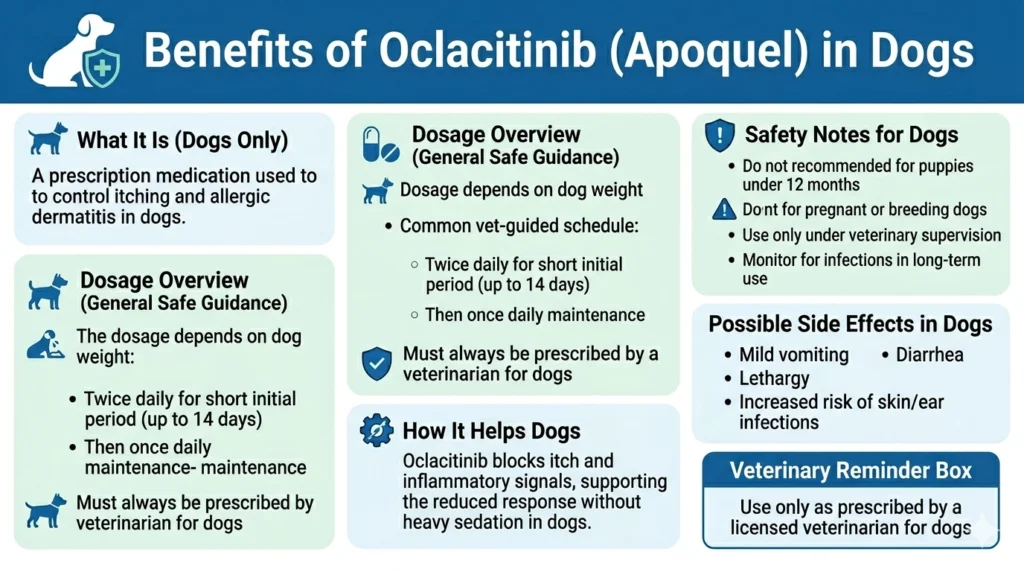
Oclacitinib (Apoquel® dosage for pets) is a very effective treatment for itchy, inflamed skin associated with allergic skin disease and is widely used as an alternative to conventional steroid treatment in veterinary medicine. It does so through immune-mediated control of itch responses and is sometimes a preferred treatment for its effectiveness and tolerability.
One of the greatest benefits of oclacitinib is that it may be able to offer similar benefits as other medications (corticosteroids like prednisolone or prednisone) but without as many side effects, which makes it a safer long-term treatment for many dogs.
Oclacitinib's main advantages are:
- Helps to soothe and calm itchy, allergic skin reactions.
- Can be as effective as steroid medication such as prednisolone or prednisone.
- Compared with steroids, associated with less side effects
- It can be used for both acute flare-ups and for long-term allergy control.
- Most well tolerated dogs.
Dosing & Administration of Oclacitinib (Apoquel) in Dogs
Oclacitinib (Apoquel®) medication for pets is a prescription drug that is taken in the mouth to help control inflammation and allergic itching in dogs. It should be administered under the supervision of a veterinarian and following prescribed guidelines, including dose and timing of administration and safety. Most dogs start to improve in 1-2 days and experience itch relief in a few days.
The drug is taken by mouth, and may be taken with or without food. If stomach upset is seen with or following an empty tummy, stomach upset should be given with food in future doses. Hands should be washed after handling it each time as it is a hazardous drug.
Dosing schedule
Loading phase (Days 1-14): twice a day (every 12 hours)
Day 15 and beyond: ONE daily dose (every 24 hours)
Dose range: 0.4–0.6 mg/kg (0.18–0.27 mg/lb)
Weight-based dosing examples
- 10 lbs: 1.8–2.7 mg
- 20 lbs: 3.6–5.4 mg
- 30 lbs: 5.4–8.1 mg
- 40 lbs: 7.2–10.8 mg
- 60 lbs: 10.8–16.2 mg
Key administration guidelines
- Must be applied within the recommended dose limits.
- Treatment duration is dependent on the condition of the dog and response to the treatment.
- Never discontinue treatment early—without a veterinarian's advice, to prevent a recurrence of symptoms
- May be used for short or long term as per medical requirements
Safety precautions
- Only for dogs 12 months or older and at least 6.6 lbs (3 kg)
- Do not use in dogs with serious infections or which have had cancer (malignant neoplasia)
- Use gloves for handling tablets, and avoid during pregnancy or nursing
- Keep away from children
When used properly under veterinary supervision, Oclacitinib dose is rapid acting, very well tolerated in most dogs, and is widely employed in the treatment of allergic skin disease in dogs.
What If You Miss a Dose of Oclacitinib (Apoquel) in Dogs?
It is important to give your dog a dose of oclacitinib (Apoquel®) if you forget to do so so your dog can receive and continue to receive safe and effective treatment for itching and inflammation. It is important to administer the medication at a fixed time each day as directed by the vet.
Take the missed dose as soon as possible if patient recalls the missed dose. If it's near time for the next dose, however, skip the missed dose and resume the regular dosing routine. The normal routine should be restored in all cases without any changes unless directed by a vet.
Important missed dose information:
- Give the missed dose as soon as you remember (if not close to next dose time)
- If it is almost time for the next dose, skip the missed dose
- After that, use the same dose as before.
- Don't give two doses at once or additional doses to compensate for a missed dose
- Start and continue with regular dose schedule as before.
When administering the missed dose, if necessary, the medication can be taken with food. Stick to the schedule as closely as possible to ensure that allergic symptoms are effectively controlled.
Are There Any Potential Side Effects of Oclacitinib (Apoquel) in Dogs?
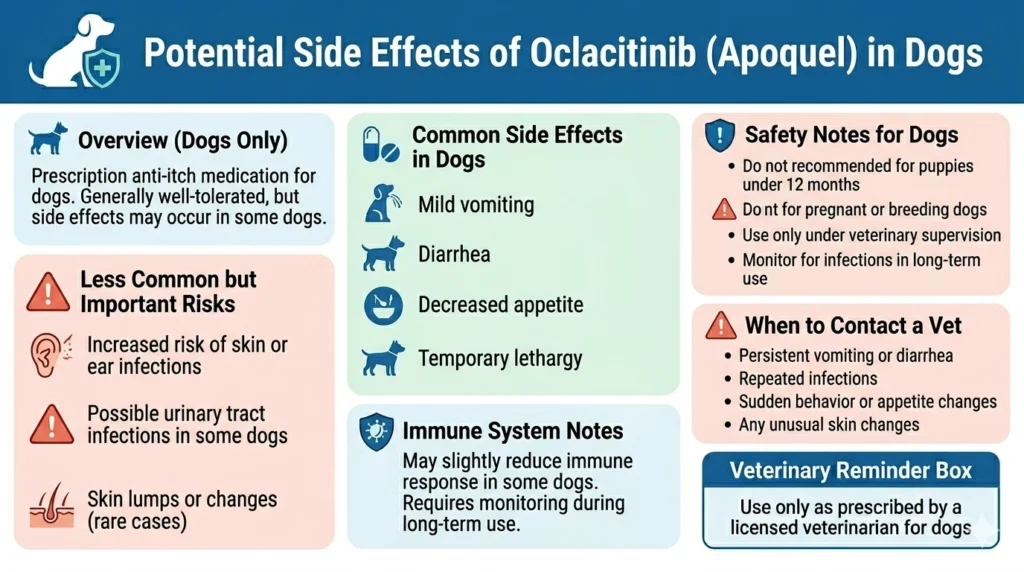
When given under the supervision of a veterinarian, Oclacitinib dosage for dogs by weight is generally a safe and well-tolerated prescription drug for dogs that is used to treat allergic itching and inflammation. As with any medications, however, it can have side effects in some dogs, and it is important for the dog to be monitored while on treatment.
Most side effects are mild and temporary and many dogs have no, or only slight, adverse reactions. If they do happen, they usually work out very rapidly, particularly if the drug is administered with meals.
Common side effects:
- Vomiting
- Diarrhea
- Decreased or loss of appetite
- Lethargy (low energy/tiredness)
Less common or reported effects:
- More likely to have infections (s. infections, ear infections, urinary tract infections, respiratory infections and pneumonia)
- Masses (new skin growths) in the skin or in the subcutaneous tissue
- Increased liver enzymes
- Feeling thirsty or hungry
- Weight loss
- Aggression or change in behavior
- Enlarged lymph nodes
- Seizures
- Leukocytes (white blood cells) are reduced as well as globulins.
- Increased cholesterol or lipase
- Occasional demodiciosis, histiocytomas or bloody diarrhea.
An additional risk of infections including mange, bacterial skin infections, ear infections and urinary tract infections may also occur, especially in susceptible dogs, when using Oclacitinib. Some dogs will become sensitive to drugs over time, so one dog may not react to the first few doses and then respond later when they are being treated.
Severe reactions – see a vet ASAP:
- The formation of a growth in the skin.
- Fever
- Shortness of breath
- Signs of infection (persistent or worsening)
- Severe or unusual behaviours or physical changes
Important safety notes:
- Not for use in oclacitinib-sensitive dogs.
- Dogs less than 12 months of age, breeding, pregnant or nursing dogs are not recommended.
- Exercise caution in dogs with severe infections, heart failure, liver disease or kidney disease
- Usually the effects last no longer than 24 hours, although they may be longer in dogs that have liver or kidney disease.
- Always let the veterinarian know if other medications or supplements are being administered
Overall, the use of oclacitinib dose for dogs per pound is widespread because most side effects are mild, rare and manageable, but it is vital that it is watched closely so that people can be certain that it is safe to use for a long period of time.
Are There Any Risk Factors for Oclacitinib (Apoquel) in Dogs?
Oclacitinib (Apoquel®) is a generally safe medication for use in the dog but there are important risk factors and restrictions to consider before use. Not all dogs should take it, particularly if they have some underlying health issues or are at a particular life stage.
The use of this medication should not be taken lightly in dogs for which safety has not been demonstrated or may exacerbate underlying disease, especially immunocompromise or infectious diseases.
Dogs and Conditions where oclacitinib should NOT be used:
- Dogs having current or recent Demodex mange (Demodex mites)
- Dogs with severe active infections (e.g. pneumonia)
- Cancerous dogs and dogs with a cancer history as it can worsen the situation or induce new tumors in the dog
- Pregnant, lactating or breeding dogs (safety has not been assessed)
- Dogs under 12 months old
Key risk considerations:
- Oclacitinib may make your dog more vulnerable to infections, such as skin infections and skin mites.
- May aggravate symptoms if the cause of the itching is an infection instead of allergies.
- May be a risk factor for new formation of benign or malignant tumors (but is not a cause of cancer) in dogs with previous cancer.
In conclusion, Apoquel dose is an effective medication to treat allergic itching, however, patient selection is crucial. Dogs with diseases related to the immune system, infections, a history of cancer, or very young age should not be given this medication.
Are There Any Drug Interactions You Should Be Aware of With Oclacitinib (Apoquel)?
Oclacitinib (Apoquel®) generally can be administered with a wide variety of commonly used veterinary drugs, but due to its actions on the immune system, there are some drug combinations that should be used with caution. Veterinarians should be knowledgeable of all medication, supplements, vitamins or herbal products a dog is taking prior to treatment.
Overall, there are no major drug interactions of clinical importance which are widely reported and it is not known to interact with a large number of commonly used drugs if managed appropriately.
Medications that are usually safe to take with oclacitinib include:
- Vaccines
- Nonsteroidal anti-inflammatory drugs (NSAIDs)
- Antibiotics
- Antiparasitic medications
- Anticonvulsants (seizure medications)
- Allergen immunotherapy (allergy shots or other allergy treatment).
- Use of steroids for a short time.
- Use of cyclosporine (such as Atopica®) for short periods of time.
Drugs that need special care or doctor's orders:
- Corticosteroids (especially long-term use)
- Cyclosporine (not recommended for long term use, not well-studied)
- Azathioprine
- Mycophenolate
- Chemotherapy-related treatment called Tigilanol tiglate (Stelfonta®)
Key safety considerations:
- There is not a complete evaluation of long term combination with other immune- suppressing drugs.
- Oclacitinib may alter immune function, so using it with other immune-system modifying drugs could be dangerous if used incorrectly or over a long period of time.
- Never use two or more treatments without advice of a veterinarian.
To conclude, oclacitinib can be used in conjunction with many common veterinary medications, however, when used in combination with other immune-suppressing medications, care must be taken, and veterinary advice should be sought.
You May Also Like to Read:
- Vitamin D3 Dosage For Dogs Calculator: Safe Guide & Chart
- Nemex-2 Dosage For Dogs Calculator: Safe Dosage Guide & Chart
FAQs
For what is oclacitinib drugs prescribed to dogs?
Oclacitinib (Apoquel®) treats and controls itching and inflammation associated with allergic skin diseases, such as atopic dermatitis, and environmental allergens in dogs.
How soon does Apoquel dose work?
Starts to relieve itching within 4 hours and most dogs have strong itch control within 24 hours.
Is Apoquel safe to use for an extended period of time?
Yes. When used as directed by a veterinarian, dogs may take Apoquel for a long period of time or even for the rest of their lives to control allergies.
Is Apoquel suitable for a short-term flare up?
Yes. It works for acute flares and the control of allergic itching.
Is Apoquel a steroid or antihistamine?
Apoquel is not a steroid, antihistamine or cyclosporine. Is a JAK inhibitor which functions by blocking the sign of itching at the source.
Is it okay to give Apoquel dosage with food?
Yes. Can be fed on or off food, whichever is easiest for the dog.
Can dogs take Apoquel for a long time?
Dogs can take it for months or years, depending on the recommendation and monitoring of a veterinarian.
What are the side effects of oclacitinib?
Side effects include vomiting, diarrhea, loss of appetite and slight lethargy. Most are short-lived and mild.
Do you need to monitor Apoquel for pets?
Yes. Periodic blood tests and other monitoring may be necessary for long-term use for the presence of infection or changes in the skin.
If you see adverse reactions, when do you need to see your veterinarian if you are using Apoquel?
If your dog becomes infected, or begins to act strangely, has skin lumps, or extreme side effects, contact your veterinarian.
Final Thoughts
Oclacitinib (Apoquel®) dosage for dogs is a rapid acting, highly effective anti-itch medication for dogs that is affected by atopic dermatitis and airborne allergens. It is effective by attacking allergic response on an immune level before it can complete, which can alleviate itching and inflammation in a dog rapidly and keep him or her feeling better. The dosage and treatment plan will depend on the dog's condition and is prescribed by a veterinarian.
Apoquel medication for dogs can be used for short term flares-up or long-term allergy control, and many dogs do well on Apoquel with relatively little side effects. It should be noted, however, that it can make skin infections such as mites more likely, and may not be suitable for dogs that have previously had cancer because it might make them more susceptible to the development of cancer.
Atopic dermatitis can sometimes be a complex, long-term disorder, and although oclacitinib is very effective for symptom control, a multi-therapy approach may be necessary to achieve complete control. Medications may not be sufficient for long term management in many cases.
In conclusion, oclacitinib is a valuable veterinary tool for providing quick relief to dogs suffering from itchy skin, but its usage must always be carefully considered with regard to the dog's health status, underlying medical issues and the need for long-term treatment.