When your dog is coughing incessantly, you may be asking yourself whether some over-the-counter drug, such as Robitussin Dosage For Dogs, will work and, most importantly, what the right amount of Robitussin to give to your dog is.
Whereas some pet drugs can be administered with a veterinarian in the process of treatment, administering the incorrect kind or dosage can cause more damage than good. This is why it is important that all pet owners know how Robitussin works, when it should be used, and how to safely dose it.
One of the most common discussed formulas that includes two of the most important ingredients is Robitussin DM which includes guaifenesin which helps to loosen and thin the airways mucus and dextromethorphan which is a cough suppressant, which decreases the desire to cough.
The drug is occasionally administered to alleviate the effects of kennel cough or mild respiratory irritation to alleviate coughing, ease breathing and clear congestion. It should be noted though that Robitussin is not a treatment of the actual source of the sickness. It cannot be taken as a single therapy in the face of bigger diseases such as respiratory infections, inflammatory allergies or congestive heart failure where alternative or additional medicines are needed.


Paid Links - As an Amazon Associate, I earn from qualifying purchases.
The other important aspect is the selection of the appropriate product. Dogs cannot take all formulas of Robitussin. You should not use formulations which include such ingredients as phenylephrine or phenylpropanolamine, and you should exercise care with combination products such as Robitussin CF which can include a variety of active drugs unsuitable in pets.
In this guide, you will find all the information you need to know about Robitussin dosage for dogs by weight such as safe dosing schedules, advantages, possible side effects and the times to avoid using it so that you can safely assure your dog of good health.
Disclaimer: This guide is for informational purposes only and is not a substitute for professional veterinary advice. Always consult your veterinarian before giving Robitussin or any medication to your dog.
Robitussin Dosage Calculator For Dogs
⚠️ Critical Safety Warnings
- NEVER use products containing Xylitol, Acetaminophen, or decongestants.
- Double-check ingredients; these can be fatal to dogs.
- Always use a calibrated oral syringe.
- Consult your veterinarian before administering any medication.
© medsdog.com
Key Takeaways
- Robitussin for dogs is not a one formula. Different products such as Robitussin CF and Robitussin DM have various active ingredients in them. In the case of dogs, only certain formulas (usually Robitussin DM) can be taken into account- and only with the assistance of a vet.
- Of the most importance are active ingredients. Dextromethorphan (cough suppressant) and guaifenesin (expectorant) can be found in Robitussin DM. Dosing is typically determined in dogs by the guaifenesin content, and not by the entire product.
- Normal dosing schedule in dogs can be as often as 4-6 hourly when required based on your veterinarians recommendation and your dogs status. Always take the dosing at the recommended intervals.
- Dogs will not be safe with all products. Combinations such as Robitussin CF dosage, or any that contains phenylephrine, phenylpropanolamine or other added decongestants should be avoided since they are harmful.
- Only use when necessary. Robitussin dose can be used to help the symptoms such as coughing when a person has some minor problems (e.g., kennel cough) but it does not work with underlying diseases as infections, allergies, and heart diseases.
- It is always best to consult with a veterinarian. Medications are metabolized differently by dogs, particularly in small breeds and therefore they require the professional advice to prevent overdose or complications.
- Observation of side effects. Even in the correct use, it is important to monitor such symptoms as vomiting, lack of energy or strange behavior and discontinue use in case of appearance of any alarming symptoms.
How Much Robitussin DM Can I Give My Dog?
Robitussin Dosing in dogs is generally determined by the guaifenesin and dextromethorphan components, and the general advice is 0.5 mg to 1.0 mg per pound of body weight as advised by the veterinarians. It can alleviate such symptoms as coughing, congestion, and mild respiratory irritation, such as kennel cough, but it is not helpful in the treatment of the cause of the illness.
Dogs cannot be assured of safety with all Robitussin. Any product containing phenylephrine or phenylpropanolamine such as Robitussin CF, should be avoided.
The guidelines concerning human dosage (e.g. 20 mL every 4 hours) are not applicable to dogs since the dosage should be adjusted depending on the body weight.
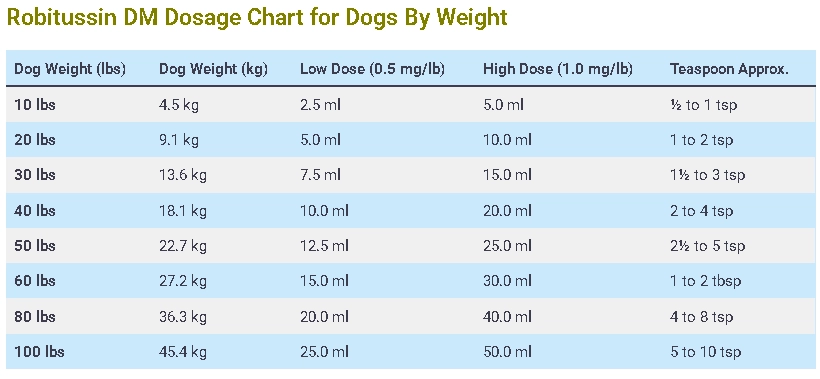
Robitussin DM Dosage Chart for Dogs By Weight
This dosage table is based on the standard veterinary recommendation of 0.5 mg to 1.0 mg of Dextromethorphan per pound of body weight, using the most common liquid concentration found in Robitussin DM (2 mg per 1 ml or 10 mg per 5 ml).
Concentration: 2 mg/ml (Standard Robitussin DM)
| Dog Weight (lbs) | Dog Weight (kg) | Low Dose (0.5 mg/lb) | High Dose (1.0 mg/lb) | Teaspoon Approx. |
| 10 lbs | 4.5 kg | 2.5 ml | 5.0 ml | ½ to 1 tsp |
| 20 lbs | 9.1 kg | 5.0 ml | 10.0 ml | 1 to 2 tsp |
| 30 lbs | 13.6 kg | 7.5 ml | 15.0 ml | 1½ to 3 tsp |
| 40 lbs | 18.1 kg | 10.0 ml | 20.0 ml | 2 to 4 tsp |
| 50 lbs | 22.7 kg | 12.5 ml | 25.0 ml | 2½ to 5 tsp |
| 60 lbs | 27.2 kg | 15.0 ml | 30.0 ml | 1 to 2 tbsp |
| 80 lbs | 36.3 kg | 20.0 ml | 40.0 ml | 4 to 8 tsp |
| 100 lbs | 45.4 kg | 25.0 ml | 50.0 ml | 5 to 10 tsp |
Critical Safety Checklist
Before using this table, you must verify the following:
- Check the Label: Ensure the product is Robitussin DM (Dextromethorphan and Guaifenesin only).
- Toxic Ingredients: Never use any formula containing Xylitol, Acetaminophen (Tylenol), or Pseudoephedrine/Phenylephrine. These can be fatal to dogs.
- Measurement: Use a clear oral syringe or a medical measuring spoon. Standard household spoons are highly inaccurate and can lead to overdose.
- Frequency: Doses are typically repeated every 6 to 8 hours as needed for cough.
- Minimum Weight: It is generally recommended not to use these products for puppies or dogs weighing less than 5 lbs without direct veterinary supervision.
Note: If your dog has a “wet” or productive cough (hacking up phlegm/mucus), suppressing the cough may actually be harmful. Consult a vet if the cough is accompanied by lethargy, fever, or loss of appetite.
What is Robitussin Dosage for Dogs
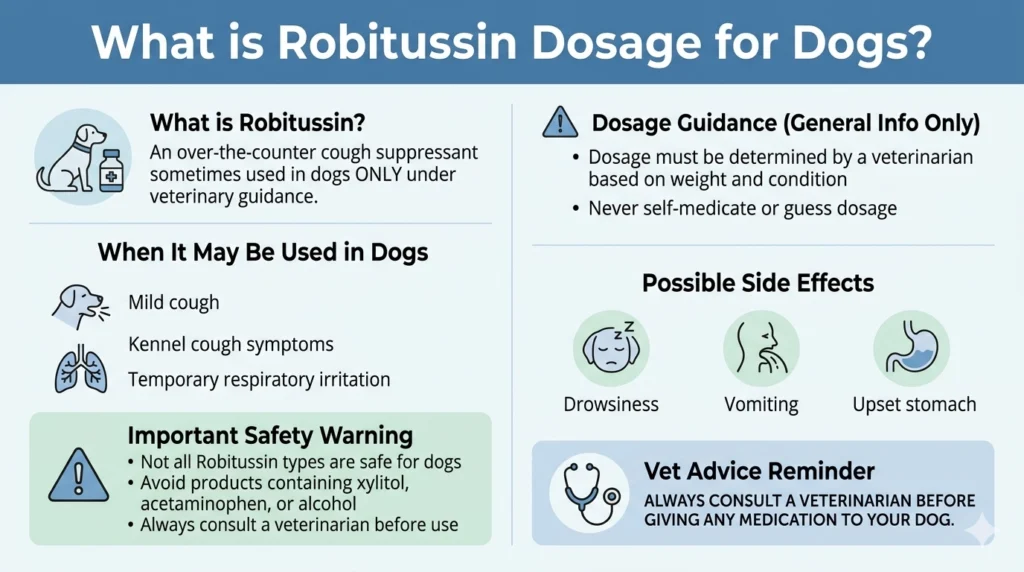
Robitussin medication for dogs is an over the counter cough medicine that is occasionally administered to dogs under a veterinarian’s supervision with the most common being the DM formula that contains guaifenesin (loosen mucus) and dextromethorphan (suppress coughing).
Although guaifenesin is regarded as a safe drug with few cardiac effects, it still can be accompanied by complications in case of improper use or overdose. Robitussin dose cannot be used alone in the treatment of severe illnesses such as respiratory infections, inflammatory allergies or heart failure that is congestive.
Should never be used without consulting a veterinarian to be properly diagnosed, given the appropriate dosage and safely administered, particularly to small breeds or dogs with existing health problems.
Is Robitussin Safe for Dogs?
Under some circumstances, robitussin can be safe in dogs although in low doses and with a lot of care.
Coughing symptoms may be relieved by some over-the-counter (OTC) Robitussin products, particularly in a disease such as kennel cough, but the safety of the product will be completely dependant on the formula and ingredients used.


Paid Links - As an Amazon Associate, I earn from qualifying purchases.
Key Safety Points:
- There are certain Robitussin products that can be administered to dogs to relieve coughs, but in small doses.
- Not every formula is safe various products are composed of various active ingredients.
- Never administer any drug to your dog without first seeing the label.
- Avoid poisonous substances, such as:
- Acetaminophen
- Ibuprofen
- Codeine
- Xylitol (artificial sweetener)
- OTC drugs can be used to alleviate symptoms but they are not a substitute of good veterinary care.
- Even when the product appears to be safe to humans, its improper use could be hazardous.
- Always ask your veterinarian the safety or safety of ingredients.
Although Robitussin drug for dogs may provide some short-term help, it is important to make sure that you use the right product and that you use it safely so as to safeguard the health of your dog.
Are All Robitussin Products Safe for My Pet?
The pets are not safe with all Robitussin products. Although Robitussin for dogs has an extensive variety of over-the-counter medications aimed at humans to relieve the symptoms of cough, cold and flu, most of these formulas include substances that are toxic to dogs.
Considerable Knowledge to learn:
- Robitussin comes in various formulations whereby each formulation has various active ingredients.
- Only some of them can be regarded as rather safe, and only in a short-term usage.
General Robitussin Products & Safety:
- Robitussin DM
- Comprised of: Dextromethorphan HBr + Guaifenesin.
- Relatively safe alternative to dogs (with the advice of the veterinarian)
- Usually administered in the short-term, e.g. kennel cough.
- Robitussin AC
- Contains: Codeine
- Not safe for dogs
- Robitussin CF
- Comprised of: Acetaminophen + Dextromethorphan HBr.
- Not safe for dogs
- Robitussin Long-lasting Cough Gels.
- Contains: Dextromethorphan HBr
- Pets not well established with regard to safety.
- Robitussin 12-Hour
- Incidents: Dextromethorphan polistirex + Dextromethorphan hydrobromide.
- Pets not well established with regard to safety.
Bottom Line:
- Not every product of Robitussin is safe to pets.
- The only widely thought of is Robitussin DM, and even then, only temporarily to help in relieving the symptoms.
- Ingredients should always be verified and it is advisable to seek the advice of a veterinarian before administering any type of Robitussin to your dog.
What is Robitussin DM for Dogs
A common over-the-counter medication in coughing that some veterinarians prescribe to dogs to help with coughing and minor respiratory problems is Robitussin DM. It includes dextromethorphan (cough suppressant) and guaifenesin (mucus-loosening expectorant), which helps to decrease coughing and improve breathing.
Although it is deemed to be safe in the correct conditions, it should not be administered without care and should only be used in the short-term.
Key Points:
- Use in short term only: Robitussin DM dosage for dogs is supposed to be used in the short term to relieve the symptoms. Veterinary care is mandatory in case of coughing, wheezing or disease.
- Human-designed: It is used quite often in dogs, but only under the advice of the vet and under his control.
Dosage & Administration:
- Dosing basing on weight is vital to safety and efficacy.
- General guidelines include:
- Every 4 hours 350-500mg/kg (guaifenesin ingredient)
- Approx. 1 mL/lb. of body weight (rough estimate, should be approved by a veterinarian)
- Example: 14 lb (6.6 kg) dog could be given a dose of approximately 19-35 mg guaifenesin.
- Examples of liquid dosing include: 2 cc/20 pounds every 8-12 hours as needed.
Important Considerations:
- Calculation of dose is using guaifenesin and not dextromethorphan.
- Guaifenesin is believed to be very safe and there are few cardiac effects, but there is still a need to be accurate.
- Extra precautions should be taken with small breeds (such as Chihuahuas) because of sensitivities and weight gain.
- There are various formulations–do not use any other formulation but Robitussin DM.
When It May Help:
- Kennel cough
- Mild respiratory irritation
- Mucus cases and coughing.
Inappropriate:
- Congestive heart failure
- As an exclusive therapy of respiratory infections.
- Pulmonary allergies not treated with inflammation.
Safety Warnings:
- Avoid those containing phenylephrine or phenylpropanolamine.
- Off-label and unknown formulations are not to be used.
- Watch closely with regard to side effects or risk of overdose.
Expected Benefits:
- Reduced coughing
- Less gagging (“gacking”)
- Easier breathing
When correctly used (correct dosing, selection of product and veterinary advice) Robitussin DM can be used to treat the cough in your dog with minimum risk and maximum safety.
Robitussin Dosage for Dogs
To prevent severe health risks, such as overdose or complications, it is critical to determine the right amount of Robitussin that should be given to dogs.
Although some of these types such as Robitussin dosage for dogs can be administered under veterinary supervision, caution is always taken when administering any kind of medication as not every dog reacts to over-the-counter drugs in the same manner.
Key Dosage Guidelines:
- Dextromethorphan dosage (principal guideline):
- 0.5 to 1 mg per pound (1–1.5 mg/kg) of body weight
- Administred every 8-12 hours.
- Liquid concentration reference:
- Common formula: 2 mg per 1 mL (or 10 mg per 5 mL)
Example Dosage:
- A 50 pound canine can be given:
- 2-3 teaspoons of liquid Robitussin DM every 8-12hours.
- Or 45-50 mg in the tablet form per dose.
Important Safety Considerations:
- Never use without consulting a veterinarian- this is not a hard-and-fast rule.
- Begin with low dosage as all dogs are sensitive to drugs.
- Do not feed less than 5 pounds (2 kg) puppies or dogs without veterinary permission.
- Dosage tables may be useful but they should not be taken as prescriptive dosage but as dosage guidelines.
The right amount of Robitussin for dogs dose that should be used in dogs helps in safe treatment of the symptoms with minimal chances of adverse effects or overdosing.
Side Effects of Robitussin in Dogs
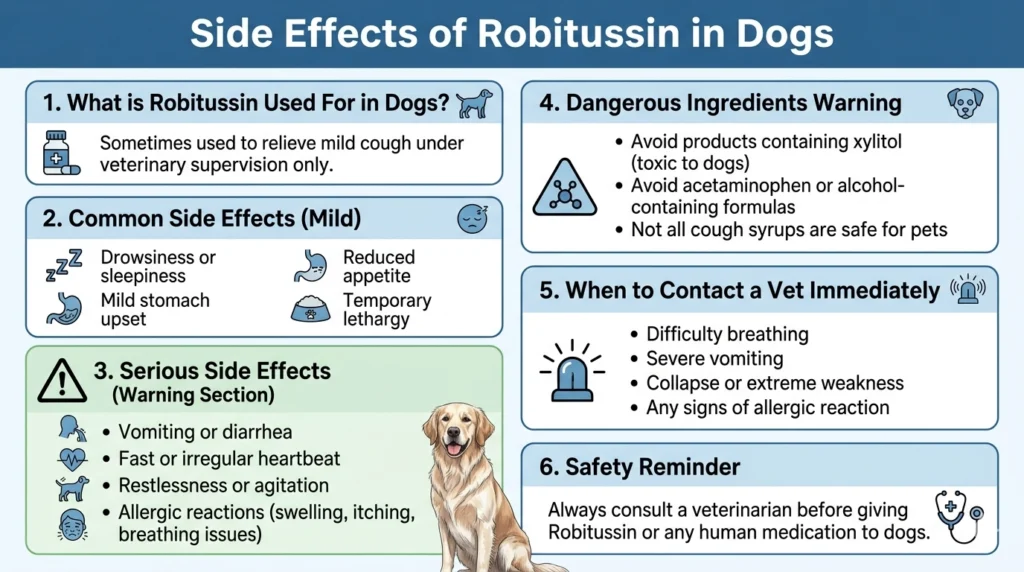
Robitussin dosage can be occasionally administered to dogs to treat short term coughing, although even at the recommended dosage Robitussin can still elicit side effects or adverse reactions in some pets, particularly the sensitive ones.
Dogs are not known to respond to medications in the same manner and even a small amount of medication may occasionally result in some observable health changes.
The most prevalent side effects of Robitussin on dogs include:
- Vomiting
- Nausea
- Diarrhea
- Loss of appetite
- Drowsiness or lethargy
- Dizziness
- Weakness
- Restlessness
- Anxiety or nervousness
- Confusion
- Drooling
- Either more or less urination.
Allergic or Sensitivity Response:
- Hives
- Facial swelling
- Skin reactions or itch.
- Breathing difficulties
Side Effects: Serious; Possible Overdose: Signs:
- Quick or irregular heartbeat.
- Muscle tremors
- Seizures
- Loss of co-ordination (incoordination)
- Collapse
- Severe weakness
- Extreme anxiety or nervousness.
Important Safety Notes:
- Even normal doses may have side effects, and in sensitive dogs.
- Accidental overdosing or overdose exposes the victim to severe neurological and heart related symptoms.
- Dogs can have a response within a short time, when they are unable to adequately metabolize the medicine.
- It is important to always be in close watch of your dog after administering Robitussin.
Times to Call a Vet as an Emergency:
- In case of any allergic response (swelling, hives, respiratory problems) in your dog.
- In case of vomiting, tremors, seizures or collapse.
- In case of overdosing or wrong dosing.
- In case of a deterioration or failure of the symptoms.
Your dog should be closely monitored, and taken to the veterinary immediately, to be safe when taking Robitussin.
Safety Precautions for Using Robitussin DM on Chihuahuas
Robitussin DM medication for dogs should be used with additional care because of the small body size, metabolism of the Chihuahuas as well as the breed-specific health hazard.
Although it can be useful in dealing with coughing and mild congestion, it can cause severe complications in the shortest possible time, when used improperly.
Before administration, it is required to be administered with strict safety measures and veterinary recommendations.
Key Safety Precautions:
- Avoid dangerous additives: Do not use products of Robitussin DM which contain
- Alcohol
- Xylitol
- Acetaminophen
- These products are poisonous to Chihuahuas and may have severe health effects.
- Take weight-based dosing:
- Normal range: 0.5-1 mL/lb body weight.
- Chihuahuas need extremely low doses which are well-calculated because of their small size.
- Begin with low dose:
- Start with the lowest recommended.
- Additional increase should be recommended by a veterinarian.
- Close observation following administration: be alert to any adverse effects, such as:
- Vomiting or diarrhea
- Drowsiness or lethargy
- Appetite loss
- Behavioral changes
- Should not be used in some health conditions:
- Should not be given to Chihuahuas with heart disease or cardiac risk, since this breed is already predisposed towards heart issues.
- Take not more than recommended dosage:
- Toxicity, respiratory depression or heart failure may be serious complications of overdosing.
- Do not use unless directed by a veterinarian.
- Avoid drug interactions:
- Should not be used in combination with other medications unless a vet approves of it.
Final Safety Reminder:
Robitussin DM can be used in the treatment of Chihuahuas to clear the cough and congestion but it should never be used without close monitoring and veterinary approval to avoid exposing this sensitive and small breed to risks.
You May Also Like to Read:
- Zoloft Dosage For Dogs Calculator: Safe Dosage Guide & Chart
- (SMZ-TMP) Sulfamethoxazole Dosage For Dogs Calculator & Safe Guide
FAQs
Is it possible to administer my dog Robitussin?
Perhaps, however, only with the supervision of a veterinarian. Dextromethorphan (Robitussin DM) may be prescribed by some vets as low dose medicine to alleviate coughing. There are, however, numerous human cough medications that have toxic components in dogs, thus never administer it without the consent of a vet.
Does Robitussin dose work on all dogs?
No. The safety varies according to the product, ingredients and the health condition of your dog. Special care is required in dogs having such illnesses as liver disease or chronic cough.
How much Robitussin is used to treat dogs?
One of the general principles is 0.5-1 mg/kg of dextromethorphan at a time with a frequency of 8-12 hours, however, it should always be verified by a doctor.
What is the effect of Robitussin medication in dogs?
Dextromethorphan is the active ingredient, which inhibits the cough center in the brain, thus reducing the desire to cough.
What does overdose of Robitussin dosage for dogs look like in dogs?
Symptoms of overdoses are tremors, seizures, rapid heart rate, collapse, confusion, vomiting and slow breathing. Urgent veterinary treatment is needed.
What are the side effects of Robitussin to dogs?
Potential side effects are vomiting, diarrhea, drowsiness, loss of appetite, drooling and anxiety or restlessness.
Does Robitussin dose have any drug interactions?
Yes. It can also have an interaction with other medicines like tramadol, fluoxetine, diphenhydramine, trazodone, selegiline and others hence you should never fail to inform your vet in case your dog is taking some medicines.
Which Robitussin for dogs can be used safely by dogs?
Certain dextromethorphan only preparations could be regarded as safe. They should not use products that have decongestants or more than one active ingredient in them.
Are there times that I am not supposed to use Robitussin medican to my dog?
Should not be used in puppies, very small dogs, pregnant or nursing pets or in dogs with heart disease, liver disease or wet/chronic cough unless directed by a veterinarian.
Final Thoughts
In some situations, such as kennel cough, Robitussin dosage for dogs per pound or kg can be an effective over-the-counter medication to relieve cough in dogs, but should be used with extreme caution.
Dogs can only be considered with regards to certain formulations, which mostly include dextromethorphan and guaifenesin, which are found in Robitussin DM, but only with the recommendation of a veterinarian.
One should bear in mind that Robitussin does not treat the underlying condition; it just alleviates such symptoms as coughing and discomfort. Due to this fact, it must never substitute the appropriate diagnosis or treatment by a veterinarian.
To ensure that your dog is safe, it is important to use the proper dosage and monitor it. The owners of pets have to make sure that they are taking the appropriate product, administering the appropriate dose according to weight and to monitor any possible side-effects or abnormal reactions.
The negative effects may be detected early which is followed by prompt veterinary action in case of necessity.
Finally, when you have any doubts regarding the number of milliliters of Robitussin dose to administer to your dog, then the surest option is to consult your veterinarian.
This will provide your pet with the right care and reduce chances of complications associated with the wrong or unsafe use of medications.