Epizyme Dosage Calculator For Dogs
Calculate veterinary recommended Epizyme powder dosages for Exocrine Pancreatic Insufficiency (EPI) management in dogs.
Recommended Dosage Results
- Preparation: Mix Epizyme powder thoroughly with moistened food (canned or dry). Allow the mixture to stand for 15–20 minutes (minimum 5–10 minutes) before serving.
- Frequency: Frequent feeding, at least 2 times daily, is important for effective management of Exocrine Pancreatic Insufficiency (EPI).
- Veterinary Adjustment: Epizyme is an FDA-approved prescription medication. No single regimen works for every dog. Adjust the dosage only under direct veterinary supervision based on clinical response and EPI severity.
If your dog just was diagnosed with exocrine pancreatic insufficiency (EPI), your veterinarian likely left you with a jar of Epizyme powder and a dosage range that felt a little vague: 3/4 – 1 teaspoon with each meal. While that is right, it still leaves many new EPI dog parents at a loss for knowing where to begin.
This guide will explain the actual Epizyme dosage for dogs, the reason that it is not stated as one single number, how to mix and dose Epizyme correctly, and what to look out for when adjusting Epizyme dosage. Further down the page you can find a free calculator to help you with planning a starting point to discuss with your vet.


Paid Links - As an Amazon Associate, I earn from qualifying purchases.
What Is Epizyme and Why Is It Prescribed to Dogs?
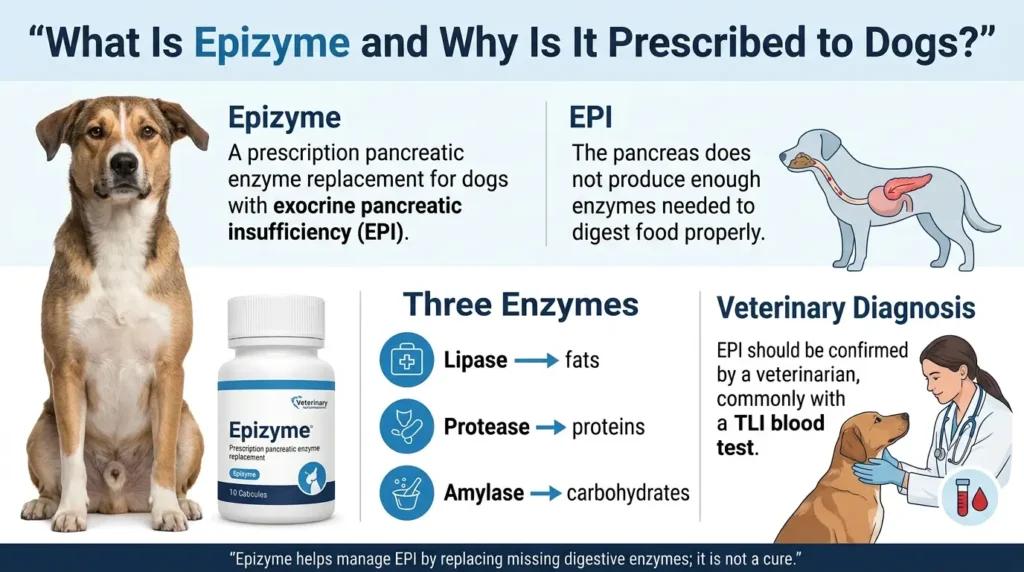
Epizyme is a prescription pancreatic enzyme powder for dogs (and cats) with EPI, which is a condition in which the pancreas does not produce enough of the enzymes required for digestion of fat, protein and carbohydrates. If those enzymes are absent, food goes through a dog’s gut pretty much intact, causing a dog to lose weight even though it eats normally or more than normal, and resulting in greasy or bulky stools and a dull coat.
Epizyme “transplants” those missing enzymes. It is formulated from concentrated, porcine (pig) pancreas and provides, per unit dose, three main enzyme classes: lipase (fat digestor), protease (protein digestor) and amylase (carbohydrate digestor). It is FDA approved and are prescription-only veterinary use.
EPI can occur in any breed of dog but is also more likely to occur in German Shepherds because they are predisposed to the disease, and it may occur secondary to chronic pancreatitis in any breed. Prior to beginning enzyme therapy, a dog must be diagnosed by a vet and usually this is done with a blood test (most commonly TLI test) not just by symptoms.
Key takeaway: Epizyme is not a cure for EPI (as there is no cure) but it is a replacement for what the pancreas cannot produce and most dogs require it for life.
Epizyme Dosage for Dogs (Quick Answer)
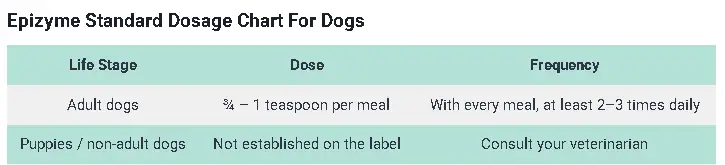
For dogs, the standard dose of Epizyme is ¾ to 1 teaspoon of powder per meal and it is fed with each meal throughout the dog’s life. This is the dose that is listed on the label of the product and consistent throughout various pharmacists’ listings of the product.
Epizyme Standard Dosage Chart For Dogs
| Life Stage | Dose | Frequency |
| Adult dogs | ¾ – 1 teaspoon per meal | With every meal, at least 2–3 times daily |
| Puppies / non-adult dogs | Not established on the label | Consult your veterinarian |
The Epizyme powder is approximately 2.8 grams per level teaspoon. That teaspoon alone provides about 71,400 USP units of lipase, 388,000 USP units of protease, and 460,000 USP units of amylase—the enzymes that actually digest food.
Why the Dose Is a Range, Not a Fixed Number
Epizyme’s labeled dose is not a weight-scaled dose, unlike some medications that are dosed based on strictly body weight (milligrams per kilogram). Rather, the “right” amount is listed as a range for adult dogs, as the amount needed would depend on the severity of the enzyme deficiency and the response of the dog.
The manufacturer’s dosing instructions state that a higher dose may be required and should be titrated up to the desired effect—well-formed stools and a stable weight—by taking into account the severity of the pancreatic insufficiency.
In practice, this means:
- Most dogs will begin at the low end (¾ teaspoon) and work their way up if stools are still loose and fatty.
- Other veterinarians begin with a whole teaspoon for dogs that have more severe deficiency.
- The “right” dose is the lowest amount that will give normal stool and stable or better weight – not the highest dose listed on the bottle!
That’s why a dosage calculator for Epizyme dog medication is more beneficial as an organizer of what you’re giving and observing about your dog’s reaction than for an actual titration; that should take place under your veterinarian’s supervision.
How to Mix and Administer Epizyme Powder
Mixing and timing are even more important than quantity. You should give Epizyme powder to dogs some contact time with wet food prior to feeding it to your dog, otherwise the enzymes will be ineffective.
Step-by-Step Mixing Instructions
First wet food. When using dry kibbles, moisten with warm water to a point where the enzymes can be activated and spread.
- Measure the powder. Don’t use a random kitchen spoon, use a standard measuring spoon instead because every little bit makes a difference if they take it every day over a few weeks.
- Mix thoroughly. Add the powder to the wet food and mix until there is no longer any dry powder visible. Do not mix evenly – do not dose evenly.
- Let it stand. Mix the food before feeding and set aside (see timing below).
- Feed at room temperature. Do not microwave the mixture as the enzymes can be affected by heat. Standing Time
How Often to Feed
This is where the confusion starts to become apparent from source to source: Some product literature may state that the mixture should sit for 5 to 10 minutes, others may say 15 to 20 minutes (the official product literature). The timeframes are both from reputable manufacturers’ documents, and the most conservative is to wait 15-20 minutes prior to feeding, unless your vet advised against it.
Many seasoned EPI dog trainers find that 15–20 minutes is enough for best results, and they stir their dog’s food halfway through.


Paid Links - As an Amazon Associate, I earn from qualifying purchases.
How Long to Let It Stand
Unlike a healthy dog, frequent feeding is more important with EPI as each meal should have a dose of enzymes to ensure its digestibility. The label specifies that it should be fed 2 to 3 times a day and Epizyme mixed with every feeding. Eating small meals throughout the day and avoiding a large meal will result in more even digestion and firmer stools.
What’s Inside Each Teaspoon of Epizyme Powder
Every 2.8-gram (1-teaspoon) dose of Epizyme powder contains:
| Enzyme | Activity per Teaspoon | Digests |
| Lipase | 71,400 USP units | Fats |
| Protease | 388,000 USP units | Proteins |
| Amylase | 460,000 USP units | Carbohydrates/starches |
There are also whole-enzyme source materials that provide supporting enzymes, such as esterases, peptidases, nucleases and elastase, in the formula. Epizyme isn’t enteric-coated, so it starts working as soon as it’s turned in to wet feed, hence the standing time before it’s fed.
Adjusting the Dose: Severity, Response, and Your Vet’s Role
There is no one correct dosage that works for all EPI dogs. Your veterinarian will likely begin on the ¾–1 teaspoon level and monitor your dog for:
- Stool quality – should improve to become firmer and less greasy or bulky in days to weeks
- Weight trend – steady weight gain or stabilization over weeks
- Appetite and energy — returns to normal as digestion improves
- Coat condition — a slower-to-change indicator, which may take longer to get better
If the stool is still loose, greasy, or if the dog doesn’t gain weight after a couple of weeks of the same dose, then your vet may try to increase to the upper end of the range or other measures (such as a low-fat diet along with enzyme therapy).
If a dog gets diarrhoea at higher doses, it could be slightly decreased. This is a normal and expected back-and-forth titration – it is not a reflection of the fact that the medication “isn’t working”.
Missed Doses and Overdose Symptoms
What to Do If You Miss a Dose
If you miss an opportunity to add Epizyme to a meal, add it as soon as you recall it that day. In case the dose is forgotten the following day, skip the dose and take the next dose on the next day, do not take two doses in one day as it may upset the digestive track without any extra benefit.
Signs of Too Much Epizyme
Do not give more than the recommended dose; this will not increase the effectiveness and may lead to side effects. Watch for:
- Diarrhea or bowel movement that is softer than normal.
- An increase in appetite combined with weight loss.
- Fat in the stool that can be seen by the naked eye and is not absorbed
If you observe any of these symptoms, do not self adjust the dose — consult your vet as these symptoms may indicate that the current dose is too low and they are in need of a dose reduction and not vice versa.
Epizyme for Puppies: What the Label Actually Covers
Official Epizyme dosing information only applies to adult dogs. There isn’t a published, labeled dosage for puppies or large dogs. Your veterinarian will know if your puppy suffers from a congenital or early-onset pancreatic enzyme deficiency and can determine an appropriate starting dose, based on puppy size, diet and response – don’t extrapolate from the adult dose range on your own.
Safety, Side Effects, and Drug Interactions
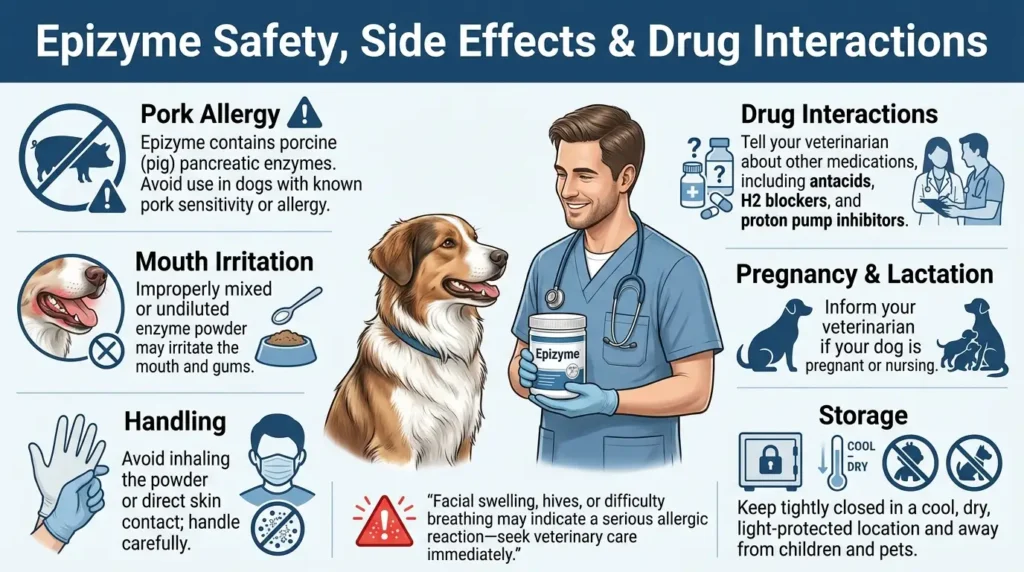
Although generally well tolerated, there are a few safety points to consider regarding Epizyme:
- Pork allergy: Epizyme dog medication is made from pig (porcine) pancreas, so it should not be given to dogs that are known to be allergic to or sensitive to pork. Although uncommon, it is possible to have a true allergic reaction and should be treated as such; if the face is swollen, hives are present or breathing becomes difficult it should be treated as an emergency.
- Mouth and gum irritation: Undiluted powder may irritate mouth if not mix properly and standing time is not adhered to in moist food, part of the reason for mixing and standing.
- Handling precautions: Do not inhale the powder nor allow it to come in contact with bare skin, as it may cause irritation to the lungs or skin of those handling it; enzymes should not be free fed, but given as directed.
- Drug interactions: If your dog is taking any other medication such as antacids, H2 blockers (such as cimetidine) or proton pump inhibitors (such as omeprazole), be sure to let your vet know as this can interfere with the enzymes’ effectiveness.
- Pregnancy/lactation: Please inform veterinarian if your dog is pregnant or lactating prior to initiating Epizyme.
- Storage: Store the powder in a tightly closed, light resistant container, away from children and pets, in a cool, dry location.
How Much Does Epizyme Cost? (Price Comparison)
The price of the Epizyme powder depends on the retailer and the bottle’s size. At the time of writing, online listings for pharmacies list Epizyme at approximately the following price, (the price can vary and will always require a valid prescription):
| Retailer | Size | Approx. Price Range |
| Chewy Pharmacy | 8 oz / 12 oz | ~$109–$157 |
| 1800PetMeds | 12 oz | ~$107–$157 (with autoship/promo pricing) |
| Medi-Vet | 8 oz | Sold to licensed vets/pharmacies only |
Prices may change and promotions may differ—just check with your pharmacy of choice before ordering and be sure the bottle size is the one prescribed by your vet.
Epizyme vs. Pancrezyme vs. Viokase: What’s the Difference?
When people are looking for information on Epizyme, they are likely to see two other names mentioned: Pancrezyme and Viokase. Let’s take a bird’s-eye look at how these compare:
| Product | Relationship to Epizyme | Notes |
| Epizyme | — | Pancreatic enzyme powder; same core enzyme profile as Pancrezyme |
| Pancrezyme | Brand-name equivalent | Same active ingredients and strengths as Epizyme, different brand |
| Viokase | Different brand, same enzyme class | Also a pancreatic enzyme replacement product; some owners report cost differences between it and Epizyme |
If your veterinarian has prescribed one of these, never change this for another enzyme class without checking first – the concentration of the enzymes and inactive ingredients may be different and the instructions for use are for the one prescribed.
Common Mistakes Dog Owners Make With Epizyme Dosing
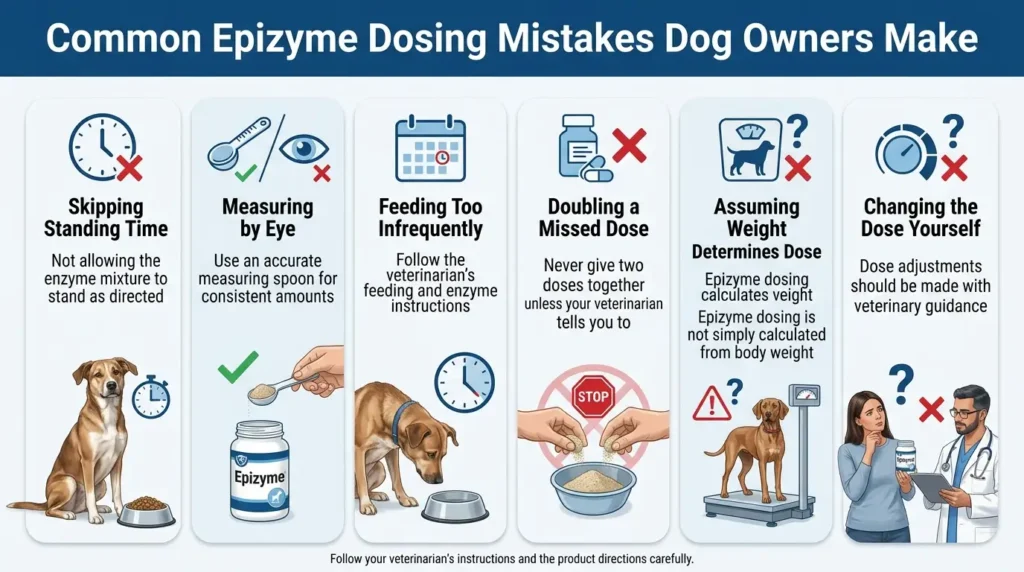
- Forgoing the standing time. Feeding right after the mixing will give the enzymes less time to begin their activity and may cause more mouth discomfort.
- Inconsistent measuring. But measuring the dose by eye (rather than by a proper measuring spoon) results in inconsistent doses and difficulties determining whether the dose is effective or not.
- Feeding too infrequently. Enzymes typically work better if taken with two small meals than with one big meal, even if the same amount of enzymes is taken.
- Taking 2 doses at the same time if a dose is missed. This is not “catching up” your dog but simply increases the risk of your dog getting an upset tummy.
- Assuming that the amount of weight is the basis for the dosage. Epizyme’s labeled indications are titrated to response, which is different than many drugs that titrate by body weight.
- Administering doses on your own, without the guidance of your vet. Too little or too much can appear the same (runny stool, lack of weight gain) and it may be difficult to interpret the picture at your dog’s next exam.
You May Also Like to Read:
- Provecta Advanced Dosage For Dogs: Calculator & Safe Guide
- Carprofen For Dogs: Dosage Calculator & Chart By Weight
FAQs
How much Epizyme should I give my dog?
The typical dosage of Epizyme powder for most adult dogs is ¾-1 teaspoon per meal, at least 2-3 times a day. The specific dose in this range will vary from dog to dog and should be determined with your veterinarian.
Does Epizyme have to be given to my dog based on their weight?
No, this is because Epizyme’s labeled dose for dogs is a range and not per lb. It is adjusted in response to symptom response, NOT scale weight.
How quickly will Epizyme work?
Usually digestion returns to normal in 1-2 days after the appropriate dose has been reached, though stool consistency, condition and weight may show visible improvement over 1 to several weeks.
Is it possible to overdose Epizyme on my dog?
Yes. Diarrhea, excess fat in the stool and increased appetite without weight gain are symptoms of overdose. Call your veterinarian if you see these symptoms, don’t try to adjust the dose on your own.
If I take a dose too late.
Give ASAP on the same day of recall. If forgotten, omit and continue with the next dose as usual (not a double dose).
can puppies take Epizyme dosage?
Label is specifically for dogs over 6 months of age. Your veterinarian may set a dose on an individual basis if your puppy is diagnosed with a pancreatic enzyme deficiency.
How long do I wait between giving Epizyme and food?
Ranges are 5-20 minutes, more commonly recommended is 15-20 minutes, which is more conservative based on manufacturer documentation.
What is the difference between Epizyme and Pancrezyme?
Both have the same strengths and active enzyme ingredients; Pancrezyme is essentially a brand of Epizyme.
Is there any cure for EPI with Epizyme?
There is no cure for EPI at present. Epizyme replaces the enzymes that the pancreas is not producing and most dogs will require it for their entire lives.
What are the side effects of Epizyme?
It is usually well tolerated by most dogs. Diarrhea (typically a sign that the dosage is incorrect), allergic reaction (rarely seen in dogs that are not sensitive to pork), and mouth or gum irritation (if the dosage is not mixed correctly) are possible problems.
Is it possible to add Epizyme to wet food only?
Yes — the powder can be added directly to wet food. For dry food, warm water should be added to the food first to help mix in the powder.
Are there any drugs that interact with Epizyme?
Yes, potentially. Tell your vet if your dog is on any other medications, as these may affect the enzyme’s activity (antacids, H2 blockers, proton pump inhibitors).
How many times a day should I feed my dog with EPI?
At least 2-3 times a day, including an Epizyme dose that is mixed into every meal.
How can I get Epizyme for my dog?
Epizyme is a prescription-only product and can only be purchased from a licensed veterinary pharmacy or a major online pet pharmacy with a valid Epizyme prescription from your veterinarian.
Key Takeaways
- The recommended dosage for the standard adult dog is ¾ to 1 teaspoon of Epizyme powder per meal every meal.
- Not weight-based: Epizyme’s labeled dose isn’t based on your dog’s body weight, rather it’s based on your dog’s response.
- Feed often: 2-3 feedings a day with each feeding dose is more effective than 1-2 large meals.
- Let it sit: After mixing the powder into the moistened food, allow the food to stand 15-20 minutes before feeding to allow the enzymes to activate.
- No set schedule, titrate, don’t guess – begin within the guidelines labeled on the bottle and tweak with vet according to the stool quality and the weight of the dog.
- Label does not apply to puppies. Your vet prescribes enzyme therapy for your puppy on an individual basis.
- It’s lifelong. There is no cure for EPI, so most dogs will require enzyme therapy with each meal for life.
Final Thoughts
The diagnosis of EPI is stressful enough and the range of dosage instead of a single number is yet one more added burden of uncertainty. But it’s within that range because EPI is different in different dogs; it’s not about getting a certain amount, it’s about determining the smallest dose, which is administered with each meal, that will maintain your dog’s digestion, weight and energy levels.
Begin at the amount (1/4 tsp to 1 tsp) your vet prescribes is in the correct mixing range, allow it to take effect and monitor your dog’s reaction. Let the calculator on this page assist with that tracking and don’t make changes alone, let your vet know about them. With a little patience and time, most dogs who have developed EPI can go on to live full, stable lives once their enzymes are stabilized.