Reviewed by [Meds Dog Team] Last updated: August 2026
Activated charcoal for Dogs is a special charcoal that has been treated to contain millions of microscopic pores, which provide a huge surface area, and bind around 100-1,000 mg of some toxins per gram of activated charcoal. This process is called adsorption, which stops poisons and toxins from entering blood stream. A canine treated with charcoal then safely removes the toxins through stool.
Veterinary products like Liqui-Char®, UAA Gel®, Toxiban® and newer sorbitol free formulations are commonly used by veterinarians for poisoning emergencies. There are activated charcoal products that include sorbitol to promote bowel movements, which may help to remove bound toxins, but using a product with repeated sorbitol can lead to dehydration and electrolyte disturbances and should be used with veterinary supervision.
The proper amount of activated charcoal to administer to dogs will vary based on the type of toxin ingested, the amount consumed, the time of ingestion and the dog’s body weight.


Paid Links - As an Amazon Associate, I earn from qualifying purchases.
This guide will teach you when to use activated charcoal and when not to, a dosage chart/calculator, how it works, side effects, administration tips, and when to seek immediate veterinary care to keep your dog safe.
Disclaimer: All the information on this article is for information purposes only. Activated charcoal for canines is used to absorb ingested toxins, however it can be life-threatening if used incorrectly. If you suspect your dog has been poisoned, don’t wait for symptoms. Call your veterinarian, an emergency animal hospital, or ASPCA Animal Poison Control at (888) 426-4435 right away. This guide is for education only and does not replace professional veterinary advice.
Activated Charcoal Dosage For Dogs
The dose of activated charcoal in dogs depend on the type of toxic or poison a canine has ingested. The veterinarian precools follows the below dosage guidelines when it comes to you activated charcoal for dogs:
Research conducted by PubMed Central in 2025 confirms the safe activated charcoal dosage for dogs, stated that a single or multi-dose protocol using 1 g/kg PO is effective and unlikely to cause clinically significant hypernatremia in hydrated dogs.
- For poisoning cases, a veterinarian may administer activated charcoal orally at 1–4 g/kg when using granules, or 6–12 mL/kg when using a suspension.
- Activated charcoal may also be prepared at 1 g per 5 mL of water, with 10 mL of the resulting slurry given orally.
- In cases of acute poisoning, a vet may use doses as high as 8 g/kg orally every 8 hours, depending on the toxin and the animal’s condition.
- For poisons that are eliminated slowly, a dose of 0.5 mg/kg every 3 hours for up to 72 hours may be used under veterinary supervision.
Activated Charcoal Dosage Calculator for Dogs
Estimate an activated charcoal dose based on clinical dosing protocols. This tool is for informational purposes only — always consult a veterinarian before treatment.
How Activated Charcoal is Supplied
- Powder: supplied as 15, 30, 40, 120, and 240 gram aliquots.
- Granules: supplied as 15 g in 120 mL, or activated charcoal (47.5%) with kaolin (10%) in 1 lb bottles and 5 kg pails.
- Liquid: supplied as 208 mg/mL in 60, 120, 240 mL bottles, and also as 15 g in 120 mL or 50 g in 240 mL.
- Suspension: available as 15 g in 120 mL or 30 g in 150 mL. Activated charcoal (10.4%) with kaolin (6.25%) is supplied in 240 mL bottles.
Key Takeaways
- Activated charcoal for dogs can be a lifesaver for a dog that ingested some toxins as it binds these toxins in the digestive tract before they are absorbed into the bloodstream.
- Does not work for all poisons. However, not all toxins bind to activated charcoal and it should not be thought of as a universal antidote.
- The dosage of activated charcoal to give a dog depends on the toxin ingested, the quantity of the toxin, when treatment starts, and the dog’s body weight.
- Even though some activated charcoal products are available over the counter, activated charcoal should only be given with the direction of a veterinarian or pet poison expert.
- Timing is critical. Activated charcoal works best if given right after a person has taken in a poison, and before the poison is completely absorbed.
- Side effects are black stools, vomiting, diarrhea, constipation and a transient black colour around the mouth or paws. However, there can be serious complications, though rare, if used incorrectly.
- Do not administer activated charcoal if a dog is unconscious, convulsing, incompetent at swallowing, or in danger of inhaling the charcoal, without veterinary advice and supervision.
- If you think your dog may have been poisoned, contact your vet or an animal poison hotline right away instead of trying to treat him or her at home yourself.
How Activated Charcoal is Supplied
- Powder Form: 5-, 30-, 40-, 120-, and 240-gram aliquots
- Granules: 15 gm in 120 mL, or activated charcoal (47.5%) and kaolin (10%) granules in 1 lb bottles and 5 kg pails
- Liquid Form: 208 mg/mL in 60, 120, 240 mL bottles and also as 15 gm in 120 mL or 50 gm in 240mL
- Suspension Form:15 gm in 120 mL or 30 gm in 150mL. Activated charcoal (10.4%) and kaolin (6.25%) is supplied in 240 mL bottles
Activated Charcoal Dosage Chart for Dogs by Weight
| Dog Weight | Weight (kg) | Granules: 1–4 g/kg | Suspension: 6–12 mL/kg | Acute Poisoning: Up to 8 g/kg | Slowly Eliminated Poison: 0.5 mg/kg |
|---|---|---|---|---|---|
| 5 lb | 2.3 kg | 2.3–9.1 g | 13.6–27.3 mL | Up to 18.2 g | 1.1 mg |
| 10 lb | 4.5 kg | 4.5–18.1 g | 27.2–54.4 mL | Up to 36.3 g | 2.3 mg |
| 15 lb | 6.8 kg | 6.8–27.2 g | 40.8–81.6 mL | Up to 54.4 g | 3.4 mg |
| 20 lb | 9.1 kg | 9.1–36.3 g | 54.6–109.2 mL | Up to 72.8 g | 4.6 mg |
| 30 lb | 13.6 kg | 13.6–54.4 g | 81.6–163.2 mL | Up to 108.8 g | 6.8 mg |
| 40 lb | 18.1 kg | 18.1–72.4 g | 108.6–217.2 mL | Up to 144.8 g | 9.1 mg |
| 50 lb | 22.7 kg | 22.7–90.8 g | 136.2–272.4 mL | Up to 181.6 g | 11.4 mg |
| 60 lb | 27.2 kg | 27.2–108.8 g | 163.2–326.4 mL | Up to 217.6 g | 13.6 mg |
| 70 lb | 31.8 kg | 31.8–127.2 g | 190.8–381.6 mL | Up to 254.4 g | 15.9 mg |
| 80 lb | 36.3 kg | 36.3–145.2 g | 217.8–435.6 mL | Up to 290.4 g | 18.2 mg |
| 90 lb | 40.8 kg | 40.8–163.2 g | 244.8–489.6 mL | Up to 326.4 g | 20.4 mg |
| 100 lb | 45.4 kg | 45.4–181.6 g | 272.4–544.8 mL | Up to 363.2 g | 22.7 mg |
Important Note: Dosage is given in grams of pure activated charcoal, in dry form. If a liquid suspension is used, and many do (10% to 20% activated charcoal in water or sorbitol), the physical amount of fluid (mL) needed will be much greater. Always check the concentration of liquids with a veterinarian.
What Is Activated Charcoal for Dogs?
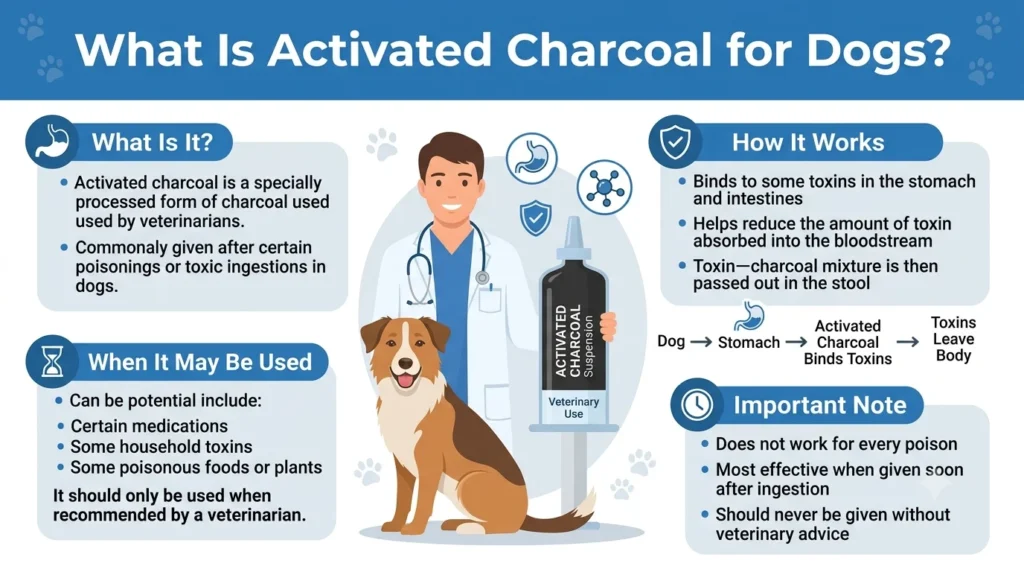
Activated charcoal Dosage For Dogs, also known as activated carbon, is a fine black powder which is very porous and produced by heating carbon-rich raw materials like wood, coconut shells, coal, or bamboo to very high temperatures, then “activating” them to produce millions of microscopic pores. This process creates an extremely porous carbon that has a very high surface area and makes it a very effective oral adsorbent employed in veterinary medicine to assist with some poisoning emergencies in dogs.
Absorption is when a substance moves into a different material, but activated charcoal dosage is done by adsorption—where the toxins stick to the surface of the charcoal. When a dog ingests activated charcoal in paste, gel or liquid form, it will bind to a lot of toxins and medications and keep them from getting into the body. The charcoal-toxin complex then passes safely through the digestive tract and is excreted with the stool, which decreases the amount of toxin reaching the vital organs of the liver, kidneys, heart and brain.
Activated charcoal medication for dogs should be given as soon after the ingestion of the toxin as possible, preferably before the toxin is out of the stomach. While early treatment is most helpful, it can be of value for some toxins several hours after ingestion depending on the toxin. Some formulations contain sorbitol (cathartic) which accelerates bowel movement and removes toxins bound to charcoal, minimizing the possibility of toxins being released and reabsorbed in the event of constipation. Kaolin may also be included in some veterinary products to aid absorption of toxins in the gut.
Activated charcoal dosage for dogs is useful in the treatment of many poisonings, but is not a universal antidote for all poisons. It may work with ibuprofen and other NSAIDs, acetaminophen, chocolate, marijuana, some rodenticides, some insecticides and even some prescription drugs (such as antidepressants). It is not effective, however, against toxins like alcohol, xylitol, bleach, antifreeze, gasoline, batteries or heavy metals like lead or iron.
Activated charcoal dose for dogs is usually just part of the treatment for a poisoning, which may also include inducing vomiting, intravenous (IV) fluids, supportive medicines, and close veterinary monitoring. Activated charcoal should only be used under a veterinarian’s instruction, as it depends on the type of toxin, the amount consumed by the dog and the condition of the dog on when to use it.
While there are some activated charcoal products that can be purchased over the counter, “natural” is not necessarily safe, and these products are not subject to the same level of efficacy testing as approved veterinary products.
What Is Activated Charcoal Used for in Pets?
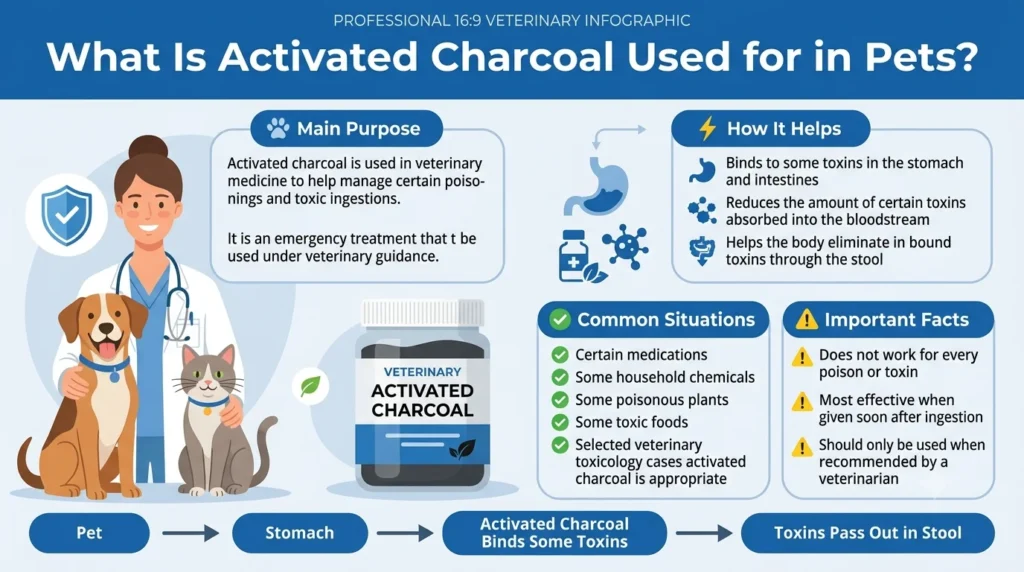
The main use of activated charcoal in dogs and cats is as an emergency treatment for acute poisoning. This functions by binding (adsorbing) to the stomach and intestines many toxins, drugs and chemicals, therefore preventing their absorption into the bloodstream. Activated charcoal can decrease the amount of toxin absorbed by the body, and is sometimes combined with other treatments like making the person vomit, giving intravenous (IV) fluids, and supportive care, to lessen the effects of poisoning.
Activated charcoal can be recommended if a pet ingests some toxic materials such as:
- Human Medications (e.g., acetaminophen (Tylenol) and some NSAIDs)
- Chocolate
- Gels and baits available to kill rats and mice.
- Marijuana
- Insecticides
- Certain prescription or animal drugs
- Products used in your home such as cleaners, lawn and garden products
- Some foods that are bad for humans
- Lilies (in cats) for treatment in veterinary conditions
Activated charcoal should not be thought of as a universal antidote, however, for every poison. Generally it does not bind well to:
- Salt (including homemade playdough and paintballs)
- Xylitol
- Alcohol (ethanol)
- Antifreeze (ethylene glycol)
- Hydrocarbon fuels, such as gasoline.
- Metals (e.g. iron)
- Alkaline (caustic) solutions (such as battery acid or bleach)
- Mineral acids, alkalis and nitrates
Activated charcoal should be given as soon as possible, preferably within an hour of toxin consumption, but veterinarians may still use it up to four hours after consumption in some toxins. If the pet has just ingested a toxin and is not yet having clinical symptoms the veterinarian might first try to induce vomiting to remove it and then administer activated charcoal to minimize absorption of any remaining toxin. Activated charcoal is not very effective if the toxins are already absorbed or once the pet has some symptoms like vomiting, diarrhea or tremors.


Paid Links - As an Amazon Associate, I earn from qualifying purchases.
Activated charcoal dosage is typically administered as a liquid, gel or paste, and powdered activated charcoal should generally be suspended in soft food or water prior to administration. Dosage will vary depending upon the size of the pet and the type of toxin, and must be guided by a veterinarian.
While some charcoal formulations can be purchased over the counter, human charcoal tablets or capsules are not appropriate for treating poisoning in pets and may contain ingredients that are not safe for pets.
Activated charcoal is used off-label in veterinary medicine; so, if a poisoning is suspected, it is best treated as an emergency, and a veterinarian or pet poison hotline should be called right away.
Single-Dose vs. Multi-Dose Activated Charcoal (MDAC)
Most poisonings only require a single dose of activated charcoal. But for certain toxins, veterinarians use multi-dose activated charcoal (MDAC) — repeated doses given over 24–48 hours to keep adsorbing toxin as it recirculates through the body.
Which Toxins Need Multiple Doses?
MDAC is typically used for toxins that undergo enterohepatic recirculation (meaning the body reabsorbs and re-releases them back into the gut) or that have a long half-life or delayed/sustained-release formulation. Common examples include:
- Cholecalciferol (vitamin D3 rodenticides)
- NSAIDs like carprofen or naproxen
- THC (marijuana)
- Theobromine (chocolate, in higher-dose cases)
- Sustained-release medications
MDAC Dosing Schedule
A common protocol is 1 to 2 g/kg given every 4 to 8 hours for 3 to 6 total doses, adjusted based on the toxin and the dog’s response. One important detail: only the first dose should include a cathartic like sorbitol — repeated cathartic doses raise the risk of dehydration and dangerously high blood sodium (hypernatremia). Every dose after the first should be plain activated charcoal.
How to Give Your Pet Activated Charcoal Safely
Activated charcoal Dosage for dogs should only be administered on the advice of a vet. It can be beneficial in some situations of poisoning, but should never be administered at home without appropriate guidance, as it can be dangerous, can delay proper care and may even make your pet more ill.
A veterinarian will conduct a physical exam before administering activated charcoal to decide if it is safe and appropriate for your pet depending on the type of toxin, time of ingestion and the overall health of your pet.
Activated charcoal is taken by mouth and is usually given as:
- A mixture of liquid suspension (slurry) and water
- A paste
- Water or food additives that turn into granules when they come into contact with water.
- A syringe-fed suspension
- A tube inserted through the nose or mouth, into the stomach (some veterinary hospital cases).
Activated charcoal can be mixed in a small amount of canned food for some dogs to make it tastier and easier to ingest. Tablets/capsules are not recommended in veterinary medicine as they are less effective than liquid formulas.
Several doses of activated charcoal may be given for some poisons to remove as much poison as possible. If the first dose includes a cathartic (e.g. sorbitol), however, subsequent doses are typically of plain activated charcoal to minimize the risk of dehydration and raised blood sodium levels (hypernatremia).
Don’t give activated charcoal to your pet if they:
- Frequent vomiting or very weak movements
- Neurological symptoms: disorientation, tremors, seizures, collapse.
- A low gag reflex or a high risk of inhaling (aspirating) the charcoal
- Loss of water or high levels of sodium in the blood
- Recent surgery of the gastrointestinal tract
- Suspected bowel obstruction, or other gastrointestinal dysfunction
- Some underlying conditions like acute kidney failure, diabetic ketoacidosis or megaesophagus
- Eaten a toxin which will not adsorb to activated charcoal
- Consumed the toxin too long ago for charcoal to be effective
Aspiration (inhalation of activated charcoal into the lungs rather than the stomach) is a very serious risk. This may result in aspiration pneumonia, which is a potentially life-threatening condition that can cause breathing problems. Activated charcoal may also create constipation and if the bowel movements are not normal, toxins trapped in the charcoal may be absorbed back into the body.
Dog Activated charcoal Dosage typically starts to be effective 1-2 hours after being administered to the gastrointestinal tract, but may not be apparent. Dry charcoal powder can irritate the respiratory tract (both people and animals), permanently stain fur, clothing and furniture and can become airborne when handling it.
When your dog or cat ingests something he might think is poisonous, do not wait for any symptoms to develop nor should you try to treat him at home without consulting your veterinarian. Certain poisons such as ibuprofen, xylitol, and grapes can cause severe internal damage before any outward symptoms are seen and prompt veterinary treatment is important.
What Are the Side Effects of Activated Charcoal in Dogs?
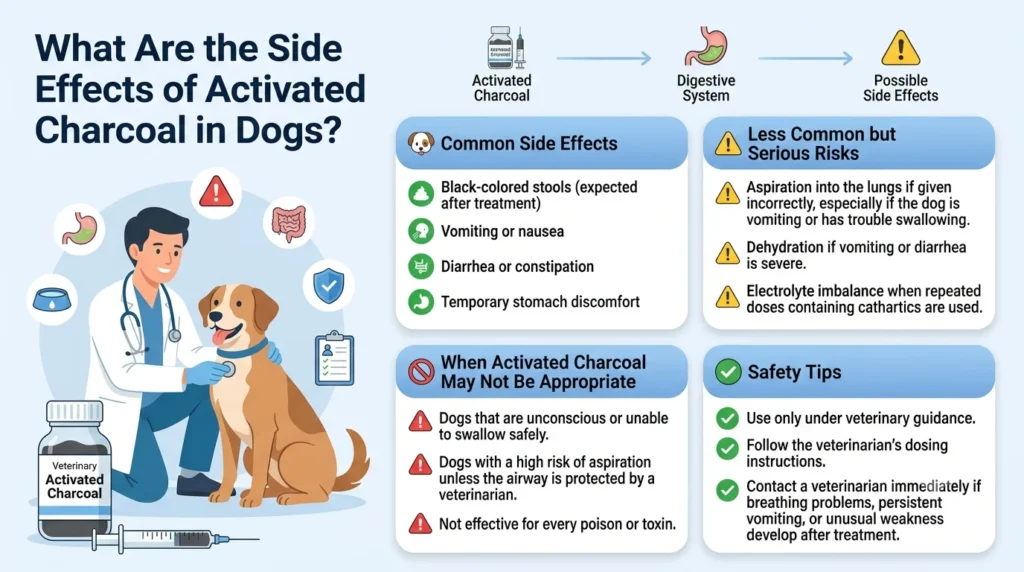
Activated charcoal is safe when used appropriately and under veterinary supervision but like any treatment there are side effects. Most reactions are mild and short-lived, and severe complications are rare except when activated charcoal is administered incorrectly or when a dog has certain health problems.
Side effects are most likely to be:
- Vomiting
- Constipation
- Diarrhea (particularly when taking products containing sorbitol)
- Black stools for 24 -48 hours.
- Black discoloration around the mouth, chest, front legs or fur.
- Dehydration
- Electrolyte imbalances
- Temporary confusion or behaviour out of the ordinary
Constipation is common: some veterinary formulations include sorbitol, a cathartic which will aid the elimination of charcoal-bound toxins through the gut. Repeated doses containing sorbitol, however, should not be given as it may also lead to soft stools, diarrhea, large stools, stomach cramps, dehydration and electrolyte disturbances.
The most severe side effects of activated charcoal are:
- Aspiration, when the charcoal goes into the lungs rather than the stomach, leading to inflammation of the lungs (aspiration pneumonitis), aspiration pneumonia, respiratory distress, or death.
- If dehydration is severe, it may result in hypernatremia (high blood sodium levels) which is a potentially life-threatening condition.
- Low blood pressure (hypotension) that could lead to weakness, sluggishness or lethargy.
Activated charcoal can also bind many oral medicines, causing them to be ineffective. Your veterinarian may suggest giving your dog 2–4 hours after activated charcoal or altering the route of administration to injectable or intravenous (IV) medications in the interim, if your dog is currently on routine medications.
Some dogs are more likely to have problems, and do not use activated charcoal in dogs that:
- Oblockage or very little movement in the gut
- Are very dehydrated, in shock or have acute kidney injury
- Inhaled or ingested substances that are not absorbed by activated charcoal, including paintballs, hydrocarbons, heavy metals or xylitol.
- Are receiving chemotherapy
- Be allergic to activated charcoal
Should not be used in dogs that are unconscious, have difficulty swallowing or are already exhibiting serious signs of poisoning as they are at a very high risk of aspiration and are typically administered via a protected airway by a veterinarian.
Black stools are to be expected for the next 24-48 hours following the treatment, but sustained black stools or any indication of severe vomiting, breathing difficulty, weakness, dehydration, collapse or any unusual behavior should be considered a veterinary emergency. Contact your veterinarian immediately if you notice any symptoms you are worried about or if they are not what you were expecting after giving your dog activated charcoal.
Does Activated Charcoal Interact With Any Dog Medications?
Yes. Activated charcoal Medication may interact with many dog medications as it can bind (adsorb) drugs in the digestive tract which affect how much of the drug is absorbed into the bloodstream. This means that when oral medications are administered too near to activated charcoal, there may be less effect.
However, if you’re administering any oral medication, you should wait 2-4 hours after charcoal is given to your dog, to help minimize this interaction. In certain cases timing cannot be the sole method to avoiding interactions as always follow your veterinarians guidelines.
Medications that need to be used with caution in combination with activated charcoal are:
- Acepromazine
- Anticholinergic drugs (including atropine, meclizine)
- Antidiarrheal medications, such as loperamide
- Antihistamines: Diphenhydramine (Benadryl) and Hydroxyzine
- Butorphanol, tramadol, hydrocodone are all examples of opioid pain medications
- Antidepressants such as tricyclic antidepressants, such as amitriptyline and clomipramine
Certain of these drugs can also be constipating when mixed with activated charcoal and can therefore contribute to gastrointestinal (GI) obstruction in predisposed dogs.
Some products may also affect the activated charcoal’s ability to bind toxins, such as:
- Dairy products
- Mineral oil
- Polyethylene glycol solutions (such as MiraLAX® and GoLYTELY®)
When giving your dog activated charcoal, be sure to inform your veterinarian of any medications, vitamins, supplements or herbal products your dog is taking. This will keep your vet from having to treat you for potential interactions and will help them decide what will be the safest course of treatment.
You May Also Like to Read:
- Imodium Dosage For Dogs: Calculator, Chart & Safe Guide
- Coconut Oil Dosage for Dogs: Safe Guide & Calculator
FAQs
What is the speed of action of activated charcoal in dogs?
Activated charcoal Dose is effective within minutes of being administered, and is best administered as soon as possible after a dog has swallowed a toxic substance. Early treatment is the best opportunity to keep toxins out of the bloodstream.
Is it OK to use activated charcoal for dogs after they have been exposed to chocolate?
If your veterinarian advises otherwise. The correct dosage, timing and method of administration of activated charcoal can be binding to the toxins in chocolate, but must be determined by a veterinary professional based upon your dog’s condition.
Does the activated charcoal interfere with dog medications?
Yes. Some oral medicines may not be as effective if they are bound to activated charcoal, as they will not be absorbed. This can impact antibiotics, anti-seizure medicines, NSAIDs and other medications. Be sure to inform your veterinarian at the time of your treatment if the dog is receiving any medication, vitamins or supplements.
When is it not a good time to give my dog activated charcoal?
Avoid administration of activated charcoal unless under veterinary advice. It should also not be used when your dog is vomiting over and over, when it is lethargic, dehydrated, having seizures, has recently undergone gastrointestinal surgery, has an intestinal problem, or has eaten a substance that charcoal won’t bind to, such as alcohol, xylitol, bleach or some heavy metals.
What if my dog forgets to take a dose of activated charcoal?
Treatment is typically only in a veterinary clinic or emergency hospital and therefore, activated charcoal is not usually missed. If it is to be given at home, follow your veterinarian’s instructions. In the event of a missed dose, administer the dose as soon as remembered, unless it is approaching the due time for the next dose. Do not administer two doses simultaneously unless directed to do so by veterinarian.
Where does activated charcoal need to be stored?
Keep activated charcoal Dosage in a closed container at room temperature (68°F-77°F/20°C-25°C). Store away from children and pets, and obey storage instructions on product labels if a compounded product.
If my dog reacts or receives too much activated charcoal, what do I do?
Call the vet right away if you think your dog might have had an overdose or if your dog starts showing you signs that are not good, like trouble breathing, a lot of vomiting, weakness, collapse or unusual behavior. If your regular veterinarian is not available, go to your nearest Emergency veterinary hospital. Have information on hand about your dog’s weight, the symptoms you noticed, and information about the product.
Final Thoughts
Activated charcoal Dosage For Dogs can effectively neutralize some poisons and can save a dog’s life as an emergency measure when the dog has been exposed to certain poisons, but it is not a cure-all. Every minute counts during a poisoning emergency, since it can best be treated as soon as possible, preferably within an hour of the toxin being swallowed. The appropriate dose, frequency, and necessity of retreatment will depend on your dog’s weight, the type of toxin and your veterinarian’s evaluation.
Activated charcoal products For dogs can be purchased over the counter, but should not be a substitute for veterinary care. Human charcoal tablets and capsules are not recommended for use in dogs for poisoning, and administering charcoal without veterinary supervision could delay important treatment or cause serious problems.
If you think your dog may have eaten something they shouldn’t have, call your vet or a pet emergency hospital right away. Early treatment provides the best chance for your dog to make a full recovery and can help you ensure the safest treatment for the toxin in question.