Medically reviewed by: Medsdog Team
Last updated: August 2026
When your dog has a bacterial infection, getting the Augmentin® (amoxicillin-clavulanate) dose right matters, too little won’t work and heal the infection, and too much raises the risk of side effects or antibiotic resistance.
This guide covers the standard Augmentin dosage for dogs, how vets calculate the ideal dosing, and how to use it safely for your furry friend, based on veterinary guidelines.
Disclaimer: This guide is for informational purposes only and is not a substitute for professional veterinary advice. All the mentioned dosages, dosage charts and calculator are mathematical calculations based on 13.75 mg/kg of combined amoxicillin + clavulanate. Different Augmentin formulations contain different amoxicillin-to-clavulanate ratios, so they should not be considered interchangeable. A veterinarian should confirm the appropriate formulation, dose, and treatment duration for the individual dog.

Paid Links - As an Amazon Associate, I earn from qualifying purchases.
The veterinary product (Clavamox) uses a different amoxicillin-to-clavulanate ratio (5:1) than most human Augmentin tablets. That means you can’t just split a human tablet based on total weight and assume it matches the vet dose the amoxicillin content, which is what the mg/lb dose is based on, varies between products.
If your vet approves using a human Augmentin tablet for your dog, they’ll calculate the dose based on the amoxicillin content specifically, not the total tablet weight. Never estimate this yourself.
What is Augmentin® For Dogs?
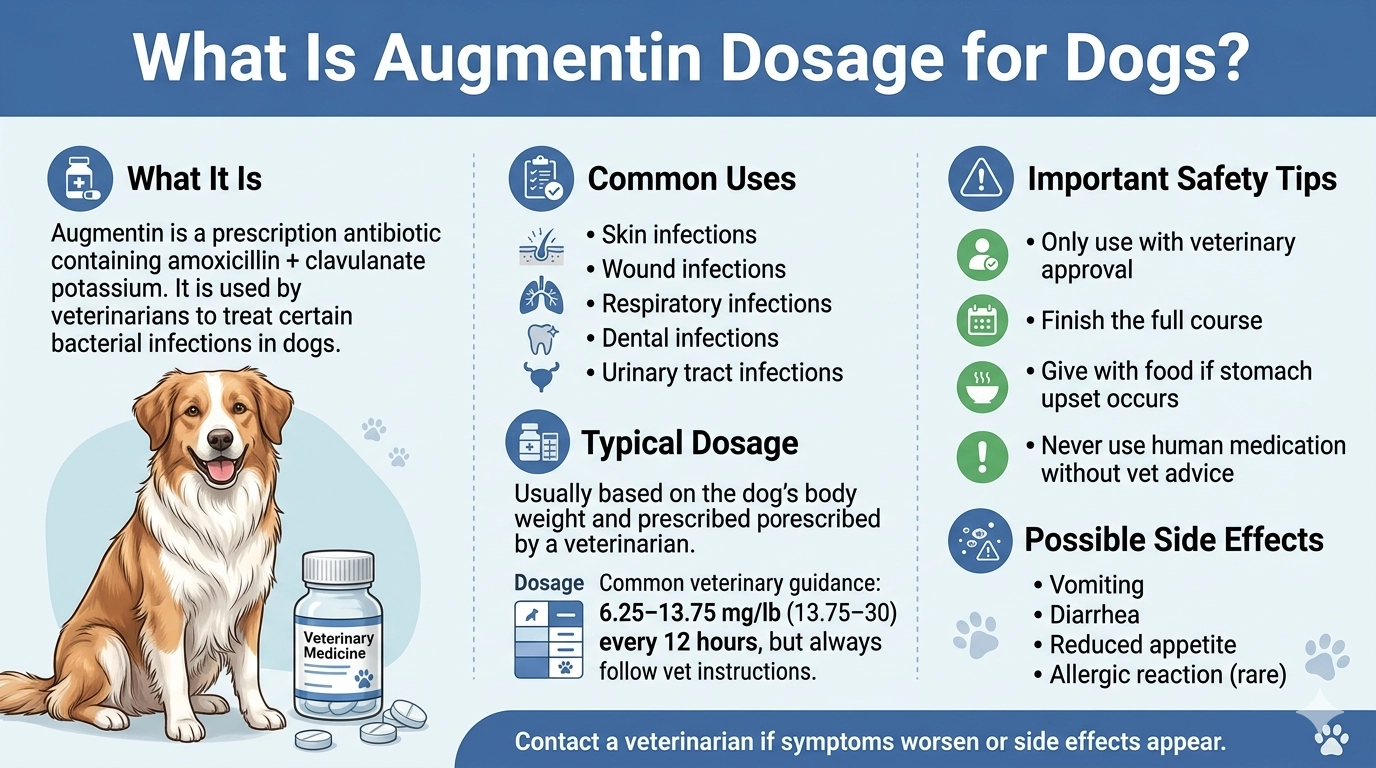
Augmentin® (or the veterinary versions of this antibiotic such as Clavamox® and other amoxicillin-clavulanate products) is a prescription broad-spectrum antibiotic that is commonly used to treat a variety of bacterial infections in dogs, such as skin infections, soft tissue infections, dental infections, wound infections, abscesses, respiratory infections, and urinary tract infections.
Augmentin is made of two drugs: amoxicillin and clavulanate potassium. Amoxicillin is a penicillin antibiotic that works by preventing the formation of bacterial cell walls. But some bacteria make enzymes called beta-lactamases (or penicillinases) which can destroy amoxicillin.
The addition of clavulanate to amoxicillin overcomes this resistance, and allows amoxicillin dosage for dogs to remain effective. This makes Augmentin useful against many bacteria that would be resistant to amoxicillin, such as some staphylococcal infections.
What is the Safe Augmentin Dosage for Dogs?
The ideal Augmentin dosage for treating bacterial infections in dogs is 13.75 mg/kg, PO, q 12 h for 5–7 d. However, your veterinarian may adjust the dosage based on your dog’s condition and the type of infection being treated.
Augmentin also comes in liquid oral suspension liquid strengths are expressed per 5 mL.
Example for a 20-kg dog (275 mg per dose):
- 125/31.25: 275 ÷ 25 = 11 mL
- 200/28.5: 275 ÷ 45.7 = 6.02 mL
- 250/62.5: 275 ÷ 62.5 = 4.4 mL
- 400/57: 275 ÷ 91.4 = 3.01 mL
- 600/42.9: 275 ÷ 128.58 = 2.14 mL
Never give Augmentin 1,000 mg/62.5 mg XR (extended release) to your dog unless specifically prescribed by a veterinarian, as this formulation is designed for human use and is not interchangeable with veterinary formulations. For Augmentin oral suspension, consult your veterinarian for the appropriate formulation and dosage for your dog.
Augmentin Dosage Calculator For Dogs
Augmentin Dosage Chart for Dogs by Weight
| Dog Weight | Approx. Weight | Calculated Dose per Administration |
|---|---|---|
| 2 kg | 4.4 lb | 27.5 mg |
| 5 kg | 11 lb | 68.8 mg |
| 10 kg | 22 lb | 137.5 mg |
| 15 kg | 33 lb | 206.3 mg |
| 20 kg | 44 lb | 275 mg |
| 25 kg | 55 lb | 343.8 mg |
| 30 kg | 66 lb | 412.5 mg |
| 35 kg | 77 lb | 481.3 mg |
| 40 kg | 88 lb | 550 mg |
| 45 kg | 99 lb | 618.8 mg |
| 50 kg | 110 lb | 687.5 mg |
| 55 kg | 121 lb | 756.3 mg |
| 60 kg | 132 lb | 825 mg |
| 65 kg | 143 lb | 893.8 mg |
| 70 kg | 154 lb | 962.5 mg |
| 75 kg | 165 lb | 1,031.3 mg |
| 80 kg | 176 lb | 1,100 mg |
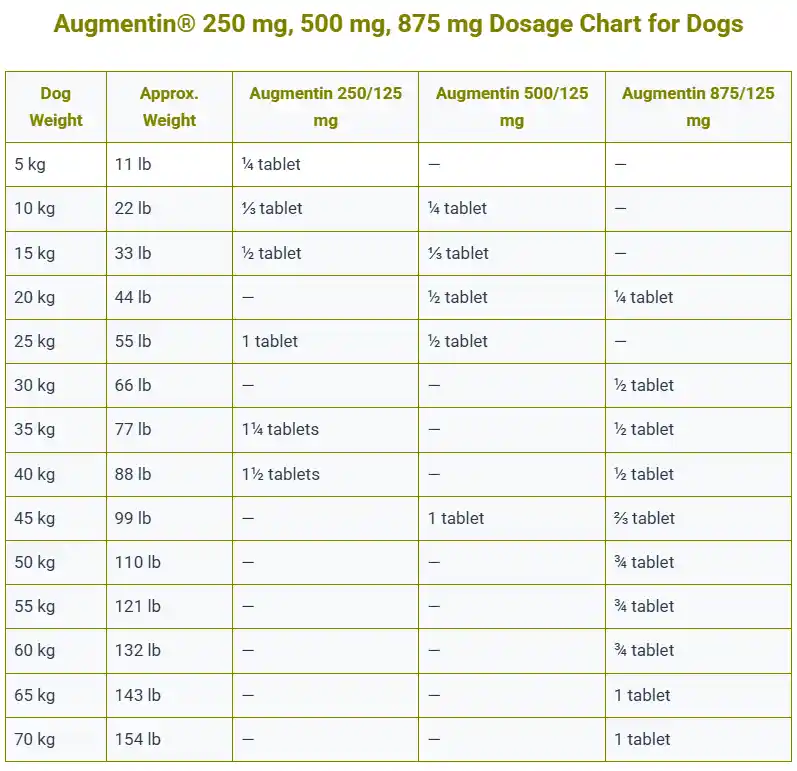
Augmentin® 250 mg, 500 mg, 875 mg Dosage Chart for Dogs
Dog Weight | Approx. Weight | Augmentin 250/125 mg | Augmentin 500/125 mg Paid Links - As an Amazon Associate, I earn from qualifying purchases. | Augmentin 875/125 mg |
|---|---|---|---|---|
5 kg | 11 lb | ¼ tablet | — | — |
10 kg | 22 lb | ⅓ tablet | ¼ tablet | — |
15 kg | 33 lb | ½ tablet | ⅓ tablet | — |
20 kg | 44 lb | — | ½ tablet | ¼ tablet |
25 kg | 55 lb | 1 tablet | ½ tablet | — |
30 kg | 66 lb | — | — | ½ tablet |
35 kg | 77 lb | 1¼ tablets | — | ½ tablet |
40 kg | 88 lb | 1½ tablets | — | ½ tablet |
45 kg | 99 lb | — | 1 tablet | ⅔ tablet |
50 kg | 110 lb | — | — | ¾ tablet |
55 kg | 121 lb | — | — | ¾ tablet |
60 kg | 132 lb | — | — | ¾ tablet |
65 kg | 143 lb | — | — | 1 tablet |
70 kg | 154 lb | — | — | 1 tablet |


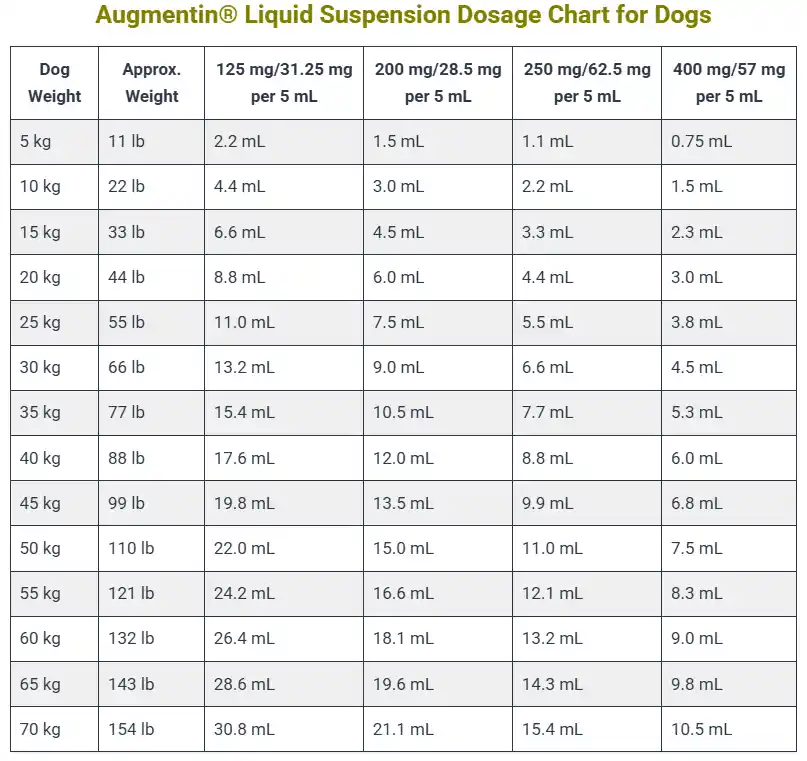
Augmentin® Liquid Suspension Dosage Chart for Dogs
| Dog Weight | Approx. Weight | 125 mg/31.25 mg per 5 mL | 200 mg/28.5 mg per 5 mL | 250 mg/62.5 mg per 5 mL | 400 mg/57 mg per 5 mL |
|---|---|---|---|---|---|
| 5 kg | 11 lb | 2.2 mL | 1.5 mL | 1.1 mL | 0.75 mL |
| 10 kg | 22 lb | 4.4 mL | 3.0 mL | 2.2 mL | 1.5 mL |
| 15 kg | 33 lb | 6.6 mL | 4.5 mL | 3.3 mL | 2.3 mL |
| 20 kg | 44 lb | 8.8 mL | 6.0 mL | 4.4 mL | 3.0 mL |
| 25 kg | 55 lb | 11.0 mL | 7.5 mL | 5.5 mL | 3.8 mL |
| 30 kg | 66 lb | 13.2 mL | 9.0 mL | 6.6 mL | 4.5 mL |
| 35 kg | 77 lb | 15.4 mL | 10.5 mL | 7.7 mL | 5.3 mL |
| 40 kg | 88 lb | 17.6 mL | 12.0 mL | 8.8 mL | 6.0 mL |
| 45 kg | 99 lb | 19.8 mL | 13.5 mL | 9.9 mL | 6.8 mL |
| 50 kg | 110 lb | 22.0 mL | 15.0 mL | 11.0 mL | 7.5 mL |
| 55 kg | 121 lb | 24.2 mL | 16.6 mL | 12.1 mL | 8.3 mL |
| 60 kg | 132 lb | 26.4 mL | 18.1 mL | 13.2 mL | 9.0 mL |
| 65 kg | 143 lb | 28.6 mL | 19.6 mL | 14.3 mL | 9.8 mL |
| 70 kg | 154 lb | 30.8 mL | 21.1 mL | 15.4 mL | 10.5 mL |
Critical Administration Reminders
- Frequency: These amounts are for one dose. Give this amount twice daily (every 12 hours) or as advised by your veternarain.
- The “Food Rule”: Amoxicillin/Clavulanate is notorious for causing nausea or diarrhea in dogs. Always give the dose with a full meal to buffer the stomach.
- Liquid Storage: If you are using the liquid suspension, it must be kept in the refrigerator and typically expires 10 days after being mixed by the pharmacy. Shake well before each use.
- Completion: Even if your dog stops coughing or itching after 3 days, you must finish the entire course prescribed by the vet to prevent antibiotic resistance.
Note: If your dog falls between weights, your veterinarian will usually recommend rounding to the nearest practical tablet size or liquid measurement based on the severity of the infection.
Human Augmentin Tablet Strengths: 375, 625, 875 mg — Can Dogs Take Them?
A lot of pet owners search for “augmentin 375 for dogs” or “augmentin 625 for dogs” because that’s what’s sitting in their medicine cabinet. Here’s what those numbers actually mean, and why the number on the box isn’t enough to dose your dog safely.
| Human Augmentin Tablet | Amoxicillin Content | Clavulanate Content | Ratio |
|---|---|---|---|
| 375 mg tablet | 250 mg | 125 mg | 2:1 |
| 625 mg tablet | 500 mg | 125 mg | 4:1 |
| 875 mg tablet | 875 mg | 125 mg | 7:1 |
Uses of Augmentin for Dogs
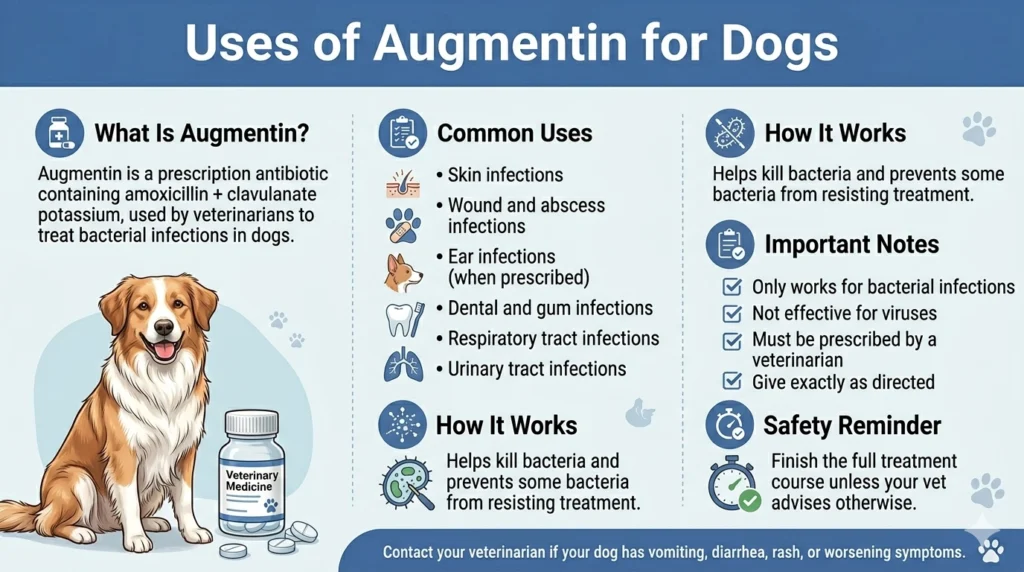
Augmentin (amoxicillin + clavulanate) is an broad-spectrum antibiotic veterinarians use to treat dogs for bacterial infections caused by susceptible organisms. This medication is particularly effective when you don’t know what type of bacteria is causing the infection or when infections may be caused by Staphylococcus bacteria that are not fully susceptible to amoxicillin.
Augmentin is commonly used for dogs to treat:
- Skin infections (often Staphylococcal infections)
- Wound infections (including bite wounds)
- Mouth and tooth infections (infected teeth)
- Bladder and urinary tract infections
- Upper respiratory infections
- Pneumonia
- Bone infections
- Anaerobic bacterial infections (bacteria that do not require oxygen)
Augmentin for dogs dose cannot be used to treat viral infections or parasites (worms and mites). However, some bacteria may still become resistant to the drug, so if your pet’s infection does not improve, check with your veterinarian.
Precautions and Side Effects of Augmentin for Dogs
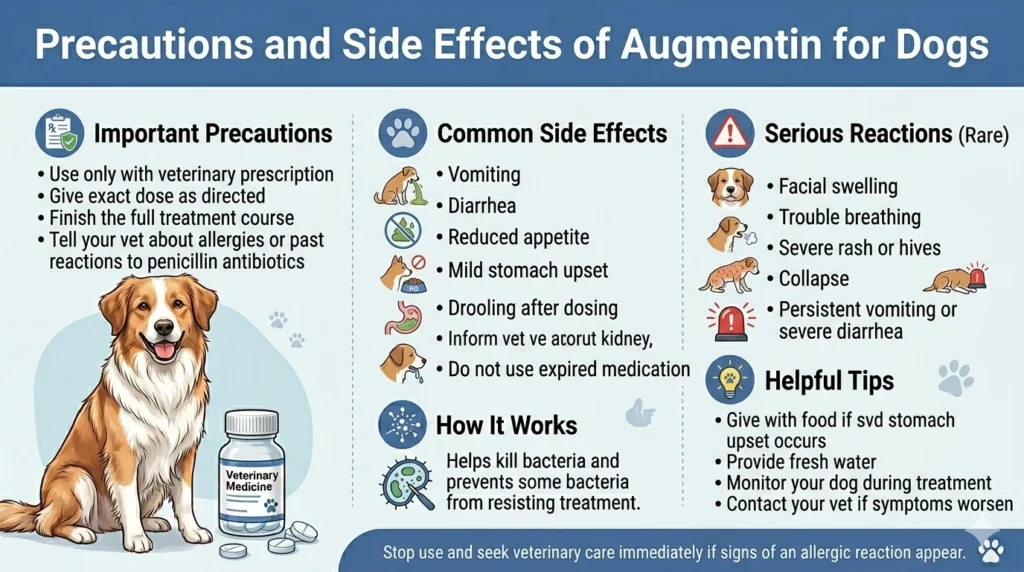
Augmentin (amoxicillin + clavulanate) is a safe and effective antibiotic for dogs when administered by a veterinarian, but there are some dogs for whom special care is needed.
Common Side Effects
The main side effects are gastrointestinal and include:
- Vomiting
- Loose stools or diarrhea
- Nausea
- Loss of appetite
- Stomach ache or upset
Feeding your dog with food can help prevent nausea, vomiting and upset stomach. Antibiotics can upset the normal balance of good gut bacteria, so some dogs may need probiotics on the recommendation of a veterinarian.
Allergic Reactions (Serious Risk)
Dogs with a sensitivity or allergy to penicillin-based antibiotics shouldn’t be given Augmentin. If your dog has:
- Hives or rash
- Facial swelling
- Difficulty breathing
- Collapse
- Fever
- Changes in white blood cell levels
- Anemia
- Anaphylaxis
Important Precautions
- Augmentin dosage for dogs per pound may interfere with other drugs, such as chloramphenicol and tetracycline, so make sure to mention any drugs your dog is currently receiving.
- Augmentin can be ineffective against some bacteria, such as methicillin-resistant Staphylococci (MRSA/MRSP). If it’s not working, a culture and sensitivity test may be required.
- Human Augmentin antibiotics for dogs products may have different ratios and concentrations of the ingredients than veterinary products, so should not be used without veterinary advice.
- The oral suspension should be stored in the refrigerator and usually only used for up to 10 days.
- Augmentin can be administered with or without food, but may be less tolerated without it.
- It does cross the placenta but is thought safe in pregnancy (with veterinary oversight).
If there are side effects or your dog deteriorates, call your vet.
Augmentin vs. Clavamox vs. Plain Amoxicillin: What’s the Difference?
This trips up a lot of owners, so here’s the comparison side by side.
| Amoxicillin | Augmentin (human brand) | Clavamox (veterinary brand) | |
|---|---|---|---|
| Active ingredients | Amoxicillin only | Amoxicillin + clavulanate | Amoxicillin + clavulanate |
| Beats beta-lactamase-producing bacteria (e.g., some Staph)? | No | Yes | Yes |
| Approved for veterinary use | Yes (extra-label common) | Not vet-labeled | Yes, FDA-approved for dogs/cats |
| Common ratio | N/A | 2:1 to 7:1 | 5:1 |
| Typical dose | ~5 mg/lb, twice daily | Based on amoxicillin content | 6.25 mg/lb (13.75 mg/kg), twice daily |
Interactions with Other Drugs
Augmentin (amoxicillin + clavulanate) medication for dogs may interact with other drugs, so it is important to discuss all drugs or supplements your dog is taking with your veterinarian.
Augmentin may be combined with other antibiotics in severe infections, when the type of bacteria causing the infection is unknown, to broaden coverage of potentially involved bacteria.
It may also work cooperatively with certain antibiotics such as the quinolones enrofloxacin, marbofloxacin and orbifloxacin (this means it might be more effective than the sum of its parts).
But drugs like Augmentin can also reduce the effectiveness of some other antibiotics, so combinations should only be used at the direction of your veterinarian.
Important drug interactions may include:
- Methotrexate – may accumulate to toxic levels if used with Augmentin
- Mycophenolate – may interact with other immunosuppressants
- Warfarin – may influence anti-coagulation and blood clotting
Be sure to talk to your vet before using Augmentin with any other prescription drug, over-the-counter drug or supplement.
What Happens If I Miss Giving a Dose of Augmentin for Dogs?
If you forget to give your dog Augmentin (Clavamox dosage for dogs), give the missed dose as soon as you remember. Then go back to the regular schedule (for example, every 12 hours or as prescribed by the veterinarian).
Or, if you remember the missed dose later and it is almost time for the next dose, then give the next dose at the scheduled time. Do not give an extra dose except as directed by your veterinarian.
Regular doses help keep the antibiotic level in your dog’s system, and help him recover fully.
You May Also Like to Read:
- Spirulina Dosage For Dogs Calculator: Safe Dosage Guide & Chart
- Allegra Dosage For Dogs Calculator: Safe Dosage Chart & Guide
Sources
- Merck Veterinary Manual: Dosages of Antistaphylococcal Antimicrobials
- Veterinary Partner (VIN) — Amoxicillin-clavulanic acid (Clavamox, Augmentin, Clavacillin), by Wendy Brooks, DVM
- U.S. FDA / DailyMed — Amoxicillin and Clavulanate Potassium drug labeling
FAQs
What is Augmentin used for in dogs?
Augmentin is often used to treat dogs’ bacterial skin, mouth, respiratory, urinary tract, and wound infections.
How much Augmentin do you give a dog?
It varies by the dog’s weight, type of infection and overall health. Doses are usually calculated based on weight.
How often should I administer Augmentin for pets to my dog?
Augmentin is typically given every 12 hours, but be sure to follow your veterinarian’s instructions.
Should I give my dog food with Augmentin dosage for dogs?
Yes, Augmentin is often given with food to decrease the chance of stomach upset, nausea or vomiting.
What do I do if I miss a dose of Augmentin?
Take the dose as soon as possible. If it is nearly time for your next dose, leave out the missed dose and give the next dose at the usual time. Do not double dose.
What are the side effects of Augmentin drug on dogs?
The most common side effects include vomiting, diarrhea, nausea, reduced appetite and stomach discomfort.
Are dogs allergic to Augmentin?
Yes. Dogs can be allergic to it, which may cause a rash, facial swelling and hives, or trouble breathing. If this occurs, see your veterinarian right away.
Can I give my dog human Augmentin?
Never administer human Augmentin unless you have your veterinarian’s consent, as the concentrations and nonactive ingredients can vary.
How fast does Augmentin work on dogs?
Dogs often improve within days, but it’s important to finish the course of treatment.
Is Augmentin safe for dogs?
Yes, Augmentin is safe when used as directed by your veterinarian.
Final Thoughts
Augmentin (amoxicillin / clavulanate) also called Clavamox, and is a widely used and effective antibiotic medication for treating bacterial skin, dental, soft tissue, respiratory, urinary and wound infections in dogs. It comes in tablet, chewable, and oral suspension forms, allowing for flexibility in administration.
Augmentin dose is generally safe when used as directed by your veterinarian and can clear up your dog’s infection. But it can cause vomiting, diarrhea, inappetence or nausea. If you observe severe side effects, increasing symptoms or allergic reactions, discontinue the medication and seek veterinary advice.
It’s important to administer Augmentin for pets dose as directed, finish the course, and never alter the prescribed dose. This ensures the infection is cured, and helps prevent development of antibiotic-resistant superbugs. When used properly and monitored, Augmentin can help keep your dog healthy and happy.