Reviewed By: Medsdog Team
Last Updated: September 2026
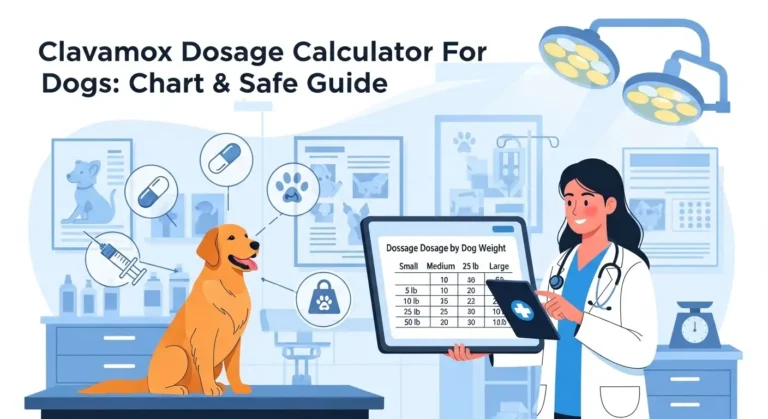
Amoxicillin/clavulanate for dogs is a combination of two prescription antibiotics, commonly prescribed by your veterinarian under the trade names Augmentin® or Clavamox®, that is used to treat bacterial infections in dogs.
Knowing the safe Amoxicillin/clavulanate dosage for dogs is essential to help your furry friend fight infections, including skin infections, bone infections, wound infections, infections in the mouth, pneumonia, and bladder infections, while avoiding overdose and toxicity.
The standard dose of amoxicillin/clavulanate for dogs is 6.25 mg/lb (13.75 mg/kg) of body weight, given every 12 hours, a total daily dose of 12.5 mg/lb (27.5 mg/kg). Some infections, such as deep skin infections, are dosed higher under veterinary direction, up to 25 mg/kg per dose.

Paid Links - As an Amazon Associate, I earn from qualifying purchases.
To help our furry friend lovers learn more about this medication, we have compiled this guide, which includes a dosage calculator, dosing chart by weight, benefits, side effects, and more.
Disclaimer: All information in this guide is provided for educational purposes only and should never replace professional veterinary advice. Different Augmentin formulations contain different amoxicillin-to-clavulanate ratios, so they should not be considered interchangeable. A veterinarian should confirm the appropriate formulation, dose, and treatment duration for the individual dog.
Amoxicillin/Clavulanate Dosage Calculator for Dogs
Estimate the amoxicillin/clavulanate (e.g., Clavamox®) dose for a dog based on standard veterinary dosing guidelines. Always confirm with your veterinarian before administering.
Estimated Dosage
Per Dose (every 12h)
—
Total Daily Dose
—
Standard dosing: 6.25 mg/lb (13.75 mg/kg) per dose, given every 12 hours — a total daily dose of 12.5 mg/lb (27.5 mg/kg). Actual prescribed dose may vary based on the condition being treated and your veterinarian’s judgment.
This calculator is for informational purposes only and does not replace professional veterinary advice. Always consult your veterinarian before giving any medication to your dog.
What is Amoxicillin+Clavulanate For Dogs?
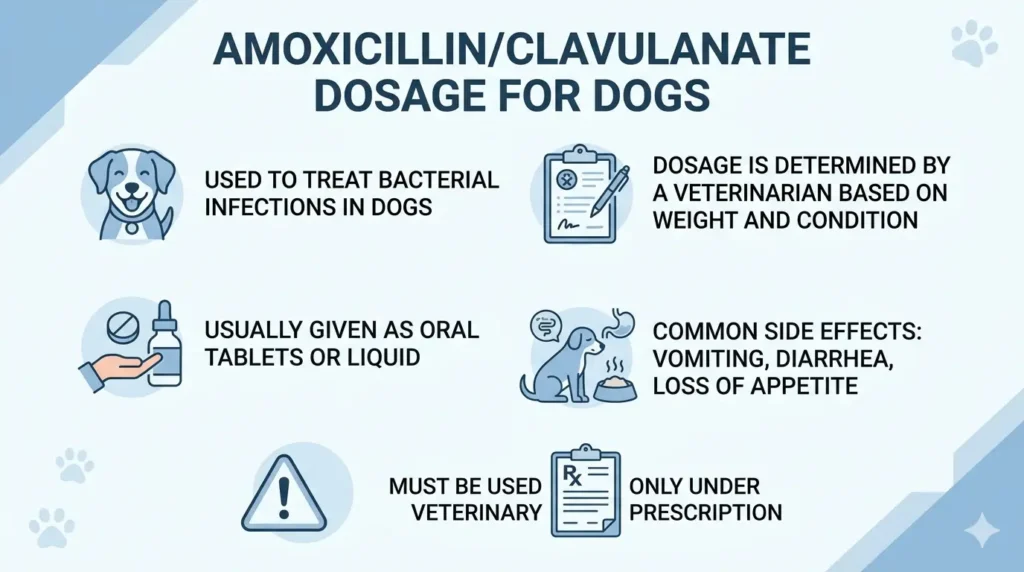
Amoxicillin + clavulanate is a combination of two prescription antibiotics that belong to a group of drugs known as penicillins. They work by interfering with the ability of bacteria to build protective cell walls. Clavulanate potassium is a beta-lactamase inhibitor that helps prevent bacteria from becoming resistant to the drug.
Amoxicillin + clavulanate, sold under the brand names Clavamox® and Augmentin®, is commonly used in dogs to treat a variety of infections, including skin infections, bone infections, wound infections, and infections in the mouth.
Amoxicillin/Clavulanate Dosage for Dogs
The recommended Amoxicillin/clavulanate dosage for dogs is 6.25 mg/lb (13.75 mg/kg) of body weight, given twice daily. This antibiotic is commonly used to treat bacterial infections such as skin and soft tissue infections, including abscesses, cellulitis, wounds, superficial and juvenile pyoderma, and periodontal infections.


Paid Links - As an Amazon Associate, I earn from qualifying purchases.
Treatment dosage is generally continued for 5–7 days or for 48 hours after all signs of infection have gone away. If your furry friend does not show improvement after 5 days of treatment, the medication should be stopped, and your veterinarian should reevaluate the condition.
More serious infections, such as deep pyoderma, may require treatment for up to 21 days, while treatment should generally not exceed 30 days unless specifically directed by a veterinarian.
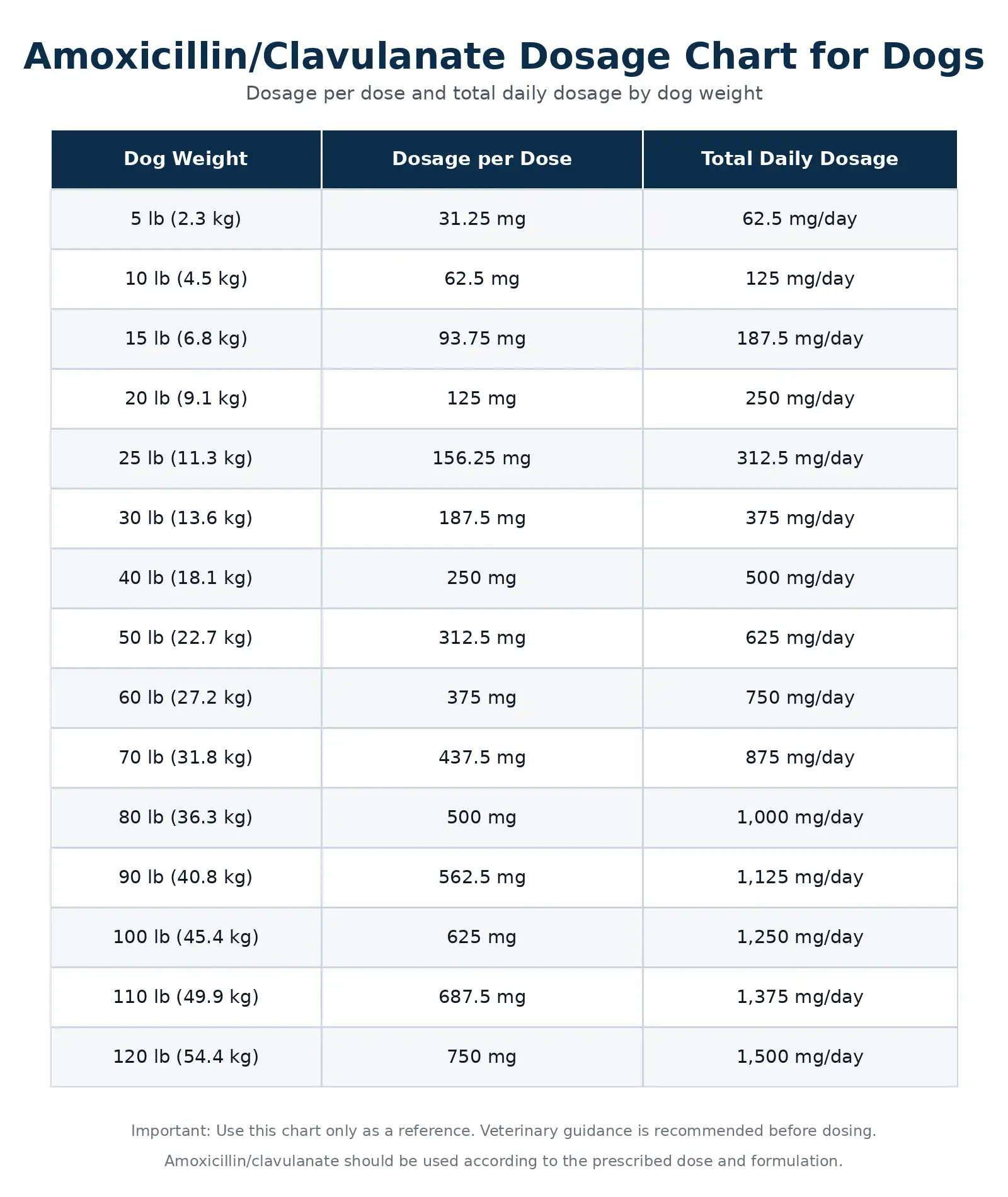
Amoxicillin/Clavulanate Dosage Chart for Dogs
| Dog Weight | Dosage per Dose | Total Daily Dosage |
|---|---|---|
| 5 lb (2.3 kg) | 31.25 mg | 62.5 mg/day |
| 10 lb (4.5 kg) | 62.5 mg | 125 mg/day |
| 15 lb (6.8 kg) | 93.75 mg | 187.5 mg/day |
| 20 lb (9.1 kg) | 125 mg | 250 mg/day |
| 25 lb (11.3 kg) | 156.25 mg | 312.5 mg/day |
| 30 lb (13.6 kg) | 187.5 mg | 375 mg/day |
| 40 lb (18.1 kg) | 250 mg | 500 mg/day |
| 50 lb (22.7 kg) | 312.5 mg | 625 mg/day |
| 60 lb (27.2 kg) | 375 mg | 750 mg/day |
| 70 lb (31.8 kg) | 437.5 mg | 875 mg/day |
| 80 lb (36.3 kg) | 500 mg | 1,000 mg/day |
| 90 lb (40.8 kg) | 562.5 mg | 1,125 mg/day |
| 100 lb (45.4 kg) | 625 mg | 1,250 mg/day |
| 110 lb (49.9 kg) | 687.5 mg | 1,375 mg/day |
| 120 lb (54.4 kg) | 750 mg | 1,500 mg/day |
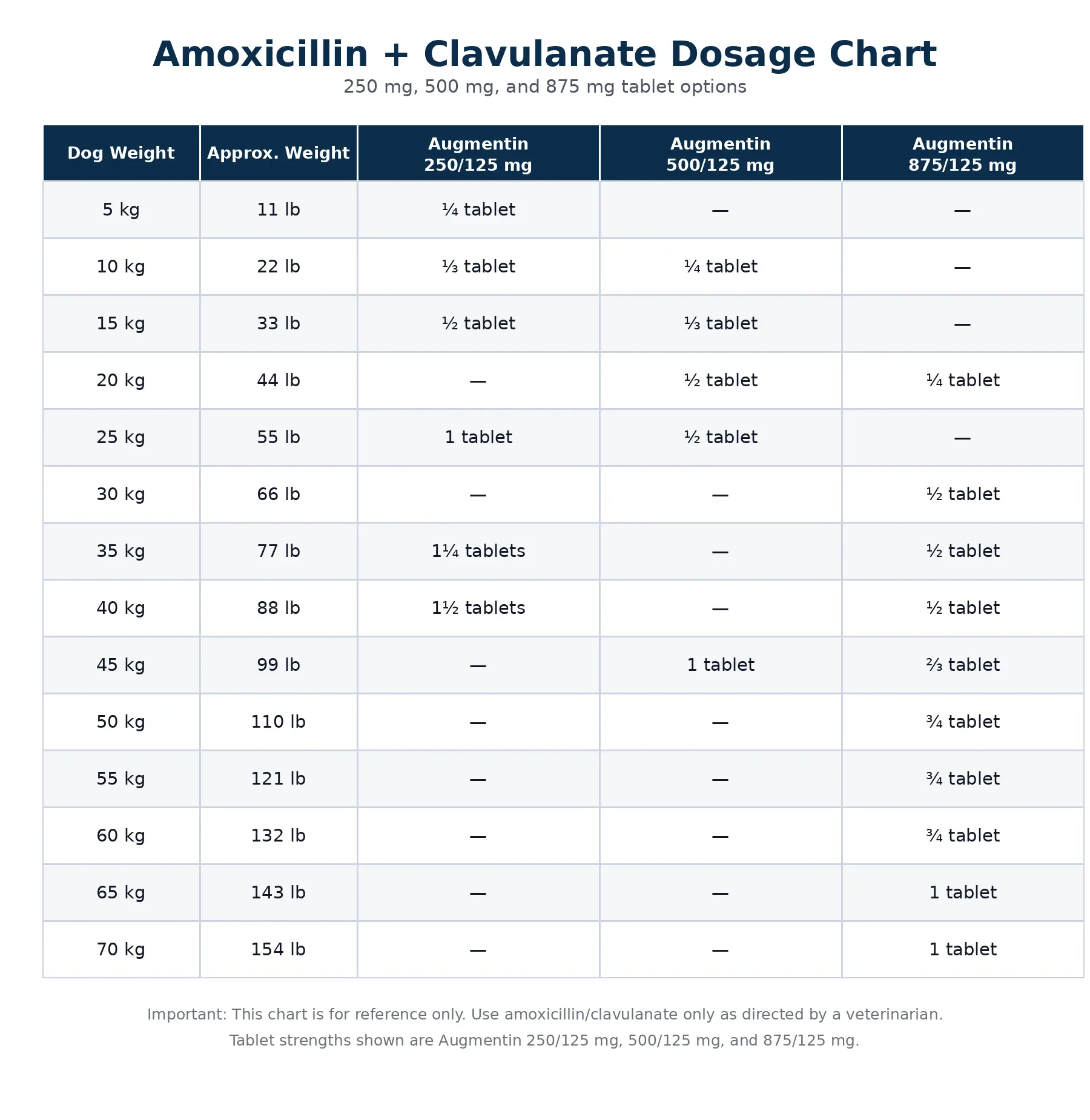
Amoxicillin + Clavulanate 250 mg, 500 mg, 875 mg Dosage Chart
Dog Weight | Approx. Weight | Augmentin 250/125 mg | Augmentin 500/125 mg | Augmentin 875/125 mg |
|---|---|---|---|---|
5 kg | 11 lb | ¼ tablet | — | — |
10 kg | 22 lb | ⅓ tablet | ¼ tablet | — |
15 kg | 33 lb | ½ tablet | ⅓ tablet | — |
20 kg | 44 lb | — | ½ tablet | ¼ tablet |
25 kg | 55 lb | 1 tablet | ½ tablet | — |
30 kg | 66 lb | — | — | ½ tablet |
35 kg | 77 lb | 1¼ tablets | — | ½ tablet |
40 kg | 88 lb | 1½ tablets | — | ½ tablet |
45 kg | 99 lb | — | 1 tablet | ⅔ tablet |
50 kg | 110 lb | — | — | ¾ tablet |
55 kg | 121 lb | — | — | ¾ tablet |
60 kg | 132 lb | — | — | ¾ tablet |
65 kg | 143 lb | — | — | 1 tablet |
70 kg | 154 lb | — | — | 1 tablet |
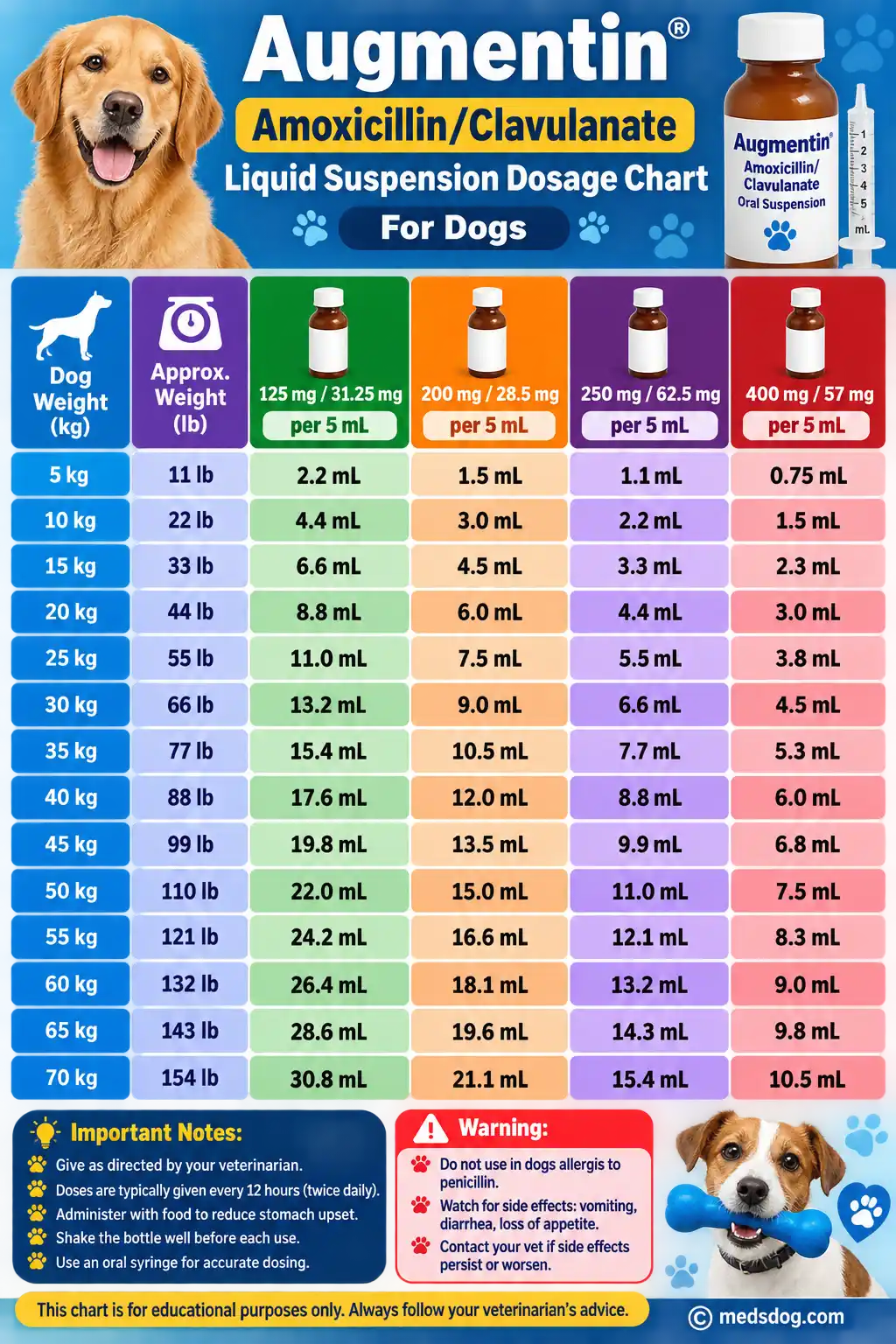
Augmentin® Amoxicillin/Clavulanate Liquid Suspension Dosage Chart
| Dog Weight | Approx. Weight | 125 mg/31.25 mg per 5 mL | 200 mg/28.5 mg per 5 mL | 250 mg/62.5 mg per 5 mL | 400 mg/57 mg per 5 mL |
|---|---|---|---|---|---|
| 5 kg | 11 lb | 2.2 mL | 1.5 mL | 1.1 mL | 0.75 mL |
| 10 kg | 22 lb | 4.4 mL | 3.0 mL | 2.2 mL | 1.5 mL |
| 15 kg | 33 lb | 6.6 mL | 4.5 mL | 3.3 mL | 2.3 mL |
| 20 kg | 44 lb | 8.8 mL | 6.0 mL | 4.4 mL | 3.0 mL |
| 25 kg | 55 lb | 11.0 mL | 7.5 mL | 5.5 mL | 3.8 mL |
| 30 kg | 66 lb | 13.2 mL | 9.0 mL | 6.6 mL | 4.5 mL |
| 35 kg | 77 lb | 15.4 mL | 10.5 mL | 7.7 mL | 5.3 mL |
| 40 kg | 88 lb | 17.6 mL | 12.0 mL | 8.8 mL | 6.0 mL |
| 45 kg | 99 lb | 19.8 mL | 13.5 mL | 9.9 mL | 6.8 mL |
| 50 kg | 110 lb | 22.0 mL | 15.0 mL | 11.0 mL | 7.5 mL |
| 55 kg | 121 lb | 24.2 mL | 16.6 mL | 12.1 mL | 8.3 mL |
| 60 kg | 132 lb | 26.4 mL | 18.1 mL | 13.2 mL | 9.0 mL |
| 65 kg | 143 lb | 28.6 mL | 19.6 mL | 14.3 mL | 9.8 mL |
| 70 kg | 154 lb | 30.8 mL | 21.1 mL | 15.4 mL | 10.5 mL |
Clavamox (Amoxicillin/Clavulanate): 62.5 mg, 125 mg, 250 mg & 375 For Dogs
- Clavamox 62.5 mg for dogs: Fits dogs around 10 lb (4.5 kg). Often split for very small puppies closer to 5 lb.
- Clavamox 125 mg for dogs dosage: Sized for dogs around 20 lb (9 kg). This is one of the most commonly prescribed strengths for small-to-medium breeds.
- Clavamox 250 mg for dogs dosage: Matches dogs around 40 lb (18 kg) a common strength for medium dogs like Beagles or Border Collies.
- Clavamox 375 mg for dogs dosage: Sized for dogs around 60 lb (27 kg), typically used for large breeds such as Labradors or Golden Retrievers.
Amoxicillin/Clavulanate vs. Plain Amoxicillin What’s the Difference?
If you’re comparing “amoxicillin dosage” numbers to “amoxicillin/clavulanate dosage” numbers and they don’t match, that’s expected they are different drugs with different label doses. Plain amoxicillin alone is typically dosed at 5–10 mg/lb, while amoxicillin/clavulanate is dosed at 6.25 mg/lb because the clavulanate component changes the tablet ratio.
Clavulanate is added specifically to overcome bacterial resistance that would otherwise make plain amoxicillin ineffective.
If your vet prescribed plain amoxicillin (no clavulanate) including a 500 mg human-strength tablet split for a large dog use our dedicated amoxicillin dosage chart and calculator instead, since the mg/lb rate and tablet sizes are different from the clavulanate combination covered on this page.
Clavamox vs. Clavacillin vs. Clavet vs. Co-Amoxiclav vs. Augmentin
Amoxicillin/clavulanate is sold under several names, and mixing them up is one of the most common (and riskiest) dosing mistakes pet owners make:
- Clavamox®: The original FDA-approved veterinary brand, 4:1 amoxicillin-to-clavulanate ratio, 6.25 mg/lb (13.75 mg/kg) label dose. This is what the chart above is based on.
- Clavacillin®: A veterinary generic/equivalent to Clavamox, same 4:1 ratio and same 6.25 mg/lb dosage.
- Clavet: A veterinary brand used in some markets outside the U.S., generally formulated at the same 4:1 ratio; always confirm the exact strength on the package, as tablet sizes can vary by country.
- Co-amoxiclav: The international/UK generic name for the amoxicillin-clavulanic acid combination; if your vet or pharmacy uses this term, the dosing principles on this page still apply, but confirm the tablet’s specific mg strength.
- Augmentin®: This is the human formulation, and it is not interchangeable mg-for-mg with the veterinary product. Augmentin comes in different amoxicillin-to-clavulanate ratios (from 2:1 up to 7:1, including the common 875 mg/125 mg human tablet), which is a different concentration of clavulanate than the 4:1 veterinary formula.
- Giving a dog a human 875/125 mg Augmentin tablet using the veterinary mg/lb rate can result in an inaccurate clavulanate dose even if the amoxicillin portion looks correct.
- For a full breakdown of how vets calculate an equivalent human-tablet dose, see our Augmentin dosage guide. Only use human Augmentin for a dog under direct veterinary instruction.
How Amoxicillin/Clavulanate Is Given & What It Treats
Amoxicillin/clavulanate is a broad-spectrum, penicillin-class antibiotic. Amoxicillin kills bacteria by damaging their cell walls; clavulanate potassium blocks the beta-lactamase enzyme that resistant bacteria use to inactivate amoxicillin.
Together, they treat infections that plain amoxicillin often can’t clear on its own.
Veterinarians frequently prescribe amoxicillin/clavulanate for:
- Dermatitis due to bacterial infections of the skin.
- Soft tissue infections, wounds and abscesses.
- Dental infections and periodontal (gum) disease are among the most common dental problems.
- Some UTIs and RTIs in off-label situations
This drug comes in tablet, chewable tablet, and oral suspension forms. Typically it is administered orally on a 12-hour basis and should be administered throughout the entire period prescribed by your veterinarian. Amoxicillin/clavulanate can be administered with or without meals, but may be administered with a small meal or treat to help dogs tolerate it better.
When administering the liquid form, shake prior to each dose, and carefully measure the dose using the provided syringe or dropper. Pet owners should always take veterinarian’s advice, and tell their veterinarian if their dog is on any other medications or supplements — and never stop early unless instructed to do so.
Amoxicillin & clavulanate dosage for dogs works against bacterial infections, but not against viral or parasitic infections. Flavored chewable tablets should also be kept safe from pets and children to avoid accidental intake or overdose.
What Are the Benefits of Amoxicillin/Clavulanate for Dogs?
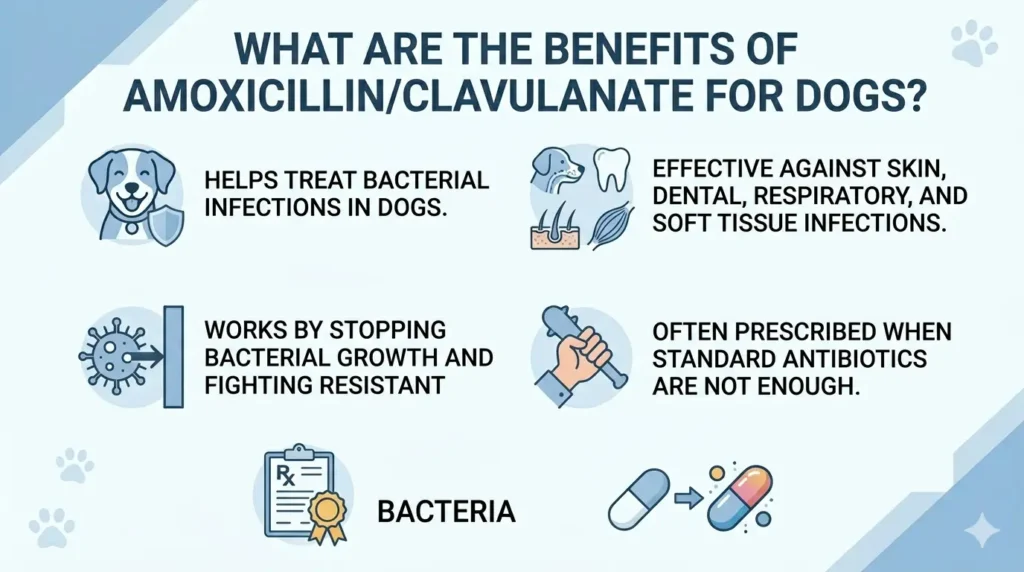
When used to treat bacterial infections susceptible to the drug, Amoxicillin/clavulanate has several benefits for dogs. It is a broad-spectrum antibiotic that can be used to treat a variety of common infections of skin, soft tissues, gums, and other areas of the body. The clavulanic acid in Amoxyl combines with the amoxicillin to make it more effective against certain bacteria.
Some key benefits of amoxicillin/clavulanate for dogs include:
- Works on the majority of common bacterial infections in dogs
- Approved for use in animals in dogs by FDA
- Formulated in several different forms such as tablet, chewable tablet, or liquid suspensions for easier administration.
- Starts to work relatively fast, within about 1-2 hours of administration
- Helps overcome some bacterial resistance to increase treatment success
Amoxicillin/clavulanate is a commonly used antibiotic in veterinary medicine due to its proven efficacy, ease of administration, and wide spectrum of activity.
Does Amoxicillin/Clavulanate Have Warnings or Side Effects?
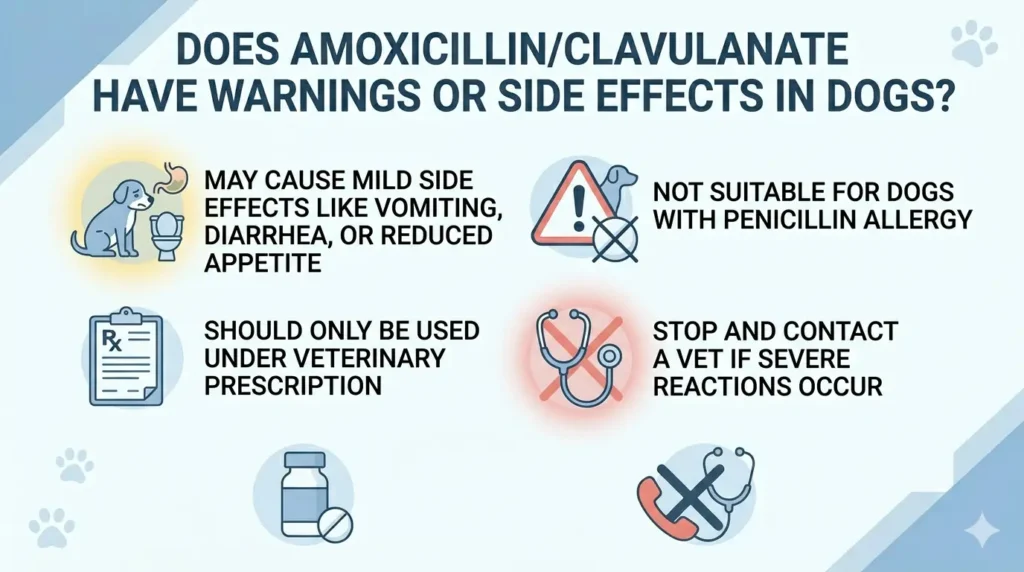
Yes. Amoxicillin/clavulanate (Clavamox®) is generally safe and effective when prescribed by a veterinarian, but may have side-effects and may not be suitable for every pet. Side effects are typically mild and involve the gastrointestinal tract; however, there are rare reports of serious side effects.
Common Side Effects
The most common side effects are:
- Vomiting
- Loose stools or diarrhea
- Loss of appetite or not eating as much as usual
These effects are often due to changes in the normal balance of bacteria in the gut caused by the antibiotics. Administration with food may help some dogs to avoid stomach upset and vomiting.
The risks of serious allergic reactions and serious risks.
Amoxicillin/clavulanate’s most severe danger is that of an allergic reaction. Do not use in pets that are known to be allergic to amoxicillin, penicillin, cephalosporins or similar antibiotics.
An allergic reaction can result in:
- A rash or rashes on the skin around the ears
- Hives (urticaria)
- Watery eyes
- Facial swelling
- Fever
- Changes in white blood cell counts
- Anemia
- Severe allergic reaction (anaphylaxis)
If your dog does develop any of these symptoms, seek emergency veterinary help immediately:
- Difficulty breathing
- Face, lip or tongue swelling
- Hives
- Collapse
Other Warnings and Precautions
As safety in breeding or pregnant animals has not been fully established, use amoxicillin/clavulanate with caution in pregnant or nursing animals. The medication can also interact with other medications, such as chloramphenicol and tetracycline, so your veterinarian needs to know if your dog is taking other medications, or supplements.
This medication is for use in dogs and cats and is not recommended to be used in rabbits, guinea pigs, chinchillas, gerbils, hamsters or other herbivores, as it may result in severe potentially life-threatening diarrhoea.
The need to understand overdose and antibiotic resistance.
Too much amoxicillin/clavulanate may cause serious health issues such as central nervous system and liver effects. If you think your pet may have suffered an overdose, get your vet’s advice or go to a veterinary emergency service right away.
The emergence of antibiotic resistant infections is another issue as these infections can develop when antibiotics are used inappropriately or when they are overused. As such, amoxicillin/clavulanate should be used to treat only bacterial infections that are suitable, and as directed by a veterinarian.
If your dog has any strange reactions to amoxicillin/clavulanate, please notify your veterinarian as soon as possible. Depending on the severity of your dog’s reaction, your vet may prescribe some symptom management, a probiotic for intestinal health and/or an alternative antibiotic.
Does Amoxicillin/Clavulanate Interact With Other Medicines?
Yes. Some medicines may interact with amoxicillin/clavulanate (Clavamox®), which may have an impact on the way they work or the risk of side effects. Prior to beginning treatment, pet owners should discuss with their veterinarian any prescription, over-the-counter, vitamin, mineral, herbal remedies or supplements that their dog is taking.
Some of the key drug-drug interactions are:
- Amoxicillin/clavulanic acid may not work as well with other antibiotics like chloramphenicol, erythromycin, sulfonamides, and tetracyclines that are used at the same time. This can affect the effectiveness of treatment, or the side effects of treatment, or can make the infection last longer.
- Amoxicillin/ clavulanic acid may interact with a drug known as methotrexate, which is used for treating some kinds of cancer and immune-related conditions and can cause toxic levels of the drug, which in turn can result in serious effects if given with amoxicillin/ clavulanic acid.
- Use of amoxicillin/clavulanate may also interact with the use of the immunosuppressive drug mycophenolate and should be discussed with your veterinarian.
- When amoxicillin/clavulanate is used together with warfarin (a blood thinning drug), these drugs may make excessive or serious bleeding more likely.
There may be other drug interactions that are not known or listed, so please ask your veterinarian before using amoxicillin/clavulanate with other medications. A careful review of your dog’s ongoing treatment can prevent any problems and ensure that the antibiotic will be safe and effective.
Alternative Antibiotics Your Vet May Consider
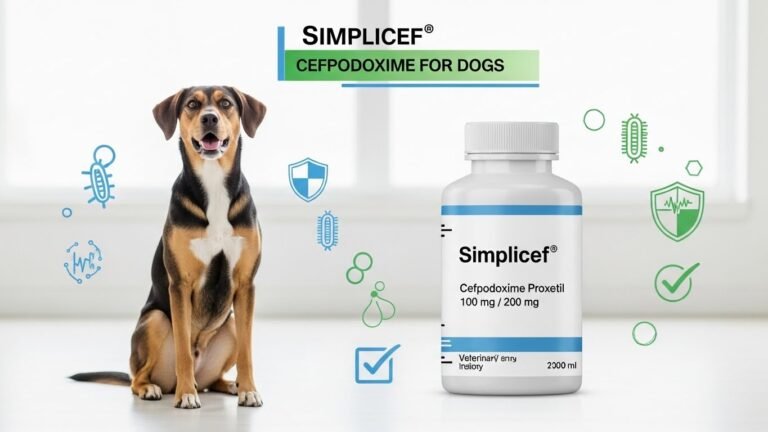
If amoxicillin + clavulanate isn’t the right fit for your dog’s infection (resistance, allergy, or a different bacterial target), your veterinarian may prescribe a different antibiotic class instead. For reference, we also cover dosing for:
- Cephalexin for canines infections a first-generation cephalosporin, often used for similar skin infections
- Doxycycline commonly used for tick-borne and respiratory infections
- Trimethoprim-sulfa (Bactrim) an alternative for some UTIs and resistant infections
- Clavamox if your prescription specifically names the Clavamox brand and you want brand-specific tablet sizing
FAQs
If my dog overdoses on Amoxicillin/Clavulanate what should I do?
Overdose can be serious and should be treated by a vet. Chewable tablets can be appealing to dogs and cats and if left unattended, they can be eaten several times. If you believe that your pet has ingested more than the recommended dose, please contact your vet or emergency vets immediately.
What If I Miss a Dose?
In case of a missed dose, administer as soon as possible or if close to the scheduled dose, skip the missed dose. If it is close to the time of the next dose, skip the missed dose and resume with the next dose as scheduled. Do not give two doses at the same time, or double doses to make up for missed doses. Follow the complete treatment program as recommended by your veterinarian.
What Are the Instructions for Storage of Amoxicillin/Clavulanate?
Tablets and chewable tablets should be stored at room temperature in a cool, dry place out of direct light, heat and moisture. Store the medicine in the original container until it needs to be given, as the medicine may not be as stable or effective if exposed to moisture. As much as possible the container should be kept closed. Oral suspension (liquid) must be refrigerated after being mixed. If some medicine is left, it must be thrown away after 10 days.
Can I Take the Tablets out of the Blister Packaging Sooner?
No. Tablets should still be in the original foil until they are ready for use. The early removal of them may impact the stability and efficiency of the medication.
Are Amoxicillin/Clavulanate Tablets given as half-tables full?
The tablets of Clavamox® are not scored and are not meant to be divided. If it is necessary to split the tablet, following your veterinarian’s instructions, the unused portion must be disposed of according to the directions on the product and not kept for long periods of time out of the container.
What If the Liquid Suspension Was Left out of the refrigerator?
After preparing, the liquid suspension must be stored in the refrigerator. If it is not used for a long time, or if there are changes in color or smell, please consult with your veterinarian or pharmacist before using.
May the Liquid Suspension be Frozen?
No. The oral suspension may be affected by the freezing and may not work. Never put the liquid medicine in the freezer.
In how much time Amoxicillin Clavulanate start work in dogs.
Amoxicillin/clavulanate starts to work in a few hours after it is given. But it may take a few days to see a noticeable improvement in your dog’s symptoms, and some infections take up to 5 days to see the clinical improvement. Do not stop giving the medicine, even if your dog seems to be feeling better.
References
- U.S. FDA / DailyMed Clavamox® and Clavacillin® approved drug labels
- MSD Veterinary ManualDosages of Antistaphylococcal Antimicrobials; Antibacterials for Integumentary Disease in Animals
- Papich, M.G. Papich Handbook of Veterinary Pharmacology
- Peer-reviewed veterinary UTI dosing trial (amoxicillin-clavulanic acid 13.75–25 mg/kg PO q12h protocol)