BPC-157 Dosage Calculator For Dogs By Weight
For dogs only. Based on research protocols of 2-10 mcg/kg.
Daily Injection Volume
– –© medsdog.com
It is understandable when you find yourself seeking better alternatives other than just managing the symptoms. Numerous owners of pets attempt good diets, supplements, pain killers, physical therapy, and the regular treatment regimens-and yet, some dogs appear to be stuck. That is why increasing interest is shifting towards regenerative support, and one of the most discussed ones is BPC-157 dose for dogs.
BPC-157 Dosage For Dogs (Body Protection Compound-157) is a synthetic peptide prepared as a sequence of a protective protein that was originally attached to gastric juice. It includes 15 amino acids and has initially been studied in gut healing, although recent studies have explored its potential to aid in tendon repair, ligament repair, joint pain, inflammatory processes, tissue healing, and overall recovery.


Paid Links - As an Amazon Associate, I earn from qualifying purchases.
Due to these potential advantages, BPC-157 medication for dogs has now become an issue of concern among integrative veterinarians, holistic pet owners, and those seeking to explore advanced wellness approaches to aging or active dogs.
Nevertheless, BPC-157 is not yet a household drug and is still investigational in veterinary medicine. It has been found that research has mostly been conducted on the animals and little evidence has been found on the canine itself, thus it should never be used in place of professional veterinary care. Especially, proper guidance is necessary since the dose of BPC-157 dosage for pets used to treat dogs may vary depending on the body weight, health condition, treatment objective, and delivery route.
You will find in this comprehensive guide what BPC-157 dosage is, how it might work, the potential benefits it may provide to dogs, safety considerations, side effects, dosage considerations and what every responsible dog owner should know before trying it.
Disclaimer: This guide is for informational purposes only and is not a substitute for professional veterinary advice. Always consult your veterinarian before giving BPC-157 or any medication to your dog.
Explore TB-500 peptide For Dogs Calculator & Guide
Key Takeaways
- BPC-157 (Body Protection Compound-157) is a synthetic peptide with research in the gut healing area, tissue repair, inflammation support, and recovery in animals.
- The use of BPC-157 dosage in dogs is increasing among pets owners that seek to support joint pain, ligament injuries, arthritis, digestive problems, and slow healing.
- It might have potential benefits, such as increased mobility, faster recovery, decreased discomfort, and improved overall wellness, but additional canine-specific research is yet to be performed.
- BPC-157 is still in experimental stages in veterinary medicine, and is not recognized as a standard approved treatment to dogs.
- The dosage may be different depending on the weight of your dog, its condition, its severity and the mode of administration (oral or injection).
- Administering an incorrect dosage can lead to exposure to side effects, or lessen efficacy.
- Side effects might include stomach upset, drowsiness, loss or gain of appetite, or irritation of the injection site.
- Never administer BPC-157 for dogs dosage, or alter the treatment regimen of your dog, without consulting a licensed veterinarian.
BPC-157 Dosage Chart For Dogs By Weight
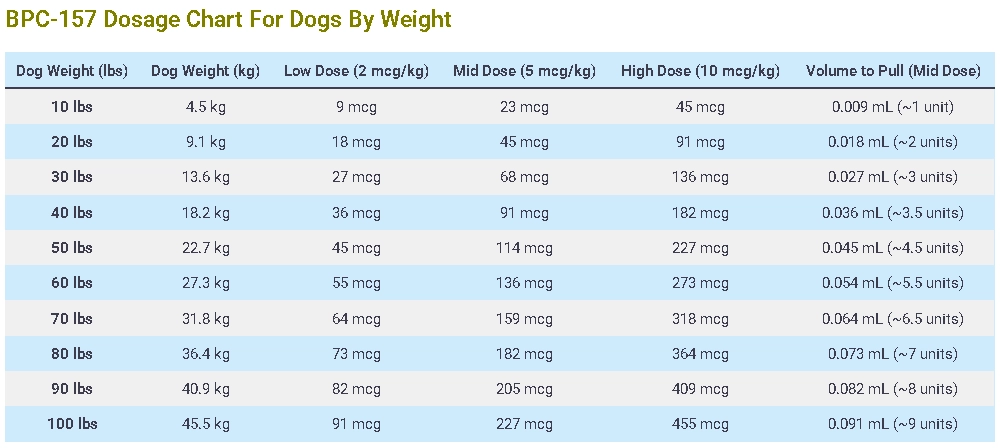
Below is a comprehensive dosage reference table based on the research protocols provided (2, 5, and 10 mcg/kg).
This table assumes a standard reconstitution of a 5 mg vial with 2 mL of bacteriostatic water, resulting in a concentration of 2,500 mcg/mL (250 mcg per 0.1 mL).
| Dog Weight (lbs) | Dog Weight (kg) | Low Dose (2 mcg/kg) | Mid Dose (5 mcg/kg) | High Dose (10 mcg/kg) | Volume to Pull (Mid Dose) |
| 10 lbs | 4.5 kg | 9 mcg | 23 mcg | 45 mcg | 0.009 mL (~1 unit) |
| 20 lbs | 9.1 kg | 18 mcg | 45 mcg | 91 mcg | 0.018 mL (~2 units) |
| 30 lbs | 13.6 kg | 27 mcg | 68 mcg | 136 mcg | 0.027 mL (~3 units) |
| 40 lbs | 18.2 kg | 36 mcg | 91 mcg | 182 mcg | 0.036 mL (~3.5 units) |
| 50 lbs | 22.7 kg | 45 mcg | 114 mcg | 227 mcg | 0.045 mL (~4.5 units) |
| 60 lbs | 27.3 kg | 55 mcg | 136 mcg | 273 mcg | 0.054 mL (~5.5 units) |
| 70 lbs | 31.8 kg | 64 mcg | 159 mcg | 318 mcg | 0.064 mL (~6.5 units) |
| 80 lbs | 36.4 kg | 73 mcg | 182 mcg | 364 mcg | 0.073 mL (~7 units) |
| 90 lbs | 40.9 kg | 82 mcg | 205 mcg | 409 mcg | 0.082 mL (~8 units) |
| 100 lbs | 45.5 kg | 91 mcg | 227 mcg | 455 mcg | 0.091 mL (~9 units) |
Understanding the Doses
- Low Dose (2 mcg/kg): Often used for maintenance, mild systemic inflammation, or supporting gut health.
- Mid Dose (5 mcg/kg): The most common "starting point" for moderate joint pain, soft tissue repair, or post-surgical healing.
- High Dose (10 mcg/kg): Typically reserved for acute/severe injuries or advanced orthopedic conditions. This level should be closely monitored by a veterinarian.
Administration Key
- The "Unit" Math: Calculations above use a standard U-100 Insulin Syringe.
- 1 unit = 0.01mL
- 10 units = 0.1mL
- Storage: Keep the reconstituted peptide in the refrigerator. Avoid shaking the vial, as peptides are fragile proteins; instead, gently swirl to mix.
- Sterility: Always wipe the rubber stopper with an alcohol prep pad before each draw to prevent contamination.
What is BPC-157 Dosage For Dogs?
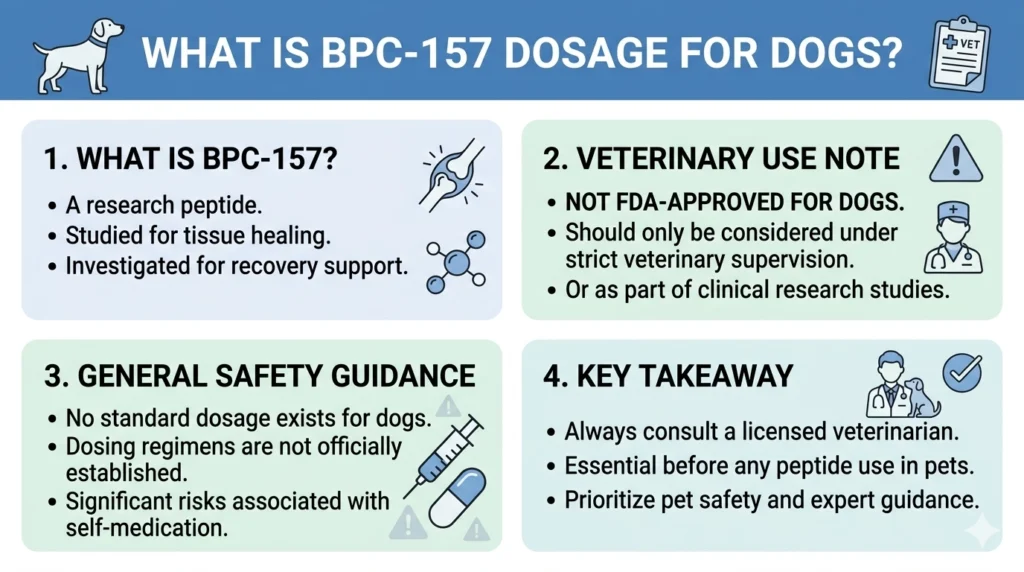
BPC-157 (Body Protection Compound-157) is a synthetic peptide made of 15 amino acids (a pentadecapeptide) derived from a protective protein naturally found in gastric juice and the stomach lining. Since its discovery, due to its role in the protection and repair of the gastrointestinal tract, BPC-157 dosage for dogs has recently drawn attention regarding its wider regenerative and healing-support properties.
Studies, primarily in rodent and animal models, indicate that BPC-157 dosage can contribute to the natural healing processes in the body by promoting tissue repair, angiogenesis (new blood vessel growth), collagen production, and regulation of inflammation. Such interventions could enhance the supply of oxygen and nutrients to injured tissues and recover.
Due to these characteristics, BPC-157 has been evaluated in terms of its potential to aid in:
- Gut lining and intestinal healing
- Repairs of tendon and ligament.
- Muscle recovery
- Joint support
- Neurotransmitter modulation and regeneration of nerves.
- Wound healing
- Immune regulation
- Kidney support and liver support.
Stability in stomach acid is also a unique property of BPC-157, which makes it possible to develop oral forms of the drug, although injectable ones are often considered more effective in specific applications.
BPC-157 for dogs is also referred to as a healing accelerator due to its ability to improve the natural repair systems. It has gained popularity as a regenerative wellness and integrative veterinary medicine to treat conditions such as chronic inflammation, delayed healing, orthopedic injuries, digestive issues, and recovery support. But there is still little clinical research in dogs, and the use in a veterinary practice is still regarded as an investigational/off-label use.
How Does BPC-157 Work?
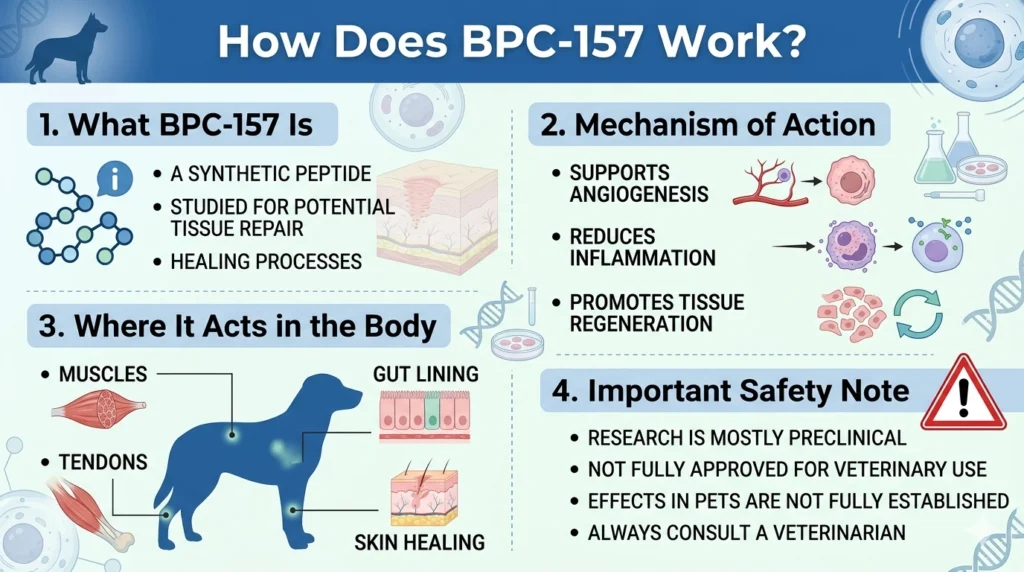
BPC-157 dosage for dogs acts by assisting the normal healing mechanisms in the body rather than simply suppressing symptoms. It can aid in healing of damaged tissues, enhance recovery and control inflammation via various pathways.
Principal Possible mechanisms of action of BPC-157.
- Stimulates blood flow: Stimulates the growth of new blood vessels (angiogenesis) to supply oxygen and nutrients to damaged tissues.
- Helps heal the tissues: Could accelerate the healing of the lining of the gut, skin, muscles, tendons, ligaments, and joints.
- Promotes collagen production: Helps strengthen connective tissues such as tendons, cartilage, and skin.
- Decreases inflammation: Can suppress chronic inflammatory cues without suppressing immune function strongly.
- Protects nerve health: May be beneficial in protecting nerve cells and help the regeneration process.
- Guard organs: Studies indicate potential protection against damage associated with stress, toxins or use of NSAIDs.
Why It’s Popular
Since BPC-157 for pets can potentially act on several systems simultaneously, it is often referred to as a systemic healing peptide, and has been studied as a general recovery support.


Paid Links - As an Amazon Associate, I earn from qualifying purchases.
General Areas of concern.
- Gastrointestinal problems such as gut inflammation.
- Osteoarthritis and joint pain.
- Injuries to tendons or ligaments.
- Slow wound healing and irritation of the skin.
- Mobility support and nerve recovery.
Potential Benefits of BPC-157 for Dogs
BPC-157 in dogs is undergoing publicity due to its potential to provide healing, recovery and wellness in dogs. Although research specific to the dog is yet to be conducted, animal studies have shown that there are a number of possible benefits.
Key Potential Benefits
- Joint Pain & Arthritis Support: Could be used to decrease the inflammation, swelling, stiffness, and discomfort in dogs with osteoarthritis or other age-related complications.
- Tendon and Ligament Healing: May be used to support the healing of the connective tissue injuries, including cruciate ligament (ACL/CCL) tears, Achilles strain, and patellar instability.
- Cartilage and Tissue Repair: Has been studied to promote the healing of tendons, ligaments, cartilage, muscles, wounds, and surgical incisions.
- Reduced Injury Recovery: Could reduce recovery time following injury, surgery, or physical exertion.
- Pain Relief Support: There are reports of less discomfort with no immune suppression that is associated with some medications.
- Nerve & Spinal Health: Shows potential protective benefit on nerve tissue and may be of benefit with nerve compression, spinal injury, or intervertebral disc conditions.
- Gastrointestinal Health: Can be used to support the integrity of the gut lining and dogs with IBD, leaky gut or chronic digestive inflammation.
- Healthy Aging Support: Healthy aging support can help maintain the mobility, activity levels, and quality of life in old dogs by supporting their joints and connective tissues.
- Systemic Healing: Can be used to control inflammation and help the body heal as a whole.
Important Note
The majority of evidence is based on animal studies and limited veterinary use and further dog specific clinical research is required to verify these advantages.
BPC-157 Dosage and Administration for Dogs
The dosage of BPC-157 used in dogs is not FDA-approved, and there are no formal guidelines on the use of BPC-157 in dogs. Present practice is informed by animal studies, off-label veterinary guidelines, and clinical experience, thus treatment must be under veterinary guidance, always.
Common Dosing Range
A range of 2-10 mcg/kg /day of body weight is commonly cited as an off-label range, based on the size, condition, and treatment objective of the dog.
- Low dose: Mild inflammation, early arthritis, preventive support.
- Mid dose: Moderate pains in the joints, post surgery, chronic problems.
- High dose: severe injuries or serious arthritis (only under the supervision of a veterinarian)
Capsule-based protocols also make use of:
- Dogs more than 75 lbs: 500 mcg per day to twice per day.
- Dogs 50–75 lbs: 500 mcg daily
- Small dogs: Decreasing pet-specific dosing under veterinary advice.
The route of administration of BPC-157.
- Subcutaneous Injection: Under the skin; often viewed as the best way of injuring the body or using generically.
- Orally: Capsules, sprays, drops, or combined with food; convenient and often used in support of the digestive system or as general support.
- Topical Forms: Research has been done on the use of topical forms in the healing of wounds, although further research is necessary.
- Food Topper: There are certain types of pet formulations that can be more easily used on a daily basis.
Typical Treatment Cycles
- Acute injuries: 2 to 4 weeks are common.
- Chronic conditions: Can be both prolonged and repeated depending on their response.
- There are some long-term protocols with 30 days on, 1 week-off to ensure effectiveness.
Important Administration Tips
- Begin on a small dose and observe reaction.
- Slower dose increments may be required with sensitive pets.
- Dosage varies based on body weight, severity, route of administration, and veterinary recommendations.
- Never use BPC-157 to treat dogs without consulting a veterinarian.
When NOT to Use BPC-157 for Dogs
BPC-157 for dogs dosage is unlikely to be suitable to all dogs, but it might have a potential benefit. Since it is still experimental and has not yet been approved of veterinary use, care must be taken.
Conditions in which BPC-157 dosage for dogs by weight might not be prescribed.
- Cancerous or at risk of cancer dogs: Due to the possibility of promoting the growth of blood vessels (angiogenesis) in pets with tumors or at risk of cancer, BPC-157 may not be the best choice.
- Healthy young dogs with no medical conditions: It is not usually aimed at pets that have no long-term problems and do not have injuries or other recovery requirements.
- Sensitive pets may respond more to the introduction of digestive health and core wellness when the pets are of highly sensitive nature.
- Unsupervised use: BPC-157 is not to be used without the advice of a qualified veterinarian.
Safety Considerations
- Usually well-tolerated in research studies.
- No significant toxicity indicators reported during the preclinical trials.
- Does not seem to have a major effect on immune functioning.
Important Reminder
Clinical trials on animal BPC-157 use are still in large-scale, so it is highly recommended that professional veterinary supervision be conducted before administering BPC-157 to dogs.
BPC-157 Safety and Side Effects for Dogs
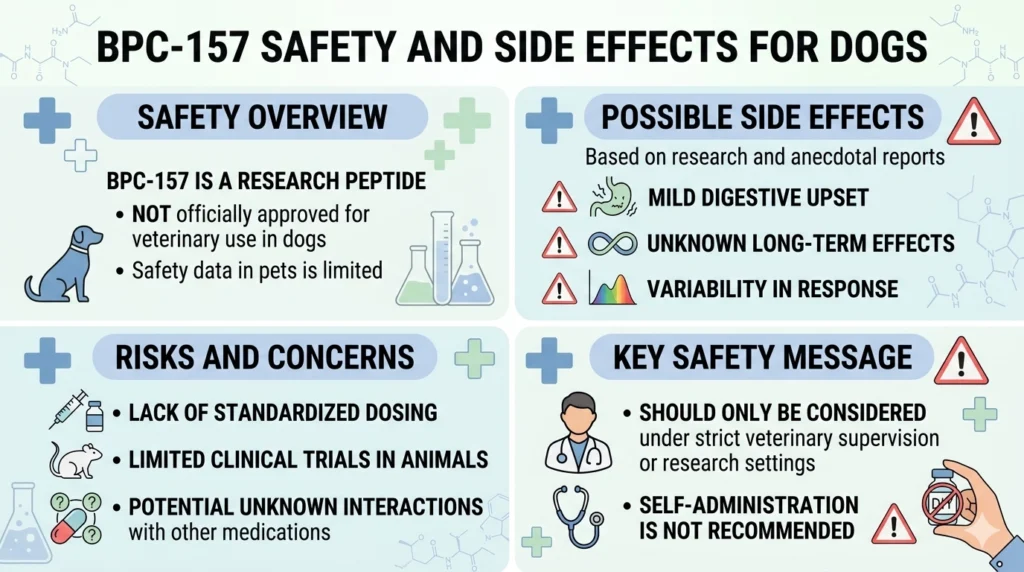
In early studies and in animal models, BPC-157 has demonstrated an overall good safety profile, although the long-term effects are still not well known. In veterinary off-label use, most dogs seem to respond well to it when appropriately dosed and monitored.
Reported Side Effects (Typically Rare and Mild)
- Temporary lethargy or slight fatigue.
- Swelling, redness, or irritation of injection site.
- Light stomach discomfort or nausea.
- Temporary headache or dizziness (reported with limited human use)
Safety Considerations
- None of the significant toxicity indicators were reported in the preclinical tests.
- Does not seem to have a significant inhibitory effect on immune activities.
- No serious organ effects have been noted in initial studies.
- The injectable forms can have less digestive problems than the oral forms.
Important Cautions
- Dogs with active cancer: Due to the potential to stimulate cell growth and the growth of blood vessels, many veterinarians do not use BPC-157 in sick pets with known cancer or risk of having a tumor.
- Not FDA-approved as veterinary use: There are no official canine dosing, product quality, and monitoring standards that are approved by the FDA.
- There are not a lot of long-term data: Additional studies are necessary to ensure the safety of long-term use.
Best Practices
- Only used under the supervision of the veterinary.
- Obtain sources in pharmaceutical-grade pharmacies with good reputations.
- Keep a close watch on your dog to note any abnormal responses when using it.
You May Also Like to Read:
- Lasix Dosage For Dogs Calculator: Safe Dosage Chart & Guide
- Augmentin Dosage For Dogs Calculator, Chart & Safe Guide
FAQs
What is BPC-157?
BPC-157 (Body Protection Compound-157) is an artificial peptide composed of 15 amino acids, based on a natural protein that is present in the stomach, and that is studied due to its healing and regenerative effects.
Is it safe to use BPC-157 for dogs?
Off-label veterinary use and animal studies indicate that it is in general well tolerated, although it is not FDA approved for dogs, and should only be used under veterinary supervision.
What can BPC-157 be used to treat in dogs?
It is typically used to treat joint pain, arthritis, ligament and tendon injuries, post-surgical recovery, nerve problems, and digestive issues such as IBD or leaky gut.
How is BPC-157 given to dogs?
Depending on the treatment objective, it can be administered through subcutaneous injections, oral capsules or drops, food-derived, or topical application.
How much should we feed the dogs?
There is no official dosing guideline. The 2-10 mcg per kg of body weight per day, which is adjusted by a veterinarian, is used in off-label protocols.
What is the time it takes to realize results?
It can be improved within 1-2 weeks, whereas some chronic diseases, such as arthritis or tissue regeneration, can require 4-6 weeks or more.
Is it possible to use BPC-157 together with other supplements?
Yes, it is usually used together with joint supplements such as glucosamine, chondroitin, omega-3s and pain management plans, though only under the guidance of veterinarians.
Does BPC-157 have any side effects in dogs?
Side effects are uncommon but may include mild lethargy, digestive discomfort or injection site irritation. It is typically thought to be well tolerated in animal research.
Final Thoughts
One of more promising regenerative tools under investigation in the field of holistic and integrative veterinary medicine is the BPC-157 dosage for dogs. It is not a magic bullet and it will not do away with surgery or fix structural issues such as bone-on-bone arthritis, or reverse severe deformities.
Still, when dealing with dogs that cannot be handled with with the help of standard medications, when facing slow-healing wounds, inflammatory diseases, and cases that could not respond well to the traditional medicines, it is still an interesting option, which needs to be carefully considered.
Its potential is in a real biological effect involving tissue repair, control of inflammation, development of blood vessels, as well as in a general positive safety profile observed in animal studies and off-label use.
Although large-scale clinical trials in dogs are yet to be done, similar anecdotal reports using the drug in dogs have been consistent and suggest potential benefits when used correctly.
With that said, BPC-157 is most effective when administered in combination with other drugs. It is most likely to be effective when it is a part of a broader health strategy which involves gut support, balanced nutrition, weight management, appropriate exercise, and overall inflammation control. In the absence of these bases, the outcome might be minimal.
Guesswork is not the safest method and more effective. It includes collaboration with a veterinarian who is well versed in the field of integrative medicine, proper dosing advice, sourcing in the reputable compounding pharmacies, and keeping a close observation of the response of your dog.
Finally, BPC-157 is most likely to be considered as an adjunctive treatment, not a one-size-fits-all treatment, but rather a part of a comprehensive wellness program designed to help improve mobility, comfort, and quality of life, particularly in aging or recovering dogs.