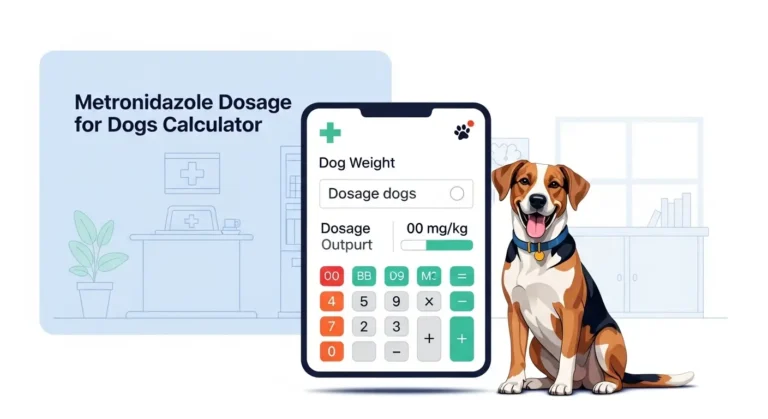
Nitrofurantoin Dosage Calculator for Dogs
Calculates Nitrofurantoin Dosage for Dogs based on the standard canine dosage of 4.4 mg/kg administered orally every 8 hours.
Dosage Results
Dose per administration
—
Frequency
—
Total daily dose
—
Course length
—
This calculation uses the standard extralabel canine dosage of 4.4 mg/kg PO every 8 hours. A published case series of 14 dogs treated for recurrent urinary tract infection used a comparable median dosage of 4.3 mg/kg PO every 8 hours for 14 days, with 12 of 14 dogs achieving a successful outcome.
- Nitrofurantoin is used in an extralabel (off-label) manner in dogs and should only be given under veterinary supervision.
- Watch for nausea, vomiting, or diarrhea, which are the most common adverse effects.
- Dogs with decreased kidney function are more prone to nerve-related side effects and may need dose adjustment.
- Do not use in animals hypersensitive to nitrofurantoin or with significant renal impairment without veterinary guidance.
- Yellow discoloration of teeth has occasionally been reported in very young dogs.
- This tool does not replace professional veterinary judgment. Always confirm dosing with a licensed veterinarian before administration.
© medsdog.com


Paid Links - As an Amazon Associate, I earn from qualifying purchases.
If your vet just prescribed your dog a product called nitrofurantoin to treat his urinary tract infection, you probably have one pressing question: How much do I actually give and how often? It’s answered right here, in the first few lines, and they take you through all the other information you want to know: dosing by weight, a printable chart, side effects, drug interactions, and what to do if you miss a dose.
Quick answer: The recommended dose of nitrofurantoin for dogs is 4.4 mg/kg PO q8; course of treatment should last for 4-10 days, as recommended by your veterinarian. This is an off-label (extralabel) use of the drug in dogs – that is, Nitrofurantoin Dosage isn’t FDA-approved particularly for use on a dogs, but it is a common practice in small animal medicine when other antibiotics have proven ineffective.
All of the following elaborates on that answer. Nothing here can take the place of a discussion with your veterinarian, but this is the information to have ready when following their advice.
What Is Nitrofurantoin?
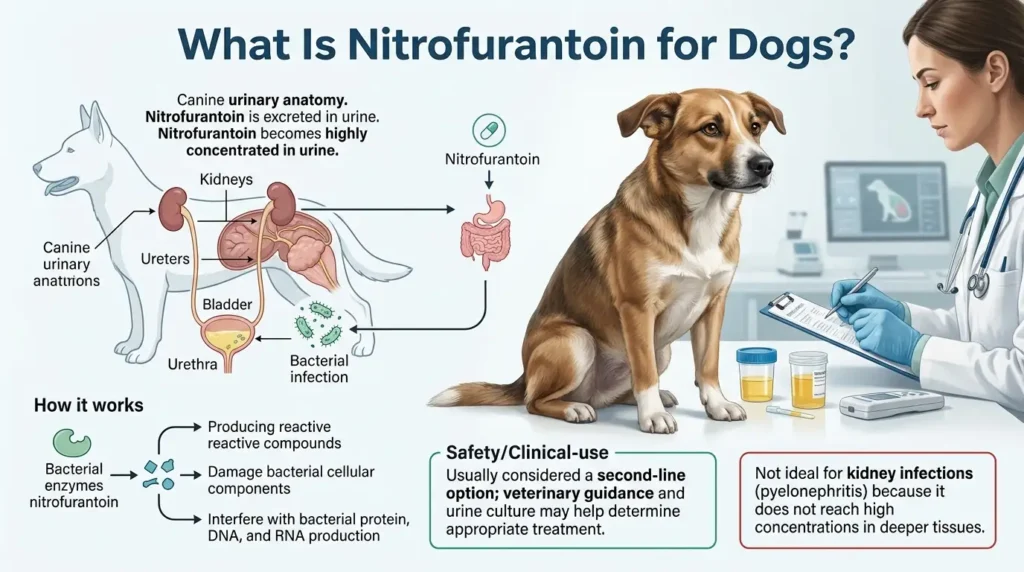
Nitrofurantoin Dosage For Dogs is an antibiotic that is used to treat bladder and urinary tract infections in dogs caused by bacteria. It is an example of a group of drugs known as the nitrofurans and it is not like most antibiotics, which fight bacteria by binding to the ribosome, instead, it is converted into active compounds by enzymes in bacteria that damage the ribosome and prevent the bacteria from producing proteins, DNA, and RNA. It is actually bactericidal in urine (at the concentration it reaches there) and not just bacteriostatic.
Nitrofurantoin dog dosage is usually used as a second-line treatment – that is, the drug is used only when a more widely used antibiotic fails to clear an infection or when a urine culture shows that the bacteria are resistant to the antibiotic. Highly effective against E. coli, Staphylococcus aureus and Streptococcus spp., but ineffective against Proteus, Pseudomonas aeruginosa and Streptococcus faecalis.
One peculiar characteristic that makes nitrofurantoin effective for UTIs in particular is that it does not get into the bloodstream or other tissues very well but gets very concentrated in the urine due to its excretion by the kidneys.
That is where an antibiotic should target a bladder infection – and it can also mean that nitrofurantoin may not be the best choice for infections that have advanced beyond the bladder (such as pyelonephritis or a kidney infection) because it does not achieve high levels in other tissues.
What is Nitrofurantoin Dosage for Dogs
Standard Dosing Formula
To Calculate the Nitrofurantoin Dosage for dogs use this Standard Formula.
4.4 mg/kg body weight, PO (by mouth), every 8 hours, for 4–10 daysThis is about 3 doses a day, spaced approximately 8 hours apart, such as at 7 a.m., 3 p.m., and 11 p.m.; it is important that there is a consistent spacing rather than exact times, due to the rapid clearance of the drug from circulation (half-life of about 20 minutes).
To calculate your dog’s dose:
- Convert your dog’s weight to kilograms if you only have pounds (divide pounds by 2.2).
- Multiply that number by 4.4 to get the milligrams per dose.
- administer that amount three times a day, 8 hours apart or more.
Example: A 22-lb dog weighs 10 kg. 10 kg × 4.4 mg/kg = 44 mg per dose, given three times daily (132 mg total per day).
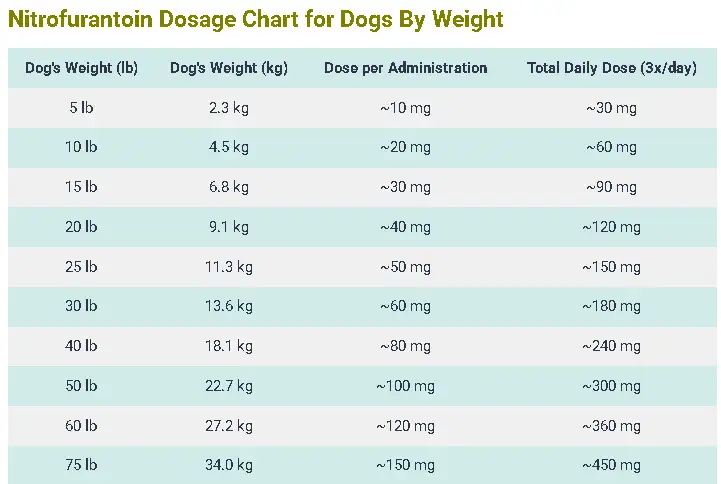
Nitrofurantoin Dosage Chart for Dogs By Weight
| Dog’s Weight (lb) | Dog’s Weight (kg) | Dose per Administration | Total Daily Dose (3x/day) |
| 5 lb | 2.3 kg | ~10 mg | ~30 mg |
| 10 lb | 4.5 kg | ~20 mg | ~60 mg |
| 15 lb | 6.8 kg | ~30 mg | ~90 mg |
| 20 lb | 9.1 kg | ~40 mg | ~120 mg |
| 25 lb | 11.3 kg | ~50 mg | ~150 mg |
| 30 lb | 13.6 kg | ~60 mg | ~180 mg |
| 40 lb | 18.1 kg | ~80 mg | ~240 mg |
| 50 lb | 22.7 kg | ~100 mg | ~300 mg |
| 60 lb | 27.2 kg | ~120 mg | ~360 mg |
| 75 lb | 34.0 kg | ~150 mg | ~450 mg |
| 90 lb | 40.8 kg | ~180 mg | ~540 mg |
| 100 lb | 45.4 kg | ~200 mg | ~600 mg |
Numbers have been rounded to the nearest 10 mg for ease of reading. Always check with your veterinarian or pharmacist, as available capsules are often available in fixed strengths (25mg, 50mg, 100 mg are common) so you may need to round up to the nearest strength or get a compounded, liquid suspension for accurate dosing in a small dog.
How Long Does Treatment Last?
The average course of treatment is 4 to 10 days depending on the severity of the infection and the response of your dog, but this will be determined by your veterinarian. A published case series of 14 dogs with UTIs treated with a slightly longer course (4.3 mg/kg q 8 hours for 14 days) had 12 of 14 dogs with a good outcome (either no bacteria detected or the infection was cleared).
The two who failed treatment were not caused by the failure of the drug at the therapeutic dose, but were due to bacterial resistance that developed while on the drug.
The bottom line: Don’t stop the complete course your vet prescribes, even if your dog appears fine after a couple days. One of the most frequent ways resistant bacteria become established is by stopping treatment early.
How to Give Nitrofurantoin to Your Dog
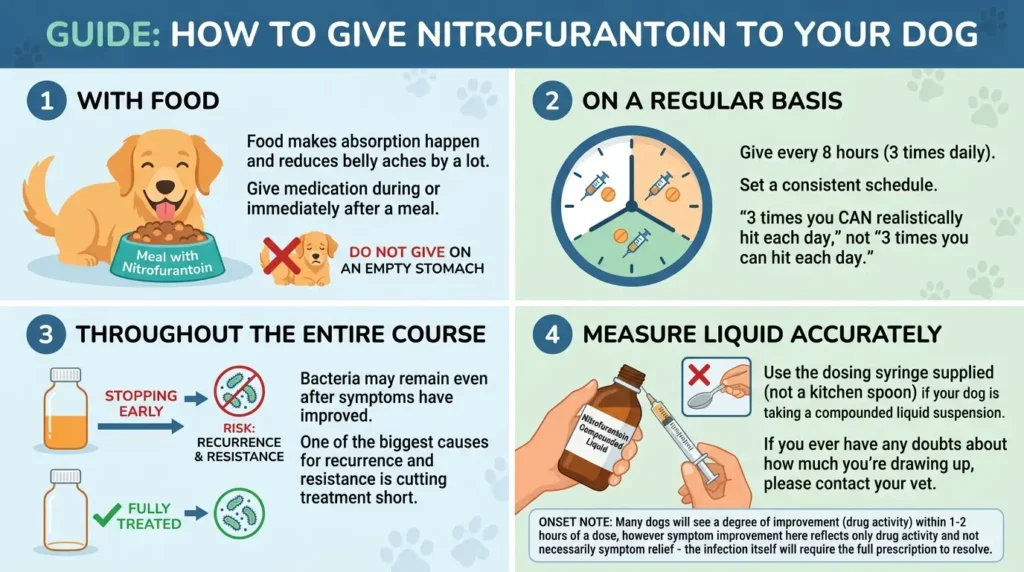
- With food. This isn’t an option: Food makes absorption happen and reduces belly aches by a lot.
- On a regular basis. Every 8 hours is 3 times you CAN realistically hit each day, not 3 times when you can hit each day.
- Throughout the entire course. Bacteria may remain even after symptoms have improved. One of the biggest causes for recurrence and resistance is cutting treatment short.
- Be sure and measure liquid formulations accurately. Use the dosing syringe supplied (not a kitchen spoon), if your dog is taking a compounded liquid suspension. If you ever have any doubts about how much you’re drawing up, please contact your vet.
Onset: Many dogs will see a degree of improvement (drug activity) within 1-2 hours of a dose, however symptom improvement here reflects only drug activity and not necessarily symptom relief – the infection itself will require the full prescription to resolve.
If You Miss a Dose
Try to give it as soon as you remember. If it’s close to time for the next dose, skip the dose you missed and resume the schedule – do not double dose! “Catch up” doses are twice as likely to cause side effects for no additional benefit.
Side Effects of Nitrofurantoin in Dogs
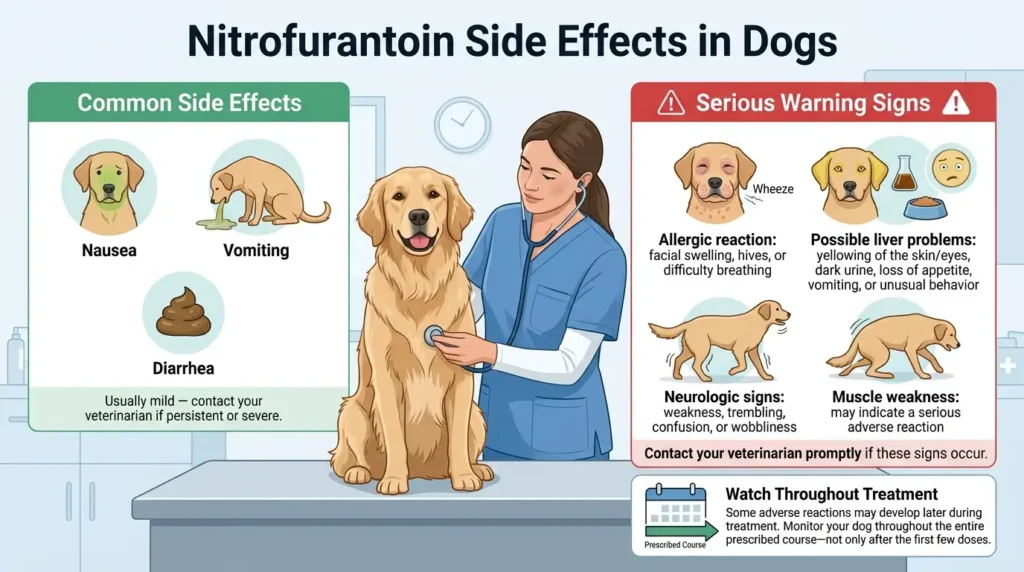
Common (and usually mild):
- Nausea
- Vomiting
- Diarrhea
Uncommon, but requires an immediate call to your vet:
- Allergic reaction – swelling around the face, hives or difficulty breathing
- Symptoms of liver damage: jaundice (yellowing of the skin or eyes) or loss of appetite, vomiting, behavior changes, seizures, or dark urine.
- Neuropathy symptoms such as weakness, trembling, confusion or wobbliness (polyneuropathy)
- Any type of muscle weakness, which could indicate a neurotoxic response.
An important point to note: a dog does not have a sensitivity reaction to the first few doses but may develop one later in the course. Be sure to look for the symptoms above throughout the treatment period, not just the first day or two.
Dogs that have a lesser function of the kidneys may be more susceptible to neurotoxic for dogs side effects (polyneuritis) as a result of the impaired ability of the kidneys to efficiently excrete the drug. For this reason, nitrofurantoin is not usually used in dogs which have a known kidney disease.
Sometimes very young dogs have been treated with nitrofurantoin and developed a yellow discolouration of their teeth, which is a cosmetic effect and not a sign of toxicity but you should be aware of if your dog is still teething.
Who Should Not Take Nitrofurantoin (Risk Factors)
Avoid nitrofurantoin in dogs that:
- Be known to have an allergy or sensitivity to nitrofurantoin or similar medications
- Have already had a kidney diagnosis
- Intended for breeding – the drug has been linked to decreased fertility, especially in males.
Exercise with extra caution and under close veterinary supervision when a dog:
- Pregnant or Nursing
- Have diabetes
- Have liver disease
- Have a history of anemia and asthma
Be sure to tell your veterinarian if your dog already takes any other medications, supplements, or health products, as several of these risk factors may not be apparent.
Nitrofurantoin Drug Interactions
Let your veterinarian know about all of your dog’s current medications and supplements. Additional precautions or dose modification is required with the following combination:
| Interacting Drug/Class | Why It Matters |
| Fluoroquinolone antibiotics (e.g., enrofloxacin) | Can reduce nitrofurantoin’s antibacterial effectiveness |
| Probenecid | Slows nitrofurantoin’s elimination through the kidneys, raising blood levels |
| Spironolactone | Combined use may increase certain side effect risks |
| Fluconazole | May alter nitrofurantoin levels in the body |
| Anticholinergic drugs (e.g., atropine) | Can slow gut motility, changing how the drug is absorbed |
| Local anesthetics (e.g., lidocaine) | Use with caution; interaction risk with nerve-related side effects |
| Psyllium and other bulk-forming fiber | May interfere with absorption if given too close together |
This is a list of interactions that are commonly cited in veterinary references; the list is not comprehensive. You should always check with your dog’s vet or a veterinary pharmacist with your dog’s particular medication list.
Nitrofurantoin Formulations and Cost
Nitrofurantoin for dogs is usually given in the form of:
- Capsules are available in 25 mg, 50 mg and 100 mg strengths and can be purchased in veterinary or compounding pharmacies.
- Liquid suspension (may be compounded) – great for small dogs or for specific weight dosing
Not available OTC for pets in the United States, requires a veterinary prescription. Each capsule typically costs $1 at a pharmacy and bulk bottles cost less per capsule, but your veterinarian or a licensed veterinary pharmacy can provide you with a precise quote depending on the strength your dog requires.
Nitrofurantoin vs. Other Common Dog UTI Antibiotics
| Antibiotic | Typical Use Case | Notes |
| Nitrofurantoin | Second-line, resistant or recurrent UTIs | Concentrates in urine; not for kidney infections |
| Amoxicillin/Clavulanate | First-line for many uncomplicated UTIs | Broader tissue distribution |
| Enrofloxacin (fluoroquinolone) | Complicated UTIs, kidney involvement | Reserved for resistant cases; interacts with nitrofurantoin |
| Trimethoprim-sulfa | Alternative first- or second-line option | Requires monitoring for certain side effects |
This comparison is used for orientation purposes only – your dog’s correct antibiotic is determined via a urine culture & sensitivity test, not a general chart. Don’t switch your dog’s antibiotic without your vet’s advice, even if it seems like a better option in theory.
Storage Instructions
- Keep at room temperature in the original container.
- Avoid exposure to light, freezing temperatures and metal surfaces.
- Store away from children and other animals.
- Not to be used in rats or in food producing animals.
Monitoring During Treatment
At the end of treatment, your veterinarian may want to schedule another recheck appointment or repeat urine culture to ensure that infection is not only symptom-free, but resolved. This is significant, as nitrofurantoin does not penetrate tissues as well and bacteria may be present even though the dog appears to be improved. Do any re-check schedule as set by your veterinarian.
In Case of Emergency
Should you think your dog has been overdosed on nitrofurantoin, or that she’s reacting to it, contact your vet’s office right away. If they are not available, follow their after hours advice or contact the closest veterinary emergency center or animal poison center.
Myth vs. Fact
Myth: “My dog is feeling better after 2 days, so I don’t need to give the antibiotic anymore.
Fact: Improvement in symptoms does not necessarily imply eradication of infection. One of the primary factors contributing to the development of antibiotic resistance and recurrent infections is stopping the antibiotic early.
Myth: “Nitrofurantoin medication is equally effective in kidney infection as in bladder infection.
Fact: It doesn’t reach high levels outside of the urinary tract so it’s generally not used for a kidney infection — a different antibiotic that has better penetration in the tissues would be more appropriate.
Myth: “I can use the nitrofurantoin drug that my family member has been prescribed for my dog.
Truth: Dosing, formulation and safety monitoring are different for humans and animals. Medicate your dog only for an ailment a veterinarian has prescribed for him or her and at the dosage he or she has outlined.
You May Also Like to Read:
- Nordic Naturals Fish Oil Dosage For Dogs: Calculator & Guide
- Nutracalm Dosage For Dogs: Calculator, Chart & Safe Guide
FAQs
What is nitrofurantoin drug used for in dogs?
It is used for treating urinary tract infections that are caused by bacteria, usually when other antibiotics fail to cure the infection or when the urine culture indicates that other antibiotics will not cure the infection.
How much nitrofurantoin do I give my dog?
This is administered orally every 8 hours for 4-10 days, depending on what the veterinarian prescribes and always at the prescribed dose of 4.4 mg/kg of body weight.
How often is nitrofurantoin given to dogs?
Every 8 hours (three times a day).
How long does a course of nitrofurantoin last?
Usually 4-10 days, depending on severity of infection and veterinarian’s assessment.
How can I administrate nitrofurantoin to my dog when he is hungry?
It is best when given with food to help absorption and minimise the risk of tummy upset.
What are the most common side effects?
Most common are nausea, vomiting and diarrhea. A more severe reaction (allergic response, liver toxicity or nerve toxicity) is rare, but needs immediate veterinary attention.
Is it okay to use nitrofurantoin in puppies?
It has been reported with yellow discolouration of the teeth in very young animals. Use only in puppies under veterinary supervision.
Is it safe to use nitrofurantoin in pregnant or nursing dogs?
Caution should be used and veterinary supervision should be obtained in these cases.
Is nitrofurantoin safe for dogs with kidney disease?
No – because it can be used in dogs with kidney disease, but there is an increased risk of side effects involving the nerves because the function of the kidneys is impaired.
If you forget a dose, what should you do?
If you do remember, take it as soon as possible, unless it is almost time for the next dose, in which case skip the dose and continue as normal. Never double up.
How soon does nitrofurantoin start to work?
It can be activated in the body within 1-2 hours and complete resolution of symptoms requires the course to be completed.
Is nitrofurantoin a cure for kidney infections?
Generally, no. It works best when the bladder infection is present as it is excreted in high levels in the urine but not levels sufficient to reach kidney tissue.
Is it possible to obtain nitrofurantoin for my dog without the prescription?
No. In the U.S. it can only be purchased with a veterinarian’s prescription, usually at a veterinary or compounding pharmacy.
Which antibiotic(s) interact with nitrofurantoin?
Some of the interactions to watch for with your vet include fluoroquinolones (such as enrofloxacin) and drugs like probenecid, spironolactone and fluconazole.
Is nitrofurantoin a substitute for Macrobid or Macrodantin?
Nitrofurantoin is a human brand of Macrobid or Macrodantin. While the active drug is the same, there are dosing, formulation and safety guidelines that differ between people and dogs; do not give a human prescription without veterinary advice.
Key Takeaways
- Standard dose: 4.4 mg/kg, PO, every 8 hours (three times a day), for 4–10 days
- Give with food to minimise stomach upset and increase absorption.
- It is usually a second-line antibiotic to use if infection is not being cured by first line antibiotic
- Side effects: nausea, vomiting, diarrhea (most common)
- Not recommended for dogs with severe kidney disease
- Don’t feed to rats, and don’t use a human-prescribed nitrofurantoin on your dog without veterinary advice about dosage.
Final Thoughts
Nitrofurantoin Dosage For Dogs is a tried and proven effective medication for dogs with UTIs who have failed to improve on first line antibiotics – but it is a medication where the details matter: Correct weight based dosage, full treatment course, administer with food, and monitor for uncommon but more serious side effects.
The math of the dosing is dead simple: 4.4 mg/kg, three times a day; it’s the surrounding care—completing the course, watching for reactions, rechecking the urine—that is key to the success of infection clearing.
If any of the above is not in accordance with your veterinarian’s prescription, please follow your veterinarian’s advice. They’ve looked at your dog and in many cases the actual bacteria they are dealing with; this guide can be used as a reference, but not in place of that.