Most dogs learn to sit faster than their owners expect, and the part that trips people up is rarely the dog. It is the timing. You hold the treat a little too high, you say the word a little too late, or you repeat the word five times while your dog stares at you, unsure which sound mattered. If that sounds familiar, this guide will help you Teach Your Dog to Sit in a calm, clear way that works for puppies, adult dogs, and rescue dogs who never learned it.
By the end of these five steps, your dog will sit when you ask, on a single word, without you waving a treat like a flag. The method uses a lure, which means a treat guides your dog into position, and then the treat fades away as the word takes over. Plan on 10 minutes of practise a day, split into short sessions, and many dogs get a reliable sit within a week. Some take longer, and that is normal. Short, cheerful sessions beat one long, tired session every time.
Time and Difficulty
Total time: about a week of short daily practise | Active time: 10 minutes a day | Difficulty: Beginner
Best for puppies over 8 weeks old, adult dogs, and dogs who are new to training. Keep sessions short and end on a win.
What You Need
- Small, soft treats your dog can swallow in 2 seconds — pea-sized pieces work well
- A treat pouch, an apron pocket, or a small bowl placed close by
- A quiet room with few distractions for the first sessions
- A lead, if you want your dog to stay in one spot while you practise
- A non-slip floor or mat, so your dog feels steady when sitting
Stand in front of your dog with a treat ready
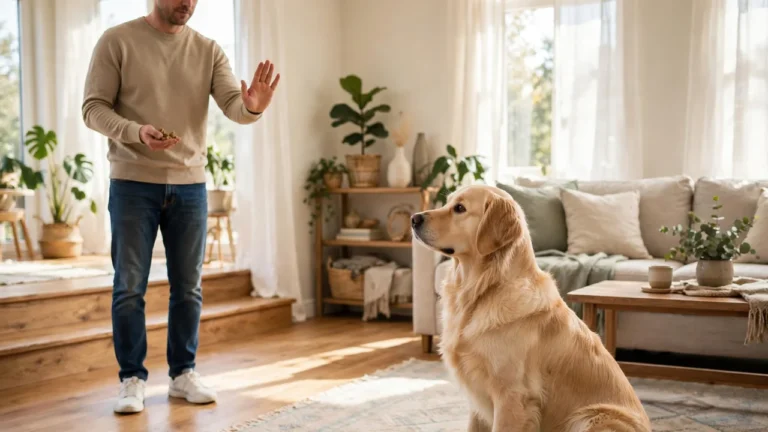
Face your dog in a quiet room, a treat pinched between your thumb and first finger. Hold your hand at your waist, not up in the air, so your dog can see the treat without jumping for it. Stay still and relaxed: dogs read body language before words. Wait until your dog looks at you or at your hand, then move on.
Move the treat slowly up and back over your dog’s head
From your waist, lift the treat slowly toward your dog’s nose, then arc it up and slightly back, about 2 inches above the head. Your dog’s nose follows the treat, the head tips back, and the back end drops to the floor on its own. That drop is the sit, and it happens without pushing, pressing, or forcing anything. If your dog jumps up instead, your hand went too high or moved too fast. Lower your hand, reset, and try a slower arc.
Mark and reward the sit the second it happens
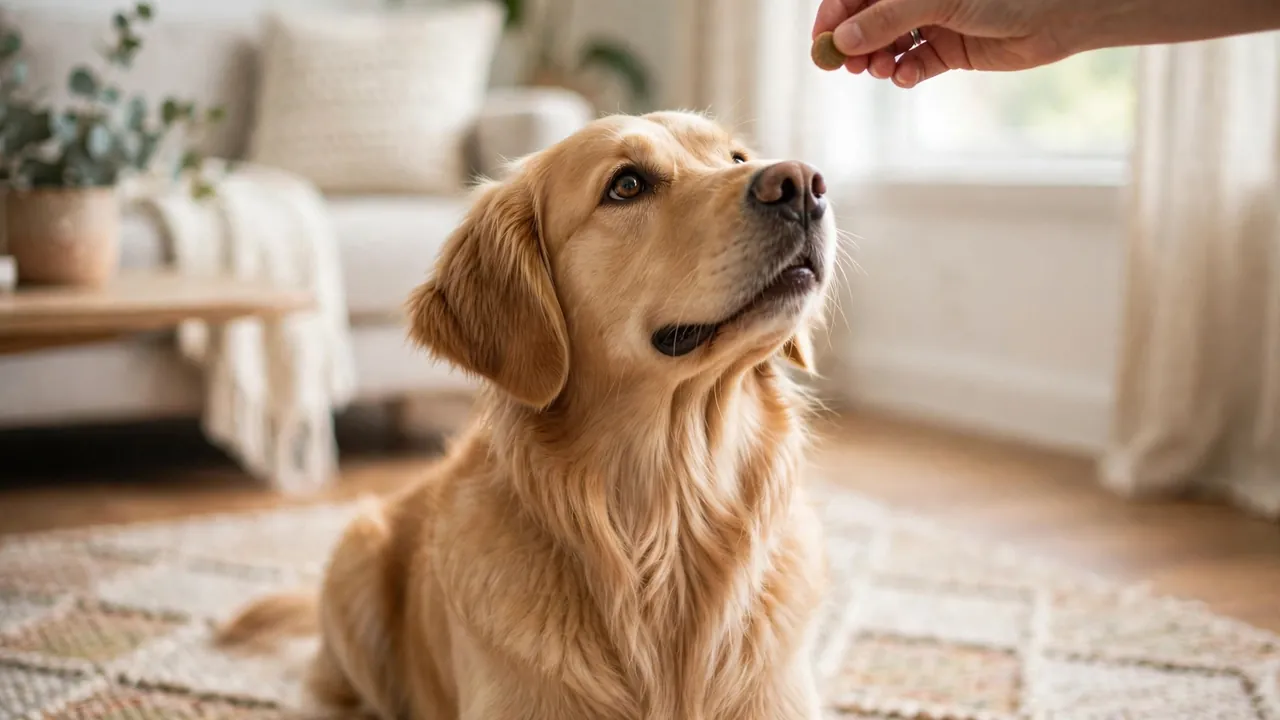
The instant your dog’s back end touches the floor, say “Yes!” in a bright voice and give the treat right away, within 1 second if you can. That marker word tells your dog exactly which moment earned the reward. Give the treat low, near the mouth, so they stay seated. Repeat 8 to 10 times, then take a short break.
Add the word “sit” before you move the treat
Once your dog sits on the lure 8 times out of 10 without hesitating, it is time to name the behaviour. Say “sit” once, in a clear, normal voice, pause for 1 second, and then move the treat in the same arc as before. Saying the word first, then luring, teaches your dog that the word predicts the action. Avoid repeating the word while your dog thinks. One “sit” is enough. If your dog does not sit, lure them through it and try again, rather than chanting the word.
Fade the treat and practise in new places
Over the next days, make the hand signal smaller: start with a full arc, then a small lift of the hand, then a flat hand with no treat in it, while still rewarding after each sit. Reward every sit at first, then reward 4 out of 5 sits, then 3 out of 5, so your dog keeps working without expecting a treat every single time. Practise in the kitchen, then the garden, then on a quiet walk, in 3-minute sessions. New places add distractions, so reward every sit when you change location.
If This Happens, Try This
| My dog jumps up for the treat | Lower your hand and move it more slowly. Keep the treat close to the nose. |
| My dog walks backwards instead of sitting | Practise with your dog’s back near a wall, so stepping back is not an option. |
| My dog sits, then pops straight back up | Reward faster, within 1 second, and give the treat low so your dog stays down. |
| My dog only sits when they see a treat | Hide treats in your pouch and reward after the sit. Fade the lure in small steps, not all at once. |
Frequently Asked Questions
How long does it take to teach a dog to sit? Many dogs learn the motion in one or two short sessions, and a reliable sit on a single word usually takes about a week of daily practise in 10-minute sessions. Puppies, older dogs, and easily distracted dogs may need a little longer.
What if my dog will not sit at all? Check your lure height first, since a treat held too high causes jumping. Practise on a non-slip surface, keep sessions to 3 minutes, and ask your vet to check for hip or back pain if sitting looks uncomfortable.
Should I push my dog’s back end down? No. Pushing can scare a dog, hurt a sore back, and teach them to resist pressure. The lure method lets the sit happen on its own, which keeps training cheerful and safe.
Can an old dog learn to sit? Yes. Older dogs learn at their own pace, and short, gentle sessions suit them well. Keep treats soft, watch for stiffness, and stop if your dog looks tired or sore.
Quick Reference Card
You need: small soft treats, a pouch or pocket, a quiet room, a non-slip floor.
- Stand in front of your dog with a treat ready.
- Move the treat slowly up and back over your dog’s head.
- Mark and reward the sit the second it happens.
- Add the word “sit” before you move the treat.
- Fade the treat and practise in new places.
That is the whole method for Teach Your Dog to Sit, and it works because it is built on timing, not force. You lured, you marked, you named, and then you faded the lure, so your dog now knows what “sit” means. Keep practising in short, happy sessions, and try teaching “down” or “stay” next, since both build on this same calm foundation. Pin this guide to try it this weekend, and enjoy that first crisp sit on a single word.