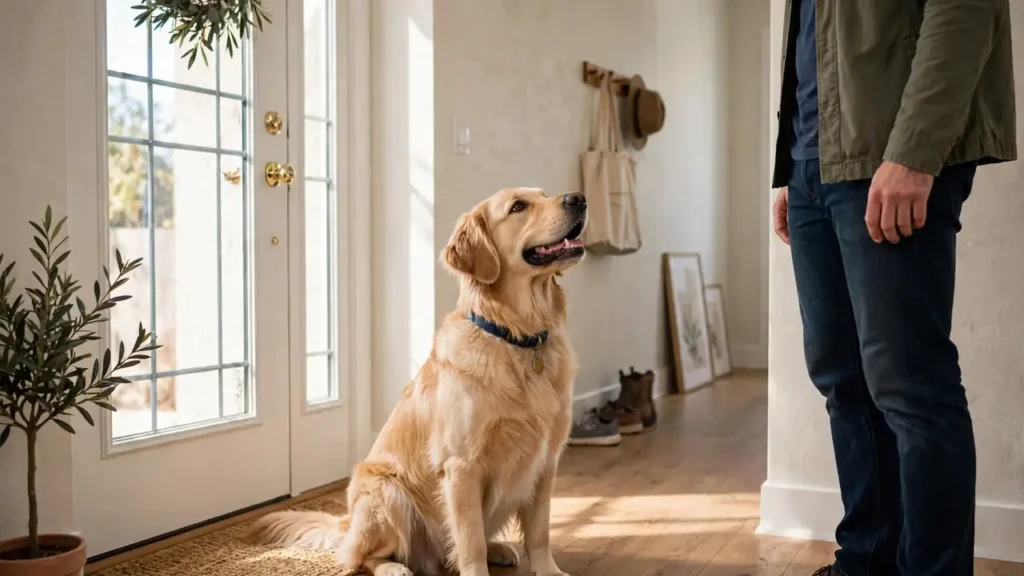
A visitor steps through the door, and your dog is already up on two legs, paws on their chest, tail wagging hard. Coats get muddy marks, small children get knocked back, and a warm hello turns into an apology. If you want to stop your dog jumping up on people, you need a plan that gives your dog a better job than jumping, not a scolding that only adds to the excitement. Dogs jump because it works: faces come closer, hands reach out, and attention arrives fast. This guide replaces that payoff with a calmer reward, so four paws on the floor becomes the habit that pays.
You will follow a nine-step plan over about two weeks. You will watch greetings for two days, teach a solid sit away from the door, practise with a helper, and then move to real visitors one at a time. Each session takes 5 to 10 minutes, and you need no special gear beyond treats, a lead, and a helper for one practise day. By the end, your dog should greet people with all four paws down, and visitors should be able to walk in without bracing for impact.
Time and Difficulty
Total time: about 2 weeks of short sessions | Active time: 5 to 10 minutes, 2 to 3 times a day | Difficulty: Beginner
Best for dogs of any age that jump up on visitors, family members, or children at the door.
What You Need
- Small, soft treats your dog loves, cut to pea size
- A treat pouch or a pocket that opens with one hand
- A lead and a harness or flat collar
- A mat or dog bed for the greeting spot
- A baby gate, if you have a hallway you can close off
- A helper who can knock and walk in on cue
- A notebook or your phone for two days of notes
At a Glance
- Watch greetings for two days and write down the pattern.
- Teach a solid sit in a quiet room.
- Reward four paws on the floor all day long.
- Agree the house rule with everyone at home.
- Stop your dog jumping up on people with a helper at the door.
- Welcome one real visitor at a time.
- Give children and excitable guests extra space.
- Reset calmly after a jump, without a fuss.
- Run a short refresher every day for two weeks.
Watch greetings for two days and write down the pattern
Two days of notes will show you more than any single greeting can. For each arrival, write down who came in, how excited your dog was on a scale of 1 to 5, and what happened in the first 10 seconds. Note the time of day, whether your dog was already restless, and whether the visitor bent down, talked in a high voice, or reached out a hand. A pattern often appears fast: some dogs jump most at the first visitor of the day, while others jump only on people they know well.
Teach a solid sit in a quiet room
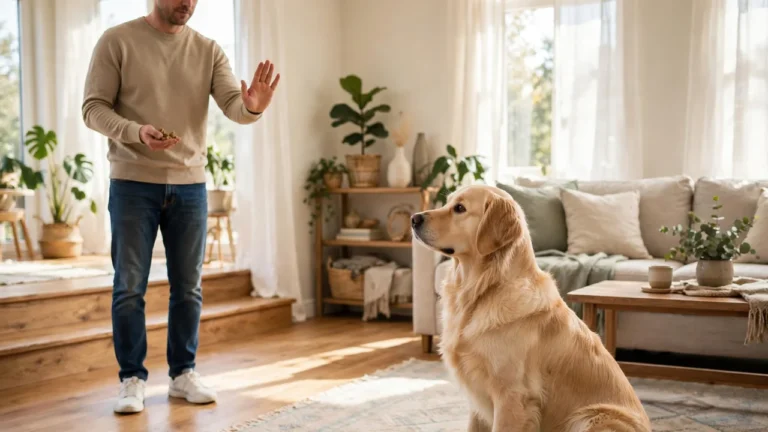
A sit that holds in a calm room gives you a greeting behaviour to ask for at the door. Hold a treat near your dog’s nose, lift it slowly over the head, and mark the sit with a clear word such as “yes” the second the back legs fold. Reward with 3 treats in a row, delivered low, so your dog stays seated while eating. A 10-second sit means your dog is ready for the next step.
Reward four paws on the floor all day long
Your dog needs proof that staying down pays better than jumping up. During normal life at home, drop a treat on the floor whenever you catch all four paws down, with no cue and no fuss. Do this 10 times a day for the first week, at odd moments: while you cook, while you watch television, while you put on shoes. The randomness matters, because your dog learns that calm feet earn treats at any time, not only during a training session.
Agree the house rule with everyone at home
One person who still greets a jumping dog with hugs can undo a week of training, so the house rule has to be shared before door practise starts. Sit down together and agree on one script: visitors turn sideways, keep hands still, and wait for four paws on the floor before they say hello. Put the rule on the fridge for one week so guests can read it too. Children get the same rule in short words: hands by your sides, wait for paws down.
Stop Your Dog Jumping Up on People With a Helper at the Door
Door practise works best when you control every part of the greeting. Ask your helper to knock, wait 5 seconds, and walk in only when your dog has four paws down. Keep your dog on a lead, stand 2 metres back from the door, and ask for a sit before the door opens. If paws leave the floor, your helper steps calmly back outside and the door closes. Repeat the knock 4 times in one session, then stop while your dog is still keen.
Heads Up
Never knee your dog in the chest, push paws down, or step on back paws to stop a jump. Those moves can hurt a dog, frighten a nervous dog, and teach an excitable dog that greetings involve rough contact. A calm step back and a closed door remove the reward without any rough handling.
Welcome one real visitor at a time
Real visitors bring new smells, voices, and energy, so keep the first real greetings small and short. Invite one calm adult, brief them on the house rule before they arrive, and meet them at the door with your dog on a lead. Let the visitor wait 10 seconds after entering before they greet your dog, and keep the greeting to 30 seconds of calm praise and one treat. End on a win.
Pro Tip
Greet the visitor yourself first, with a hug or a handshake, while your dog waits on the lead. That short pause lets the excitement of the arrival pass before your dog gets a turn, and it shows your dog that visitors are calm people, not a race to the door.
Give children and excitable guests extra space
Children sit at face height for a jumping dog, and loud guests raise the excitement in the whole room, so both need a wider safety gap. Keep 3 metres between your dog and a child visitor until your dog has four paws down, and use the baby gate if you have one. Let the child drop a treat on the floor rather than hand it over, so small fingers stay clear of an eager mouth. If your dog cannot settle, move the greeting outside, where there is more room to step back.
Reset calmly after a jump, without a fuss
A jump during training is information, not a failure, and a loud reaction only adds fuel to the next greeting. Turn sideways, fold your arms, and wait in silence until all four paws land back on the floor. The moment they do, mark it with “yes” and drop a treat low, so the reward lands where you want the paws to stay. After 3 calm resets in one greeting, take a break in another room.
Run a short refresher every day for two weeks
New habits fade fast if the rewards stop, so keep a short daily refresher going after the first wins. Run one 5-minute door session each day for 14 days, mixing helper knocks with one real greeting when you can. Keep rewarding four paws down at odd moments around the house, and review your notes each Sunday to check whether jumps are rarer, shorter, or less intense. Once a full week passes with no jumps, you can drop the lead at the door and keep treats in a bowl by the entrance for visitors to use.


Paid Links - As an Amazon Associate, I earn from qualifying purchases.
Troubleshooting
| If This Happens | Try This |
|---|---|
| Your dog jumps only on one favourite person. | Practise with that person as the helper for 3 sessions, and ask them to arrive calmly, with no high voice and no bending down. |
| Your dog sits, then springs up as the visitor reaches out. | Ask visitors to wait 10 seconds after entering, and reward the sit twice before they greet your dog. |
| Progress stalls after a good first week. | Go back one step, shorten sessions to 5 minutes, and check that every person at home still follows the same house rule. |
| Your dog jumps when off the lead but not on it. | Keep the lead on for greetings for another week, and use the baby gate so you can end a greeting fast if paws leave the floor. |
Frequently Asked Questions
How long does it take to stop a dog jumping up? Most dogs show a clear drop in jumping within 2 weeks of short, daily sessions, with calm greetings taking hold in 3 to 4 weeks. Dogs that have jumped for years, or that jump from fear as well as excitement, may need longer, and that is normal.
Should I ignore my dog completely when it jumps? Turning away and staying quiet works better than scolding, because it removes the attention the jump was chasing. The key is what happens next: reward the second all four paws land on the floor, so your dog learns what earns attention.
Does this work for large dogs and puppies? Yes, with one change for size: keep a lead and a baby gate in use for longer with large dogs, and keep sessions to 5 minutes for puppies, whose focus runs out fast. The steps stay the same, but the safety gap matters more with a big dog.
What if visitors will not follow the house rule? Greet those visitors outside or behind the baby gate, and keep your dog on a lead until the excitement passes. You cannot train someone else’s behaviour, but you can control the space, the distance, and the timing of the greeting.
Quick Reference Card
You need: small treats, treat pouch, lead, mat, baby gate, helper, notebook.
- Watch greetings for two days and note the pattern.
- Teach a solid sit in a quiet room.
- Reward four paws on the floor all day long.
- Agree the house rule with everyone at home.
- Practise with a helper at the door.
- Welcome one real visitor at a time.
- Give children and excitable guests extra space.
- Reset calmly after a jump, without a fuss.
- Run a short refresher every day for two weeks.
By the end of two weeks, your dog should meet visitors with four paws on the floor, and greetings should feel calm instead of chaotic. Keep the refresher going, keep treats by the door, and practise with a new visitor now and then so the calm habit holds. If this guide helped you stop your dog jumping up on people, save it to Pinterest so you can find the steps again for the next guest at your door.