The doorbell rings, your dog rushes to the door, and barking fills the house before you reach the handle. Visitors step back, phone calls get cut short, and calm greetings turn into a scramble. If you want to stop your dog barking at the doorbell, the fix is not louder shouting or a harsher tone. Dogs bark at the door because the sound predicts a stranger, excitement, and a rush of movement, so training must change what the sound means and give your dog a clear job to do instead.
This guide gives you a nine-step plan you can run in short sessions at home. You will watch your dog’s triggers for two days, teach a quiet cue away from the door, practise with a low-volume doorbell sound, and build up to real visitors. Most dogs show a clear drop in barking within two weeks if sessions stay short, rewards stay generous, and the whole household follows the same rules. Each session takes 5 to 10 minutes, and you need no special gear beyond treats, a mat, and a willing helper for one practise day.
Time and Difficulty
Total time: about 2 weeks of short sessions | Active time: 5 to 10 minutes, 2 to 3 times a day | Difficulty: Beginner
Best for dogs of any age that bark at the doorbell, knock, or visitors at the door.
What You Need
- Small, soft treats your dog loves, cut to pea size
- A treat pouch or pocket you can reach fast
- A doorbell recording on your phone, with volume control
- A mat or dog bed that fits a few feet from the front door
- A lead, for controlled practise at the door
- A baby gate, to block the hallway on days you cannot train
- A helper who can ring the bell and wait outside
- A small notebook, to record barking episodes for two days

At a Glance
- Record every barking episode for two days.
- Teach a quiet cue in a calm room.
- Play the doorbell sound at low volume.
- Move training closer to the front door.
- Send your dog to a mat before the door opens.
- Practise with a helper knocking at the door.
- Stop your dog barking at the doorbell during real visits.
- Set up the house for days you cannot train.
- Review progress after two weeks.
Record every barking episode for two days
Keep a small notebook by the door for two days. Note the time, who arrived, and how long the barking lasted after the bell. Patterns show up fast: some dogs bark only for delivery drivers, others bark at every knock, ring, and footstep on the path. A clear record tells you which trigger to train first, and it gives you a baseline to compare against after two weeks of work.
Teach a quiet cue in a calm room
Start in a quiet room with no doorbell in earshot. Wait for a natural pause in your dog’s noise, say “quiet” once in a low, steady voice, and hand over a treat the second the noise stops. Repeat this 5 times, then add a short pause before the treat. Your dog learns that quiet brings the reward, not barking, and that lesson carries into door training later. Keep the room calm, the treats small, and the sessions short, so the cue stays linked to stillness rather than excitement.
Play the doorbell sound at low volume
Play a doorbell recording on your phone at the lowest volume your dog can hear. The moment your dog looks toward the sound without barking, mark it with “yes” and give a treat. Raise the volume one notch every 2 or 3 repetitions, and drop back a notch if barking returns. 10 short repetitions beat one long session, and ending on a calm repetition leaves your dog ready for the next round.
Move training closer to the front door
Move your training chair a few feet closer to the front door each day, keeping the same low-volume sound and reward pattern. Watch for stiff legs, a raised tail, or a fixed stare, which signal that the distance closed too fast. Step back to the last distance where your dog stayed calm, and build from there. Slow distance work stops the door itself from becoming a trigger again, and it lets your dog practise calm behaviour where real visits happen.
Send your dog to a mat before the door opens
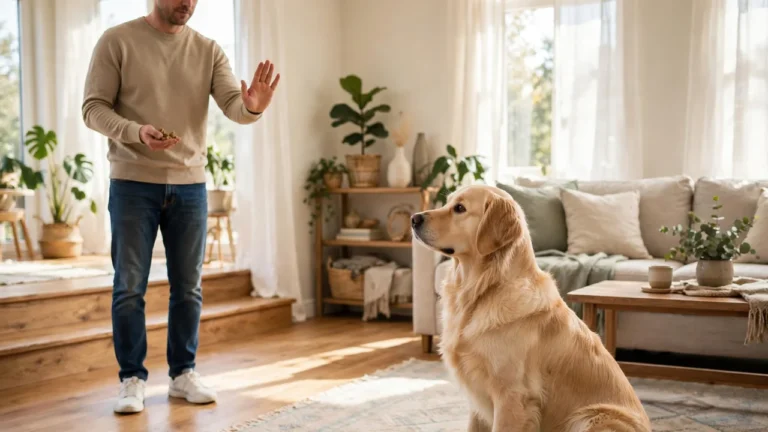
Put a mat 3 or 4 feet from the door, in a spot at home where your dog can still see who arrives. Lure your dog onto the mat with a treat, say “mat”, and reward 4 calm seconds on it. Build the stay to 30 seconds over several short sessions, rewarding calm waiting rather than staring at the door. A mat gives your dog a place to be, which beats asking a fired-up dog to stand still with nowhere to go.
Pro tip
Practise the mat stay at calm times of day first, with no bell at all. A mat that only appears when the doorbell rings feels like a trap, while a mat your dog already loves feels like a good place to wait.
Practise with a helper knocking at the door
Ask a helper to ring the bell once, wait outside, and ring again only when you signal. Send your dog to the mat, reward the quiet wait, and open the door a crack while your dog stays put. Close the door if barking starts, wait for a quiet pause, and try again with a shorter wait. 3 calm repetitions in a row mean your dog is ready for a real visitor, not a rushed greeting.
Stop your dog barking at the doorbell during real visits
Run the same routine you practised for real visits, with no shortcuts. Send your dog to the mat before you touch the handle, reward the quiet wait, and let your visitor enter only while your dog stays calm. Ask visitors to ignore your dog until all four paws stay on the mat, then let them say hello in a low voice. If barking breaks out, step back inside, close the door, and reset the mat wait. Brief every guest before you open the door, because a rushed greeting can undo a week of calm practise in seconds.
Set up the house for days you cannot train
On days you cannot train, manage the door so barking does not get practised all day. Keep the front room door closed, use a baby gate to block the hallway, and put a sign on the door asking delivery drivers to leave parcels without ringing. Give your dog a chew in a back room before expected deliveries. Management is not giving up; it stops old habits from undoing your training between sessions.
Heads up
Never shout over barking, and never use a bark collar, spray, or punishment to silence your dog. Shouting sounds like joining in, and punishment can raise fear and make door barking worse. If barking comes with lunging, snapping, or panic, talk to your vet or a certified trainer before continuing.
Review progress after two weeks
After two weeks, compare your new notes with the first two days. Count barks per visit, note how fast quiet returns, and look for the time of day that still causes trouble. Keep the routines that worked, drop one routine that did not, and add a single new challenge, such as a second visitor or a longer mat wait. Progress rarely moves in a straight line, so a flat week still counts if barking bursts are shorter than before.


Paid Links - As an Amazon Associate, I earn from qualifying purchases.
Troubleshooting: If This Happens, Try This
| Dog barks at the recording even at low volume | Move to another room, lower the volume further, and reward looking toward the sound without barking before moving closer. |
| Dog leaves the mat when the door opens | Open the door only a crack, reward staying put, and close it again if paws leave the mat. Build the open-door time in seconds, not minutes. |
| Dog is calm in practise but barks for real visitors | Use a known visitor as a bridge step, brief them in advance, and keep the first real visits short, with treats ready. |
| One person in the house undoes the training | Agree on one routine together: mat first, quiet wait, then greeting. Tape the steps inside the front door so every person follows them. |
Frequently Asked Questions
How long does it take to stop doorbell barking? Most dogs improve within 2 weeks of short, daily sessions, with calmer greetings in 3 to 4 weeks. Dogs with a long barking habit or high fear may need longer, and that is normal.
Should I stop my dog barking completely? No. Barking is a normal way for dogs to alert you. The goal is a short alert bark, then quiet on cue, not a dog that never makes a sound.
Do I need a special doorbell or device? No. A phone recording of a doorbell, a mat, and small treats cover every step in this guide. A helper for one practise day helps, but you can also practise with recorded sounds alone.
What if my dog barks at knocks as well as the bell? Train knocks the same way: record the knock, play it at low volume, reward quiet, and move closer to the door in stages. Most dogs transfer the lesson once one door sound feels safe.
Quick Reference Card
You need: small treats, treat pouch, doorbell recording, mat, lead, baby gate, helper, notebook.
- Record barking episodes for two days.
- Teach “quiet” in a calm room.
- Play the doorbell sound at low volume.
- Move training closer to the front door.
- Send your dog to a mat before the door opens.
- Practise with a helper at the door.
- Run the same routine for real visits.
- Manage the house on days you cannot train.
- Review progress after two weeks.
By the end of two weeks your dog should hear the bell, head to the mat, and wait quietly while you answer the door. That change makes every visit calmer, for your dog, your guests, and you. Keep the mat routine going for a few more weeks, and practise with a new visitor now and then so the calm habit holds. If this guide helped your doorbell feel less chaotic, save it to Pinterest so you can find the steps again. You can stop your dog barking at the doorbell, one short, calm session at a time.