Selamectin Dosage Calculator For Dogs By Weight
For Dogs Only
© medsdog.com


Paid Links - As an Amazon Associate, I earn from qualifying purchases.
Selamectin Dosage For Dogs is a safe and effective topical anti-parasitic drug for dogs, that helps guard against a variety of common, and potentially serious parasites. Selamectin is sold under several different names, including Revolution®, Revolt™, Selarid® and Senergy®, and is used to prevent heartworm disease, and treat and control flea, ear mites, and some skin parasites, and is applied directly to the skin once a month. It is also effective against sarcoptic mange in dogs, and helps to control American dog tick infestations. There are several different selamectin products in varying strengths and formulations, so it is important to know selamectin dose for dogs to ensure the maximum protection and safety.
Selamectin dose is often used as a combined product by veterinarians, as it helps pet owners control parasites such as mites, heartworms and fleas in one convenient, monthly application. Products with Selamectin have the same active ingredient and mode of action, but may be different in brand, package, and cost. It's important to get the dosage right for your dog, as giving him too little may make it less effective and giving him too much can make him more susceptible to side effects.
This comprehensive selamectin dosage guide for dogs will help you understand the recommended dosage chart, working, uses, how to give selamectin to your dog, safety measures and precautions, side effects, and answers to common questions. This guide will assist you in using Revolution®, Revolt™, Selarid® or other selamectin products safely and effectively, ensuring that your dog remains protected all year long.
Key Takeaways
- Selamectin is a drug found in a number of veterinarian products, such as Revolution®, Revolt™, Selarid® and Senergy®, and is used to treat, prevent, and control several internal and external parasites in dogs.
- It protects against heartworm disease monthly and is effective in treating and controlling flea infestations, ear mites and sarcoptic mange (scabies).
- Selamectin drug for dogs by weight is effective at killing adult fleas and preventing the hatching of flea eggs for up to 30 days, which helps to stop the flea life cycle and prevent re-infestation.
- It is also labelled in dogs for the control of infestations of American dog tick, Derma centor variabilis.
- It's taken as topical application, as a spot-on drug applied directly to the skin between the shoulder blades and then it lasts for one month after application.
- Selamectin works best when applied to dry skin and fur, and try to avoid bathing or swimming your dog within 2 hours of treatment.
- To keep safe and effective protection from parasites, it is important the right dose is given, according to weight.
- Do not use Selamectin in puppies younger than 6 weeks of age and dogs that are sick, debilitated or substantially underweight unless instructed by a veterinarian.
- Selamectin is generally well tolerated by most dogs although there can be some minor side effects, including flea litter loss, mild skin irritation or gastrointestinal issues at the application site.
- Selamectin products are prescription-only items and the pet owner always needs to follow the veterinarian's instructions for dosage.
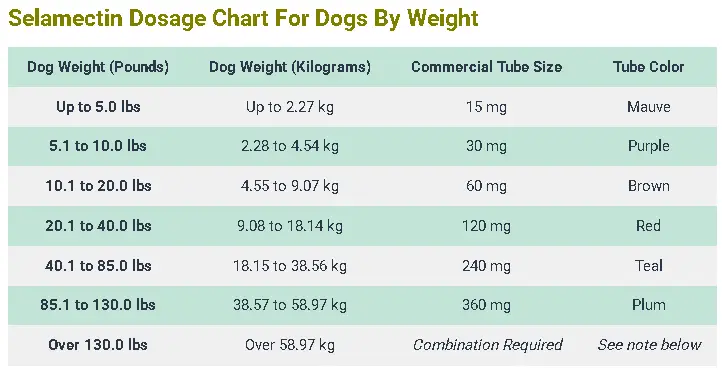
Selamectin Dosage Chart For Dogs By Weight
| Dog Weight (Pounds) | Dog Weight (Kilograms) | Commercial Tube Size | Tube Color |
| Up to 5.0 lbs | Up to 2.27 kg | 15 mg | Mauve |
| 5.1 to 10.0 lbs | 2.28 to 4.54 kg | 30 mg | Purple |
| 10.1 to 20.0 lbs | 4.55 to 9.07 kg | 60 mg | Brown |
| 20.1 to 40.0 lbs | 9.08 to 18.14 kg | 120 mg | Red |
| 40.1 to 85.0 lbs | 18.15 to 38.56 kg | 240 mg | Teal |
| 85.1 to 130.0 lbs | 38.57 to 58.97 kg | 360 mg | Plum |
| Over 130.0 lbs | Over 58.97 kg | Combination Required | See note below |
Key Dosing Rules to Keep in Mind
- For Dogs Over 130 lbs (58.97 kg): Standard single tubes will not provide a high enough dosage. A veterinarian will need to combine multiple standard tubes to safely meet or exceed the target minimum active ingredient requirements.
- Therapeutic Ratios: These pre-measured commercial tubes are formulated to ensure a minimum of 2.7 mg of active ingredient per 1 lb of body weight (or 6.0 mg per 1 kg).
Disclaimer: This table is for general informational purposes only and does not replace professional veterinary medical advice. Always consult your veterinarian to verify calculations and safety before administering any prescription medication to your dog.
What Is Selamectin?
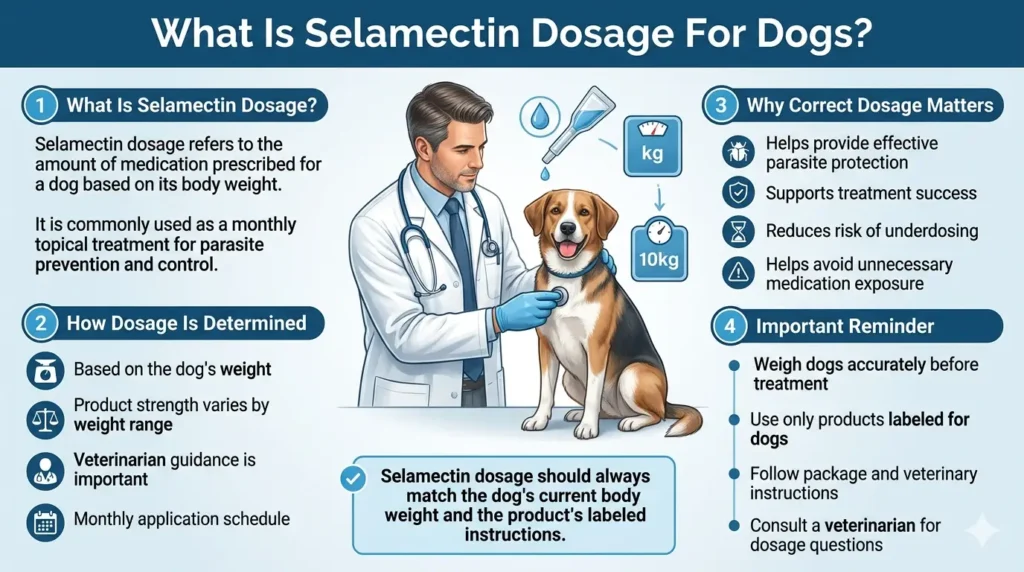
Selamectin Dosage For Dogs is an antiparasitic drug that is applied onto the skin of dogs and cats and prescribed by veterinarians to prevent, treat, and control many internal and external parasites. It is a member of the class of drugs known as avermectins, which are used to treat parasites, and is sold under the following brands: Revolution®, Revolt™, Selarid®, Senergy®, Stronghold®, Paradyne®, and Chanhold®. The medicine is applied directly to the skin, usually at the back of the neck, and is usually given once a month.
Selamectin is used in dogs to prevent heartworm disease, and to treat or control flea infections, ear mites, sarcoptic mange (scabies), and infestations of the American dog tick. In cats, it treats roundworms, hookworms, ear mites and fleas and prevents heartworm disease. Selamectin will kill adult fleas and stop the eggs from hatching, which will help to break the flea life cycle and reduce future infestations.
Selamectin medication is also absorbed into the blood stream after topical application and is distributed throughout the body and is active against parasites on and within the animal. It is active 4 – 8 hours after application and is fully effective within 7 days. Monthly doses will give continuous protection from many common parasites.
Selamectin can also be used for some extra-label (off-label) applications, such as nasal mites, notoedric mange, cordylobolosis and other parasites, that may be prescribed by the veterinarian. Off Label: Not approved for this use by veterinary regulatory authorities, but supported by veterinary evidence.
Selamectin was approved for use in dogs and puppies 6 weeks old or older and cats and kittens 8 weeks old or older. There are several dose strengths and it requires a veterinarian's prescription for its use. Since prevention is a key factor in maintaining pet health, veterinarians often recommend year-round selamectin treatment to provide protection from fleas, heartworms, mites and other damaging parasites.
How Is Selamectin Used in Dogs?
Selamectin dose is a topical antiparasitic drug that is used in dogs and cats to prevent and treat parasites like ear mites, skin mites, certain ticks, and heartworms. It is applied topically to the skin at the base of the neck and between the shoulder blades, and is absorbed through the skin and through the natural oils secreted by the skin into the bloodstream. Selamectin is absorbed into the bloodstream and acts by disrupting the nervous system of susceptible parasites, which leads to their death and gives continuous protection.
Selamectin can be used in dogs and puppies 6 weeks or older, and cats and kittens 8 weeks or older. Generally, this is given monthly (once every 30 days) for ongoing control of parasites, although your veterinarian may advise a different dosage regimen for specific diseases or for use in situations other than as labeled.
When using selamectin, make sure that the pet's skin and coat are dry. Divide hair so that skin can be seen; apply the end of the single use tube directly to the skin and squeeze the product out in one area. It is not recommended to massage the medication into the skin and the site of application should not be touched until it is dry. To be effective, selamectin must be applied to dry, healthy, unbroken skin; it may not work as well or may irritate if applied to wet or damaged skin.
Pets must not lick or rub the treated area, and other animals in the home should not come in contact with the treated area until it's dry. Dogs should not be bathed for 2 hours after application and cats should not be bathed for 24 hours. The product is flammable and pet owners should avoid direct skin contact with the medication, wash hands thoroughly after handling or wear gloves.
Selamectin dosage for pets starts to work in 4-8 hours after application and is expected to be fully effective in 7 days. With dogs, it can take up to 5 days for the ticks to be removed. Treatment monthly is recommended to protect against ongoing flea, tick, mite and heartworm control. If the tick burden is high, a second dose may be necessary 2 weeks after the first dose and then again monthly as is the current practice.
To prevent the spread of fleas, applying it monthly will destroy the adult fleas and prevent the eggs from hatching. If fleas are already present in the household, multiple months of treatment for all pets will be needed to completely eradicate the flea problem in the home. With ear mites and sarcoptic mange, reapplication will most likely be needed monthly as the eggs may have survived the initial application and will hatch later.


Paid Links - As an Amazon Associate, I earn from qualifying purchases.
Selamectin used as a treatment for heartworm should be given monthly, preferably on a continuous basis year round or at least during the mosquito season as recommended by a veterinarian. Selamectin can be used to replace other heartworm preventatives; ideally the first selamectin dose should be within one month from the last dose of another heartworm product. Follow your veterinarian's advice regarding dosage, length of treatment, and when to avoid using these products for parasite control and make sure to let your veterinarian know if your pet is on any other medications, supplements, or herbal products.
What Are the Benefits of Selamectin for Dogs?

Selamectin is a topical (skin) medicine that protects your dog against a variety of common parasites that can impact their health, and is given once a month. It works on both internal and external parasites, so it can be used as an all-in-one preventative treatment and is often used for yearlong parasite control.
Among its greatest benefits is the fact that selamectin also prevents heartworm disease, which is a life-threatening disease that can be transmitted by mosquitoes. It also has the ability to kill adult fleas and inhibit the hatching of flea eggs for up to one month, which will help in breaking the flea life cycle and minimising re-infestation.
Key benefits of selamectin for dogs include:
- When used monthly prevents heartworm disease.
- Kills adult fleas and repels flea eggs for 30 days.
- Treats and controls ear mites.
- Prevents and treats sarcoptic mange (scabies).
- Regulates the populations of American dog tick, Dermacentor variabilis.
- Delivers protection with easy-to-use topical application once a month.
Another key advantage is that it's easy to use. Selamectin is administered topically (placed on the skin on the back of the neck) and does not need to be given orally. The drug is effective within 4-8 hours after administration and packs a month's worth of protection into a single dose.
Selamectin's safety profile is also known. Safe for use in dogs 6 weeks of age and older, it is FDA approved for canines and puppies and is generally well tolerated if used correctly. Weight specific formulations ensure the correct dose, and packaging and use of tubes make the medication easy to administer for pet owners.
In summary, selamectin is one of the most effective methods of protecting dogs from fleas, heartworms, mites, and some ticks, and is quick acting, easy to use, and proven safe.
Does Selamectin Have Warnings or Side Effects in Pets?
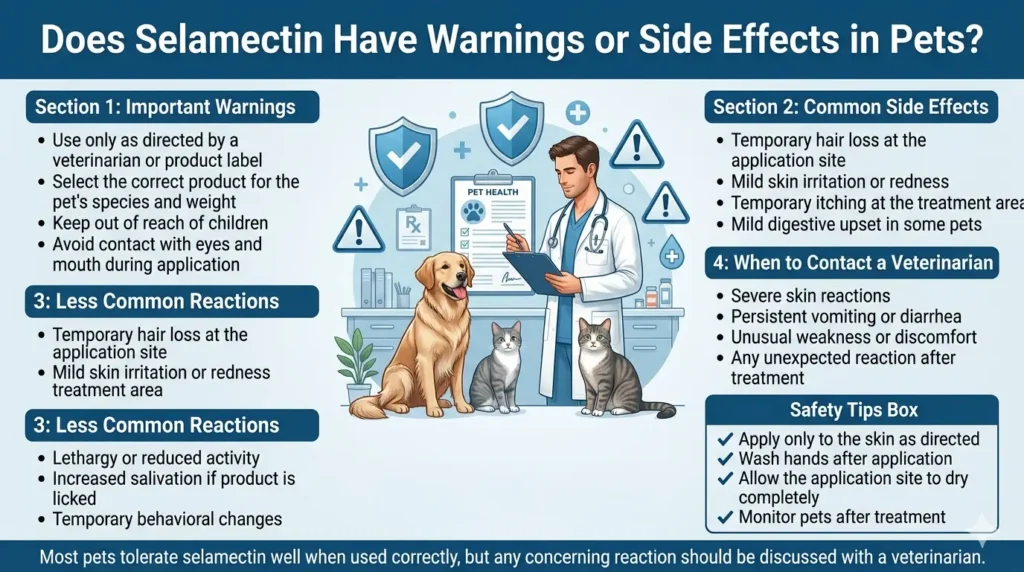
Selamectin is a well-tolerated and safe drug when administered correctly. But, as with all medications, there are some side effects that may occur in some pets and there are precautions that need to be taken with use. Side effects are rare, and are usually mild and temporary.
Important Warnings and Precautions
Never use Selamectin on a pet known to be allergic or sensitive to Selamectin.
It is also not approved to treat:
- Dogs under 6 weeks old
- Cats less than 8 weeks old
Be careful when using selamectin in:
- Pets that are sick, debilitated, frail or under weight.
- Animals that are pregnant or lactating
- Pets which fail to have been tested for heartworm infection at the proper point in time
- Cats and dogs that have the MDR1/ABCB1 gene that may make them more sensitive to some drugs
Drug sensitivity may occur in certain dog breeds, such as Collies, Sheepdogs and related crosses, because of the mutation in the MDR1/ABCB1 gene. These mutations can happen in cats too, but are thought to be less common.
Selamectin contains alcohol and is flammable, so avoid heat source, sparks and open flames during and after application.
Common Side Effects
The side effects listed below are rare in dogs and cats:
- Hair loss at the site of application (temporary)
- Scratching or itching around the site of treatment
- Redness, irritation, flaking or slight inflammation of the skin.
- Hives (urticaria)
- Powdery residue, stiff or clumped hair or discolored hair at site of application.
- Vomiting
- Diarrhoea or loose stools (occasionally blood)
- Decreased appetite
- Excessive salivation (drooling)
- Lethargy or tiredness
- Rapid or shallow breath, shortness of breath
- Fever
Most changes that occur at the application site are temporary and will not impact the safety or effectiveness of the medication.
They are rare but serious side effects.
Severe reactions are rare but can occur and include:
- Muscle tremors
- Walking problems or problems with coordination (ataxia)
- Seizures
- Difficulty breathing
Seek veterinarian's advice immediately if any severe reaction occurs.
Accidental Oral Ingestion
Selamectin has many side effects which are more common if it is ingested than applied topically. Signs may include:
- Excessive drooling
- Vomiting
- Decreased appetite
- Increased urination
- Lethargy
If accidental ingestion or overdose is suspected, immediate veterinary attention should be sought.
Knowing what side effects have been reported.
It should be noted that adverse reactions reported do not always indicate that the medicine is responsible for the adverse reaction. In clinical trials and post marketing surveillance, any symptom following treatment is recorded, regardless of whether it may be related to the drug or not. The list of reported reactions may seem long, but most pets who take selamectin don't have any sort of major issues. Veterinarians take into account the potential risks and benefits for each pet before prescribing the medication.
Selamectin is a long lasting treatment that usually lasts for 4-6 weeks, and may last longer in pets with kidney or liver disease. It is always important for pet owners to be vigilant and watch their animals after treatment and call a veterinarian if any unusual symptoms occur.
Does Selamectin Interact With Other Medicines?
Selamectin is generally safe to use in combination with many commonly used veterinary products. It was used safely in clinical trials with the following: vaccines, dewormers, other antiparasitic drugs, antibiotics, cortisone (or steroid) and medicated shampoos, flea collars, and dip medications. With any medicine, however, drug interactions can occur and should be taken into account prior to starting therapy.
When a pet owner takes their dog to the vet, they should always let their veterinarian know about any prescription or over the counter medicines, vitamins, minerals, supplements or herbal products that the pet is taking. This will minimize the risk of any possible interaction and use of selamectin safely.
Some drugs should be used with a little more care, especially in dogs that are genetically predisposed to increased sensitivity to certain drugs (the MDR1/ABCB1 genetic mutation). Veterinarians should take the following medications into consideration when using selamectin or may need to be used with caution when selamectin is present:
- Cyclosporine
- Diltiazem
- Erythromycin
- Spironolactone
- Verapamil
- Antifungal drugs, such as azole drugs:
- Itraconazole
- Ketoconazole
Breeds of dogs that are likely to have the MDR1/ABCB1 mutation like Collies and other herding dogs can be more sensitive to adverse affects of certain medications when combined together.
This is not a comprehensive list of all potential drug interactions; however, no major interaction problems have been commonly reported with selamectin. Veterinarians should ask patients about their medical history and any current medications before administering selamectin treatment to ensure the optimum treatment plan for each pet.
You May Also Like to Read:
- Grapiprant Dosage For Dogs: Calculator, Chart & Safe Guide
- Glucosamine/Chondroitin Dosage For Dogs Calculator & Safe Guide
FAQs
Do Pet Owners have any Safety Concerns?
Yes. Selamectin drug is considered safe to use when applied correctly, but there are a few precautions which pet owners should take during and after use. Do not allow children to have access to selamectin and do not use if you are known to be allergic to it. Avoid direct contact with skin, clothing and eyes. Wash your hands well after applying selamectin and try not to touch the spot it was put on your pet until it is dry. The product is also highly flammable and must also be stored and used away from heat sources, open flames and sparks.
What if I Give My Dog Too Much Selamectin?
Selamectin has a wide safety margin and overdose is unlikely to occur if the product is used according to the instructions. If you think your dog may have been given too much, or your dog may have accidentally eaten the product or is exhibiting signs of an adverse reaction, contact your vet or emergency veterinary clinic straight away. Have details of the product used, dog's weight, dosage given and any symptoms that have arisen.
If you forget a dose, what should you do?
In case of a missed dose, apply selamectin as soon as you remember and then resume your monthly application schedule. Never give a double dose if it is missed. Treatment should be resumed monthly if it has been more than eight weeks since the previous dose(s). However, for dogs, a heartworm test may be recommended about six months later as heartworm infections take months to develop after exposure to infected mosquitoes.
Is it Necessary to Watch My Dog When He's on Selamectin?
Generally, no routine lab monitoring is needed when selamectin is being used. However, your veterinarian may want to periodically assess your dog to make sure that the medicine is working to keep the parasites under control and prevent infections. Owners should monitor for any atypical side effects or behavior changes at home, and reach out to their veterinarian if there are any concerns.
What is the proper storage for Selamectin?
Selamectin dosage for dogs should be kept in the original container at temperatures below 86°F (30°C). Medication is flammable and needs to be kept away from excessive heat, direct sunlight, flames, sparks and other ignition sources. With proper storage, the product will remain effective and safe.
What is Selamectin packaged in?
Selamectin products come in a variety of different weight based dosage strengths to guarantee proper dosing of a dog or cat, depending on its size. Typically, a product comes in 3- or 6-tube cartons of single doses and there are special formulations for puppies, kittens, adult dogs, and adult cats.
Final Thoughts
Selamectin Dosage For Dogs By Weight is a veterinarian-prescribed topical treatment that has proven itself to be a reliable treatment against several of the most common parasites that can affect dogs. It can prevent heartworm disease, kill adult fleas, prevent flea eggs from hatching, treat ear mites, control sarcoptic mange and control certain tick infestations with a single monthly application. Because it is so convenient, very effective and has a relatively good safety margin, it is a popular choice for year around protection against parasites.
When it comes to selamectin for dogs, it's crucial to use the correct dosage to ensure the best possible protection without compromising safety. Dosage is dependent upon body weight and other health considerations, so pet owners should always rely on their veterinarian’s advice and only use the strength of product recommended for their dog.
Selamectin is well tolerated by most dogs, however, monitoring for possible side effects and sticking to a monthly treatment schedule can help you get the most out of the treatment. By preventing parasites, you are not only keeping your dog more comfortable and free from illness, but also helping to make your home a more healthy environment, free from fleas and other parasites.
Ask your veterinarian if selamectin is right for your dog's particular needs and if you have any questions regarding selamectin's dosing, safety and parasite prevention.