Quick answer: “Nux vomica” might refer to a plant which is a source of strychnine, or to an ultra-diluted homeopathic remedy for dogs with gastrointestinal upset. Most pet owners are interested in the homeopathic product, but there is no known clinically established dosing chart for it and mainstream veterinary medicine has not found evidence of its effectiveness.
This guide has clear explanations to help you make a safe, and informed decision with your vet.


Paid Links - As an Amazon Associate, I earn from qualifying purchases.
What Is Nux Vomica?
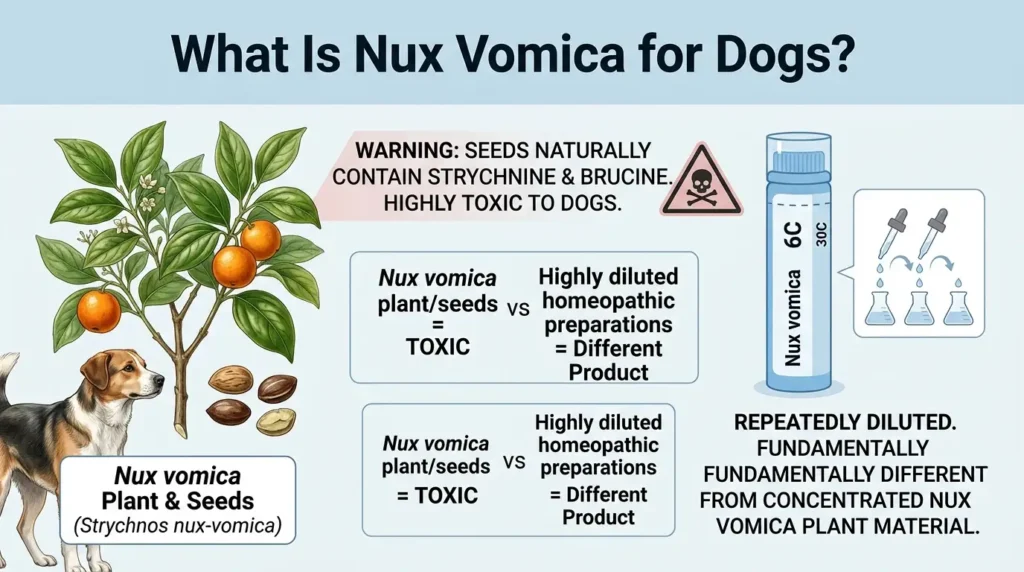
Nux vomica medication is derived from the seeds of a tree, Strychnos nux-vomica, found in India and Southeast Asia. The seeds contain two toxic alkaloids (strychnine and brucine) naturally. It’s the same plant that was once used to make poison for rodents and predators and it is really toxic — strychnine is a very low toxic dose in dogs.
Homeopathy, on the other hand, uses “Nux vomica” to denote something else: a “drug” made by repeatedly diluting a nux vomica tincture, frequently to the point where none of the strychnine remains, based on their concepts of “like cures like” and the “law of minimum dose. These are principles of homeopathy, not conventional pharmacology.
When a pet food label reads “Nux Vomica 6C,” or “30C” or “Nux Vomica Homaccord,” it is not the plant itself, or even a concentrated form of the strychnine that is being used. This is a huge difference for safety reasons and should be the first thing you check before you think about feeding anything to your dog.
Quick Facts Box
| Term | What it means |
| Raw nux vomica seed | Natural source of strychnine and brucine; toxic |
| Homeopathic Nux Vomica | Diluted preparation used in homeopathy; sold as pellets, drops, or combination remedies for pets |
| Potency (e.g., 6C, 30C, 200C) | A code for how many times the original substance was diluted — higher number generally means more dilution |
| Nux Vomica Homaccord | A brand-name combination homeopathic product that includes nux vomica among other ingredients |
What Homeopathic Nux Vomica Is Claimed to Help With in Dogs
In holistic and homeopathic veterinary medicine, nux vomica is among one of the more frequently accessed remedies for dogs with regard to acute digestion upset. Owners and homeopathic practitioners are accustomed to putting it in conjunction with:
- Vomiting, particularly following a “garbage gut” (“eating too much of the wrong food”)
- Diarrhea or straining
- Overeating, gas or “hungover” appearance after ingesting an unpleasant food or too much food
- General feeling of nausea or vomiting without much vomiting
- Some practitioners attribute some degree of irritability or restlessness, which they call “digestive discomfort.
Note: these are homeopathic indications as used in veterinary practice, not the result of controlled veterinary clinical trials. Well-established research organizations such as the Council on Research of the American Veterinary Medical Association have examined the homeopathy literature and have concluded that there is generally no evidence of a beneficial effect of homeopathy in animals through well-designed studies.
That is a significant difference between what is advertised and what has been proven in a scientific study, but it does not mean that the remedy is not safe at higher dilutions regularly used, nor that it should not be used as a substitute for veterinary diagnosis, however, for anything more than mild and transient symptoms.
Does Nux Vomica Actually Work for Dogs? What the Evidence Shows
The most forthright answer out there is that the evidence of homeopathy’s effectiveness in veterinary medicine is poor. The Council on Research at the AVMA reviewed the literature and determined that studies that were purported to have a beneficial effect after using homeopathy in animals were either anecdotal or had poor study design, and well-designed studies generally did not demonstrate a clear treatment effect.
The AVMA’s House of Delegates has discussed the matter on several occasions but has yet to rule on a ban on the practice, stating only that all treatment modalities must be subjected to “the same evidentiary standard.
That puts owners in a grey area:
- The risk of using a homeopathic remedy is generally low if your dog experiences only minor (one vomiting episode, one loose stool, no other symptoms) and temporary digestive upset and your vet is comfortable with you trying a homeopathic remedy while keeping your dog under observation.
- Homeopathy should never be used as an alternative to veterinary examination if your dog exhibits persistent vomiting/diarrhea, blood in stool and/or vomit, lethargy, refusal to eat/drink, and/or signs of pain. These symptoms may be a sign of obstruction, poisoning, pancreatitis, infection, or other conditions that require diagnosis.
So, in conclusion, don’t use homeopathic nux vomica dose as a recommended treatment, but if you want to try something that is unproven, low risk (because it is diluted to such high levels), and very mild symptoms, go for it, under veterinary supervision of course.
Nux Vomica Dosage for Dogs: Why There’s No Universal Chart (and What to Do Instead)
Perhaps you found yourself here searching for one of these two things: a calculator or a dosage chart based on weight. The truthful and responsible answer is that there’s no clinically proven, standardized dose of homeopathic nux vomica for dogs.
Whereas a prescription drug has a known mg/kg dose with pharmacokinetic studies to support the dose, homeopathic remedies are given as a specific dose as determined by each manufacturer using their own labeling convention, which differs according to:
- Form (liquid drops, pellets, tablets, combination formulas such as Homaccord-style products)
- Potency (6C, 30C, 200C, etc.)
- Brand-specific dilution and manufacturing process of the product.
- Either one remedy or combined with other homeopathic ingredients.
Due to that variation, whatever “X drops per pound” chart you see online is either one brand’s “standard” and is being passed off as everyone’s, or it is just plain made up. We will not post bogus data here. Rather, here’s how to dose responsibly:
How to Determine a Safe Dose
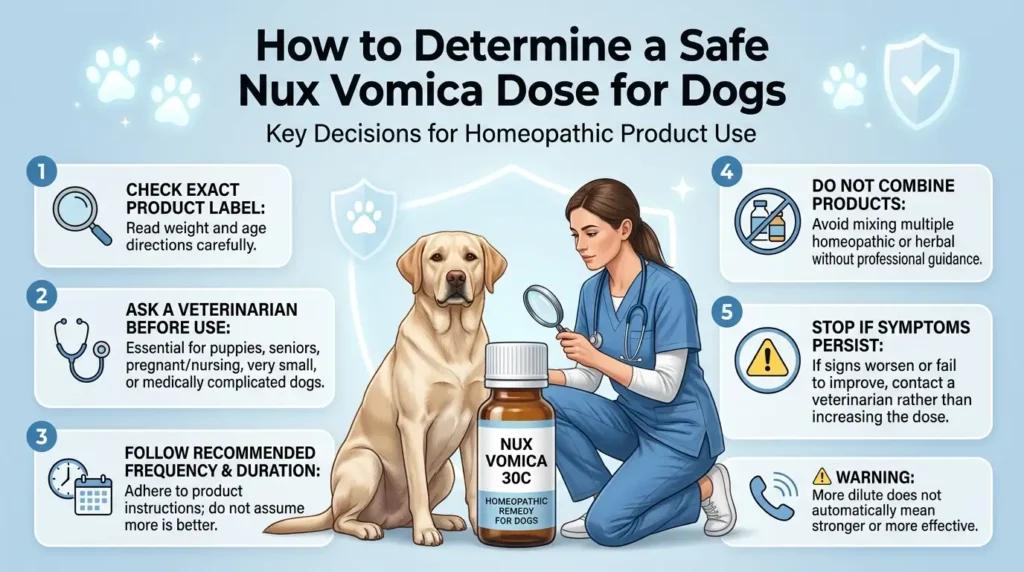
- Always begin with the actual product label. All lawful homeopathy pet products sold in the USA have directions on how to dose it by weight tier or age. This label, and not a generic online chart, is the manufacturer’s recommended information regarding their particular formulation and strength.
- Before beginning any remedy, particularly with puppies, senior dogs, pregnant or nursing dogs, dogs under 5-10 lbs, or dogs with health issues, call your veterinarian, preferably one with holistic/integrative training.
- Employ lowest working frequency. Homeopathic medicines for acute symptoms are usually taken for a short period of time and weeded out as the symptoms clear up, not taken indefinitely—so check the directions on the specific product, but do not assume.
- Do not mix different homeopathic/herbal products without supervision. Natural does not equal safe when using products stacked.
- If the symptoms do not improve in the time frame suggested in the label (usually within a day or two for acute digestive issues) or if symptoms deteriorate at any time, cease and contact your vet. If the symptom persists and/or progresses, a “non-working” remedy is a clue to a diagnosis, NOT to a higher dose. A Word on ‘More Dilute is Stronger’
The potency labels (6C, 30C, 200C) used in homeopathy indicate an increased potency with increased dilution, which is contrary to the standard tenets of conventional pharmacology, which state that the more dilute the less potent.
Do not presume that a higher potency number is “safer” or “stronger” than another like you would with a traditional drug—all potency numbers are specific to the product label instructions and use.


Paid Links - As an Amazon Associate, I earn from qualifying purchases.
Side Effects of Homeopathic Nux Vomica in Dogs
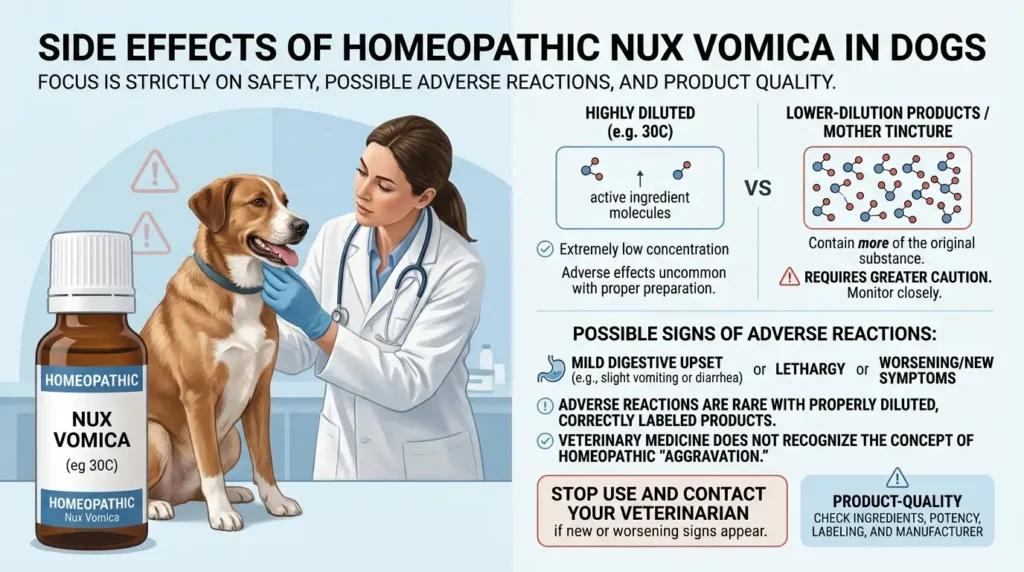
However, since the homeopathic preparations generally contain strychnine that is far too dilute to have any measurable pharmacologic effect when applied as indicated, reports of such effects from properly diluted, correctly labeled preparations are rare in the literature consulted. That said:
- Low potency products (such as low dilutions or mother tinctures) have greater potential to contain the original substance than high potency products. Check what you are providing.
- Individual sensitivity varies. Some owners do experience a slight upset of the gut, lethargy or a temporary increase in symptoms (according to homeopathic theory – “homeopathic aggravation”) upon commencement of a remedy.
- The quality of the products depends on the manufacturer. Select trusted brands, look for a clear ingredient/potency label, and do not take products that do not have clear labels.
If your dog develops any new or worsening signs after the introduction of any remedy, discontinue and inform your veterinarian.
Real Risks: Don’t Confuse the Remedy With the Poison
This is the section that matters most for safety.
The seeds of Strychnos nux-vomica, and products containing strychnine, are indeed, very seriously, poisonous to dogs. The Merck Veterinary Manual reports that the oral LD50 of strychnine is approximately 0.5–1 mg/kg in dogs, so a small dose, per kilogram of body weight, can be fatal.
Historically, the use of strychnine in pelleted baits (which are usually bright red or green) has been aimed at gopher, mole, and other pest control; and dogs, particularly young, large-breed, intact males, are overrepresented in strychnine poisoning cases reported to the ASPCA Animal Poison Control Center.
Signs of Strychnine Poisoning in Dogs
Symptoms typically appear fast — often within 10 minutes to 2 hours of exposure:
- Nervousness, tenseness or abnormal stiffness.
- Rigid, splayed legs (a “sawhorse” stance).
- Shaking of muscles that can then become full-body convulsions.
- Epilepsy which is made worse or caused by touch, sound or bright light
- Trouble breathing or pauses in breathing.
It’s an emergency for the vet! Don’t wait for symptoms to get worse if you suspect that your dog ate rodent/gopher bait, or any product you are not certain is a properly diluted homeopathic remedy with raw nux vomica seeds.
How to Avoid Confusion
- Purchase nux vomica homeopathic remedies from well-known pet health companies that have legible labels with the potency listed (such as 6C, 30C) and a complete list of ingredients.
- Do not use garden, pest-control products or “natural rodenticide” products as a substitute for a pet homeopathic remedy — even though both may have “nux vomica” listed as a source.
- Ensure pets cannot reach any pest-control products and inquire about neighbors or landscapers using strychnine bait in the vicinity.
Drug and Supplement Interactions
There are no formal interaction studies of homeopathic nux vomica in dogs, and generally few homeopathic products in veterinary medicine have been the subject of formal interaction studies. As a safety measure in general:
- In addition to prescription medications, inform your veterinarian of any supplements, herbs or homeopathic remedies your dog takes, so he or she can be aware of potential issues and maintain an accurate record.
- If using more than one digestive product (such as a homeopathic product and an herbal digestive supplement and an OTC anti-nausea product), be careful because we don’t yet know what the effect is of using them together on a dog’s digestive tract, and each one may not be harmful on its own.
- If your dog is taking any prescription meds for chronic diseases (seizure disorders, heart disease, kidney or liver disease), consult your vet before introducing anything new, homeopathic or not.
Raw Nux Vomica vs. Homeopathic Nux Vomica: Side-by-Side
| Raw Nux Vomica Seed / Strychnine | Homeopathic Nux Vomica (e.g., 6C–200C) | |
| What it is | Natural plant source of strychnine and brucine | Highly diluted preparation made from a nux vomica tincture |
| Toxicity | High — LD50 ~0.5–1 mg/kg in dogs | Generally considered low at high dilutions, but not zero-risk, especially at low potencies |
| Regulatory status | Restricted/banned as pesticide in many countries | Sold over the counter as a homeopathic pet product in the U.S. |
| Clinical evidence in dogs | Well-documented toxicology (poisoning literature) | Limited; major veterinary bodies report no clear evidence of treatment benefit |
| Typical use case | None (poison; historically pest control) | Marketed for mild, acute digestive upset |
| Emergency risk | Yes — rapid-onset, life-threatening | Low at proper dilution; still stop use and call your vet if any adverse reaction occurs |
Myth vs. Fact
Myth: ‘Nux vomica for dogs is just a natural and harmless herb.
Fact: the plant contains one of the more dangerous poisons that a dog might come across, strychnine, which is a natural source. The homeopathy product is a different thing, also very diluted – it all depends on the variety of homeopathic remedy you are talking about.
Myth: “The lower the homeopathic potency, the more dilute the medicine is, and the more effective it is, and the less of it is required.
Fact: This is one of the principles of homeopathy and not of conventional pharmacology. Never assume anything about potency and dosing; always follow the specific product’s label.
Myth: “Proven to work if used on pets.
Fact: Homeopathic pet products can be legally sold without the same efficacy evidence in clinical situations that conventional veterinary products require. Large veterinary research reviews have not shown definite advantages.
When to Call Your Vet Immediately
Dogs should not be kept as a wait-and-see, and should be taken straight to the vet or emergency clinic if they show:
- Persistent vomiting or diarrhea (more than one or two times)
- Any blood in vomit or stool
- Shakes or stiffens muscles or adopts a “sawhorse” posture
- Any type of seizures
- Difficulty breathing
- Excessive sluggishness or collapse.
- Exposure to rodent/gopher bait, to garden chemicals or to an unknown substance.
You May Also Like to Read:
- Pexion Dosage For Dogs: Calculator, Chart & Safe Guide
- Prazosin Dosage For Dogs: Calculator, Chart & Safe Guide
FAQs
Are nux vomica dog pills is safe?
Owners and holistic practitioners who use this product have found it to be low-risk at the typical high dilutions, but there is not much clinical evidence to back up this. and the raw plant/strychnine form is definitely dangerous. Use of the word “safe” is solely based on the product and potency being used; always check the label and veterinarian.
What is the maximum amount of nux vomica for a dog?
There is no standard, clinically proven dosage. Use the exact dosage as written on the label for the product that you have purchased and verify the dose and frequency of administration with your veterinarian before beginning.
Will nux vomica cure my dog from vomiting or diarrhea?
No controlled clinical studies have proven that it is effective at curing digestive illness in dogs. It has been used for mild, short-term upset and monitoring by some owners but if symptoms are ongoing or severe there may be serious underlying causes that require veterinary diagnosis.
Is nux vomica the same as strychnine?
Not used in its homeopathic form. The toxic alkaloid in raw nux vomica seeds is called strychnine. The homeopathic use of nux vomica usually results in a solution containing very little or no nux vomica, due to the extent of dilution.
How can you tell if your dog has been poisoned with nux vomica/strychnine?
Sudden onset of stiffness, a “sawhorse” posture, muscle tremors, seizures (may be precipitated by touch or sound) and difficulty breathing. This is not what should happen to a properly diluted homeopathic remedy, and is a medical emergency.
Can puppies take homeopathic nux vomica medication?
Always consult with your veterinarian. Pediatric-related information for homeopathy preparations is not well documented and puppies are smaller and sensitive to any substance.
Is it safe to administer nux vomica with my dog’s other medications?
Before combining, tell your vet about all of the medicines your dog takes, including homeopathic ones. There is no formal interaction study for homeopathic nux vomica; here it is up to your vet’s discretion.
Where would I get homeopathic nux vomica for dogs?
Some holistic pet wellness stores and integrative veterinary offices sell it. Select brands whose potency and ingredient content is clearly listed and preferably known to your veterinarian.
Does AVMA recommend Homeopathy for dogs?
No. The AVMA’s Council on Research has said there’s no clinical evidence for using homeopathy to treat or prevent disease in animals, and although it hasn’t endorsed it, it also hasn’t banned veterinarians from providing it.
What is the distinction between 6C, 30C and 200C potency?
These numbers indicate the dilutions of the original substance, according to the homeopathic system. They are not equivalent to a standard dose like a milligram dose of a traditional medicine; follow the instructions on the label of the particular product.
Will homeopathic nux vomica interfere with anesthesia prior to my dog’s surgery?
Before any surgery, let your dog’s veterinary surgical team know if your dog is taking any supplements or homeopathic remedies, even if there is no known risk of interaction.
Key Takeaways
- Two substances are called by the same name. The seeds of Strychnos nux-vomica are poisonous and contain strychnine which is a fast acting poison. Homeopathic nux vomica dosage for dogs has been diluted to such an extent that there is hardly any plant material left.
- There is no universal dosage chart known to be effective. Because homeopathic dosing is determined by each manufacturer’s label, not by clinical pharmacology, this article will not attempt to create a dose that does not exist — and you should not place any trust on a generic dose you find online over your product’s label.
- However, homeopathy has failed to find clinical evidence of treating or preventing disease in animals, as far as major veterinary groups are concerned. That isn’t to say that owners cannot decide to use it, but it is a good indicator of what to expect.
- True Strychnine toxicity is a medical emergency which has nothing in common with a homeopathic remedy. Be aware of the difference, you don’t want to be caught confusing the two.
- Please include your vet, particularly if your dog is a puppy, senior, pregnant, nursing, or on any medications.
Final Thoughts
The name ‘Nux vomica’ is actually two discussions in one. One is a poisonous plant and has a well-documented dangerous poisoning profile in dogs. The other is a homeopathic product which is a very weak dilution and owners have found to be effective for slight digestive problems, but which mainstream veterinary research has been unable to substantiate by clinical evidence.
If you’re thinking about using it for your dog, there is a responsible way to do this: only purchase a product from a reputable source that is clearly labelled; only use it according to the instructions on that label, and not a generic chart from the internet; consult your vet about using it – particularly if the symptoms are more than mild and temporary; and remember what the symptoms of actual poisoning are so you don’t mistake a homeopathic remedy for a true toxic exposure.
Your veterinarian’s office is always a better starting point for a treatment than a home remedy, when you have any doubt.