Glucosamine/Chondroitin Dosage Calculator For Dogs By Weight
Accurate Glucosamine & Chondroitin requirements based on your dog’s weight
1. Your Dog’s Weight
2. Product Label Info Optional
Loading Dose
Weeks 1 to 6 Protocol


Maintenance Dose
Week 7 Onward Protocol
How To Administer Your Dog’s Dosage:
- Check the “Active Ingredients” breakdown on your supplement’s packaging label.
- Note down the exact milligram (mg) amount provided per single chew, tablet, or liquid metric.
- Match your product’s numbers to the calculated mg targets above to see how many units your dog requires daily.
© medsdog.com
One of the most popular joint-support supplements is Glucosamine/Chondroitin Dosage For Dogs, particularly for dogs suffering arthritis and/or osteoarthritis, joint pain, stiffness, mobility issues and/or age-related wear and tear. The cartilage or the protective cushion that lies between the bones can deteriorate over the years through running, jumping, playing and use and cause inflammation and pain in the joints. When the cartilage wears away, bones can rub against one another, causing limping, decreased mobility, trouble climbing stairs, difficulty getting into/out of cars or furniture, and a decline in quality of life.
As a rule, veterinarians prescribe glucosamine and chondroitin to support the health of your dog’s joints and keep him moving. A natural compound, glucosamine is used to repair and maintain cartilage, and chondroitin helps keep moisture in cartilage and may even slow down the breakdown of cartilage. These ingredients offer a synergistic combination that aids in maintaining healthy joints, enhancing flexibility, alleviating stiffness, and ensuring smooth and comfortable movement. These are often prescribed for older age dogs, dogs that have injuries, larger breeds who are at risk for joint problems and dogs with a osteoarthritis diagnosis.
Joint disease ranks among the most frequent health issues in dogs, and is a growing concern for millions of dogs around the world, especially with aging. But with early joint support, dogs can enjoy time spent with their family members, playing and taking walks for a longer time. Although glucosamine and chondroitin cannot cure arthritis, they can be a valuable part of a holistic joint-care program, and may be combined with veterinarian-prescribed pain or anti-inflammatory medication if necessary.
In this guide, you’ll find out everything you need to know about glucosamine/chondroitin dosage for dogs, how they work, dosage charts by weight, possible benefits, potential side effects, safety considerations, and the best ways to give your dog glucosamine and chondroitin for optimal effectiveness.
Key Takeaways
- Glucosamine dosage for dogs is a dietary supplement and amino sugar that is often used to help maintain healthy joints and mobility in canine pets.
- The most widely used are glucosamine sulfate, glucosamine hydrochloride and N-acetyl glucosamine; of which glucosamine sulfate and glucosamine hydrochloride are the most popular for joint support.
- Glucosamine is thought to supply the building blocks required to maintain healthy cartilage that cushions the joints and enables comfortable movement.
- The regular supplementation may benefit of protecting the joints, slowing down the degeneration of cartilage, enhancing mobility and range of motion, decreasing joint discomfort and aiding in recovery after joint problems.
- Glucosamine is not considered dangerous for dogs, although it sometimes causes a slight increase in water intake and stomach upsets in some dogs at high doses.
- The amount of your dog’s daily dose depends on the size of your dog, health status, and individual needs, so it is best to consult the veterinarian for guidance before beginning to supplement.
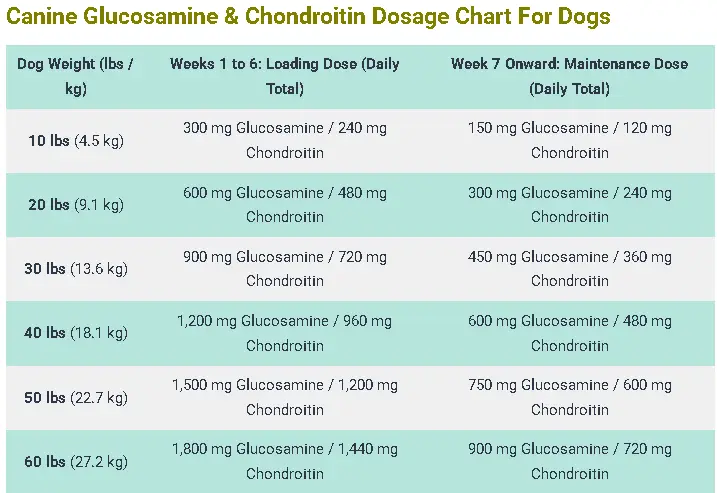
Canine Glucosamine & Chondroitin Dosage Chart For Dogs
This reference chart provides the exact daily milligram (mg) requirements based on your dog’s weight in both pounds (lbs) and kilograms (kg).
| Dog Weight (lbs / kg) | Weeks 1 to 6: Loading Dose (Daily Total) | Week 7 Onward: Maintenance Dose (Daily Total) |
| 10 lbs (4.5 kg) | 300 mg Glucosamine / 240 mg Chondroitin | 150 mg Glucosamine / 120 mg Chondroitin |
| 20 lbs (9.1 kg) | 600 mg Glucosamine / 480 mg Chondroitin | 300 mg Glucosamine / 240 mg Chondroitin |
| 30 lbs (13.6 kg) | 900 mg Glucosamine / 720 mg Chondroitin | 450 mg Glucosamine / 360 mg Chondroitin |
| 40 lbs (18.1 kg) | 1,200 mg Glucosamine / 960 mg Chondroitin | 600 mg Glucosamine / 480 mg Chondroitin |
| 50 lbs (22.7 kg) | 1,500 mg Glucosamine / 1,200 mg Chondroitin | 750 mg Glucosamine / 600 mg Chondroitin |
| 60 lbs (27.2 kg) | 1,800 mg Glucosamine / 1,440 mg Chondroitin | 900 mg Glucosamine / 720 mg Chondroitin |
| 70 lbs (31.8 kg) | 2,100 mg Glucosamine / 1,680 mg Chondroitin | 1,050 mg Glucosamine / 840 mg Chondroitin |
| 80 lbs (36.3 kg) | 2,400 mg Glucosamine / 1,920 mg Chondroitin | 1,200 mg Glucosamine / 960 mg Chondroitin |
| 90 lbs (40.8 kg) | 2,700 mg Glucosamine / 2,160 mg Chondroitin | 1,350 mg Glucosamine / 1,080 mg Chondroitin |
| 100 lbs (45.4 kg) | 3,000 mg Glucosamine / 2,400 mg Chondroitin | 1,500 mg Glucosamine / 1,200 mg Chondroitin |
Key Reminders For Administration
- Splitting the Dose: For larger daily quantities (especially during the initial 6-week loading phase), it is highly recommended to split the total dosage evenly between morning and evening meals to maximize absorption and reduce potential stomach sensitivity.
- Checking Product Labels: Always verify the active mg amounts per chew or tablet listed on your specific supplement container. A single target dose might require a fraction of a chew or multiple treats depending on product strength.
What Is Glucosamine/Chondroitin for Dogs?
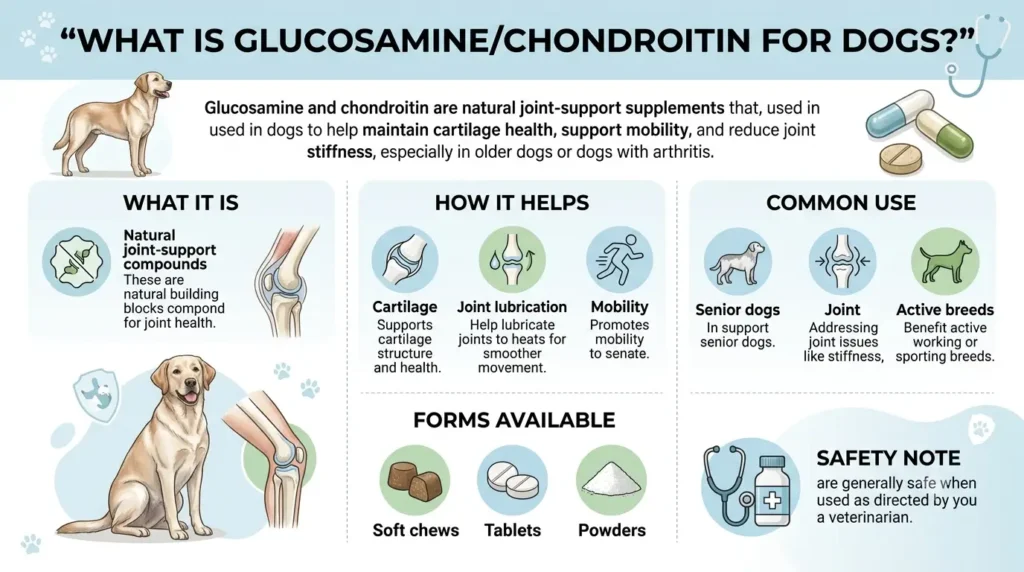
Glucosamine and chondroitin dosage for dogs are popular nutritional supplements that can aid in supporting joint health, cartilage maintenance and mobility in dogs. They are frequently prescribed for dogs suffering from arthritis, degenerative joint diseases, hip dysplasia, joint injuries, after surgery and geriatric stiffness. Glucosamine and chondroitin are found alone in some supplements, but in many, they are paired because they act in concert to preserve and provide protection to the cartilage.
Glucosamine for dogs is a naturally occurring amino sugar, which is synthesized from glucose and glutamine in the body. It is an important component of cartilage, ligaments, tendons and synovial fluid, which is the fluid that lubricates the joints so they move smoothly. It also possesses slight anti-inflammatory activity and is a vital component in the development, repair and maintenance of joint cartilage. With the ageing of the dog, production of glucosamine can decrease, making it more difficult for the joint to heal normal wear and tear, which can lead to stiffness, discomfort and decreased mobility.
Chondroitin for dogs is a natural carbohydrate found in cartilage that helps maintain the water content, elasticity and strength of cartilage. It aids to absorb shock in joints, supplies nutrients to joint tissue, helps to produce cartilage and may reduce the actions of destructive enzymes that can cause cartilage to break down. Combined, glucosamine and chondroitin can assist in maintaining the health of the joints and mobility.


Paid Links - As an Amazon Associate, I earn from qualifying purchases.
Glucosamine is typically sold in three different forms: glucosamine sulphate, glucosamine hydrochloride (HCl) and N-acetyl glucosamine. The most common varieties of glucosamine available in canine joint supplements are glucosamine sulfate and glucosamine hydrochloride. Glucosamine and chondroitin come from shellfish and crustacean shells, sea mollusks, cartilage from cows, pigs, chickens, and sharks, and some are made in labs, or are derived from plants.
Glucosamine/chondroitin products are not prescription medications, but dietary supplements, so they do not need a veterinary prescription. They come in different forms such as chewable tablets, soft chews, powder, capsules and fortified dog food. Product quality and formulations may vary; it is best to talk with the vet to determine the best supplement for your dog.
How Is Glucosamine & Chondroitin Used for Dogs?
Glucosamine and chondroitin is often recommended for the health and function of joints in dogs—especially for dogs that have arthritis, degenerative joint disease, a joint injury or age-related stiffness. It helps maintain cartilage, facilitates formation of synovial fluid and increases the lubricity of the joints to help avoid painful movements.
Common uses of glucosamine/chondroitin include:
- Supporting dogs with OCD and DDD
- Maintaining the health of the cartilage and function of the joints
- Enhance joint lubrication and mobility.
- Decreasing joint pain and swelling
- Helping to heal after joint surgery or disc injuries in the spine
- Supporting active and performance dogs to reach their best health.
Glucosamine/chondroitin dose comes in a variety of forms, such as tablets, capsules, chewable tablets, powder which is added to food or in a liquid for the mouth. May be administered with or without food, depending on your dog’s stomach upset, may be helpful to administer with a small meal or treat.
Most treatment schemes start at a higher dose for 4–6 weeks and then switch to a lower dose for longer term treatment. Symptoms can improve in days for some dogs, but it generally takes 2-6 weeks to see the full effects.
Prior to beginning glucosamine/chondroitin therapy, always use the dosage recommended by your veterinarian and tell your veterinarian if your dog is taking any medication, vitamins, supplements, or herbal products.
What Are the Benefits of Glucosamine/Chondroitin for Dogs?
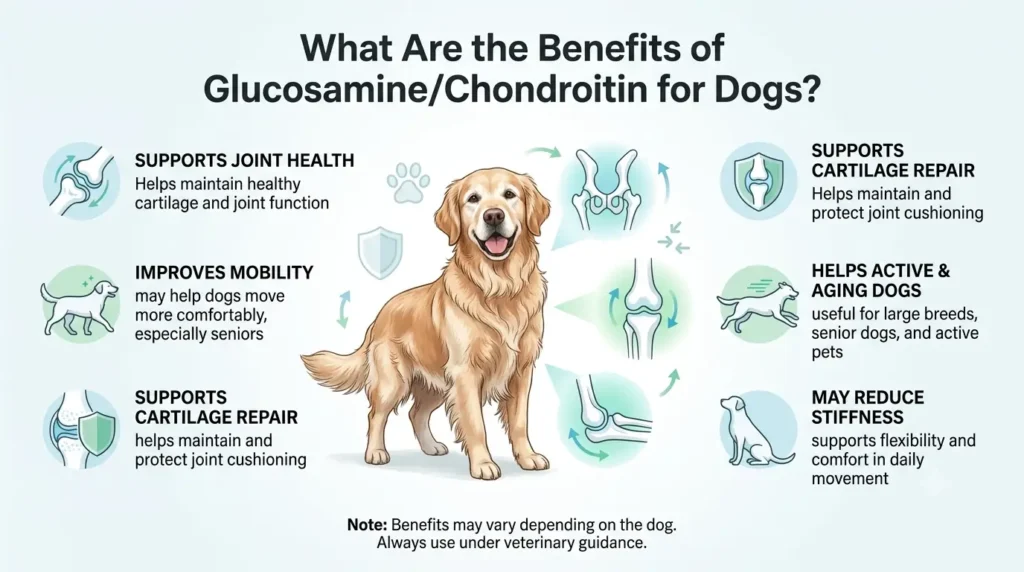
Glucosamine and chondroitin Dosage For Dogs by weight are among the most popular joint-support supplements for dogs, helping maintain healthy cartilage, supporting mobility and promoting long-term joint function. As a combination, they can offer complementary benefits that can keep dogs mobile and comfortable, particularly for older dogs with osteoarthritis or hip dysplasia, or those with joint injuries.
Some of the main advantages of glucosamine/chondroitin are:
- Promotes comfortable and healthy-looking joints without pain in arthritic conditions and other joint problems
- Helps to repair cartilage and slow cartilage breakdown
- Helps to alleviate joint swelling and stiffness, making movement easier.
- Increases range of motion, flexibility and mobility
- Promotes synovial fluid production for improved joint lubrication
- May assist recovery following surgery or injury of the joint
- Supports healthy joint function in active, athletic and aging dogs
- Can be used in conjunction with other joint care measures and veterinarian-prescribed NSAIDs
- Can be used for long periods of time in a large number of dogs, side effects are rare
- Available without a prescription in a variety of supplement forms
Chondroitin also acts to support the joints by helping to preserve the cartilage, stimulate the production of cartilage, and decrease the activity of enzymes that can help to break down cartilage. When paired with glucosamine, it forms an effective joint-support supplement that maintains joint health, yet provides comfort and mobility.
Most dogs do not experience any adverse effects when taking glucosamine/chondroitin; however, pet owners should look out for any unusual side effects that may occur, including changes in the digestive tract, lethargy, sleep changes, increased thirst or urination, and allergic reactions. Safe and effective use recommended, with veterinary guidance.
Does Glucosamine/Chondroitin Have Warnings or Side Effects?
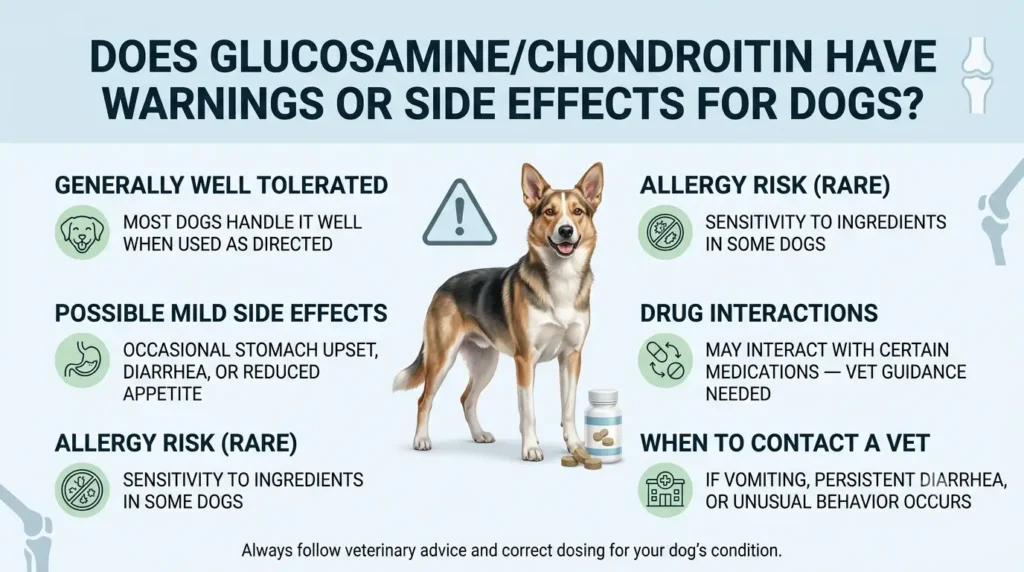
Glucosamine/chondroitin is safe for most dogs and cats and has few side effects. They are rarely severe or lasting when they do occur. But pet owners should be mindful of potential reactions, and when they might need to take extra precautions.
Side effects of the medication may include:
- Mild stomach upset
- Gas (flatulence)
- Loose stools or soft stools
- Some pets vomit or have diarrhea.
Uncommon side effects, especially when taking higher doses, can be:
- Increased thirst
- Increased urination
- Fatigue
- Trouble sleeping or insomnia
These products are not recommended for pets that are allergic to glucosamine, chondroitin, shellfish, fish, mollusks or any of the ingredients in the supplement. Some of the glucosamine supplements are made from shellfish and this can cause more of a reaction in dogs that have a shellfish allergy.
If your pet shows signs of an allergic reaction, such as: get veterinary help right away.
- Irregular or difficult breathing.
- Difficulty breathing or other breathing issues
- Swelling or puffiness around the face.
- Rash
- Fever
Exercise caution when using glucosamine/chondroitin in:
- Animals with asthma or any other illness that makes breathing difficult
- Pets on low potassium foods, as some foods have more potassium than needed in a low potassium diet
- Pregnant or nursing animals except as advised by a veterinarian.
Also keep in mind that sensitivities might be developed over time. A pet may not have a reaction to the supplement the first time, but may develop an allergic reaction or intolerance to it with repeated use. If you observe any of the unusual symptoms, stop the supplement and inform your veterinarian as soon as possible.
Since glucosamine/chondroitin is a supplement and not a prescription drug, there is variation from product to product and from one formulation to another. The safest and right most way to choose and use a supplement is to consult your vet before deciding.
Are There Any Drug Interactions I Should Be Aware Of?
Yes. While glucosamine/chondroitin is generally safe, it can interact with some drugs and may alter the way that they work. Be sure to let your veterinarian know if your pet is taking any prescription or over-the-counter medications, vitamins, supplements, or herbals prior to beginning glucosamine/chondroitin.
Be extra cautious when using glucosamine/chondroitin in combination with:
- Anticoagulants and blood thinners (e.g. heparin, warfarin and rivaroxaban) because the combination could make stomach or intestinal bleeding more likely.
- Medications such as insulin, glipizide, metformin and other antidiabetic drugs may interfere with the effectiveness of this product and can possibly increase blood sugar levels, so diabetes medications should not be used in conjunction with glucosamine/chondroitin.
- A chemotherapy drug called doxorubicin, as glucosamine/chondroitin may reduce its effectiveness.
- Some NSAIDs including carprofen, firocoxib and diclofenac that must be used with care in the hands of a veterinary professional.
- Sertraline, a medication that may need to be monitored especially if taking glucosamine/chondroitin.
All possible interactions are not yet well understood so veterinary advice should be sought before using glucosamine/chondroitin with another drug. Your veterinarian can help determine if any dosage changes or increased monitoring is necessary if your pet is on multiple treatments.
You May Also Like to Read:
- Pantoprazole Dosage For Dogs: Calculator, Chart & Safe Guide
- Sucralfate Dosage For Dogs: Calculator, Chart & Safe Guide
FAQs
Are human glucosamine supplements safe for dogs?
You should not give your dog a glucosamine supplement made for humans without first consulting your veterinarian. Certain ingredients found in human products can be harmful to dogs but not to humans, for example, xylitol. Human supplements can also have incorrect dosages and formulations not intended for dogs. Products that are formulated specifically for dogs are typically safer for your dog as they offer the correct dosage and formulations for your dog.
What is the maximum dose of glucosamine for dogs?
Dosage of glucosamine for dogs can vary, depending on the size of the dog, health status and veterinarian’s advice. Taking more than the recommended dose could make side effects like vomiting, diarrhea, constipation, weight gain or obesity more likely to happen. Glucosamine doses may not cause any problems, but contact your vet if your dog has eaten too much of it.
If your dog misses a dose of the glucosamine/chondroitin, what should you do?
If a dose is missed, administer as soon as possible. If it is close to the next dose, however, skip the missed dose and resume with next scheduled dose. Avoid giving more than one dose at a time or doubling a dose to catch up.
What should I do if my dog overdoses on glucosamine/chondroitin?
If you think your dog has over-consumed glucosamine/chondroitin or if you think your dog is experiencing a negative effect, talk to your vet or an emergency veterinary clinic immediately. Be ready to list details regarding the product, your dog’s weight and any signs that you have noticed.
Should I monitor my dog when it’s on glucosamine/chondroitin?
Yes. Schedule any additional visits and monitoring as recommended by your veterinarian. Keep an eye out for any unusual symptoms or changes in behavior at home. If you see anything that you suspect, discontinue the supplement and seek veterinary advice.
How to store glucosamine/chondroitin dose.
Store glucosamine/chondroitin according to the manufacturer’s instructions, typically at room temperature. Store product away from moisture and light and out of sight and reach of children and pets.
Do pet owners have safety issues to be concerned of?
Glucosamine/chondroitin should be kept out of the reach of children. Wash your hands after giving the supplement and do not touch if you are allergic to any ingredient.
Which one is the best dog glucosamine supplement?
There is no one “best” glucosamine supplement, it depends on your dog’s needs. For some dogs, it may be beneficial to use products which include glucosamine and other supplements that support the joints like chondroitin or MSM. Formulations are available as chewable tablets, soft chews, liquids, powders, and treats that help your dog find a formulation that suits him. Your vet will be able to advise you which is best for your pet.
Final Thoughts
The most well known supplement for dogs’ joints is glucosamine and chondroitin, which is used to maintain healthy cartilage, enhance mobility and help to support joint function over time. They are often prescribed for dogs that have osteoarthritis, stiff joints from old age, hip dysplasia, joint injuries and other issues related to mobility.
These supplements are typically safe and tolerated, but it is important to use the correct dosage and product for optimal results. It will take some time for benefits to become fully evident, and some dogs are more responsive than others. With proper veterinary care, weight management, exercise and other treatments, regular use can help to support your dog’s comfort and quality of life.
Always check with your veterinarian before beginning glucosamine/chondroitin treatment to make sure it is right for your particular pet’s needs, and will not interfere with any other medications or health issues your dog may have. When used appropriately, glucosamine/chondroitin can be an effective supplement in a holistic joint health program that keep your dog moving and at ease for years to come.