Salmon Oil Dosage Calculator For Dogs
Calculate the accurate daily salmon oil dose based on your dog’s weight.
Recommended Dosage Results
Important Guidance & Safety Notes:
- Mix the recommended daily amount directly with your dog’s regular food.
- Fresh drinking water should be available at all times.
- Store in a dry, cool place away from direct sunlight. Reseal properly after opening.
- For best before date, see product packaging.
- For canine use only. Keep out of reach of other animals and children.
The only thing that matters when it comes to salmon oil Dosage for dogs is weight. Once you do, the rest—nicer skin, shinier coat, easier joints—usually follows. Do it wrong, and you'll be spending too much, or risk the side effects if you don't spend enough. The dosage chart and calculator below is designed to work in both pounds and kilograms, and includes the safety information most product labels omit.


Paid Links - As an Amazon Associate, I earn from qualifying purchases.
It's simple to add salmon oil to your dog's meal. The problem most owners have is getting the dosage correct: too low and it is hardly effective, too high and it may cause stomach upset or more. This is a dosage guide by weight (pounds and kg) with an explanation of how to get to these numbers, so that you're not just guessing.
What Is Salmon Oil, and Why Do Dogs Need It?
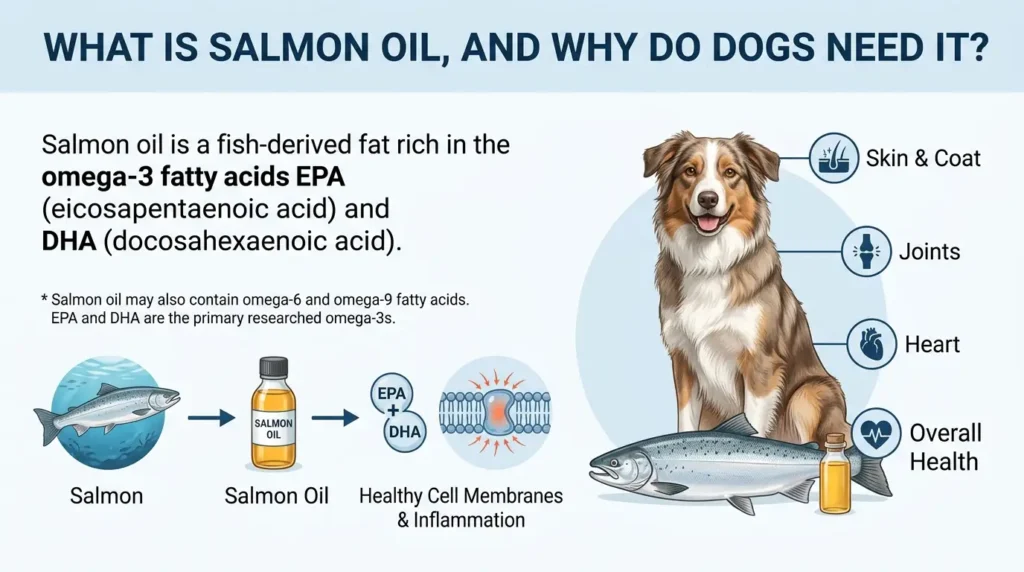
Salmon oil is a fat derived from the salmon fish that contains two long-chain omega 3 fats EPA (eicosapentaenoic acid) and DHA (docosahexaenoic acid). Just as with humans, dogs are unable to synthesize EPA and DHA in significant quantities and must obtain them from their diet (or supplements).
The body uses these fatty acids to construct healthy cell membranes and to generate compounds which help to regulate inflammation. This is why you'll often hear about salmon oil and how it benefits the skin, joints, and heart of dogs.
Salmon oil supplements usually have small amounts of other fatty acids, namely omega-6 and omega-9 fatty acids, which are also beneficial for the skin barrier and overall coat quality, but omega-3 (EPA and DHA) is the fatty acid for which there is the most research.
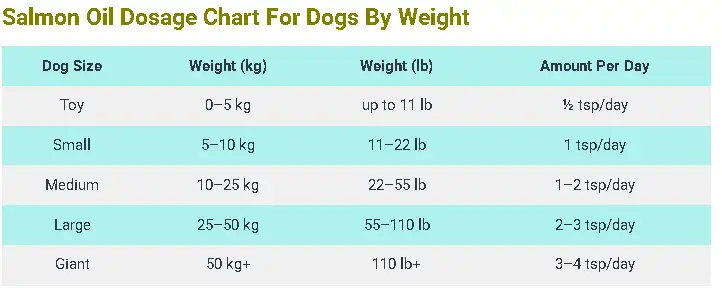
Salmon Oil Dosage Chart For Dogs By Weight
The chart below is an accepted guideline used for feeding most mainstream salmon oil products, once a day, blended into the feed (teaspoons).
| Dog Size | Weight (kg) | Weight (lb) | Amount Per Day |
| Toy | 0–5 kg | up to 11 lb | ½ tsp/day |
| Small | 5–10 kg | 11–22 lb | 1 tsp/day |
| Medium | 10–25 kg | 22–55 lb | 1–2 tsp/day |
| Large | 25–50 kg | 55–110 lb | 2–3 tsp/day |
| Giant | 50 kg+ | 110 lb+ | 3–4 tsp/day |
Mix the recommended daily amount with your dog's food, once a day. Fresh drinking water should be available at all times.
Don't want to do the calculation yourself? At the top of this page, there is a salmon oil dosage calculator - enter your dog's weight in either lbs or kg, and it will instantly calculate the recommended dosage.
How To Read The Chart
- The dose for toy and small dogs is fixed, since there isn't much room for a range at low body weight (4 lb vs 10 lb is not really a meaningful difference in teaspoons).
- The Medium/Large/Giant category is provided as a guideline, you can begin at the lower end and work up, particularly if your dog has not been on fish oil before.
- Giant breeds over 50 kg (110 lb) don't have a hard upper cap on this chart. If your dog is significantly heavier than that (a Great Dane or Mastiff, for instance), do not exceed 3-4 tsp/day and contact your veterinarian if you believe that your dog requires more.
The Science-Based Way To Dose: Milligrams Per Kilogram
While teaspoon charts are useful, they do not indicate the strength of a given product because some salmon oils have more EPA and DHA per teaspoon than others. Omega-3s are usually dosed in veterinary medicine by milligrams of combined EPA + DHA per kg of body weight, rather than by volume.
A typical general guideline is 50-220mg/kg/day of total EPA + DHA; many veterinary nutritionists suggest 100mg/kg/day for general wellness support. Sometimes a maximum rate is listed in veterinary literature as being 310 × (body weight in kg)^0.75 mg/day.
This approach is accurate, but does require your product to list EPA/DHA per serving, which is located on the bottle in the "Guaranteed Analysis" or supplement facts panel.
How To Calculate Your Dog's Omega-3 Dose
- Convert your dog's weight to kilograms (weight in lb ÷ 2.2).
- Multiply this by 100 to determine a general daily amount in milligrams of combined EPA + DHA (adjust the dose between 50-220 mg/kg as per vet's advice and the reason for supplementation).
- Check your product label for the EPA + DHA content per teaspoon or per mL.
- Divide the desired dose by the number of EPA + DHA per teaspoon or mL to determine the number of teaspoons or mL to feed.
Example: A 20 kg (44 lb) dog at 100 mg/kg needs about 2,000 mg of combined EPA + DHA per day. The specific product it is in may vary the amount of dosage the dog requires, so in this case, the dog would need about 4 teaspoons of the product per day if it contains 500mg of EPA + DHA per teaspoon, which is a good example of why it is difficult to calculate the mg/kg dosage and the label's teaspoon dosage exactly.
If there is a great difference between the numbers on the label and on a typical teaspoon chart, use the manufacturer's label as this is the concentration for this product and consult your vet if in doubt.
How To Give Your Dog Salmon Oil
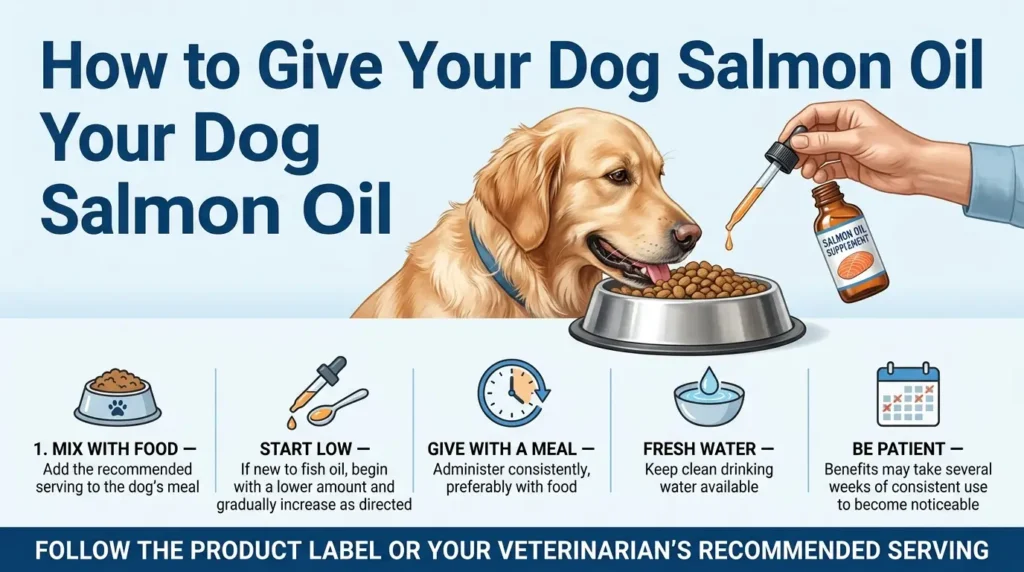
- Mix it into food. Add the daily serving size straight on top of the dog's food and mix it in. Most dogs love the fishy flavor, and they normally don't need to be tricked into eating it.
- If new, start low. If your dog hasn't previously taken fish oil, start with half the recommended dose for the first few days and then gradually increase to the full dose. This allows the digestive system to get used to it and reduces the risk of diarrhea.
- Administer once a day. preferably at the same time of day as a meal, as this will make it a habit.
- Have fresh water on hand. This is normal advice given in all feeding guidelines and is applicable to all oil-based supplements.
- Be patient. Typically, several weeks (8 weeks or more) of daily use is required for visible results because fatty acids must be built into cell membranes throughout the body.
Benefits Of Salmon Oil For Dogs
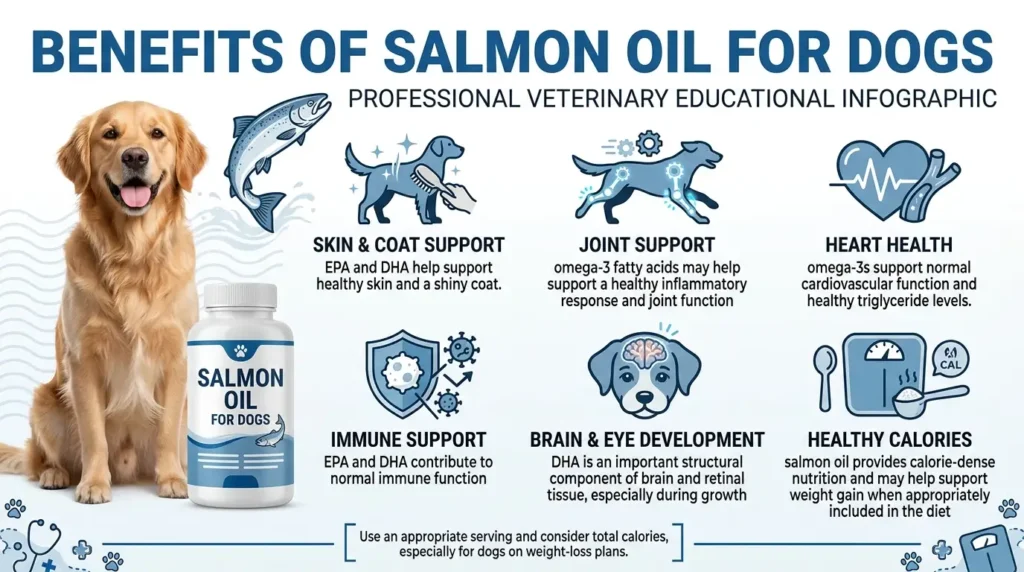
- Condition of skin and coat. EPA and DHA help maintain the skin barrier which will help keep skin dry, itch-free and flaky, and will lead to a shinier coat in the long term.
- Joint support and flexibility. Omega-3s are linked with diminished generation of inflammatory compounds, which is why fish oil is often utilized together with other doggie joint care.
- Heart health. Omega 3 fatty acids may contribute to maintaining normal cardiovascular function and healthy triglycerides.
- Immune support. DHA and EPA are also necessary for immune cell function and can help to improve a dog's resilience.
- Development of brain and eyes. It is a structural part of brain and retinal tissue, hence the emphasis on its importance for puppies as they grow and for older dogs for cognitive function.
- Healthy weight gain in thin dogs or puppies. Salmon oil is a calorie-rich food, which can be beneficial for dogs that are too thin to gain weight, but due to its calorie density, should be fed with caution to dogs on a weight loss plan.
Can You Give A Dog Too Much Salmon Oil?
Yes. Within the recommended dose range, salmon oil is generally very safe; however too much is not necessarily better. If you exceed the recommended amount for your dog's weight, you run the risk of hurting your dog's tummy, helping him gain the pounds and, in a few (and serious) instances, developing pancreatitis—especially if your dog is one of those prone to it, or is overweight.
Follow the instructions on the label or on the calculator on this page and do not "double up" because you think it will give you quicker results.


Paid Links - As an Amazon Associate, I earn from qualifying purchases.
Side Effects Of Salmon Oil In Dogs
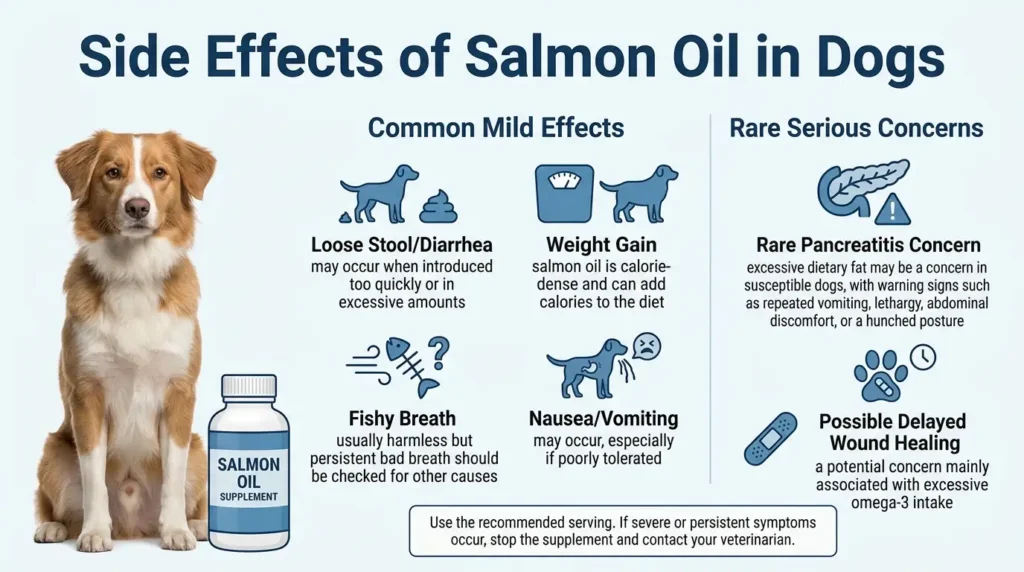
While salmon oil is generally safe for dogs, like all supplements, side effects can occur, particularly if given in amounts exceeding recommended levels:
- Loose stool or diarrhea which is the most common side effect, and typically subsides when the dosage is lowered or when it is introduced more slowly.
- Weight gain – because of the energy density of salmon oil, it can lead to additional weight gain if administered as a supplement to a complete ration.
- Fishy or "off" breath – typically harmless, but constant non-oil related bad breath may indicate dental problems that should be investigated.
- If the child throws up or complains of sickness, especially if it is fed too rapidly or on an empty stomach.
- Pancreatitis (rare) — is a more serious risk in dogs that are overweight and/or that have a predisposition to pancreatitis, because fish oil is a concentrated fat source. Be sure to look for hunched posture, repeated vomiting, lethargy or abdominal pain and make sure to contact your vet right away when you see these signs.
- Delayed wound healing – a theoretical issue that has been reported in veterinary literature with high doses; not a concern at normal maintenance dose.
If you see any of the above symptoms, reduce the dosage for a few days and re-introduce gradually. Discontinue and consult your veterinarian if symptoms are severe and don't improve.
Precautions and Drug Interactions
While salmon oil dosage for dogs is safe for most healthy dogs it is possible to potentially use it with caution or to have a conversation with your veterinarian first in the following circumstances:
- Dogs taking NSAIDs (e.g. carprofen, meloxicam or robenacoxib): Omega-3s and NSAIDs both affect inflammatory pathways, and their use together is frequently used in veterinary medicine but should be supervised by your vet particularly in regards to the dosing of the NSAID.
- Dogs taking blood thinners or blood clotting disorders: Omega 3 fatty acids for dogs can slightly decrease clumping in the plates (blood clotting ability). This effect is typically low at standard doses, but should be noted to your veterinarian, especially prior to surgery.
- Aspirin: fish oil should not be mixed with aspirin, as both have an impact on platelet function and aspirin itself is not routinely prescribed to dogs (unless advised by a veterinarian).
- Dogs on chemotherapy: consult your veterinary oncologist first as the use of fish oil may interact with some forms of cancer treatment.
- Dogs previously diagnosed with pancreatitis and/or overweight dogs: due to the extra fat in the salmon oil, a reduced initial dose and careful monitoring would be recommended.
- Diabetic dogs: omega-3 supplementation may be beneficial in some studies, however consult your vet before beginning.
- Prior to surgery: Due to the slight impact on clotting, some veterinarians advise stopping fish oil supplements for a period of time before any planned surgery – consult your veterinarian for his/her timing advice.
None of this is to say that salmon oil is bad for these types of dogs — there are many dogs that use it and it works well for a lot of them when used under the guidance of a veterinarian. In these scenarios, it just means that you need to have a discussion with your veterinarian before you begin.
Salmon Oil For Puppies, Senior, and Pregnant Dogs
- Puppies: The majority of salmon oil products are suitable for puppies as early as 8-12 weeks (see individual product labels), and DHA in particular can aid with the development of brain and eyes during this growth period. Dose based on the current weight of your puppy and re-check the dosage regularly as your puppy grows.
- Senior dogs: Although older dogs may benefit most from omega-3 support for joints and cognition, seniors are also more likely to have underlying conditions (kidney disease, heart disease, medication use) and may want to make a quick trip to the vet before beginning any omega-3 supplementation.
- Pregnant or nursing dogs: Omega 3s are useful for the growth and development of the puppy's brain, and many breeders and veterinarians will recommend fish oil during pregnancy and lactation; however, as nutrition and energy requirements change drastically during these periods, the dosage should be decided with the vet and not according to a standard adult dosage chart.
Salmon Oil vs. Other Oils For Dogs
Salmon oil vs. other fish oils (like cod liver oil): Other fish oils (such as cod liver oil) contain omega-3s, too, but other fish oils are also loaded with vitamin A and vitamin D, which can become toxic when fed in excess. This is not to say that salmon oil doesn't have an overdose potential, but it's not as common with it as it is with other oils, which is why it's more commonly used every day.
Salmon oil vs. plant-based oils (flaxseed, coconut, olive oil): Plant oils are primarily a source of ALA (alpha-linolenic acid), which is a short-chain omega 3. Dogs are not very efficient at converting ALA to EPA and DHA, and would have to ingest a considerable amount of plant oil to realize a fraction of the benefit that a small amount of salmon oil provides.
Myth vs. Fact
| Myth | Fact |
| "More salmon oil means faster results." | Exceeding the recommended dose doesn't speed up benefits — it mainly raises the risk of diarrhea, weight gain, and pancreatitis. |
| "All fish oils are the same." | EPA/DHA concentration varies a lot by brand and species. Always dose based on your specific product's label, not a generic number. |
| "Salmon oil will fix skin problems overnight." | Most owners see visible coat and skin changes after roughly 8 weeks of consistent daily use, not days. |
| "Salmon oil is only for older dogs with joint pain." | Puppies, adult dogs, and seniors can all benefit — the reasons for supplementing just shift with life stage. |
Common Mistakes To Avoid
- Taking an educated guess rather than weighing your dog at the time of administration.
- Increasing amount too fast after starting rather than increasing a little each day.
- Combining it with a fattening diet without reducing the total calorie intake, which results in weight gain.
- Don't ignore sniff test — rancid oil is discernibly "off" and should not be fed.
- Failing to inform your veterinarian your dog is receiving a fish oil supplement, particularly if your dog is taking another drug or prior to surgery.
How To Store Salmon Oil
Salmon oil for dogs tends to go rancid (oxidize), making it less effective and potentially upsetting the digestive system. Store the bottle in a cool, dry area out of sunlight, tighten up the cap after use and see the best before date on the bottle.
If you open most salmon oil products, you'll find they should be taken within a couple of months of opening — you'll have to check the label of your particular product to find out how long this window is. Do not feed oil that has a "fishy" odour, but has an "off" or "sour" odour.
You May Also Like to Read:
- Lorazepam Ativan For Dogs Dosage Calculator & Dosing Chart
- Epizyme Dosage For Dogs: Calculator and Safe Dosage Guide
FAQs
What is the correct amount of salmon oil for dogs?
This will vary with the weight of your dog. As a general guideline: ½ tsp/day for toy dogs (up to 11 lb), 1 tsp/day for small dogs (11–22 lb), 1–2 tsp/day for medium dogs (22–55 lb), 2–3 tsp/day for large dogs (55–110 lb), and 3–4 tsp/day for giant dogs (110 lb+). For an instant, weight-specific answer use the calculator above.
Can I give my dog too much salmon oil?
Yes. Diarrhea, weight gain and in rare instances, pancreatitis can be a problem if a dog is overfed, particularly if this is a factor in a dog that is already predisposed to the disease. Do not exceed recommended dosage based on weight of dog.
When will the salmon oil take effect?
Most owners see improvements in coat and skin condition after about 8 weeks of regular daily feedings as it takes time for the fatty acids to be absorbed by the body's cells.
Is it safe to give puppies salmon oil?
Yes, most products are safe to use starting at around 8–12 weeks old (refer to individual label). DHA helps growing puppies develop a healthy brain and healthy eyes.
Can dogs take salmon oil daily?
Yes — it is designed to be fed daily at the appropriate dosage, for most healthy dogs. Dogs with a history of pancreatitis, dogs prone to bleeding disorders, and certain medications should be supplemented under the supervision of a veterinarian.
Can you take salmon oil with medicines?
It can. Because of its mild effect on inflammation and blood clotting, salmon oil can interact with NSAIDs, blood thinners, aspirin, and chemotherapy drugs. Report any supplements you give your dog to your veterinarian.
What is salmon oil side effects in dogs?
The most common symptoms are loose stool, weight gain, and smelly breath. More severe but less common complications are vomiting and pancreatitis, typically associated with excessive feeding.
Is it possible to give salmon oil without mixing it in with food?
Many will love the taste and will not be adversely affected by it being given directly (e.g. from a spoon) provided the total amount given is not exceeded – the important factor is how much is given.
When is the best time to give the salmon oil, morning or night?
There is no solid evidence either time is better, it is consistency that counts. Choose a meal and set this time aside every day.
What makes Salmon Oil different than Krill Oil or Cod Liver Oil?
Krill oil is a superior source of EPA/DHA in a slightly different form, and tends to be more expensive. It also provides omega-3s, which is great — but cod liver oil also contains vitamin A and D, and therefore can be overfed with these nutrients, whereas salmon oil generally does not have this problem.
Does a dog allergy medicine with salmon oil work?
In dogs with environmental or food allergies, it may be helpful with the anti-inflammatory effect that is has in suppressing itching and maintaining the structural integrity of the skin, but it is not a substitute for allergy diagnosis and treatment.
Which is the best liquid or capsule salmon oil?
These both provide the same fatty acids. Liquid is easier to fine tune the correct dose for your dog's weight, and capsules can be easier to dose and mess free – either will do the job if dosed correctly.
What if my dog doesn't like the food that has the salmon oil in it?
Use a smaller initial amount, make sure that the oil is not rancid, or give it straight if your dog can take it better that way.
Key Takeaways
- Most salmon oil labels dose by dog size: roughly ½ tsp/day for toy dogs, up to 3–4 tsp/day for giant breeds.
- A more specific approach that vets use is by milligrams of EPA + DHA per kg of body weight (usually between 50 and 220 mg/kg with 100 mg/kg as a starting point).
- Diarrhea, weight gain or — in rare instances — pancreatitis may result from too much salmon oil, particularly in dogs predisposed to pancreatitis.
- If your dog is taking any of these medications — NSAIDs, blood thinners, and chemotherapy drugs — be sure to let your veterinarian know, as they can interact with the salmon oil.
- You can expect results in your coat, skin and joints in about 8 weeks with regular daily use.
Final Thoughts
The addition of salmon oil to a dog's diet is one of the easier, well-supported supplements for a dog, but it is "simple" only if it is given at an appropriate dose based on the dog's actual weight. With the help of the calculator or chart above, find that number and add it slowly while being aware of the few side effects that are worth monitoring.
Before beginning, if your dog is on any medication or has a health condition, it is best to consult your veterinarian first to ensure that the salmon oil supplements are working the way they are supposed—helping your dog's skin, joints, and health in general—without an unwanted side effect!