Laverdia Dosage Calculator For Dogs
Calculate accurate LAVERDIA dosage protocols based on official guidelines.
Recommended Dosage Results
Important Handling & Dosage Guidance
- Feeding: Feed the dog immediately before giving LAVERDIA.
- Safety: Wear protective disposable chemotherapy-resistant gloves when handling LAVERDIA.
- Tablet Handling: Do NOT split or crush tablets. Use an appropriate combination of tablets to administer the calculated dose.
- Monitoring: If initial dose (1.25 mg/kg) is tolerated after 2 weeks, increase to 1.5 mg/kg. If adverse reactions occur, dose reductions of 0.25 mg/kg (to a minimum of 1.0 mg/kg) or dose interruptions may be considered.
© medsdog.com
Laverdia (verdinexor) is approved by the FDA for use in dogs with lymphoma and represents an important milestone in veterinary oncology because all the options for treatment are not available to every dog parent — this often includes CHOP, a combination chemotherapy protocol borrowed from humans that is administered intravenously and orally.
Laverdia Dosage for dogs is a Selective Inhibitor of Nuclear Export (SINE), unlike traditional chemotherapy. It binds to XPO1 and prevents the export of tumour-suppressor proteins from the cell’s nucleus, where they are most needed. This stops the cancer cell cycle and induces programmed cell death (apoptosis) in the lymphoma cells, but not in most normal cells.
When your dog has just received a diagnosis of lymphoma, your veterinary oncologist will probably have already talked to you about treating the condition with chemotherapy — and determining the proper Laverdia dosage for your dog is one of the most important steps to starting treatment safely. In the following sections, we will dissect Laverdia-CA1, recommended dosage, potential side effects, and what to expect so you and your veterinarian can determine if it’s a suitable solution for your dog’s treatment plan.
What is Laverdia Dosage For Dogs?
The LAVERDIA (verdinexor) dose for dogs with canine lymphoma is 1.25 mg/kg body weight, initially given orally twice a week (e.g. Monday and Thursday) with at least 72 hours between doses. Dosage may be increased to 1.50 mg/kg BID by a veterinarian if well tolerated after 2 weeks to improve therapeutic efficacy.
Side effects can be minimised by giving the tablets immediately after feeding, not splitting or crushing tablets and always handling with protective chemotherapy resistant gloves.
LAVERDIA Dosing Protocol Summary
| Dosing Protocol Phase | Dosage Rate | Administration Frequency | Rest Interval Requirement | Note / Duration |
| Initial Dose | 1.25 mg/kg | Twice per week (e.g., Mon & Thu or Tue & Fri) | Minimum 72 hours | Weeks 1 and 2 |
| Escalated Dose | 1.50 mg/kg | Twice per week (e.g., Mon & Thu or Tue & Fri) | Minimum 72 hours | Week 3 onward (if tolerated) |
| Reduced Dose | 1.00 mg/kg | Twice per week (e.g., Mon & Thu or Tue & Fri) | Minimum 72 hours | Minimum dose for adverse reaction management |
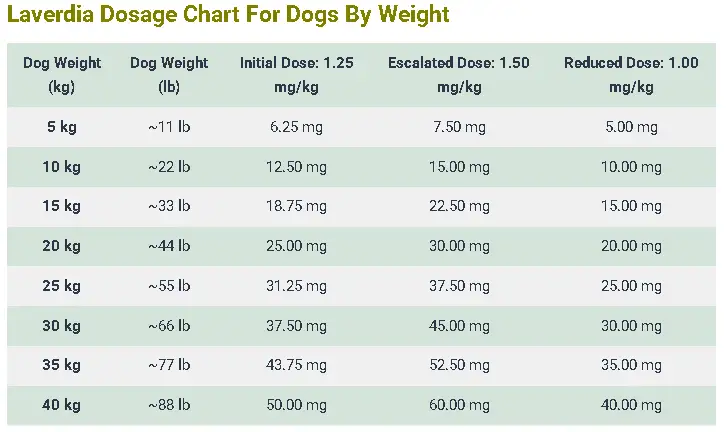
Laverdia Dosage Chart For Dogs By Weight
| Dog Weight (kg) | Dog Weight (lb) | Initial Dose: 1.25 mg/kg | Escalated Dose: 1.50 mg/kg | Reduced Dose: 1.00 mg/kg |
| 5 kg | ~11 lb | 6.25 mg | 7.50 mg | 5.00 mg |
| 10 kg | ~22 lb | 12.50 mg | 15.00 mg | 10.00 mg |
| 15 kg | ~33 lb | 18.75 mg | 22.50 mg | 15.00 mg |
| 20 kg | ~44 lb | 25.00 mg | 30.00 mg | 20.00 mg |
| 25 kg | ~55 lb | 31.25 mg | 37.50 mg | 25.00 mg |
| 30 kg | ~66 lb | 37.50 mg | 45.00 mg | 30.00 mg |
| 35 kg | ~77 lb | 43.75 mg | 52.50 mg | 35.00 mg |
| 40 kg | ~88 lb | 50.00 mg | 60.00 mg | 40.00 mg |
Administration Rules
- Timing: Administer orally twice per week with at least 72 hours between doses.
- Feeding: Always feed the dog immediately before administering the tablet.
- Handling: Wear protective disposable chemotherapy-resistant gloves when handling tablets.
- Integrity: Do not split or crush tablets. Combine tablet strengths to reach the intended dose.
What Is Laverdia?
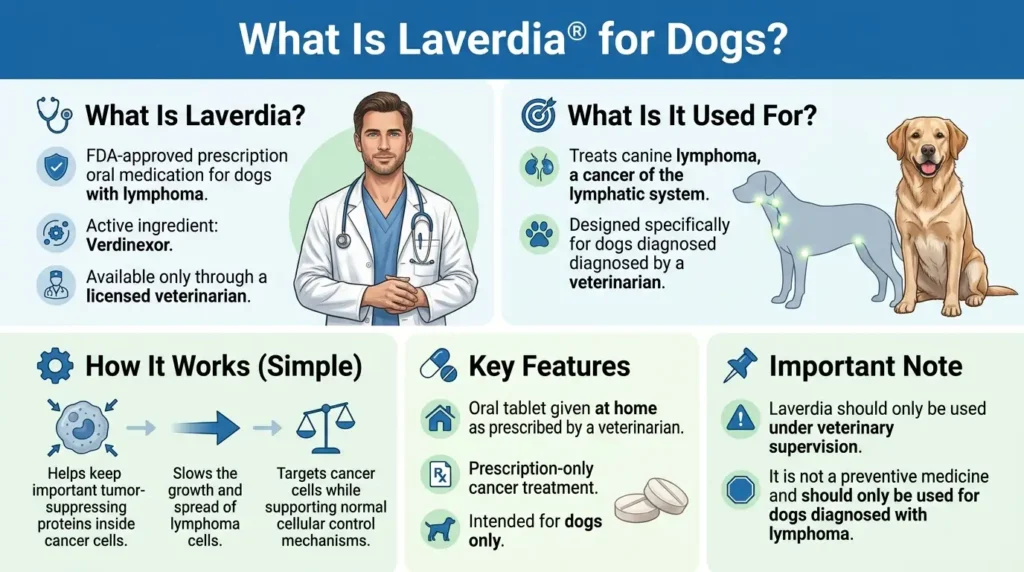
Verdinexor is an oral drug specifically developed for the treatment of lymphoma in dogs and is a brand called Laverdia-CA1. In January 2021, it became the first-ever FDA-conditionally approved oral drug for canine lymphoma and then, in January 2026, it received full approval after a landmark field study in 160 dogs demonstrated its efficacy, marking an important milestone in veterinary oncology.
Previously, all chemotherapy treatments for canine lymphoma had to be injected in a veterinarian’s office. Laverdia changed that by providing a convenient alternative treatment for pets and pet parents, so they can avoid a trip to the vet’s office.
The unique aspect of Laverdia for dogs is its mode of action. It is not a fast acting chemotherapy agent that targets rapidly dividing cells, but a Selective Inhibitor of Nuclear Export (SINE) — all new class of veterinary anti-cancer therapy. Laverdia binds to XPO1, which is a protein which blocks tumor-suppressor proteins from exiting the nucleus of the cell.
The proteins are naturally occurring and are trapped in place to halt the cancer cell cycle and induce programmed cell death (apoptosis) in the lymphoma cells whilst largely avoiding the healthy cells.
Laverdia is a medication approved for veterinary use in the United States by the FDA for treatment of lymphoma in dogs and is administered orally, usually at home, under veterinary supervision.
How Does Laverdia Work?
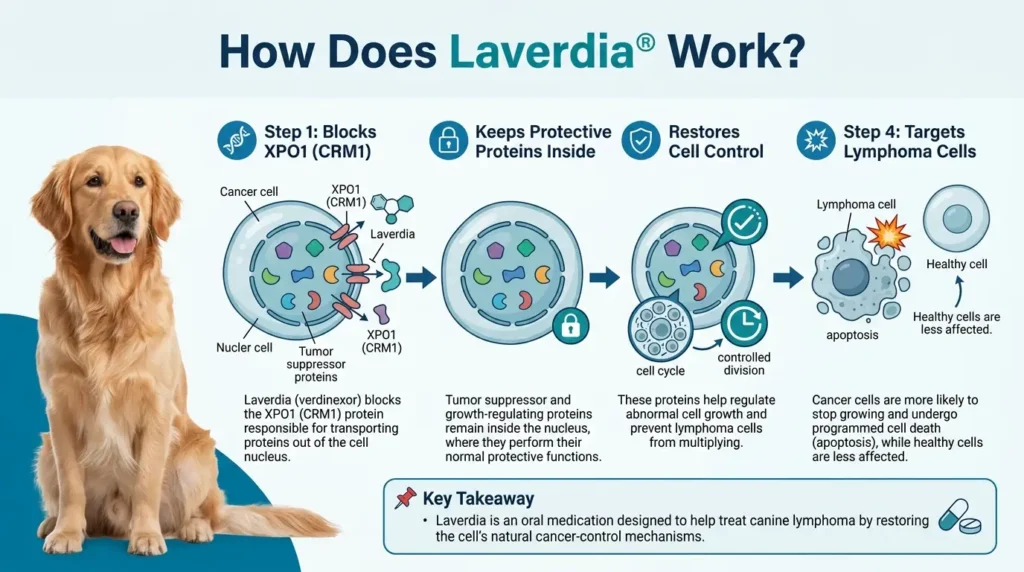
Your dog’s body has tumour suppressing proteins in every cell as a natural protection mechanism against cancer. In normal cells, these proteins remain in the nucleus and regulate cell growth and stimulate programmed cell death (apoptosis) if a cell’s DNA is damaged or deranged.
Cancer cells find a way around this defense by hijacking a transport protein called XPO1 (also known as Exportin 1 or CRM1), which normally helps keep balance in the cell by binding excess tumor suppressor proteins and removing them from the nucleus. In cancer cells, XPO1 is often over-expressed, meaning that they make more of the transport protein and so move even more of the tumor suppressors out of the nucleus and away from where they’re needed. The cancer cell turns off its own safety switch by eliminating the proteins which otherwise would cause apoptosis, allowing the cancer cell to survive.
That’s where Laverdia (verdinexor) comes into play. Laverdia directly binds to XPO1 and thus it can no longer bind with the tumor suppressant proteins. These proteins are trapped in the nucleus where they promote apoptosis in the cancer cells only.
This mechanism is a weakness that is unique to cancer cells and does not affect the other rapidly dividing cells, which is why Laverdia is called a “targeted therapy”: laverdia acts in a different way to the traditional chemotherapy drugs such as vincristine, doxorubicin, or cyclophosphamide.
This targeted approach allows Laverdia medication to be effective against cancer while allowing it to potentially have fewer side effects compared to some traditional chemotherapy drugs and may be effective in cases where the cancer cells may have become resistant to traditional chemotherapy drugs, particularly in dogs that are in relapse.
How Is Laverdia Administered?
An advantage of Laverdia is the convenience: It is taken as an oral tablet at home twice a week with at least 72 hours between doses (such as Monday and Thursday, or Tuesday and Friday). That translates to a much lower number of visits to the clinic, as the injectable regimens, such as CHOP, require weekly or biweekly visits for 19 to 25 weeks.
Dosing basics:
- By mouth, as a tablet, as directed and prescribed by your veterinarian.
- Give Laverdia with a meal – immediately prior to each dose.
- Your veterinarian will prescribe a dose, depending on your dog’s weight
- Usually therapy begins with a smaller dose twice a week and is raised or lowered based on your dog’s response.
- Ensure that your dog has swallowed the whole tablet.
- Do not break or split the tablet.
- The medication will begin to work within 1-5 hours, but the changes may not be apparent.
Safety precautions at home:
- Laverdia is a hazardous drug, therefore it is important to avoid accidental exposure:
- Use gloves resistant to the chemotherapy which are disposable.
- In the event a tablet is accidentally dropped, be sure to retrieve it and dispose of it properly.
- Wash hands well after contact with medication.
- Wear gloves for 3 days after every dose when handling bodily fluids, waste, food and water bowls, and toys of your dog’s.
- Do not keep in contact with the bodily fluid and excretions of the pet following administration for up to 5 days.
- Children and pregnant women or women who could become pregnant should not handle the medicine or be exposed to any bodily fluids of a treated dog during this time period
Ongoing monitoring:
- Your veterinarian will arrange for regular checkups and blood tests, which will usually be every 1 to 2 weeks initially.
- This will help you to know if your dog is tolerating the medication well.
- Frequency of monitoring generally decreases when your veterinarian is certain that there are no major complications.
How Effective Is Laverdia?
The effectiveness of Laverdia has been studied in several clinical trials. The time to progression of the disease was significantly longer in dogs treated with Laverdia vs placebo (37 days vs 23 days, P = .011) in the key field trial that earned full FDA approval in both B-cell and T-cell lymphoma.
While these numbers are small compared to multi-agent chemotherapy protocols, the context is important in the dogs used in the studies, many of which were dogs that had failed other chemotherapy and Laverdia was therefore being used as a rescue therapy, not as a first-line treatment. For dogs for which conventional chemotherapy has failed, any time in stable disease or remission is significant.


Paid Links - As an Amazon Associate, I earn from qualifying purchases.
A previous Phase II trial reported in BMC Veterinary Research led by scientists showed that verdinexor alone achieved an overall objective response rate of 37%. Of particular interest, was the response rate, a staggering 71%, seen in dogs with T-cell lymphoma, as this type of lymphoma is usually more difficult to treat and more likely to be fatal using conventional chemotherapy.
Laverdia dog medication can be used as a standalone treatment or combined with other chemotherapy drugs. Many oncologists find it most useful as part of a more comprehensive treatment plan — particularly if the dog is in relapse or as a maintenance treatment once remission is accomplished with alternative treatment plans.
What Are the Side Effects of Laverdia?
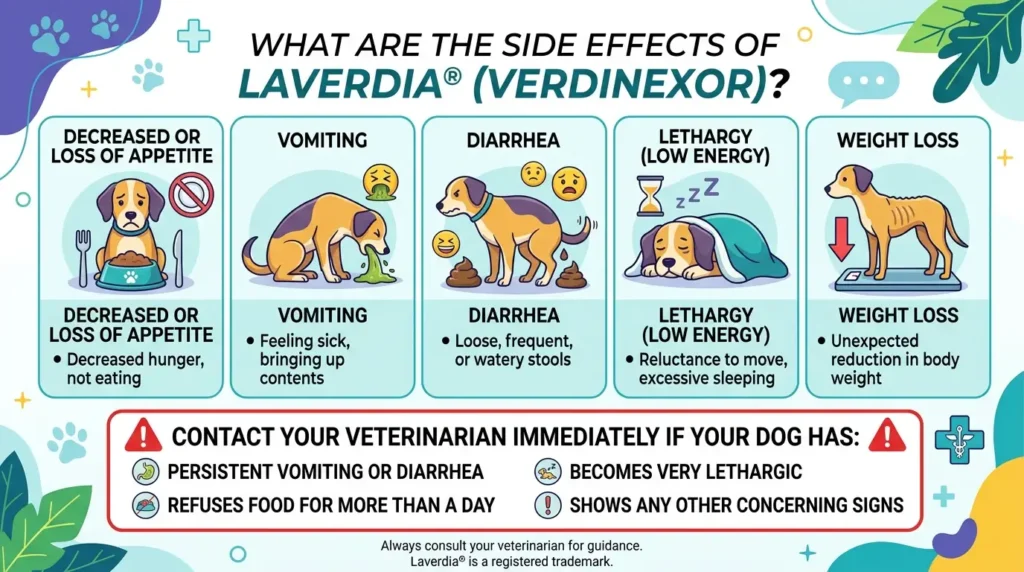
As with any cancer treatment, there are some side effects that come with Laverdia. These are some signs to look out for and strategies for dealing with them.
Commonly reported side effects:
- The most common side effect is loss of appetite (anorexia).
- Weight loss
- Vomiting and diarrhea
- Drowsiness and loss of energy/activity
- Drinking more water (polydipsia) and urinating more (polyuria)
- Increases in liver enzymes (hepatotoxicity)
- A decrease in platelets (thrombocytopenia)
- Low levels of white blood cells (neutropenia)
- Anemia
- Excessive shedding
- Occasionally, kidney problems
Pet parents are most likely to notice gastrointestinal side effects, such as nausea, vomiting and decreased appetite. Usually these can be treated with anti-nausea drugs given by your veterinarian (maropitant/Cerenia or ondansetron) and that stomach may settle after a few hours when you feed it a small bland meal.
Serious reactions – if you notice: stop the medication and contact your vet immediately.
- Any symptoms of allergic reaction, including irregular breathing, rash, fever or puffiness/swelling of the face
- Vomiting, diarrhea or not eating for more than 1 day
- Symptoms of bone marrow suppression (weakness, bruising or bleeding for no reason, fever)
- Cough or shortness of breath
- Shaking, convulsions or confusion
Drug sensitivities may occur over time, with repeated exposure — your dog might be fine with the first few doses, but develop a reaction later, so it’s important to watch for allergic reactions throughout the entire treatment.
Monitoring and dose changes:
Your veterinarian will check your dog’s bloodwork at regular intervals while it is taking Laverdia to detect problems early, such as elevations in liver enzymes and alterations in blood cell counts. In case of serious side effects, your veterinarian may need to change the dosage or may decide to stop the medication for some time and prescribe some additional medicines.
Laverdia is a moderate-acting drug, meaning side effects will cease to occur in days to weeks after stopping the drug, but the effects may persist in dogs with kidney and/or liver disease.
Warning on reproductive and human safety:
Laverdia dose can have negative effects on animal or human reproduction, such as birth defects and decreased fertility. Children and pregnant women should not come into contact with the dog’s feces, urine, vomit or saliva for 72 hours following the last dose.
Will Laverdia Work for Your Dog?
Laverdia may be prescribed in several situations: if your pet parent prefers an at-home oral chemotherapy over an injectable chemotherapy, in combination with another protocol designed by your oncologist, as a rescue therapy for dogs whose lymphoma has returned following initial chemotherapy, as maintenance chemotherapy to help extend remission after initial therapy, or because frequent visits to the clinic for injectable chemotherapy may be impractical because of distance, schedule, or stress to your dog.
However, each dog’s lymphoma will be unique. Whether this is the best option depends on the kind of lymphoma (B-cell vs. T-cell), the stage of disease, your dog’s overall health and liver/kidney function and how he or she has reacted to other treatments. Laverdia may have an effect on liver function, so dogs with pre-existing liver disease or high liver enzyme levels may not be good candidates.
It’s also important to set realistic expectations. Laverdia is an exciting step forward in veterinary oncology, but it isn’t a cure for lymphoma. Its effectiveness, as with all lymphoma treatments, is to control it, prolong quality time and keep the dog comfortable for as long as possible.
You May Also Like to Read:
- Laxatone Dosage For Dogs: Calculator, Chart & Safe Guide
- Lax’aire Dosage For Dogs: Calculator, Chart & Safe Guide
FAQs
What are the uses of Laverdia dosage?
Laverdia-CA1 (verdinexor) is oral tablet medication for treating lymphoma in dogs. The first FDA-approved oral drug for canine lymphoma, it inhibits the XPO1 protein, causing cancer cells to die (apoptosis).
How is Laverdia given to dogs?
Laverdia is taken orally at home twice a week, with at least 72 hours between doses (Monday and Thursday). Food should be fed immediately before each dose as it is absorbed better with food. Tablets must not be divided, crushed in any way and should be taken whole.
In which strength(s) is Laverdia available?
Laverdia-CA1 comes in three different strengths: 2.5 mg, 10 mg, and 50 mg, and it is immediate-release coated tablet. Individually packaged in a carton, each strength is contained in a 50-count HDPE bottle with a heat-sealed, child-resistant cap and a desiccant packet.
How effective is Laverdia for treating canine lymphoma?
During the key field trial, which led to full FDA approval, the time to disease progression was significantly longer in dogs treated with Laverdia compared to the placebo group (37 days versus 23 days respectively). The overall response rate in the earlier Phase II study was 37%, and the response rate was particularly high for dogs with T-cell lymphoma (71%).
What is the most common side effect of Laverdia?
Loss of appetite, weight loss, vomiting, diarrhea, lethargy, increased thirst, increased urination, high liver enzymes, low platelet and white blood cell counts are the most common side effects reported. Sometimes gastrointestinal effects are the most prominent and can be treated with anti-nausea drug.
Who should not use Laverdia medication?
Laverdia should not be used in dogs which are allergic to any component of the drug, pregnant, nursing, breeders (including males), weigh less than 19.8 lb (9 kg) or have not been confirmed to have lymphoma. Should be used with caution in dogs less than 7 months of age or in dogs with kidney disease, liver disease, diabetes, heart disease, severe infections or high blood calcium.
Can humans handle Laverdia?
Precautionary measures must be used when handling Laverdia as it is a hazardous drug. Use gloves that are resistant to chemotherapy when handling the tablets or a treated dog’s waste, and wash hands thoroughly after handling. Pregnant or nursing women and children should not handle the medicine or come in contact with feces, urine, vomit or saliva of the treated dog for 3 days following each administration.
Laverdia must be stored and disposed of how?
Laverdia bottles should be stored at controlled room temperatures between 20°-25°C (68°-77°F). If there is any product or waste material left over, it should be disposed of following proper protocol for disposal of cytotoxic (chemotherapy) drugs.
Is it possible to combine Laverdia with other cancer therapies?
Treatment with Laverdia is indicated in combination with other chemotherapy agents as part of a more extensive treatment regimen, or alone, as a rescue therapy for relapsed lymphoma or as maintenance therapy after remission. However, its safety and effectiveness when combined with other chemotherapeutic agents has not yet been studied formally.
Does Laverdia cure dog lymphoma?
No. Laverdia is an important breakthrough in the field of veterinary oncology, but it is not a cure. As with any lymphoma treatment, it is aimed at controlling the disease, providing as much quality time for the dog as possible and keeping them comfortable.
Key Takeaways
- Laverdia-CA1 (verdinexor) is the first FDA-approved oral tablet for treating lymphoma in dogs, conditionally approved in January 2021 and granted full FDA approval in January 2026 after a pivotal 160-dog field study.
- It acts as a Selective Inhibitor of Nuclear Export (SINE) and prevents the action of the XPO1 protein, which keeps tumour-suppressor proteins in the nucleus and causes cell death (apoptosis) specifically in cancer cells, unlike conventional chemotherapy.
- Laverdia medicine should be administered at home as an oral tablet, twice a week with at least 72 hours between doses, always fed before giving the tablet to achieve better absorption; do NOT split or crush the tablet.
- In clinical studies, the time to disease progression was significantly longer than placebo (37 days vs placebo 23 days) and overall response rate was 37% with 71% response rate in T-cell lymphoma dogs.
- Side effects can include a loss of appetite, weight loss, vomiting, diarrhea, lethargy, increased thirst/urination, high liver enzymes and low platelet or white blood cell counts, and blood testing must be done on a regular basis during treatment.
- Laverdia must not be used in dogs that are under 19.8 lb (9 kg), pregnant, nursing or breeding dogs, or in dogs that have not been diagnosed with lymphoma, and should be used with caution in dogs with liver, kidney, heart or other health problems.
- It is a dangerous drug – handlers need to wear gloves resistant to chemotherapy drugs and children and pregnant or nursing women should avoid touching the drug or a dog treated with it for 3 days after each dose.
- Laverdia is a first-line, combination, rescue and maintenance therapy, but it is not a cure – it provides for controlling the progression of the disease and maintaining the quality of life.
- Tablets are available in various strengths (2.5 mg, 10 mg, and 50 mg), and are kept at 20°–25°C (68°–77°F); unopened product should be disposed of as a cytotoxic drug.
Final Thoughts
Laverdia-CA1 dosage for dogs is a true paradigm shift in the treatment of canine lymphoma. As the first ever oral medicine to be approved for this disease, it provides pet parents an option they’ve been longing for for years: an option to treat cancer at home, rather than constantly going to the clinic and following a protocol for injection like CHOP. That will make a difference in treatment compliance and quality of life for dogs that have relapsed with lymphoma and for families that are not able to make frequent visits for chemo.
However, Laverdia isn’t a fit-for-all solution. It is not a cure, not effective in all types of lymphoma, and has real risks—common gastrointestinal side effects to serious precautions for humans handling the animal. It may or may not be the right answer for your dog, depending on his diagnosis, past medical history and previous treatment response.
The key action you can take is to have an open discussion with your veterinary oncologist. They can compare Laverdia against other drugs – as a first line treatment, as part of a combination or as a rescue therapy after your dog has already relapsed – and develop a treatment plan that works for your dog. When monitored and precautions are taken, Laverdia can be a valuable new product for enjoying a longer comfortable, quality time with your dog.