Motion sickness can turn an exciting trip into a stressful experience for both dogs and their owners. Dogs affected by motion sickness may show signs such as nausea, vomiting, excessive drooling, lip licking, panting, yawning, whining, restlessness, diarrhea, and general discomfort during car, boat, or airplane travel. In some cases, repeated episodes can cause dogs to associate travel with anxiety and fear, making future trips even more challenging.
The most popular drug for doggy car sickness is Dimenhydrinate Dosage For Dogs. An over-the-counter antihistamine and antiemetic that acts on the vestibular system, the portion of the inner ear and brain that is responsible for balance and motion perception, to reduce nausea and vomiting. If this mechanism is over stimulated during travel, dogs may experience dizziness, nausea and motion sickness. Dimenhydrinate for dogs acts by blocking some of the signals, and many dogs are able to travel without it.
Dimenhydrinate dose for dogs is widely used in veterinary practice, but is not specifically approved by the U.S. Food and Drug Administration (FDA) for veterinary use. It can be legally used by veterinarians as an extra-label drug if appropriate. The correct dose depends on your dog’s weight, age, health status, and other medications he is taking, so only administer Dimenhydrinate with the supervision of a veterinarian.
This guide will cover all the necessary details on Dimenhydrinate dosage for dogs by weight, ranging from the recommended dosage to how it works, potential benefits, possible side effects, safety precautions, and when it might or might not be the right choice for your dog. This knowledge will help you to make informed decisions and make your dog more comfortable when traveling.



Paid Links - As an Amazon Associate, I earn from qualifying purchases.
Disclaimer: All information in this guide is provided for educational purposes only and should never replace professional veterinary advice.
Dimenhydrinate Dosage Calculator For Dogs By Weight
Calculates the standard veterinary dosage of 2 mg to 4 mg per pound for dogs using standard 50mg tablets.
© medsdog.com
Key Takeaways
- Dimenhydrinate, commonly known by the trade name Dramamine®, is an antihistamine that is used in dogs to treat nausea and vomiting from motion sickness and/or vestibular disease.
- Dogs are most likely to experience sedation or drowsiness as a side effect of Dimenhydrinate.
- A few dogs may also have a dry mouth and/or may not be able to fully empty their bladder.
- Dramamine is an OTC product, but should be administered with veterinary supervision.
- Dimenhydrinate is not a drug that can be safely used for all dogs, and misdosing can cause problems.
- Before using Dimenhydrinate, it is always best to check with your veterinarian if it is suitable and safe for your dog.
How Much Dimenhydrinate Can I Give My Dog?
The recommended dimenhydrinate dosage for dog’s motion sickness is 2 mg to 4 mg per pound (4.4–8.8 mg/kg) of your dog’s body weight every 8 hours
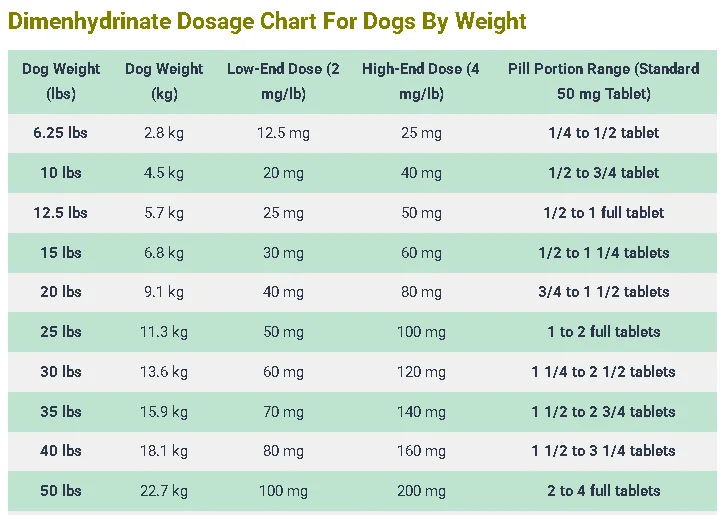
Dimenhydrinate Dosage Chart For Dogs By Weight
This comprehensive reference guide is calculated using the standard veterinary dosage rate of 2 mg to 4 mg per pound of body weight, using standard human over-the-counter 50 mg tablets.
| Dog Weight (lbs) | Dog Weight (kg) | Low-End Dose (2 mg/lb) | High-End Dose (4 mg/lb) | Pill Portion Range (Standard 50 mg Tablet) |
| 6.25 lbs | 2.8 kg | 12.5 mg | 25 mg | 1/4 to 1/2 tablet |
| 10 lbs | 4.5 kg | 20 mg | 40 mg | 1/2 to 3/4 tablet |
| 12.5 lbs | 5.7 kg | 25 mg | 50 mg | 1/2 to 1 full tablet |
| 15 lbs | 6.8 kg | 30 mg | 60 mg | 1/2 to 1 1/4 tablets |
| 20 lbs | 9.1 kg | 40 mg | 80 mg | 3/4 to 1 1/2 tablets |
| 25 lbs | 11.3 kg | 50 mg | 100 mg | 1 to 2 full tablets |
| 30 lbs | 13.6 kg | 60 mg | 120 mg | 1 1/4 to 2 1/2 tablets |
| 35 lbs | 15.9 kg | 70 mg | 140 mg | 1 1/2 to 2 3/4 tablets |
| 40 lbs | 18.1 kg | 80 mg | 160 mg | 1 1/2 to 3 1/4 tablets |
| 50 lbs | 22.7 kg | 100 mg | 200 mg | 2 to 4 full tablets |
| 60 lbs | 27.2 kg | 120 mg | 240 mg | 2 1/2 to 4 3/4 tablets |
| 70 lbs | 31.8 kg | 140 mg | 280 mg | 2 3/4 to 5 1/2 tablets |
| 75 lbs | 34.0 kg | 150 mg | 300 mg | 3 to 6 full tablets |
| 80 lbs | 36.3 kg | 160 mg | 320 mg | 3 1/4 to 6 1/2 tablets |
| 90 lbs | 40.8 kg | 180 mg | 360 mg | 3 1/2 to 7 1/4 tablets |
| 100 lbs | 45.4 kg | 200 mg | 400 mg | 4 to 8 full tablets |
Key Administration Guidelines
- Timing is Everything: To effectively prevent motion sickness, administer the calculated dose 30 to 60 minutes before car rides, flights, or travel.
- The ” sedation” Effect: Dimenhydrinate will make most dogs drowsy. If your dog becomes completely unresponsive or experiences extreme lethargy, you have likely dosed too high on the scale.
- Frequency: This medication passes through a dog’s system relatively quickly and can be repeated up to 3 times per day, spaced roughly 8 hours apart if continuous travel is required.
- Check the Ingredients: Ensure you are using plain, generic Dimenhydrinate (like original Dramamine). Never use “Dramamine Less Drowsy” (which contains Meclizine) or any formula mixed with pain relievers, decongestants, or artificial sweeteners like Xylitol, which are highly toxic to dogs.
What Is Dimenhydrinate?
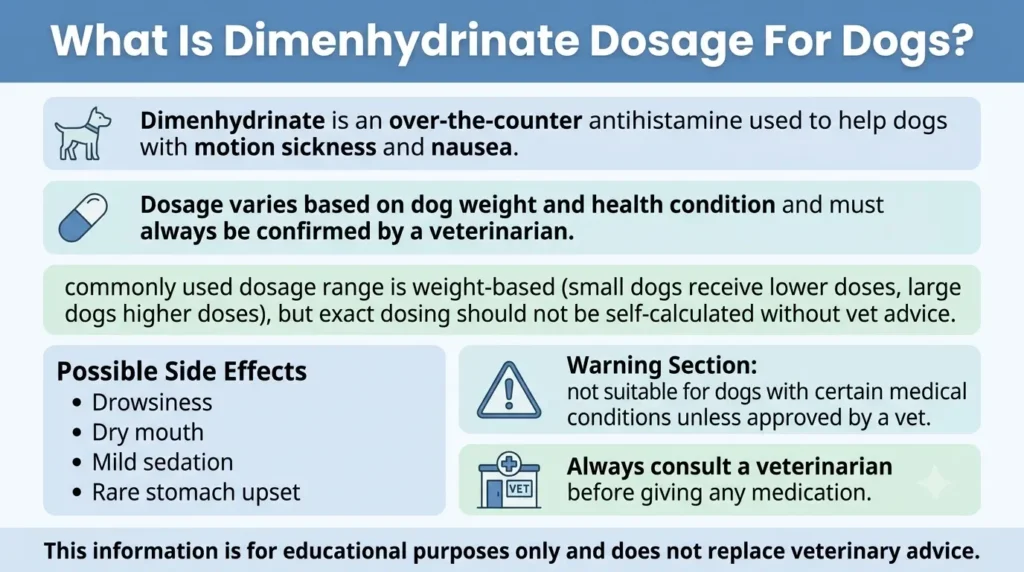
Dimenhydrinate Medication is an antihistamine and anticholinergic antiemetic that is used to prevent and treat travel-related discomfort, dizziness, nausea and vomiting in dogs. It is commonly marketed as Dramamine®, Gravol®, Travtabs®, Driminate®, Triptone® and other similar names. It is usually recommended for dogs that vomit when traveling in a car, a boat or an airplane, but can also be used to help control nausea associated with vestibular disease, which is a disease of balance and coordination.
Dimenhydrinate for pets acts by blocking histamine receptors and decreasing stimulation of the vestibular system so that the dog does not feel as nauseated and as off balance when moving. It’s in the same category of drugs as diphenhydramine (Benadryl®), but functions in the body differently and is mainly prescribed for motion sickness, not allergies.
Dimenhydrinate is approved for use in humans, but is an “off-label” (extra-label) use in dogs and cats. Veterinarians often prescribe it, however, when it’s right and give the pet specific instructions about the dose.
No veterinary-formulation of Dimenhydrinate exists. It comes in a variety of human products that can be bought over the counter, such as tablets and chewable tablets; the injectable products are usually only sold in veterinary hospitals. As the active ingredient and strength of Dramamine® can vary from one product to another, pet owners should always check the ingredient label and, before use, ask their veterinarian for the proper Dramamine® formulation and dosage for their dog.
How Does Dimenhydrinate Work?
Acting on the body’s balance pathways and the nausea pathways, Dimenhydrinate (Dramamine®) is effective for motion sickness and some types of nausea related to the vestibular system in dogs. It works as an antihistamine and anticholinergic drug to block some signals which cause dizziness, nausea, and vomiting while travelling.


Paid Links - As an Amazon Associate, I earn from qualifying purchases.
It has two main methods of action. Dimenhydrinate Dosage For Dogs acts as an H1 histamine-receptor antagonist, which aids to prevent the transmission of movement and balance information from the inner ear (vestibular system) to the vomiting center in the brain. This medication helps minimize symptoms of motion sickness and enhance a dog’s balance by reducing this stimulation.
Secondly, Dimenhydrinate has anticholinergic actions that prevent the release of acetylcholine, a chemical messenger responsible for initiating nausea and the vomiting reaction. The drug blocks the action of acetylcholine, which helps to minimize feelings of nausea and prevents vomiting caused by upset related to motion.
This is why Dimenhydrinate for dogs is so effective for travel induced motion sickness being a dual action approach. Additionally, dogs may be mildly sedated or drowsy when taking the medication, which can also help to minimize stress and discomfort during travel.
Dimenhydrinate usually takes effect 30-60 minutes after administration, making it useful to administer before travelling. It usually lasts 3 to 6 hours and can be used to keep your dog more comfortable when traveling in a car, on a boat or airplane.
What Are the Benefits of Dimenhydrinate?
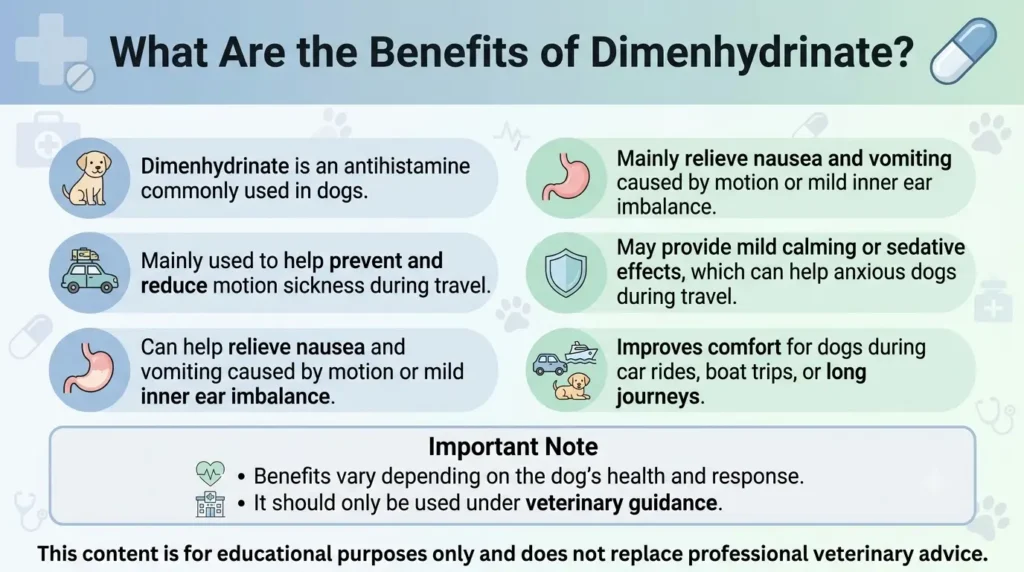
Dimenhydrinate offers several key advantages to dogs and cats with nausea, vomiting and car sickness. It is often used to enhance traveling comfort and to calm pets when traveling by car, boat or aircraft.
Key Benefits of Dimenhydrinate
- Helps prevent and treat nausea and vomiting in dog & cat.
- Recommended for the prevention of motion sickness during travel.
- Can alleviate travel discomfort and make travelling more comfortable for pets.
- Can be found in different formulations such as tablets, chewable tablets, and injectables.
- Permits flexible treatment options; injectable doses can be given in a veterinary clinic, oral doses can be used at home as necessary.
- Well tolerated by most animals if handled as directed by veterinarian.
Additional Considerations
- Dimenhydrinate may be used to control vomiting, but should not be used as the sole means of control if poisoning or toxic substance ingestion is suspected.
- If there is any possibility that the vomiting is caused by toxin ingestion or other serious underlying causes, veterinary evaluation is required.
In conclusion, Dimenhydrinate is a versatile and widely used drug that is effective in managing nausea, vomiting, and motion sickness and provides easy dosing for both veterinary and home use.
Does Dimenhydrinate Have Warnings or Side Effects?
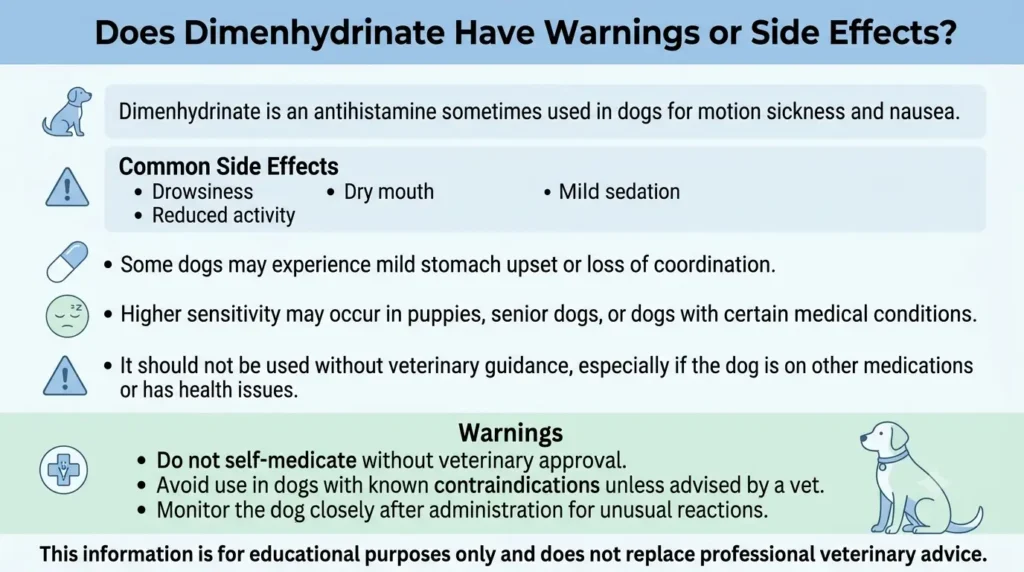
Dimenhydrinate (Dramamine®) is considered relatively safe when used as directed, but, like any drug, it has potential side effects and may not be appropriate for all dogs. Owners of pets should be aware of the possible risks, signs, and situations that warrant added caution prior to administering this medicine.
The side effects of Dimenhydrinate in dogs are common.
The most common side effect is sedation or drowsiness, and dogs may look sleepy and lethargic or not responsive as usual.
Other potential side effects are:
- Dry mouth
- Increased thirst
- Urinary retention and/or dysuria
- Decreased appetite
- Vomiting
- Diarrhea
- Constipation
- Blurred vision
- Rapid heart rate
- Dry eyes
- Hyperactivity or agitation instead of sedation (paradoxical reaction)
Side effects typically occur within 1-2 hours of administration and typically abate when the drug wears off. Some dogs may not sleep, but become hyperactive, and the drug should not be given again if that happens.
Severe Side Effects and Warnings of an Emergency
If your dog has: Get him/her to the veterinarian’s office right away.
- Difficulty breathing
- Difficulty urinating
- Facial swelling
- Hives
- Rash
- Collapse
- Seizures
- Unresponsiveness
- Coma
- Lethargy, low activity, dizziness, extreme slow reaction time
These symptoms could be a reaction to allergies, overdose or severe adverse side effects and should be treated by a veterinarian immediately.
Some dogs should not be given Dimenhydrinate
Dogs should NOT be treated with Dimenhydrinate when they:
- Have an allergy to Dimenhydrinate or other antihistamines
- Are neonatal (very young puppies)
- Will undergo antigen skin testing in the next 2 weeks
Use with caution in dogs with
Dogs with the following should only use Dimenhydrinate under the guidance of a veterinarian:
- Glaucoma
- Seizure disorders or past history of seizures.
- Hyperthyroidism (overactive thyroid)
- Heart disease
- High blood pressure
- Enlarged prostate
- Gastrointestinal blockage
- Urinary tract/bladder obstruction
- Lung diseases like asthma or obstructive lung disease.
- Liver disease
- Kidney disease
- Older age (geriatric dogs)
- Pregnancy or nursing
Additional Precautions
- Dimenhydrinate drugs for dogs should be used with caution in working dogs and dogs engaged in activities which require alertness as sedation may impair the dog’s ability to perform.
- Drug sensitivities can occur over time, even if a dog took a drug at a previous dose with no problems.
- Other drugs, such as tranquilizers, sedatives and heparin may interact with Dimenhydrinate; your veterinarian should check all drugs and supplements your dog is taking.
- The medication usually has a short duration of action and will not remain effective for more than 24 hours, but can be longer in dogs with liver or kidney disease.
When to Contact Your Veterinarian
Closely watch your pet after each dose and during treatment. Stop administering and contact your veterinarian or an emergency veterinary hospital immediately if unusual behavior or worsening side effects are noticed, if an allergic reaction occurs or suspected overdose occurs.
Are There Any Drug Interactions I Should Be Aware Of?
It is possible that Dimenhydrinate (Dramamine®) for dogs may interact with other medications and could cause greater side effects or may affect the way the other medicine works. When administering Dimenhydrinate to your dog, always be sure to tell your veterinarian about any other prescription or nonprescription medications, vitamins, supplements, herbal remedies, or other treatments that your dog is taking.
Medications That May Interact With Dimenhydrinate
Anticholinergic Medications
Using Dimenhydrinate with other anticholinergic drugs may increase the risk of side effects such as:
- Dry mouth
- Difficulty urinating
- Blurred vision
- Constipation
- Rapid heart rate
Examples include:
- Atropine
- Glycopyrrolate
- Tricyclic antidepressants
Central Nervous System (CNS) Depressants and Sedatives
Dimenhydrinate may cause drowsiness and sedation, and its use in combination with other drugs which have central nervous system depressant effects may be associated with an increased risk of excessive sedation.
Examples include:
- Benzodiazepines (diazepam, lorazepam)
- Opioids
- Sedatives
- Anesthesia medications
- Anti-anxiety medications
- Gabapentin and other muscle relaxants.
- Trazodone
- Antiseizure drugs, such as phenobarbital
Other Medications That May Interact
- Other antihistamines such as diphenhydramine
- Monoamine oxidase inhibitors (MAOIs), such as selegiline
- Antidepressants such as tricyclic antidepressants like amitriptyline and clomipramine.
- Antidepressants that include SSRIs, including fluoxetine and sertraline
- Levothyroxine
- Omeprazole and other proton pump inhibitors (PPIs)
- Tramadol
- Prednisone
- Medications that treat the heart such as beta blockers, diuretics, ACE inhibitors
- Allopurinol
- Metoclopramide
Allergy Testing Precaution
Dimenhydrinate interferes with skin allergy testing using antigen. When a dog is on this medication it should be stopped at least 2 weeks prior to allergy tests, unless otherwise directed by a veterinarian.
Important Safety Reminder
This is not a full list of the drug interactions that can occur. Dimenhydrinate may interact with many other medications and supplements, so be sure to talk with your veterinarian before beginning treatment, particularly if your dog is already using other drugs or has any other health issues.
What if My Pet Takes Too Much Dimenhydrinate or Has an Overdose?
An overdose of Dramamine® (Dimenhydrinate) can be a serious medical emergency. Please call the veterinarian or veterinary emergency clinic immediately if the dog or cat has taken more than prescribed Dimenhydrinate or may have taken too much Dimenhydrinate by accident.
It is important to get veterinary treatment, even if your pet does not become immediately ill. Getting early help may lower the likelihood of severe complications and enhance the possibility for a successful recovery.
If you think someone has overdosed
- Call your vet right away!
- If your veterinarian is not available, contact the nearest Emergency Veterinary Hospital.
- Describe the drug, the dosage and approximate quantity ingested.
- Do not hesitate to follow your veterinarian’s instructions carefully and seek emergency help if recommended.
If an overdose is suspected, DO NOT wait until symptoms occur to consult a professional veterinarian.
You May Also Like to Read:
- Bedinvetmab Dosage For Dogs: Calculator, Chart & Safe Guide
- Loperamide Dosage For Dogs: Calculator, Chart & Safe Guide
FAQs
If my pet consumes too much Dimenhydrinate, what should I do?
If you think that your pet has ingested more than the recommended dose of Dimenhydrinate, contact your veterinarian or a veterinary emergency clinic right away. Do not wait until the symptoms show up.
What if I forget to take my Dimenhydrinate Dosage for dogs?
Usually not a problem, as Dimenhydrinate is likely to be administered as necessary. In case of a missed dose, take it at the time of remembrance and then follow the schedule from that point. Never double the dosage.
Dimenhydrinate is stored how?
Dimenhydrinate should be stored on room temperature and in an area where there is no light. Avoid freezing liquid products. Storage of compounded medications should be in compliance with the compounding pharmacy.
Is any monitoring needed while my pet is taking Dimenhydrinate?
There is no set routine monitoring. However, your veterinarian may check if the medication is working and you should observe your pet for any side effects.
What will I do if I get into an emergency situation?
Always contact your veterinarian if you think your pet may have an overdose or adverse reaction. If they are not available, take them to the closest veterinary emergency hospital.
Are there any side effects of Can Dimenhydrinate in pets?
Yes, side effects can happen – they might be lethargy, dry mouth, urinary retention, vomiting or diarrhea. The majority of side effects are temporary and mild.
At what age is it no longer necessary to give Dimenhydrinate?
Discontinue administering Dimenhydrinate and consult your veterinarian if your pet exhibits any of the following serious side effects: difficulty breathing, seizures, collapse, or allergic reactions.
Is it safe to use Dimenhydrinate in all pets?
Not all pets will be safe on it. Should be administered with care to animals with some health issues, and only under veterinary advice.
Final Thoughts
In conclusion, when used properly, Dimenhydrinate (Dramamine®) may be a useful tool in the treatment of motion sickness in dogs. It’s an over the counter human medication, but can be safe for dogs if the correct amount is calculated, and a veterinarian approves it. These are always best given with the advice of a veterinarian to ensure it’s safe and effective for your dog, depending on their health and weight.
Although tolerable in most dogs, dimenhydrinate may have side effects that include sedation, drowsiness and dry mouth. It can also interact with other medications, so it is even more critical to receive veterinary advice before use.
Remember, not all trips have to be road trips when your dog is feeling uncomfortable, in addition to medication. When car rides can be stressful or make them feel unwell, short walks or local dog-friendly parks, or activities at home, can make for great alternatives. At times, the most effective method to keep your dog comfortable is to keep them at home.
The end result is to ensure that your dog is happy, healthy and comfortable. Sometimes, this might involve giving Dimenhydrinate before you travel and sometimes, it might just be about planning your trip around your dog.