Medically reviewed by: Medsdog Team
Last updated: September 2026
If your dog has loose stools, constipation, or anal gland trouble, there’s a good chance your vet has mentioned psyllium husk. It’s one of the few supplements that can genuinely help in both directions but how much psyllium husk you give your dog matters more than almost any other factor in whether it helps or causes gas, bloating, or a blockage.
This guide gives you the exact weight-based dosage, an interactive calculator, real published study data (not vague “studies show” claims), and the specific situations where you should skip it and call your vet instead.
The most studied and recommended psyllium husk dosage for dogs is about ½ teaspoon once daily for small dogs under 20 lbs, up to 1–2 teaspoons once daily for larger dogs, and up to 4 tablespoons per day for working dogs.


Paid Links - As an Amazon Associate, I earn from qualifying purchases.
Disclaimer: All information in this guide is provided for educational purposes only and should never replace professional veterinary advice.
Psyllium Husk Dosage Calculator For Dogs
Enter your dog’s weight to get a suggested psyllium husk dose
This calculator provides a general estimate based on weight ranges and is not a substitute for veterinary advice. Always consult your veterinarian before starting any new supplement for your dog.
Vital Preparation Rule: Never feed dry psyllium powder. Mix every 1 g with about 20 ml (roughly 4 teaspoons) of water and let it swell for 30 minutes before serving, to prevent it from swelling in the throat or gut before it's diluted.
What Is Psyllium Husk for Dogs?
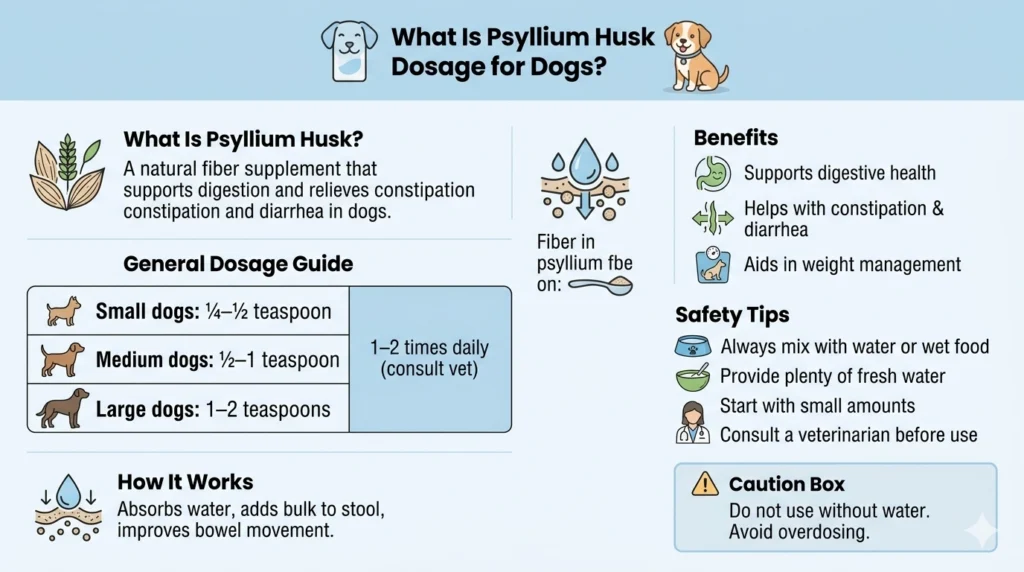
Psyllium husk is the fibrous outer coating of the seed of Plantago ovata, a plant grown mainly in mediterranean region. Once milled into a fine powder, it becomes one of the most studied soluble fibers used in both human and veterinary medicine.
Unlike insoluble fiber (think wheat bran), which mostly passes through the gut unchanged, psyllium husk absorbs many times its weight in water and turns into a soft gel. That gel is what gives it its unusual dual effect: it can soften hard, constipated stool and firm up loose, diarrheal stool, depending on what your dog's gut needs.
For dogs, only plain, unflavored psyllium husk powder is appropriate. Flavored human fiber products often contain xylitol or added sugar, both of which are unsafe for dogs' xylitol in particular is one of the common household items that can be dangerous or even fatal for dogs in far smaller amounts than most owners realize.
Is Psyllium Husk Safe and Good for Dogs?
Yes, psyllium husk is safe and beneficial for most dogs when dosed correctly and given with enough water. It's used by veterinarians for:
That said, "safe" depends entirely on getting the dose and hydration right. Too little won't do much; too much, or too little water, can cause gas, bloating, or in rare cases a blockage. The dosage chart below is your starting point not a substitute for your vet's guidance, especially if your dog has an existing health condition.
How Much Psyllium Husk Can Dogs Take?
The ideal dose of psyllium husk for dogs depends on the weight and diarrhea condition of the pet. Minor diarrhea may require a lower dose, while chronic diarrhea may require a higher recommended dose.
The dosage of psyllium husk for dogs falls under the below categories:
Psyllium Husk Dosage Chart for Dogs by Weight
| Dog Weight / Size | Recommended Psyllium Husk Dosage | Frequency | How to Give |
|---|---|---|---|
| Small dogs — Under 20 lb | ½ teaspoon | Once daily | Mix with food |
| Medium to large-size dogs — 20 lb and above | 1–2 teaspoons | Once daily | Mix with food |
| Giant breed & working dogs | Up to 4 tablespoons | Per day | Mix with food |

How Much Psyllium Husk Per Day, By Condition
The right daily amount also depends on why you're giving it. Here's how vets generally adjust the approach:


Paid Links - As an Amazon Associate, I earn from qualifying purchases.
For diarrhea or loose stool: Start at the low end of the chart above, given once daily with a meal. Most owners see firmer stool within 24–48 hours. If there's no improvement after a few days, don't just increase the dose call your vet, since persistent diarrhea can have causes, psyllium won't fix.
For constipation: Start low and increase water intake alongside the dose constipation from insufficient hydration can actually worsen if you increase fiber without also increasing fluids. Splitting the dose into two smaller servings (morning and evening) rather than one large one tends to be gentler.
For anal gland support: A slightly higher, consistent daily dose (toward the middle of the chart) tends to work best, since the goal here is a firmer, bulkier stool on a regular schedule to naturally express the glands. This works best as ongoing maintenance rather than an occasional dose — some owners find it helpful alongside dedicated anal gland support supplements like Glandex, which combine fiber with additional gland-supporting ingredients.
For weight management: Given before meals, psyllium's swelling action can increase satiety and help reduce begging between meals. It's an adjunct to a calorie-controlled diet, not a substitute for one.
What the Research Actually Shows
Chronic large-bowel diarrhea in working dogs
(Alves et al., 2021, BMC Veterinary Research): 22 police working dogs with chronic idiopathic diarrhea were given 4 tablespoons of psyllium husk per day for one month. Response was rated "very good" in 50% of dogs and "good" in another 40%. Defecation frequency dropped from an average of 3.5 to 2.9 times per day, 90% of dogs had consistently normal stools by the end of the month, and dogs gained an average of 2 kg. Notably, many of these benefits persisted for a month even after supplementation stopped.


How Psyllium Husk Works in a Dogs Digestive System
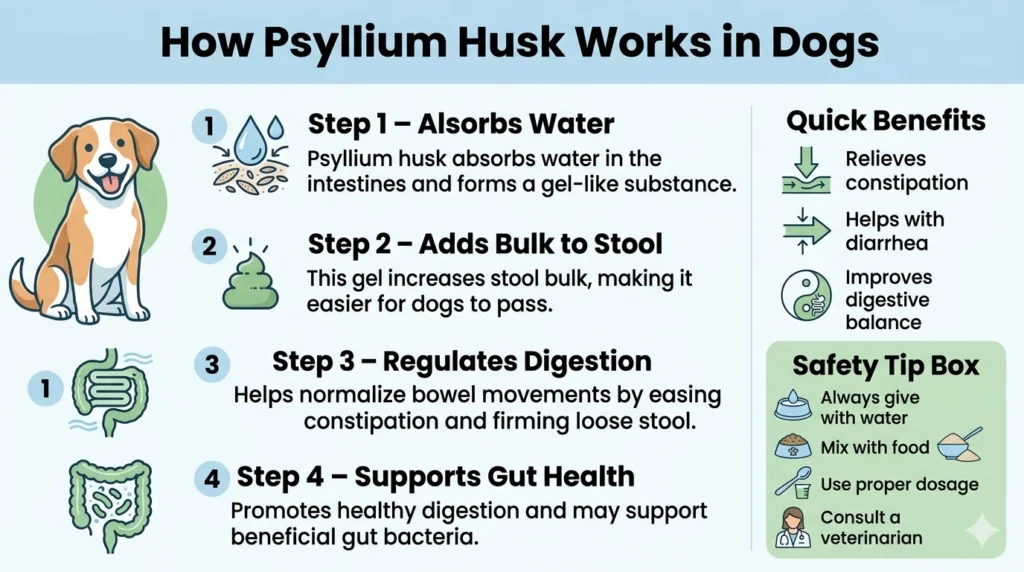
Psyllium husk for dogs is a soluble fiber supplement which helps in digestion, gut and overall wellness of a dog.
It works in the following way:
- Water Absorption and Gel Formation: Psyllium absorbs water in the intestines which forms a soft gel-like mass to be propelled easily through the digestive tract.
- Dual Action Stool Normalization: Soft stool and means that people lose their stool when they have diarrhea and hard stool when they are constipated; this helps the body to restore normalcy in the digestive system.
- Prebiotic Benefits: Supplies the intestinal beneficial bacteria which ferment some of the fiber into short-chain fatty acids such as butyrate feeding the colon cells and enhancing the intestinal barrier.
- Anal Gland Support: The stool bulk can be increased to empty anal glands in a natural manner, therefore, alleviating inflammation and pain.
- Metabolic and Systemic Effects: Reduces glucose uptake, assists in glucose regulation, has a minor lipid-lowering effect, and raises the levels of satiety, which can help maintain a healthy weight.
- Clinical Results: It has been concluded that daily psyllium supplementation enhances the consistency of the stool, defecation frequency, chronic diarrhea and can be used to help underweight dogs gain healthy weight.
Important Implication: Psyllium husk dose is a safe, natural, and multi-purpose fiber which enhances the regularity of the intestines, prebiotic gut maintenance, stool consistency, metabolic wellness, and general well-being of the dog.
Benefits
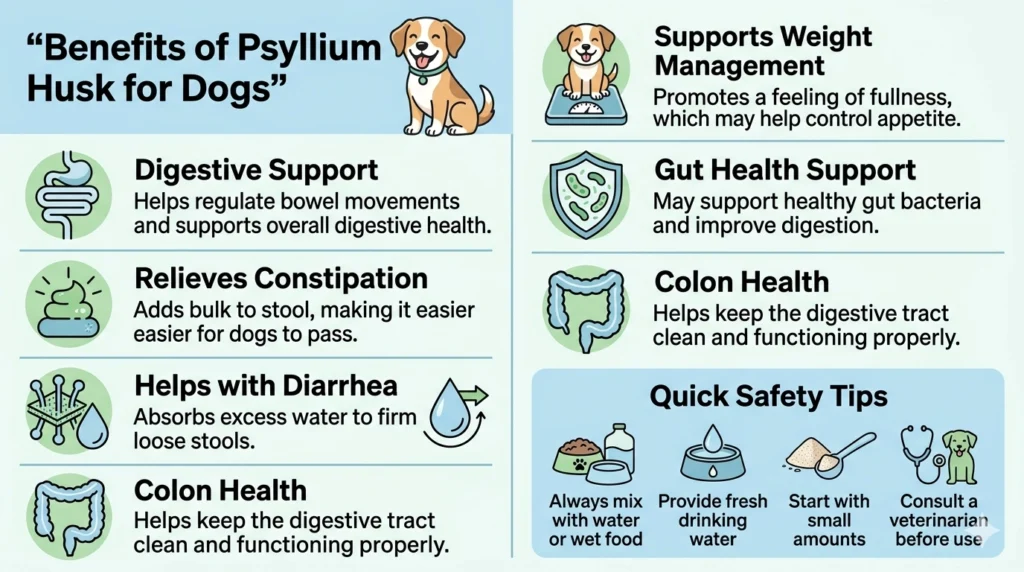
Psyllium husk is an evidence-based, natural, soluble fiber supplement with numerous benefits to dogs, including the focus on digestive health, anal glands functionality, and weight management.
The benefits of this product are practical, unlike a cure-all, and supported by research in both dog and human research.
Key Benefits:
- Stool Normalization: Corrects loose and hard stools, and soothes dogs that are affected with chronic diarrhea or constipation.
- Digestive Support: Is a mild bulk-forming laxative, enhancing the regularity and gastrointestinal comfort.
- Anal Gland Health: Maximizes the bowel motility, assists in the expression of the anal glands and avoids inflammation.
- Weight Management: Satiety-enhancing, satiating, and healthy weight management.
- Metabolic Support: Can assist in the regulation of the blood sugar level and the lipid profiles, which are involved in the long-term metabolism.
- Short-term and Rapid: Digestive benefits are seen in the first few days and two weeks, and with long-term usage, it leads to microbiome stability and permanent gut health.
- Broad-spectrum: Can be used in various gastrointestinal conditions such as chronic large-bowel diarrhea, constipation caused by low-fiber diets as well as in irritable bowel syndrome.
Conclusion: Psyllium husk dosage is a safe, effective, and research based supplement that aids in digestive harmony, anal gland functionality, weight management and canine wellness when used on a regular basis.
Side Effects
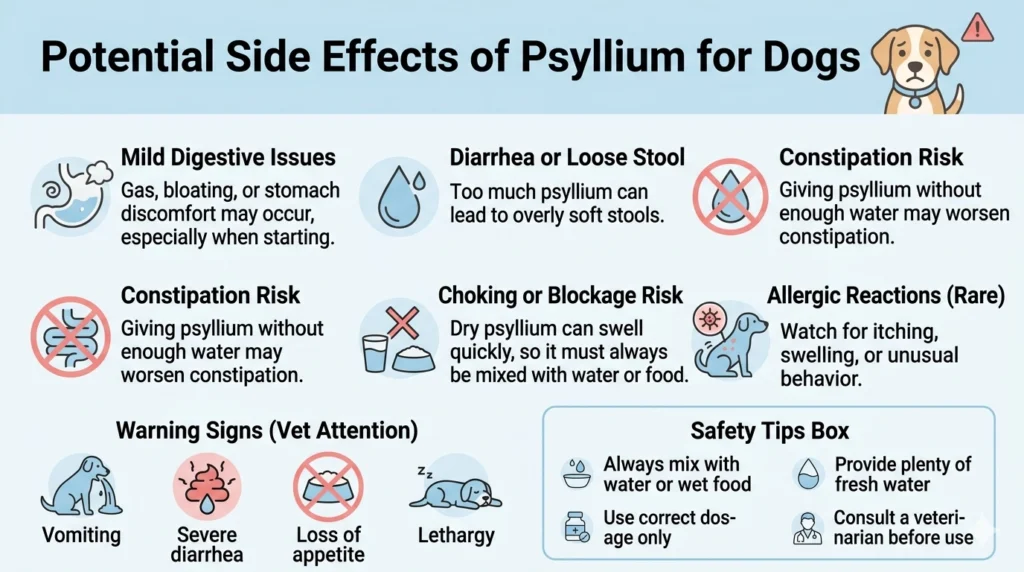
Common, mild side effects, usually from introducing it too quickly:
- Gas or flatulence
- Bloating or mild stomach discomfort
- Temporary loose stool, or paradoxically, temporary constipation
- Cramping
Avoid or use only under direct veterinary supervision if your dog has:
Drug interactions
Psyllium can slow or reduce absorption of some oral medications, including certain thyroid drugs and antibiotics. As a general rule, give other medications 1–2 hours apart from psyllium unless your vet advises otherwise.
Call your vet immediately if your dog shows lethargy, repeated vomiting, sharp abdominal pain, or bloody diarrhea while on psyllium these are not typical side effects and need prompt evaluation. If your dog also shows sudden vomiting after getting into something else in the house, it's worth reviewing our guide on common household items that can be dangerous for dogs to rule out an unrelated ingestion issue.
If dehydration is ever a concern alongside digestive upset, an electrolyte solution such as the Pedialyte dosing guide for dogs is worth discussing with your vet as supportive care psyllium itself is not a treatment for dehydration.
How to Give Psyllium Husk to Your Dog?
Psyllium husk can be easily administered to your dog if done with care. To be safe, effective and optimally digested.
follow these steps:
- Accurate Measurement
- Proper measuring spoon/gram scale.
- Due to uneven dosing, avoid making guesses.
- Prepare Psyllium Gel
- Combine psyllium powder by 5-10 times that of water (e.g. 1/2 teaspoon powder with 2-3 tablespoons water).
- Allow to boil until it sets into a gel (2-3 minutes).
- To remove dry lumps, stir thoroughly into food.
- Feeding Options
- Wet food: Add to canned or fresh food.
- Wet kibble: Wet the kibble by adding warm water, and mixing with psyllium gel.
- Picky eaters: Bone broth, plain yogurt, or small portions of unsalted homemade meat broth can be used as the carrier.
- Start Slowly
- Start with a single meal a day the first 3-5 days.
- Keep track of the poop and comfort.
- In case of tolerance, it can be considered dividing doses into breakfast and dinner.
- Hydration
- Make sure that fresh water is free at all times.
- Promote additional postprandial consumption of psyllium.
- Timing
- Administer psyllium with food, but not on an empty stomach.
- Regular schedule aids in setting a regular bowel movement and alleviates cramping.
- Monitor Response
- Maintain a stool journal 1-2 weeks:
- Stool firmness (1–7 scale)
- Frequency of defecation
- Mucus or blood.
- Symptoms of difficulty or pain.
- Adjusting Dose
- Stool excessively liquid: Reduce dose slightly.
- Stool that is too hard or straining: Reduce dose or drink more water.
- No improvement after 2 weeks: See your veterinarian.
- Gas or bloating: Discontinue gradually and add the gradual introduction.
- What to do when to Call a Vet.
- Lassitude, vomiting, sharp pain in the abdomen, or bloody diarrhea.
These steps guarantee that psyllium husk is used to keep dogs healthy in terms of proper digestion, bowel movement and gut health with fewer side effects.
FAQs
Is it possible to give human psyllium products (e.g. Metamucil) to dogs?
Unflavored psyllium husk dose only is safe. Never use products that contain sweeteners (particularly xylitol), sugars or additives. Options that are pet-specific are safer, but pure psyllium powder can be used with veterinary recommendations.
Is psyllium a de-toxifier?
No, it has a weak detox action. It is not to be applied to toxin exposure- contact a veterinarian in case of such cases.
Psyllium vs. Pumpkin - which is better?
Pumpkin: Provides fiber and nutrients, assists in stool bulk and expression of anal glands.
Psyllium: Fiber that is soluble and regulates diarrhea and constipation and provides a more powerful gut health benefit.
Option is based on the needs of your dog.
What are the negatives or side effects?
Gas or bloating when added to rapidly.
Possibility of choking or blockage of the intestines due to lack of sufficient water.
Excess use can interfere with the absorption of nutrients.
Is monitoring required?
Yes. Adhere to veterinary exams when prescribed and watch out to any deviant changes at home. Do not use and see a vet in case of problems.
What is the storage of psyllium?
Keep at room temperature in a tightly-closed container, and not exposed to moisture or to children or pets.
What to do in case of emergency or overdose?
Call your veterinarian or an emergency. Reporting of adverse effects can be done to FDA or Health Canada.
What should I do in case of a missed dose?
Give it immediately remembered, and resume the regular schedule. Do not increase dose.
Final Thoughts
Psyllium husk is one of the few supplements that can genuinely help with both ends of the stool spectrum but the Psyllium husk dog dose, the water ratio, and how gradually you introduce it are what actually determine whether it helps or backfires. Use the calculator and chart above as your starting point, watch your dog's response for the first two weeks, and loop in your veterinarian before starting if your dog is a puppy, a senior, pregnant, or on any other medication.