Disclaimer: All information in this guide is provided for educational purposes only and should never replace professional veterinary advice.
Griseofulvin Dosage Calculator for Dogs
Educational calculator based on veterinary dosage ranges. Always follow your veterinarian’s prescription.
Calculation Results
• Microsize dosage range: 10–50 mg/kg/day (commonly 50 mg/kg once daily).
• Ultramicrosize dosage range: 5–20 mg/kg/day (commonly 5–10 mg/kg once daily).
Always administer Griseofulvin exactly as prescribed by your veterinarian. Dosage and treatment duration depend on the fungal infection, formulation, and your dog’s medical condition.
© medsdog.com
Today, griseofulvin Dosage For Dogs is used less in the United States for dogs, and is the only antifungal agent approved for systemic use that was developed specifically for veterinary use; however, newer antifungal agents may offer better safety, efficacy and convenience. But, in some instances, veterinarians may suggest the use of griseofulvin, especially when topical treatments fail to work or the fungal infection is extensive and needs to be treated systemically.


Paid Links - As an Amazon Associate, I earn from qualifying purchases.
When discussing a proper dosage for a dog with Griseofulvin it is important that you consider the formulation of the medicine. It comes in the microsize and ultramicrosize forms; the latter is much more readily absorbed and thus is used at a lower dose. The dosage of the formulation can affect how well it works or the risk of side effects.
This guide will show you how to figure out the right dose of Griseofulvin for your dog based on his weight, the appropriate dose ranges for both types of Griseofulvin, an easy-to-use dosage calculator and chart, some potential side effects, and a few safety precautions so your dog gets effective, responsible treatment under your veterinarian’s care.
Key Takeaways
- Griseofulvin (Fulvicin, Gris-PEG) is a systemic antifungal drug that treats ringworm (dermatophytosis) and other fungal infections susceptible to it in dogs.
- Dogs should take the correct dosage of Griseofulvin, which will depend upon the weight of the dog, the formulation of the drug (microsize or ultramicrosize), and your veterinarian’s prescription.
- Note that microsize and ultramicrosize formulations cannot be substituted for each other; lower doses of the latter are available and will be absorbed more efficiently.
- Griseofulvin is the only FDA-approved systemic antifungal for veterinary use, but is used less today in the U.S. than are newer antifungal drugs.
- Side effects include vomiting, diarrhoea, loss of appetite and weakness. Very few serious side effects occur but should be treated by a veterinarian.
- Griseofulvin can only be used under veterinary supervision, and should not be used in dogs with some liver or blood conditions, very young puppies and pregnant dogs.
- Graduate the entire treatment program as directed, even if the lesions on your dog seem to be improving prior to the end of the treatment.
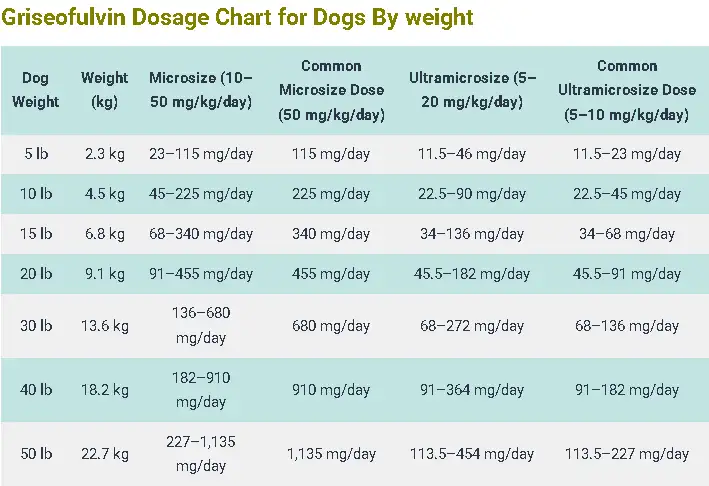
Griseofulvin Dosage Chart for Dogs By weight
| Dog Weight | Weight (kg) | Microsize (10–50 mg/kg/day) | Common Microsize Dose (50 mg/kg/day) | Ultramicrosize (5–20 mg/kg/day) | Common Ultramicrosize Dose (5–10 mg/kg/day) |
|---|---|---|---|---|---|
| 5 lb | 2.3 kg | 23–115 mg/day | 115 mg/day | 11.5–46 mg/day | 11.5–23 mg/day |
| 10 lb | 4.5 kg | 45–225 mg/day | 225 mg/day | 22.5–90 mg/day | 22.5–45 mg/day |
| 15 lb | 6.8 kg | 68–340 mg/day | 340 mg/day | 34–136 mg/day | 34–68 mg/day |
| 20 lb | 9.1 kg | 91–455 mg/day | 455 mg/day | 45.5–182 mg/day | 45.5–91 mg/day |
| 30 lb | 13.6 kg | 136–680 mg/day | 680 mg/day | 68–272 mg/day | 68–136 mg/day |
| 40 lb | 18.2 kg | 182–910 mg/day | 910 mg/day | 91–364 mg/day | 91–182 mg/day |
| 50 lb | 22.7 kg | 227–1,135 mg/day | 1,135 mg/day | 113.5–454 mg/day | 113.5–227 mg/day |
| 60 lb | 27.3 kg | 273–1,365 mg/day | 1,365 mg/day | 136.5–546 mg/day | 136.5–273 mg/day |
| 70 lb | 31.8 kg | 318–1,590 mg/day | 1,590 mg/day | 159–636 mg/day | 159–318 mg/day |
| 80 lb | 36.4 kg | 364–1,820 mg/day | 1,820 mg/day | 182–728 mg/day | 182–364 mg/day |
| 90 lb | 40.9 kg | 409–2,045 mg/day | 2,045 mg/day | 204.5–818 mg/day | 204.5–409 mg/day |
| 100 lb | 45.5 kg | 455–2,275 mg/day | 2,275 mg/day | 227.5–910 mg/day | 227.5–455 mg/day |
Note:
This chart provides estimated daily Griseofulvin dosages for dogs based on commonly referenced veterinary dosing ranges. The appropriate dose depends on the formulation used (microsize or ultramicrosize), the type and severity of the fungal infection, and your veterinarian’s instructions. Microsize and ultramicrosize formulations are not interchangeable because ultramicrosize is absorbed more efficiently and requires lower doses. Always use the exact formulation and dosage prescribed by your veterinarian.
What Is Griseofulvin?
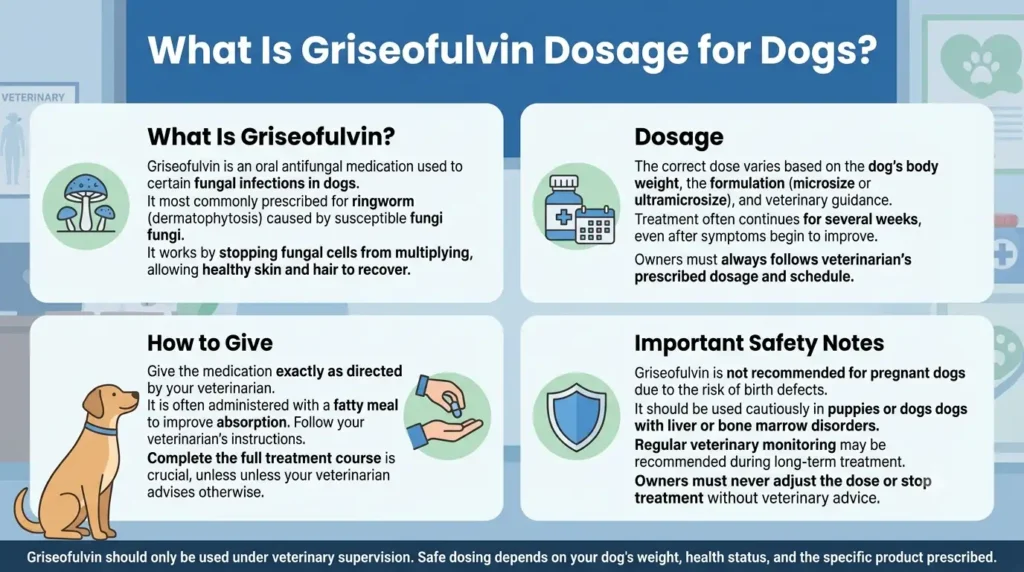
Griseofulvin (full names: Fulvicin®, Gris-Peg® and Grisovin®) is an anti-fungal drug that treats ringworm (dermatophytosis) and other fungal infections of the skin, hair and nails. It is only effective against the dermatophyte fungi which cause ringworm in dogs, such as Microsporum, Trichophyton and Epidermophyton species. It is not effective against bacterial infections and other fungal diseases.
Griseofulvin Dosage for dogs prevents fungal cells from dividing and reproducing, helping to stop the infection spreading. Medication gets deposited in new growth of hair and nails, thus maintaining healthy tissue. It works on new growth, so treatment might take longer than with some newer antifungal drugs.
Griseofulvin medication for dogs comes in a variety of preparations, such as tablets or oral compounds (liquid preparations) made especially for animals. In dogs and many other animals, its use is off-label (extra-label) and it is used in a way that has not been approved by the U.S. Food and Drug Administration (FDA) or Health Canada for the species. If this medication is used off-label, then veterinarian instructions and recommendations for correct dosage and treatment should be strictly adhered to.
Potential Side Effects of Griseofulvin in Dogs
When used at the proper dose directed by the veterinarian, griseofulvin is generally safe and tolerated by dogs. While most dogs have no or minimal issues during treatment, there may be side effects. Most reactions are mild and involve the digestive tract, and are rare and serious, so veterinary attention is required immediately.
Side effects include:
- Loss of appetite
- Vomiting
- Loose stools or diarrhoea
- Stomach upset
- Sensitivity to sunlight, which could result in sunburn in dogs who have thin coats or light-colored skin
While uncommon, serious side effects can occur and should not be overlooked. If your dog experiences any of the following symptoms, please call your veterinarian’s office right away:
- Weak or pale gums, unusual bleeding or indications of anemia
- Weakness, poor coordination, collapse, or very lethargic
- Fever
- If the vomiting or loss of appetite continues
- Any yellow discoloration of skin, eyes, or gums (jaundice), which could be indicative of liver damage
- Severe skin rash, dermatitis, sores, or a rash all over the skin
- Indications of bone marrow suppression such as low red blood cells, white blood cells or platelets
There can be an allergic/drug sensitivity reaction after repeated doses even in cases where no reaction occurred when treatment was begun. Because of this, be sure to carefully watch your dog during the whole course of the treatment and let the vet know if you notice any unusual symptoms.
Griseofulvin should be avoided in:
- Dogs known to be allergic to the drug
- Pregnant dogs
- Breeding males
- Puppies under 12 weeks old
- Severely affected liver disease dogs
Griseofulvin should be used with caution in lactating dogs as its safety during lactation is not completely determined. It can also interact with some medications such as phenobarbital and warfarin (coumarin) so be sure to inform your veterinarian of any supplements or medication your dog is taking prior to treatment.
Are There Any Drug Interactions I Should Be Aware Of?
Yes. Griseofulvin may interact with several medications and supplements, making it more likely to have side effects or affecting how one or more medicines work. Inform your veterinarian before beginning treatment if your dog is taking any other medications, over the counter drugs, vitamins, herbal remedies or supplements.
Some of the medications that may interact with griseofulvin include:
- Aspirin and other NSAIDs (non-steroidal anti-inflammatory drugs)
- Barbiturates, such as phenobarbital
- Immunosuppressants, such as cyclosporine
- Theophylline and aminophylline
- Warfarin and other coumarin anticoagulants (oral blood thinners)
- Estrogens (e.g. estriol)
- Carbamazepine
- Valproic acid
- Ketoconazole
- Itraconazole
- Cephalexin
- Amoxicillin
- Diphenhydramine (Benadryl)
- Bone marrow–suppressing medications
- Certain dietary supplements
- Alcohol (where applicable)
These possible interactions do not necessarily prevent these drugs from being used together, but may necessitate dosage changes, more frequent monitoring, or even a different medication. Before giving griseofulvin with any other supplement or medication, always ask your veterinarian about the possible side effects.


Paid Links - As an Amazon Associate, I earn from qualifying purchases.
How to Store Griseofulvin Dosage
Keep griseofulvin at room temperature (between 59°F and 86°F or 15°C and 30°C). Do not leave the medicine in temperatures higher than 104°F (40°C) because high temperatures could make the medicine unstable.
For proper storage:
- Store the medicine in a secure place in a locked container.
- Keep it away from direct sunlight.
- Keep in a cool dry area, away from heat and moisture.
- Do not let children or pets come in contact with the container or handle it because they could swallow it.
If extra storage directions are given by your veterinarian or on the label, always follow these – particularly for compounded formulations.
You May Also Like to Read:
- Rovera Dosage for Dogs: Calculator, Chart & Safe Guide
- Librela Dosage For dogs Calculator, Chart & Safe Dosage Guide
FAQs
My dog missed a dose of griseofulvin, what should I do?
If a dose is missed, administer as soon as possible. In case the time of the next dose is near, skip the missed dose and resume with the next dose as scheduled. Do not give two doses at the same time to compensate for one dose.
Will my dog need to be monitored during griseofulvin treatment?
Yes. Fungal cultures may be performed to ensure success of treatment, and blood cell counts may also be performed before and during treatment, as well as liver enzyme levels. Monitor your dog at home for any other potential side effects and reach out to your veterinarian if you notice any.
Dogs usually take griseofulvin for about how many days?
Treatment will take around a month, and if the fungal infection is particularly stubborn, may need to be treated for several weeks or three months or more. Do not stop the treatment if your dog’s skin seems to be doing better sooner than the recommended time.
Is it okay that my dog is on griseofulvin and the veterinarian wants to give him vaccinations?
In most cases, yes. No evidence of interaction with griseofulvin and routine vaccines. But, please be sure to tell your veterinarian your dog is taking this medication prior to any scheduled vaccinations.
Is it OK to bathe my dog when it is being treated for ringworm?
Yes. Bathing is, in general, safe and can be recommended as a treatment in ringworm. If using a medicated antifungal shampoo, consult your vet first. Since ringworm is contagious, wash your hands well after handling or bathing your dog.
Is it safe to use griseofulvin in breeding or pregnant dogs?
Due to possible birth defects and toxicity to developing puppies, pregnant dogs should not be treated with No. Griseofulvin. It is also not recommended for breeding males or nursing dogs unless specifically directed by the vet.
Does griseofulvin work on bacterial or yeast infections?
Griseofulvin dose for dogs is effective against only a few of the fungi that can cause ringworm (dermatophytes). Does not work for Bacterial infection or most Yeast infection, requires other drugs.
If my dog overdoes on griseofulvin, or if he or she is allergic to griseofulvin, what should I do?
If you suspect an overdose, or your animal is showing signs of an allergic response (severe itching, swelling, skin blisters, peeling skin, a rash or trouble getting around), contact your veterinarian or emergency veterinary clinic right away. Take the medication container with you so your veterinarian can easily find out the medication and dosage level.
Final Thoughts
Griseofulvin Dosage For dogs is a systemic antifungal drug that can be used by a veterinarian to treat dermatophytosis (ringworm), and other susceptible fungal skin diseases in dogs. While newer antifungal drug therapies are more widely used today due to their increased safety and efficacy, griseofulvin may still be recommended for some patients who may not best benefit from other drug therapies.
It is important to use the right dose of Griseofulvin for dogs to achieve the desired results. Always use the dose according to the body weight, specific formulation (microsize or ultramicrosize) and instructions from your veterinarian. While treating, watch your dog for any common symptoms that may occur, including vomiting, diarrhea, loss of appetite, or unusual lethargy or sluggishness, and seek veterinary help immediately if you notice any serious symptoms or indications of an allergic reaction.
Don’t change the dose or discontinue use without your vet’s advice, even if your dog’s symptoms get better. Taking the entire prescription of medicine to kill the fungus infection and to minimize the chance of it returning. For questions and concerns regarding griseofulvin or the treatment plan for your dog, your veterinarian can provide you with the best guidance.