Medically Reviewed By: Medsdog Team
Last Updated: September 2026
If your dog is in pain, suffereing from bowel disease or hides under the bed when there is thunderstorm, trembles when he hears the sound of fireworks, or is destructive when he is left alone, then you probably are finding the solution to ease him of the fear. Clonidine may help your furry friend
The Clonidine dosage for dogs is 0.01–0.05 mg/kg (0.005–0.02 mg/lb), given every 8 to 12 hours. It is usually started at the low end and adjusted based on how your dog responds.
Below in this guide, you’ll find the full clonidine dosage chart by weight, a dosing calculator, benefits, side effects and more.


Paid Links - As an Amazon Associate, I earn from qualifying purchases.
Disclaimer: All information in this guide is provided for educational purposes only and should never replace professional veterinary advice.
Clonidine Dosage Calculator for Dogs
Estimate a clonidine dose range based on your dog’s weight and treatment purpose.
Please enter a valid weight greater than 0.
Estimated Clonidine Dose
This calculator provides a general estimate only and is not a substitute for veterinary advice. Always confirm the exact dose, frequency, and suitability with a licensed veterinarian before administering any medication.
Clonidine For Dogs Overview
What is Clonidine For Dogs?

Clonidine commonly known with brand names Catpress® or Duraclon®, belongs to a class of drugs known as central alpha 2 adrenergic agonists. Is a drug used for the treatment of high blood pressure in humans, has become an important tool in the veterinary behavior field for the treatment of anxiety and fear-based behaviors in dogs.
Dogs Clonidine also help in pain relief as well as muscle relaxation in canines. It is also used to treat inflammatory bowel disease and other behavioral disorders in dogs.
Is Clonidine Safe For Dogs?
Clonidine has not been approved by the U.S. Food and Drug Administration for veterinary use specifically, but vets with experience in behavior medicine have used it safely and effectively for years now. It is a prescription drug and can only be obtained from a veterinarian or by prescription from a vet.
How Much Clonidine Can I Give My Dog?
The veterinarian-suggested range of Clonidine dosage for dogs is 0.01–0.05 mg/kg (0.005–0.02 mg/lb), given every 8 to 12 hours. This means that different canine conditions require different doses of the medicine.
Clonidine Dosage Chart for Dogs by Weight
| Dog Weight (lbs) | Dog Weight (kg) | Low Dose (0.01 mg/kg) | Moderate Dose (0.03 mg/kg) | High Dose (0.05 mg/kg) |
|---|---|---|---|---|
| 5 lbs | 2.3 kg | 0.023 mg | 0.07 mg | 0.115 mg |
| 10 lbs | 4.5 kg | 0.045 mg | 0.135 mg | 0.225 mg |
| 15 lbs | 6.8 kg | 0.068 mg | 0.204 mg | 0.34 mg |
| 20 lbs | 9.1 kg | 0.091 mg | 0.273 mg | 0.455 mg |
| 25 lbs | 11.4 kg | 0.114 mg | 0.342 mg | 0.57 mg |
| 30 lbs | 13.6 kg | 0.136 mg | 0.408 mg | 0.68 mg |
| 40 lbs | 18.2 kg | 0.182 mg | 0.546 mg | 0.91 mg |
| 50 lbs | 22.7 kg | 0.227 mg | 0.681 mg | 1.135 mg |
| 60 lbs | 27.3 kg | 0.273 mg | 0.819 mg | 1.365 mg |
| 70 lbs | 31.8 kg | 0.318 mg | 0.954 mg | 1.59 mg |
| 80 lbs | 36.4 kg | 0.364 mg | 1.092 mg | 1.82 mg |
| 90 lbs | 40.9 kg | 0.409 mg | 1.227 mg | 2.045 mg |
| 100 lbs | 45.5 kg | 0.455 mg | 1.365 mg | 2.275 mg |

Clonidine HCl 0.1 mg, 0.2 mg & 0.3 mg Dosage Chart for Dogs
| Dog Weight | Approx. Weight | Behavioral Starting Dose (0.01–0.02 mg/kg) | Recommended Tablet Strength | IBD Dose (0.005–0.01 mg/kg) | Recommended Tablet Strength* |
|---|---|---|---|---|---|
| 5 lb | 2.3 kg | 0.023–0.046 mg | 0.1 mg — ¼ tablet† | 0.012–0.023 mg | 0.1 mg — ¼ tablet |
| 10 lb | 4.5 kg | 0.045–0.090 mg | 0.1 mg — ½ tablet | 0.023–0.045 mg | 0.1 mg — ¼ tablet |
| 15 lb | 6.8 kg | 0.068–0.136 mg | 0.1 mg — ½–1 tablet | 0.034–0.068 mg | 0.1 mg — ½ tablet |
| 20 lb | 9.1 kg | 0.091–0.182 mg | 0.1 mg — 1 tablet | 0.046–0.091 mg | 0.1 mg — ½ tablet |
| 25 lb | 11.3 kg | 0.113–0.226 mg | 0.1 mg — 1 tablet | 0.057–0.113 mg | 0.1 mg — ½–1 tablet |
| 30 lb | 13.6 kg | 0.136–0.272 mg | 0.2 mg — 1 tablet | 0.068–0.136 mg | 0.1 mg — 1 tablet |
| 40 lb | 18.1 kg | 0.181–0.362 mg | 0.2 mg — 1 tablet | 0.091–0.181 mg | 0.1 mg — 1 tablet |
| 50 lb | 22.7 kg | 0.227–0.454 mg | 0.2 mg — 1 tablet | 0.114–0.227 mg | 0.2 mg — ½ tablet |
| 60 lb | 27.2 kg | 0.272–0.544 mg | 0.3 mg — 1 tablet | 0.136–0.272 mg | 0.2 mg — 1 tablet |
| 70 lb | 31.8 kg | 0.318–0.636 mg | 0.3 mg — 1 tablet | 0.159–0.318 mg | 0.3 mg — ½ tablet |
| 80 lb | 36.3 kg | 0.363–0.726 mg | 0.3 mg — 1 tablet | 0.182–0.363 mg | 0.2 mg — 1 tablet |
| 90 lb | 40.8 kg | 0.408–0.816 mg | 0.3 mg — 1 tablet | 0.204–0.408 mg | 0.2 mg — 1 tablet |
| 100 lb | 45.4 kg | 0.454–0.908 mg | 0.3 mg — 1 tablet | 0.227–0.454 mg | 0.3 mg — 1 tablet |
| 110 lb | 49.9 kg | 0.499–0.998 mg | 0.3 mg — 1 tablet | 0.250–0.499 mg | 0.3 mg — 1 tablet |
| 120 lb | 54.4 kg | 0.544–1.088 mg | 0.3 mg — 1 tablet | 0.272–0.544 mg | 0.3 mg — 1 tablet |

How to Calculate Your Dog’s Clonidine Dose
Getting the clonidine dose for dogs per kg right starts with a few simple inputs. Here’s the exact process the calculator on this page uses:
- Weigh your dog accurately. A digital scale is ideal; your vet’s office can also provide a current weight.
- Convert pounds to kilograms, if needed, by dividing by 2.2. A 40-lb dog is 18.2 kg.
- Confirm the prescribed dose in mg/kg. Most dogs start at 0.01 mg/kg and may be titrated up to 0.05 mg/kg.
- Multiply weight (kg) × dose (mg/kg) to get the total milligrams needed.
- Match to available tablet strength. Compounded clonidine for dogs is commonly available in 0.025 mg, 0.05 mg, 0.1 mg, and 0.2 mg tablets.
- Double-check your math, and confirm with your veterinarian before administering.
For example: An 18.2 kg (40-lb) dog prescribed 0.03 mg/kg needs a total dose of 0.546 mg typically given as a 0.5 mg tablet or a combination of smaller tablets, as directed by your vet.
Use the interactive calculator above this article to run the math automatically for your dog’s exact weight.
What Is Clonidine Used for in Dogs?
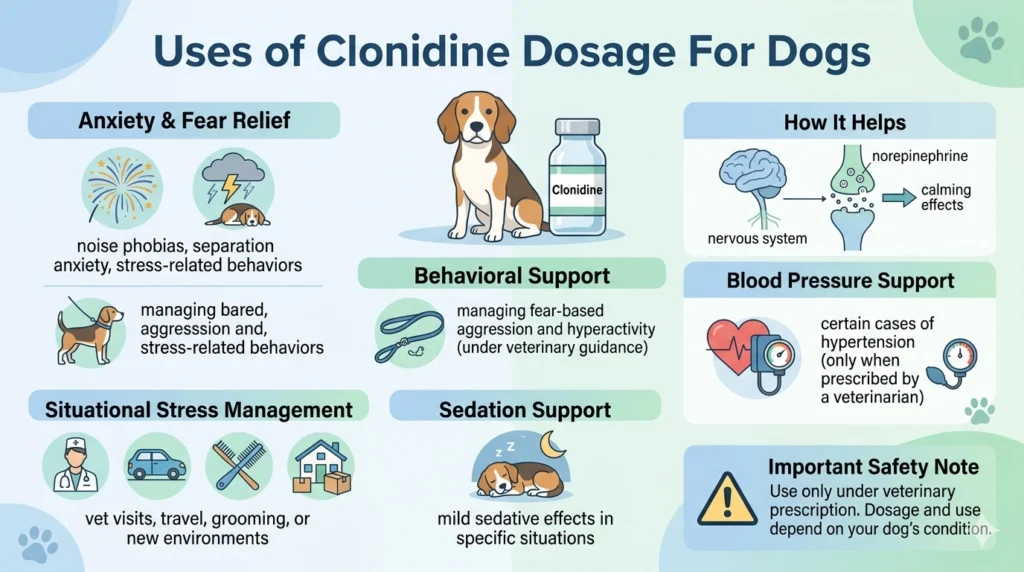
Clonidine for dogs is prescribed off-label by veterinarians and veterinary behaviorists for several fear- and anxiety-related conditions:


Paid Links - As an Amazon Associate, I earn from qualifying purchases.
Separation Anxiety
Dogs that bark, destroy furniture, or eliminate indoors when left alone may be calmer with clonidine given before you leave often paired with a longer-acting daily medication like the fluoxetine or the Clomicalm (clomipramine).
Noise Phobias
Thunderstorms, fireworks, and construction noise are among the most common triggers for canine anxiety. Some veterinary behaviorists prefer clonidine over benzodiazepines such as the Xanax (alprazolam) for storm phobia, citing fewer paradoxical reactions and no dependence risk though the right choice always depends on the individual dog.
Fear-based Aggression and Leash Reactivity.
By lowering a dog’s baseline arousal, clonidine can make dogs less reactive to triggers and more receptive to behavior modification training, whether that’s fear-based aggression at home or lunging on leash walks.
Situational Anxiety
Vet visits, grooming appointments, and car travel are common as-needed uses. Clonidine is sometimes paired with the trazodone who don’t get full relief from trazodone alone before a vet visit.
Adjunct/combination Therapy
Because clonidine works through a completely different mechanism than SSRIs or tricyclic antidepressants, it’s frequently added on top of a daily baseline medication to cover “breakthrough” anxiety, without stacking side effects from the same drug class.
Other veterinary uses
Less commonly, clonidine is also used to help manage pian, muscle relaxation stress-related diarrhea (its constipating effect can help firm loose stools) and, in a clinical rather than at-home setting, as part of diagnostic testing for pheochromocytoma and growth hormone deficiency.
How Long Does Clonidine Last in Dogs?
This is one of the most common questions pet owners ask, and you’ll find conflicting numbers across the internet mainly because “how long it lasts” can mean three different things:
Precautions and Side Effects
Every medication carries the possibility of risk and clonidine is no exception.
While generally this medication is well-tolerated, it is important to understand the potential side effects and precautions that come along before using a clonidine dosage for dogs calculator.
Common Side Effects
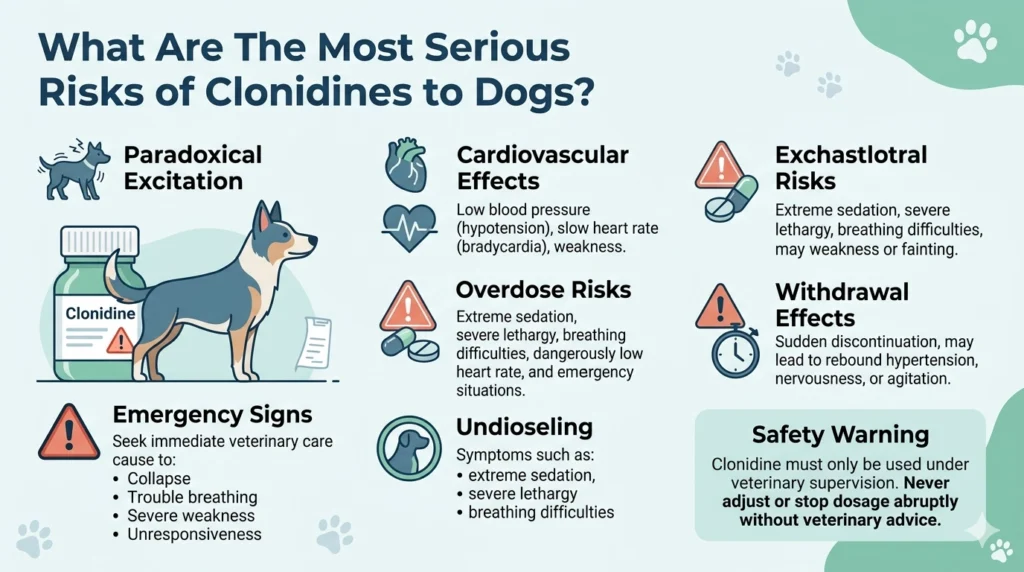
The most reported side effect is sedation. Since clonidine is supposed to help to calm down the brain, some dogs may become too sleepy or lethargic, especially on the first day of being on the drug or at larger doses.
This usually is mild and many times diminishes as the dog adapts to the drug. If you feel it is too much to be sedated, your veterinarian might be able to reduce.
Dry mouth is another side-effect which is known or known. In dogs, this may manifest itself by increased water consumption, lip smacking or seeking out water more frequently than normal.
While they are not harmful, it is something to be observed.
Constipation may be a problem in some dogs. Ensuring sufficient hydration and monitoring the bowel movements will help control this side effect.
Less common, but possible side effects are:
- Lack of coordination/ unsteadiness
- Agitation or paradoxical excitement (opposite of calming that you want to have)
- Decreased heart rate
- Lowered blood pressure
What Are the Most Serious Risks?
Clonidine vs. Other Anxiety Medications
| Medication | Drug Class | Onset | Typical Use Pattern | Notes |
|---|---|---|---|---|
| Clonidine | Alpha-2 agonist | 60–90 min | As-needed or 2x daily | Fast-acting; often an add-on, not a first choice |
| Trazodone | Serotonin antagonist/reuptake inhibitor | 60–90 min | As-needed | Frequently combined with clonidine for vet visits |
| Xanax (alprazolam) | Benzodiazepine | 30–60 min | As-needed | Faster-acting but higher risk of paradoxical excitement and dependence |
| Fluoxetine (Prozac) | SSRI | 2–4 weeks for full effect | Daily, long-term | Baseline daily therapy, not for acute events |
Because clonidine and trazodone or fluoxetine work through different mechanisms, combining them is common practice but always under veterinary guidance, since combining any sedatives increases the risk of excessive sedation or low blood pressure.
Precautions & Drug Interactions
Use with caution in dogs with:
- Heart disease (clonidine affects heart rate and blood pressure)
- Kidney or liver disease (may slow drug clearance, raising the risk of side effects)
- Known hypersensitivity to clonidine
- Pregnancy or nursing (clonidine crosses the placenta and into milk)
Known drug interactions
| Interacting Medication | Why It Matters |
|---|---|
| Other alpha-2 agonists, e.g., Sileo see the dexmedetomidine guide for dogs | Duplicating this drug class raises the risk of excessive sedation and low blood pressure |
| MAOIs, e.g., Anipryl see the selegiline use for dogs | Can cause dangerous interactions with alpha-2 agonists |
| Beta-blockers and calcium channel blockers, e.g., the atenolol | Additive effect on heart rate and blood pressure |
| ACE inhibitors, e.g., the enalapril | May compound blood-pressure-lowering effects |
| Tricyclic antidepressants, e.g., the amitriptyline or clomipramine | Combination sedatives increase risk of over-sedation |
| Other sedatives/tranquilizers | Additive sedation |
| Certain antibiotics, e.g., sulfamethoxazole/trimethoprim | Reported interaction; discuss timing with your vet |
FAQs
Can I use a clonidine dosage for dogs Calculator for any size dog?
Yes, a clonidine dosage for dogs calculator works for any size dog as the dose is based on the weight. However, very small dogs (under 5 pounds) must be given very precise doses and it may be necessary to split tablets.
Your veterinarian can help establish if clonidine is suitable with small breeds/breed toys.
How-long does it take for clonidine to work in dogs?
Clonidine usually works after 60 to 90 minutes when it is taken by mouth. For best results administer it before the stress response sets in.
What do I do if my dog vomits because of clonidine?
If your dog vomits soon after he gets the medication, contact your veterinarian for instructions. They may advise waiting and giving another dose or they might suggest giving the next dose with food to minimize the stomach upset.
is Clonidine For Dogs safe for long term use for dogs?
Clonidine can be used on a long-term basis in dogs with chronic anxiety disorders.
However, regular changes and check-up on blood pressures by your veterinarian are recommended for dogs who are under chronic therapeutic drugs.
What happens if my dog accidentally overdoses on clonidine?
If you think there is an overdose, seek veterinary help immediately. Slowed breathing, difficulty in waking, slowed breathing, and low body temperature are some of the signs. Bring with you the bottle of medication to be sure of exactly what was ingested by the pet.
Final Thoughts
Clonidine is a useful option for dogs with issues with fear-based anxiety, noise phobias and situational stress. When administer at a safe Clonidine dosage for dogs and under veterinary supervision this drug can have a major impact on the quality of life of the anxious dog and its anxious owner.
Used at the correct weight-based dose and combined with behavior modification, it can make a real difference for an anxious dog and the people who love them.
Every dog responds differently, so patience and close communication with your veterinarian remain essential. If you’re considering clonidine for your dog, talk to your vet or a veterinary behaviorist about whether it’s the right fit.
Do not hesitate to ask questions, report side effects or notice issues about your dog’s response to clonidine.
References:
- Smith, J. (2026). Pharmacokinetics of Orally Administered Clonidine in Dogs. Journal of Veterinary Pharmacology and Therapeutics.
- Ciribassi, J.J., et al. (2014). Using clonidine and trazodone for anxiety-based behavior disorders in dogs. DVM360.
- Ogata, N., et al. (2011). The use of clonidine in the treatment of fear-based behavior problems in dogs: An open trial. Journal of Veterinary Behavior.