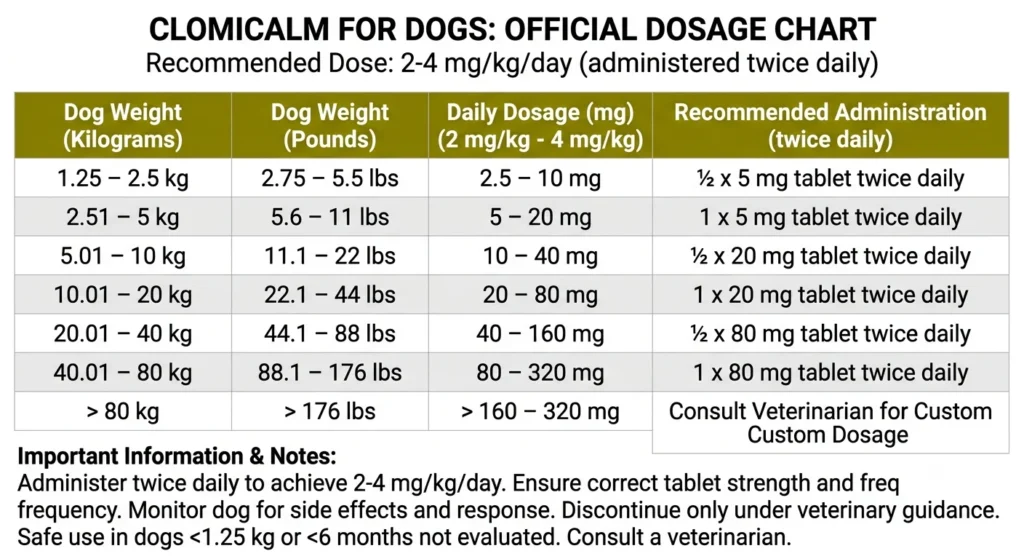
Clomicalm Dosage Calculator For Dogs
Estimate the recommended daily Clomicalm (clomipramine) dosage using the official dosage guideline of 2–4 mg/kg/day. This calculator is intended for educational purposes only and does not replace veterinary advice.
Dosage Results
- Prescription medication—use only under veterinary supervision.
- Recommended dosage range: 2–4 mg/kg/day (0.9–1.8 mg/lb/day).
- Giving with a small amount of food may reduce vomiting.
- Behavior modification should accompany treatment for separation anxiety.
- The veterinarian determines the most appropriate tablet strength (5 mg, 20 mg, or 80 mg).
- Potential side effects include vomiting, reduced appetite, appetite changes, and lethargy.
- Long-term safety beyond 12 weeks has not been fully evaluated.
- Do not discontinue therapy abruptly without veterinary guidance; dose reduction is typically gradual.
© medsdog.com
Dogs should never be given clomicalm unless a veterinarian has determined the dosage, using your dog’s body weight. Clomicalm® (clomipramine hydrochloride) is a FDA-approved prescription drug that is primarily used to treat separation anxiety in dogs older than 6 months of age in conjunction with a structured behavior modification program.
It is a tricyclic antidepressant (TCA) that works by increasing levels of serotonin and norepinephrine, thus decreasing anxiety-related behavior, including excessive barking, destructive chewing, inappropriate urination or defecation, pacing and other signs of stress when left alone. Sometimes, veterinarians may also prescribe clomipramine for canine compulsive behavior (OCD) and other anxiety-related disorders.


Paid Links - As an Amazon Associate, I earn from qualifying purchases.
The typical dose of Clomicalm for dogs is 2-4 mg per kg (0.9-1.8 mg per lb) of body weight, taken once a day or twice a day as your dog responds and tolerates the medication.
The medication is available in 5mg, 20mg and 80mg oral tablets and can often be administered with a little food to minimize gastrointestinal upset. Clomicalm can be very effective, but it can be used in combination with regular training and behavior modification and not stand alone for solving behavior problems.
Veterinary supervision is really important with this treatment as dosage, duration of treatment and monitoring of the dog throughout treatment can vary from dog to dog in order to be the most effective and avoid any side effects such as vomiting, loss of appetite, lethargy or interactions with other medications.
This complete guide shows you how to calculate the right Clomicalm Dosage For Dogs, offers an easy to follow dosage chart, features a Clomicalm dosage calculator, explains tablet strengths and instructions, and provides information on benefits, side effects, safety precautions, drug interactions, and when it may or may not be the right choice.
What is Clomicalm Dosage For Dogs?
Clomicalm dosing for dogs by weight is the veterinarian-prescribed dosage of clomipramine hydrochloride to be administered to help manage separation anxiety along with behavior modification training. Dosage is suggested to be 2-4mg/kg/day (0.9-1.8mg/lb/day) once daily or twice daily as per dog’s response and tolerance.
Clomicalm comes in 5mg, 20mg and 80mg tablets and the dosage should always be decided upon by your vet in consultation with your dog’s weight, history and specific needs.
Clomicalm Dosage Chart for Dogs By Weight
Recommended dosage: 2–4 mg/kg/day (0.9–1.8 mg/lb/day)
Administration: May be given once daily or divided into two equal doses (every 12 hours), as directed by your veterinarian.
| Dog Weight | Weight | Total Daily Dose | If Given Twice Daily (Per Dose) |
|---|---|---|---|
| 5 lb | 2.3 kg | 4.6–9.2 mg/day | 2.3–4.6 mg |
| 10 lb | 4.5 kg | 9.0–18.0 mg/day | 4.5–9.0 mg |
| 15 lb | 6.8 kg | 13.6–27.2 mg/day | 6.8–13.6 mg |
| 20 lb | 9.1 kg | 18.2–36.4 mg/day | 9.1–18.2 mg |
| 25 lb | 11.4 kg | 22.8–45.6 mg/day | 11.4–22.8 mg |
| 30 lb | 13.6 kg | 27.2–54.4 mg/day | 13.6–27.2 mg |
| 40 lb | 18.2 kg | 36.4–72.8 mg/day | 18.2–36.4 mg |
| 50 lb | 22.7 kg | 45.4–90.8 mg/day | 22.7–45.4 mg |
| 60 lb | 27.3 kg | 54.6–109.2 mg/day | 27.3–54.6 mg |
| 70 lb | 31.8 kg | 63.6–127.2 mg/day | 31.8–63.6 mg |
| 80 lb | 36.4 kg | 72.8–145.6 mg/day | 36.4–72.8 mg |
| 90 lb | 40.9 kg | 81.8–163.6 mg/day | 40.9–81.8 mg |
| 100 lb | 45.5 kg | 91.0–182.0 mg/day | 45.5–91.0 mg |
Available Tablet Strengths
- 5 mg tablets
- 20 mg tablets
- 80 mg tablets
Important Notes
- Clomicalm (clomipramine) is a prescription-only medication or dogs.
- A recommended dosage is 2–4 mg/kg/day, but your veterinarian will determine your dog’s specific dosage based on his condition and response to the treatment.
- May be given either once a day or twice a day (every 12 hours).
- Clomicalm can be administered with small quantity of food in order to minimize vomiting.
- Clomicalm should be used in conjunction with a behaviour modification program for separation anxiety.
- Never alter or stop the drug without the advice of the veterinarian. When treatment is discontinued, dose reductions will usually be made slowly.
What Is Clomicalm for Dogs?

Clomicalm® (clomipramine hydrochloride) is a prescription tricyclic antidepressant (TCA) that has been approved by the FDA for treating separation anxiety in dogs over 6 months of age. Best used in conjunction with a behaviour modification and training programme so that dogs can learn to have healthier responses to being alone.
Clomicalm’s effect is on the chemicals serotonin and norepinephrine in the brain, which are important for mood, anxiety and behavior.
It can restore the balance of these neurotransmitters, which can ultimately help minimize anxiety-related behavior, including destructive chewing, excess urination or defecation, excessive barking and other stress behaviors related to separation anxiety.
Veterinarians can also use clomipramine to treat noise phobias, aggression, obsessive-compulsive disorder (OCD), compulsive behaviors, and other anxiety-related behavioral disorders in dogs if necessary. Clomicalm is a dibenzazepine tricyclic antidepressant drug that is available in forms of oral tablets containing clomipramine hydrochloride, which are flavoured with meat components to enhance palatability and ease of administration.
Some other veterinary applications of clomipramine may be regarded as off label – that is, used as the veterinarian sees fit. For dogs, Clomicalm is approved for separation anxiety. Clomicalm is a prescription drug and should be used under veterinary care only to ensure that the treatment is safe and effective.
How Clomicalm Works
The mechanism of action for Clomicalm® (clomipramine hydrochloride) is interference with the action of the central nervous system (CNS), thereby aiding to reduce anxiety related behaviours in dogs. It’s a “tricyclic antidepressant”, which means it helps keep the important chemical serotonin in the brain by blocking its reuptake by the brain. Serotonin is a key factor in the balance of mood, emotion and stress reactions, and can be used to restore a balance of chemicals that may lead to behaviour issues.
Clomicalm medication supports improved serotonin activity to treat the real reason behind separation anxiety, not just its effects. This can minimize behaviors like excessive barking, destructive chewing, wrong elimination, obsessive-compulsive behaviors (OCD), aggression, and other anxiety-related behaviors.


Paid Links - As an Amazon Associate, I earn from qualifying purchases.
Clomicalm dosage is best used in conjunction with a well-designed behavior modification and training plan, which helps dogs more readily learn positive behavior. Clomicalm is not intended to put your dog to sleep, or to treat depression, although some dogs may feel a bit sleepy while being given Clomicalm.
What Is Clomicalm Used for in Dogs?
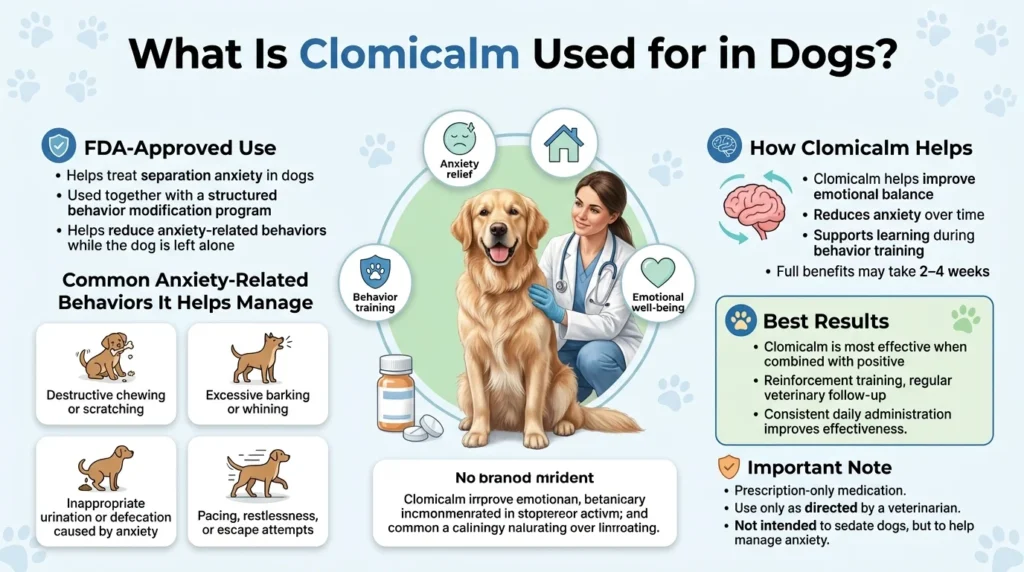
Clomicalm® (clomipramine hydrochloride) is a prescription drug that is approved by the FDA for treating separation anxiety in dogs 6 months and older. Most effective when used in conjunction with a behaviour modification and training programme, which will help the dog to calm down and re-engage with positive learning about behaviour.
Clomicalm dosage does not just sedate dogs – it aims to decrease the anxiety which leads to unwanted behavior.
Clomicalm is often used to treat separation anxiety and many of its symptoms, such as:
- Too much barking or whining
- Chewing or house soiling that is destructive
- Inappropriate urination or defecation (house soiling)
- Excessive drooling
- Other behaviours that result from isolation that may be observed as stress-related.
In certain instances, veterinarians might also use Clomicalm off-label (extra-label) for other anxiety-related ailments, including:
- Noise phobias
- Compulsive behaviors (tail chasing, circling, or excessive licking).
- Anxiety-related behavioral disorder (others)
Studies have not proven, however, that Clomicalm for dogs will be helpful in treating aggression; thus, it is not recommended for this use. Medical and behavioral evaluation should be conducted prior to giving Clomicalm; the veterinarian should verify that separation anxiety or a suitable condition is indeed the cause. However, the medication should only be used as directed by your veterinarian as off-label uses are not covered by FDA approved labelling.
FDA Study on Clomicalm
The effectiveness of Clomicalm® (clomipramine hydrochloride) in approximately 200 dogs suffering from separation anxiety was studied in a clinical investigation sponsored by FDA. One half of the dogs were given Clomicalm and behavior modification training and the other half were given behavior modification training and a placebo.
The researchers also found that after only one week, 47 percent of the dogs treated with Clomicalm improved compared with 29 percent of those receiving the placebo, indicating a potential for increased early improvement with the drug in addition to behavior modification.
The difference between the two groups narrowed by week eight, when 65% of the dogs in the Clomicalm group improved versus a 55% improvement with the placebo group. The results suggest that although Clomicalm can be used to help speed up initial progress, behavior modification should play a significant role in effective long-term treatment for separation anxiety.
A compounded product of clomipramine may be recommended over the FDA-approved product in some cases, by a veterinarian.
Medications should be compounded if:
- An appropriate strength for commercial use has not yet been determined.
- A dog has trouble taking regular tablets or capsules.
- A dog is allergic to a non-active ingredient of the FDA approved drug.
Compounded clomipramine products are not FDA approved, but are made by a licensed pharmacist or veterinarian for a specific dog’s medical requirements. Whether or not your vet prescribes a compounded formulation depends on your pet.
Possible Side Effects of Clomicalm in Dogs
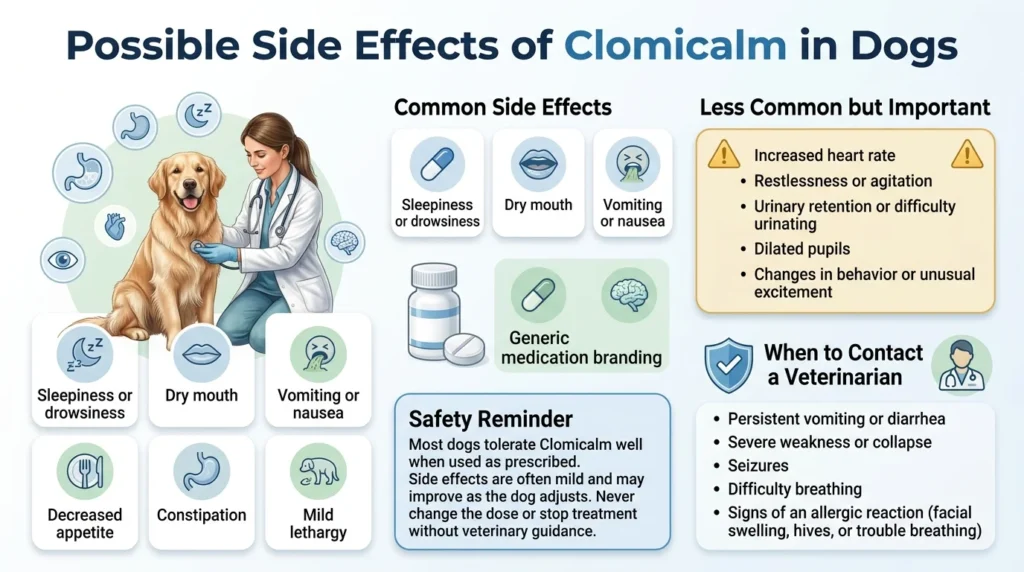
As with any other prescription drug, Clomicalm® (clomipramine hydrochloride) may have side effects, particularly the first few days after treatment begins, as the body acclimates to the drug. Most are mild and transient but some reactions may be severe and need immediate veterinary care. The most frequently reported side effects in FDA clinical trials were vomiting (25%), diarrhea (11%), lethargy (10%), increased thirst (5%) and changes in appetite (3%).
Side effects can include:
- Vomiting
- Diarrhea
- Lethargy or drowsiness
- Loss or change of appetite
- Dry mouth
- Constipation
- Difficulty urinating
- Increased thirst
- Grogginess or confusion
- Panting
- Mild agitation
- Weakness
- Higher than expected liver enzymes
- Increased or decreased heart rates (faster or slower)
While rare, severe reactions will need veterinary attention. If your dog develops any of these symptoms, stop giving him/her Clomicalm and talk to your vet immediately.
- Seizures
- Trouble breathing or allergic reaction (swelling of face, lips, tongue, or hives)
- Speeding up or irregular heartbeat.
- High blood pressure
- Over panting and fever
- Rigidity or weakness of muscles
- Severe lameness or collapse.
- Abnormal bleeding
- Coma
Clomicalm dosage should not be used in puppies under 6 months of age, male breeding dogs (because it may cause testicular hypoplasia) or dogs with cardiovascular disease, narrow-angle glaucoma, or a history of seizures. Additionally, it must not be used in combination with some central nervous system drugs, such as some general anesthetics, and your veterinarian may choose to discontinue it prior to elective surgery.
Clomipramine medication may also decrease several thyroid parameters, thus possibly complicating the diagnosis of hypothyroidism. If thyroid testing is required, or if long term treatment is necessary, your veterinarian may be monitoring thyroid function. In the event your dog feels unwell or exhibits any abnormal signs or symptoms during your dog’s use of Clomicalm, please consult your veterinarian immediately.
Clomicalm Precautions for Dogs
Your veterinarian will want to assess your dog’s overall health, medications your dog is taking, and your dog’s behavior before beginning the use of Clomicalm® (clomipramine hydrochloride). As Clomicalm may interact with some medical conditions and medications, close veterinary monitoring during treatment is necessary.
Owners should also note any changes in their dog’s behavior, appetite, general health, or home situation, as these changes can impact treatment success (e.g., moving to a new house, changes to routine, addition of a family member or pet, etc.). It may be that for some dogs there is some degree of lethargy or even a brief exacerbation of separation anxiety reactions (barking, crying, etc.) during the first few days of treatment.
Clomicalm should not be used in dogs with any of the following problems:
- Have an allergy to clomipramine or other tricyclic antidepressants (TCAs)
- Have or are using monoamine oxidase inhibitors (MAOIs), for example, selegiline or anti-flea collars with amitraz in them
- Are breeding males
- Are less than 6 months old.
- Have had seizures in the past
Exercise caution when using Clomicalm in dogs with:
- Any heart disease or irregularity of the heartbeat.
- Glaucoma or “dry eyes”
- Liver or kidney disease;
- Diabetes
- Thyroid disease (including hyperthyroidism)
- Slowing of gastrointestinal movements or constipation
- Trouble urinating or urinary retention
- Adrenal tumors
- Aggressive behavior
- Very young age, pregnancy or lactation (safety is not established)
Additional precautions include:
- Avoid feeding aged cheese while your dog is taking Clomicalm dosage.
- Let your veterinarian know if your pet is taking any medicines or supplements, since certain combinations can make for serious side effects.
- Clomicalm is not recommended for treating aggression.
- If an overdose is suspected, contact a veterinarian right away: clomipramine is a drug with a small safety margin; even small overdoses can be serious.
Signs of a clomipramine overdose may include:
- Excessive sedation
- Vomiting
- Wobbly or uncoordinated gait (ataxia)
- High or low heart rates, or irregular heart rhythms
Dogs that receive Clomicalm with other antidepressants are also prone to serotonin syndrome, which can be fatal. Symptoms include:
- Tremors
- Muscle spasms
- Seizures
- High body temperature (hyperthermia)
- Death in severe cases.
Always follow your vet’s advice carefully and never alter the dosage or discontinue treatment without consulting your vet.
Clomicalm Drug Interactions for Dogs
Clomicalm® (clomipramine hydrochloride) may interact with a variety of medicines, supplements, and even certain foods. Certain interactions can cause the side effects to be worse or may cause dangerous problems such as central nervous system (CNS) toxicity, serotonin syndrome, respiratory depression, irregular heart rhythm, or death. Always disclose to your veterinarian when your dog is taking any other medicines, vitamins, herbal remedies or over the counter medications prior to initiating Clomicalm therapy.
Do not use Clomicalm with monoamine oxidase inhibitors (MAOIs) or within 14 days of using a MAOI, such as:
- Selegiline (Anipryl®)
- Products that contain amitz in them (Preventic® Collar or Mitaban® Dip)
Severe CNS toxicity and other life-threatening reactions can occur when used in combination with Clomicalm.
Clomicalm should be used with caution in conjunction with drugs like:
- Other antidepressant medications, such as SSRIs, tricyclic antidepressants, trazodone, bupropion, buspirone, mirtazapine, and clonidine.
- Medications that slow the central nervous system, sedatives, opioids (like tramadol or fentanyl), muscle relaxants, antihistamines and anxiety medications.
- General anesthetic drugs (e.g., Ketamine or Propofol) and neuroleptic drugs
- Drugs that block the action of acetylcholine (anticholinergics, e.g., atropine, amantadine)
- Sympathomimetic drugs
- Medications for blood pressure (including enalapril, amlodipine and other drugs)
- Albuterol
- Levothyroxine
- Metoclopramide
- Ondansetron
- Nonsteroidal Anti-Inflammatory Drugs (NSAIDs)
- Other enzyme-inducing drugs include phenobarbital.
- Cimetidine, fluoxetine, azole antifungals (ketoconazole and itraconazole) and some antibiotics (fluoroquinolones, macrolides, and metronidazole)
Certain drugs can affect the amount of clomipramine that might be in your blood and some drugs may interfere with the way your body breaks down clomipramine. Clomicalm can also affect the levels of some drugs in the blood, such as phenobarbital, as it can affect liver enzymes.
Additional precautions include:
- Do not feed aged cheeses because they may increase the risk of adverse reactions.
- Clomicalm can affect blood glucose and thyroid tests; please notify your veterinarian if your dog is being sent for blood tests.
- Your veterinarian may wish to stop your dog on Clomicalm prior to elective surgery, when clinically appropriate.
This is not a comprehensive list of drug interactions, so do not begin, discontinue or alter any medication without first consulting with your veterinarian, while your dog is on Clomicalm.
You May Also Like to Read:
- Calcium Gluconate For Dogs: Calculator, Chart & Safe Guide
- Citravet Dosage For Dogs: Calculator, Chart & Safe Guide
FAQs
How to store Clomicalm for dogs?
Clomicalm dose should be stored in its original, tightly closed container in a dry place (59–77°F, 15–25°C) where it will be protected from moisture and light. Store medications as directed on the label and keep them away from children and pets.
If I forget to take my dose of Clomicalm should I do something about it?
If the dose is missed, give it as soon as possible. If the next scheduled dose is to be given within 12 hours, skip the dose and resume with the next scheduled dose. Do not give double doses to catch up on missed doses.
If my dog accidentally overdoses on Clomicalm, what should I do?
If you think your pet has overdosed, see your vet or emergency vet right away. May show signs of vomiting, lethargy, weakness, poor coordination, dilated pupils, abnormal vocalization, or change in heart rate.
Should I watch my dog while he’s on Clomicalm?
Your vet will do some initial liver function tests and an electrocardiogram (ECG) prior to treatment. They will keep an eye on your dog during the treatment and be able to look for any reaction or side effects or changes in the health of your dog.
What should I NOT do while my dog is on Clomicalm?
Never administer new prescription drugs, non-prescription drugs, herbs or vitamins without veterinary authorization. In addition, avoid abrupt withdrawal of Clomicalm medication without veterinary advice since abrupt withdrawal can produce undesirable side effects.
Is Clomicalm the same as clomipramine?
Yes. Clomipramine hydrochloride is a tricyclic antidepressant drug whose brand name is Clomicalm® and is approved for the treatment of separation anxiety in dogs plus behavior modification.
How do you know if your dog has separation anxiety?
Excessive barking or whining, destructive chewing or digging, inappropriate urination or defecation, excessive drooling, other anxious behavior when the dog is alone or separated from its owner.
What are signs of dog separation anxiety?
Separation anxiety could be the cause if your dog’s anxiety-related behaviors only occur when he is separated from you. A video of your dog during these episodes may be useful, however, a veterinary examination is required, as there are other medical and behavioural problems which may cause the same symptoms.
So, what’s the best way to treat separation anxiety in dogs?
Behavior modification training and veterinarian prescribed medication (Clomicalm) if needed is the best approach. The combination has been used in clinical studies and has been demonstrated to enhance response to treatment more rapidly than behavior training alone.
How long does it take for my dog to take Clomicalm?
The length of treatment is dependent upon how your dog responds and progresses with behavior modification. Your veterinarian will monitor your dog’s status and decide when it will be safe to reduce the dose or stop giving the medication. Do not discontinue treatment without veterinary advice.
Key Takeaways
- Clomicalm® (clomipramine hydrochloride) is a prescription drug that is approved by the Food and Drug Administration (FDA) for the treatment of separation anxiety in dogs 6 months and older.
- However, it is highly effective when used in conjunction with behavior modification and training and not as a single treatment.
- Dosage should be 2-4 mg/kg/day (0.9-1.8 mg/lb/day) and administered either once a day or twice a day as directed by your veterinarian.
- Clomicalm may also be prescribed for some anxiety-related problems, such as noise phobias and compulsive behaviours, off-label by veterinarians.
- Side effects include vomiting, diarrhea, lethargy, changes in appetite and an increased thirst, and serious reactions will need immediate veterinary attention.
- Clomicalm dose has a low therapeutic index, meaning that it can be harmful to overdose. Take the correct dose as always!
- Tell your veterinarian about all medications, supplements, and herbal products your dog is taking to help prevent potentially serious drug interactions.
- Do not increase, decrease, or discontinue treatment without first consulting with your veterinarian or use new medications.
Final Thoughts
Clomicalm® (clomipramine hydrochloride) is a prescription medicine that has been FDA-approved for treating separation anxiety in dogs and can be very effective particularly when combined with a structured behavior modification program. Note: the correct dosage is always dependent upon your dog’s body weight, and should be carefully chosen by your vet to ensure the greatest benefit and least likelihood of side effects.
While many dogs do well on Clomicalm, the medication may interact with a few drugs and has a very small therapeutic window, so keeping this small window for correct dosage is extremely important. Follow the veterinarian’s instructions for administration and watch your dog closely for any problems, contact your veterinarian right away if you think your dog has been overdosed or if he or she is having serious side effects.
When used alongside veterinary guidance and regular monitoring, and with consistent training, Clomicalm dosage can be a valuable tool in helping dogs develop healthier and calmer behaviors, and live a better life.