Disclaimer: This guide is for informational purposes only and is not a substitute for professional veterinary advice. Always consult your veterinarian before giving Onsior or any medication to your dog.
Onsior® Dosage Calculator For Dogs
Robenacoxib dose estimate based on your dog’s weight and condition.
Approved for dogs 5.5 lb (2.5 kg) or more.
Approved for dogs 4 months of age or older.
This calculator gives an estimate for general information only and is not a substitute for veterinary advice. Always confirm the dose, tablet strength and treatment length with your veterinarian and follow the product label.


Paid Links - As an Amazon Associate, I earn from qualifying purchases.
Onsior® Dosage For Dogs (robenacoxib) is a prescription drug that belongs to the group known as non-steroidal anti-inflammatory drugs (NSAIDs) and is a Cox-2 inhibitor. It is designed to help ease the pain and inflammation in dogs, typically following soft tissue surgery.
Onsior is commonly used before and after surgery by veterinarians as it targets areas that are inflamed, helping to reduce pain without affecting other healthy tissues. The flavored tablets are round, beige to brown, yeast flavored and contain the active ingredient robenacoxib making them more acceptable to many dogs.
Giving the correct Onsior dose for dogs by weight is important to help manage pain and minimise side effects. Onsior is approved for use in dogs 5.5 lbs (2.5 kg) or more and 4 months of age or older and is usually only used for a maximum of 3 consecutive days after an operation. This is a prescription NSAID, so it should only be administered as directed by your veterinarian.
Administering greater amounts, using Onsior for longer than the prescribed course or using Onsior in combination with other NSAIDs or corticosteroids may increase the risk of serious side effects.
This comprehensive guide to Onsior will show you how to determine the correct dosage for your dog, what the recommended dosage chart and Onsior tablet strengths are, how and when to use Onsior, and safety precautions and side effects, and answer frequently asked questions.
From our Onsior dosage calculator to just information backed by veterinarians, this guide has all you need to help your dog recover safely and comfortably.
Key Takeaways
- Onsior® (robenacoxib) is a COX-2 selective NSAID indicated for controlling pain and inflammation in dogs, especially following soft tissue surgery.
- It can be used in dogs 4 months of age or older and 5.5 lbs (2.5kg) or higher.
- The Onsior dosage for dogs depends on the weight of the pet and will always be prescribed to the dog by a veterinarian. Tablets are not scored and should not be broken.
- Treatments are usually no more than 3 straight days for postoperative pain control.
- Onsior tablets are flavored with yeast and will taste better to many dogs.
- Do not exceed the recommended dosage, prolong treatment without veterinary guidance or mix Onsior with other NSAIDs or steroids.
- Possible side effects include vomiting, diarrhoea, loss of appetite or drowsiness. If there are severe or unusual reactions, contact your veterinarian.
- Dogs suffering from kidney, liver, heart disease, dehydration, stomach ulcers, or bleeding disorders might need special precautions or a different medication.
- If your dog has other underlying health issues or other medications, regular veterinary checks need to be performed.
- While our Onsior Dosage Calculator and dosage chart are provided as a reference, always follow your veterinarian’s advice as this takes precedence over any online calculator or guide.
How Much Onsior® For Dogs?
- For Osteoarthritis: Recommended dose is 1-2 mg/kg administered without food or at least 30 minutes before or after a meal.
- For Soft tissue surgery: Recommended dose is 2 mg/kg with a range of 2–4 mg/kg. Administer, without food, approximately 30 minutes before the operation, and once a day for up to 2 additional days
| Dog Weight | Weight (kg) | Osteoarthritis Dose 1–2 mg/kg | Soft Tissue Surgery Dose 2–4 mg/kg |
|---|---|---|---|
| 5 lb | 2.3 kg | 2.3–4.6 mg | 4.6–9.1 mg |
| 10 lb | 4.5 kg | 4.5–9 mg | 9–18 mg |
| 15 lb | 6.8 kg | 6.8–13.6 mg | 13.6–27.2 mg |
| 20 lb | 9.1 kg | 9.1–18.2 mg | 18.2–36.4 mg |
| 25 lb | 11.3 kg | 11.3–22.7 mg | 22.7–45.4 mg |
| 30 lb | 13.6 kg | 13.6–27.2 mg | 27.2–54.4 mg |
| 40 lb | 18.1 kg | 18.1–36.3 mg | 36.3–72.6 mg |
| 50 lb | 22.7 kg | 22.7–45.4 mg | 45.4–90.8 mg |
| 60 lb | 27.2 kg | 27.2–54.4 mg | 54.4–108.9 mg |
| 70 lb | 31.8 kg | 31.8–63.5 mg | 63.5–127.0 mg |
| 80 lb | 36.3 kg | 36.3–72.6 mg | 72.6–145.2 mg |
| 90 lb | 40.8 kg | 40.8–81.6 mg | 81.6–163.3 mg |
| 100 lb | 45.4 kg | 45.4–90.7 mg | 90.7–181.4 mg |
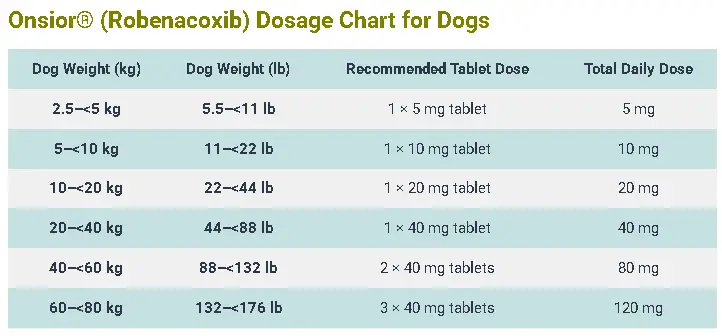
Onsior® (Robenacoxib) Dosage Chart for Dogs
| Dog Weight (kg) | Dog Weight (lb) | Recommended Tablet Dose | Total Daily Dose |
|---|---|---|---|
| 2.5–<5 kg | 5.5–<11 lb | 1 × 5 mg tablet | 5 mg |
| 5–<10 kg | 11–<22 lb | 1 × 10 mg tablet | 10 mg |
| 10–<20 kg | 22–<44 lb | 1 × 20 mg tablet | 20 mg |
| 20–<40 kg | 44–<88 lb | 1 × 40 mg tablet | 40 mg |
| 40–<60 kg | 88–<132 lb | 2 × 40 mg tablets | 80 mg |
| 60–<80 kg | 132–<176 lb | 3 × 40 mg tablets | 120 mg |
Dosage Guidelines
- Target dosage: Approximately 1-2 mg/kg orally once daily.
- Frequency: Once daily.
- Maximum duration: Up to 3 consecutive days.
- Minimum age: 4 months.
- Minimum weight: 2.5 kg (5.5 lb).
- Tablets must not be split or broken. Use only whole tablets.
- May be given with or without food.
- For dogs weighing less than 2.5 kg (5.5 lb) or 80 kg (176 lb) and above, consult a veterinarian before use.
What Is Onsior® (Robenacoxib)?
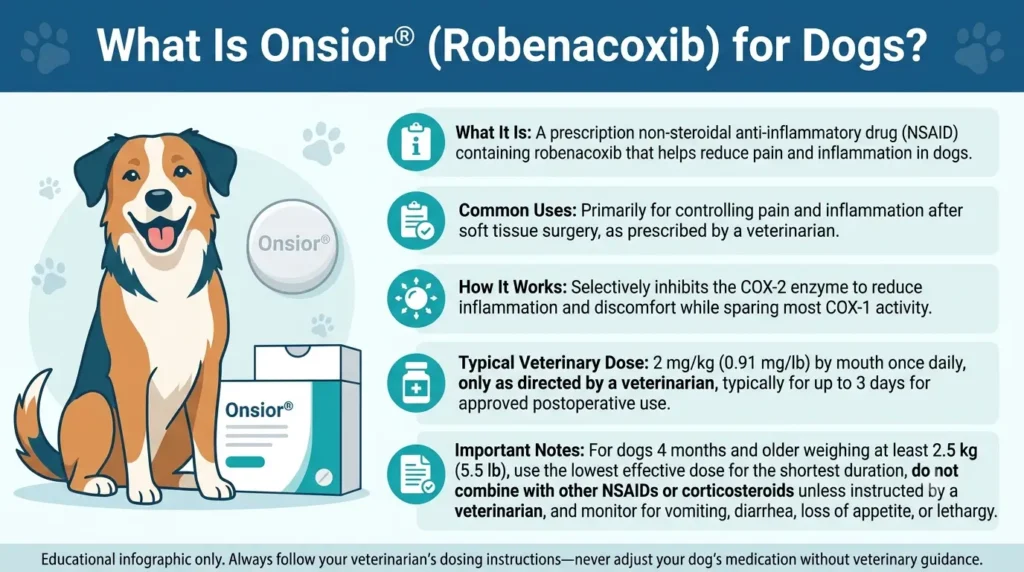
Onsior® (robenacoxib) is a prescription non-steroidal anti-inflammatory drug (NSAID) of a class of drugs known as coxibs, or COX-2 selective. Is indicated for the relief of pain and inflammation in dogs, especially prior to and following soft tissue surgery. The active ingredient, robenacoxib, works in the inflamed tissues to give you effective pain relief and has less of an effect on healthy tissues than non-selective NSAIDs.
Onsior drug for dogs is approved for postoperative pain and inflammation in dogs 4 months or older and 5.5 lbs (2.5 kg) or more undergoing soft tissue surgery. Treatment may only be administered for up to 3 consecutive days and under the direction of a veterinarian.
Onsior tablets are round, beige to brown, flavored with yeast and come in various strengths for accurate weight based dosing. As it is a prescription drug, the proper Onsior dosage for dogs is always best determined by a veterinarian to ensure safe and effective treatment.
Benefits of Onsior® (Robenacoxib) for Dogs
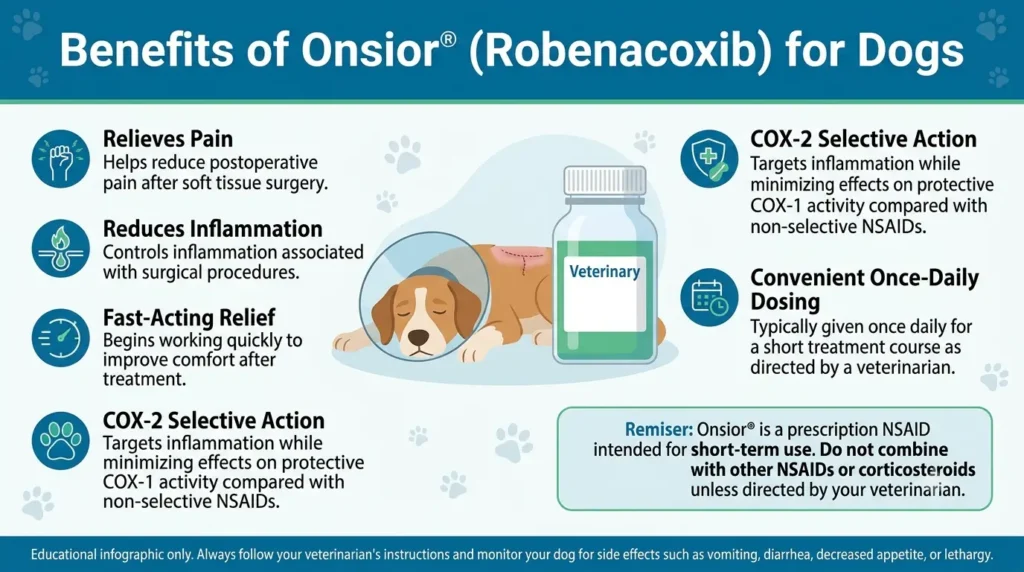
Onsior® (robenacoxib) is a COX-2 selective NSAID that can be used to manage the pain and inflammation of soft tissue surgery in dogs. It’s created for brief postoperative pain alleviation and intends to get to the inflamed.
Key Benefits
- Effectively relieves pain and inflammation pre and post soft tissue surgery.
- Allowed for short term use (3 or less consecutive days) for postoperative pain.
- Treats inflamed areas, bringing the relief to those areas that need it most.
- Can be given with or without food; providing more dosing flexibility.
- In 3 or 6 tablet blister packs for convenient treatment courses.
Uses of Onsior® (Robenacoxib) for Dogs
Onsior® (robenacoxib) helps relieve pain and inflammation in dogs, and is a prescription COX-2 selective NSAID. It is prescribed most often for pain following surgery, but may be used veterinarians deem appropriate for the treatment of pain and inflammation of musculoskeletal diseases, such as osteoarthritis and fractures.
Common Uses
- Manages pain and inflammation pre and post operatively.
- When prescribed by a veterinarian, helps control pain symptoms from musculoskeletal conditions like osteoarthritis and fractures.
- Should be given orally as prescribed by your veterinarian.
- Give whole tablet – Onsior tablets should NOT be split, broken or crushed.
- Treatment is restricted to once a day and a maximum total of three doses over 3 consecutive days.
- Never add or give more medicine or more often than your veterinarian has instructed.
Side Effects of Onsior® (Robenacoxib) for Dogs
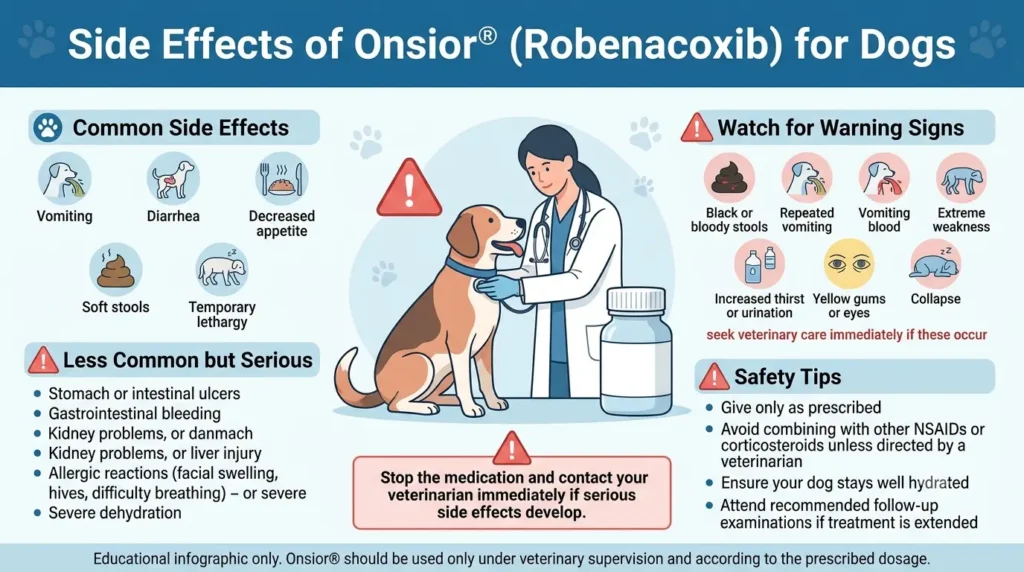
As with other non-steroidal anti-inflammatory drugs (NSAIDs), Onsior® (robenacoxib) may have side effects. When administered as directed, the majority of dogs do not have any reaction to the drug, though some may get upset stomachs or more severe reactions that may need veterinary attention. If any side effect persists, gets worse or you see something unusual, contact your veterinarian immediately.
Common Side Effects
- Vomiting
- Soft stools or diarrhea
- Decreased appetite (anorexia)
- Feeling tired or less energetic
- Depression
- Blood in the stool
- Bleeding or infection from the surgery cut
- Increased liver enzymes (usually after extended use)
- Disease or failure of the kidneys
They can be very serious side effects and medical attention from a vet must be sought as soon as possible.
If your dog becomes ill, has a reaction or symptoms from giving Onsior, discontinue it and talk to your veterinarian right away.


Paid Links - As an Amazon Associate, I earn from qualifying purchases.
- Strong or ongoing vomiting or diarrhoea
- Jaundice – yellowing of the skin, eyes or gums.
- Increased or decreased water use or urination
- Seizures
- Abnormal behavior
- Poor co-ordination (incoordination)
- Weakness
Signs of Overdose
Taking too much Onsior can lead to serious problems, such as:
- Severe gastrointestinal upset
- Gastrointestinal ulcers
- Perforation of stomach or intestine.
- Damaged or failed kidneys
- Infection and inflammation of the abdominal cavity (peritonitis)
- A life-threatening systemic (body-wide) infection (sepsis)
Dogs That May Not Take Onsior
Do not use Onsior in dogs that:
- Have an allergy to robenacoxib or other NSAIDs
- Have gastrointestinal ulcers
- Are pregnant or nursing mothers?
- Are younger than 4 months of age
In dogs that, Use With Extreme Caution.
Dogs should be closely monitored or Onsior should be avoided unless prescribed by a veterinarian if they:
- Are dehydrated
- Taking diuretic drugs (water pills)
- Suffer from serious kidney, liver or heart disease
- Are elderly (geriatric)
- Have bleeding disorders
Important Safety Notes
- Before beginning Onsior treatment, blood tests may be ordered to assess kidney and liver function and risk factors.
- Never give Onsior prescribed for one pet to another pet without your veterinarian’s approval.
- The drug typically is metabolized out of the body in a few days but in dogs with liver or kidney disease, it can last longer.
Drug & Food Interactions of Onsior® (Robenacoxib) for Dogs
Tell your veterinarian about any other medications, vitamins, supplements, and herbs your dog receives prior to administering Onsior® (robenacoxib).
Robenacoxib may interact with a number of other medicines, causing gastrointestinal bleeding, kidney damage or other side effects. Your veterinarian may dose the drugs differently and be more diligent if the drugs need to be used at the same time.
Drug Interactions
Don’t use Onsior concurrently with:
- Other NSAIDs (e.g., aspirin) because they increase the risk of stomach ulcers and bleeding.
- Corticosteroids (e.g., prednisone, dexamethasone) that greatly enhance the risk of gastrointestinal toxicity.
Please use Onsior with care in dogs that are on:
- Aminoglycoside antibiotics (such as gentamicin, amikacin) – can make the body more susceptible to kidney damage.
- Furosemide (Lasix®).
- Cimetidine.
- Insulin – can lead to hypoglycemia (low blood sugar).
- Cyclosporine (Atopica®).
- Methotrexate.
- Clopidogrel – could lead to bleeding.
- Selective serotonin reuptake inhibitors (SSRIs) (such as fluoxetine).
- Tricyclic anti-depressants (such as amitriptyline, clomipramine).
Food Interactions
- Onsior tablets can be given with or without food.
- No particular food interactions are listed, but always follow your veterinarian’s instructions for administration.
Important Safety Tips
- Before starting Onsior, always let your veterinarian know of all medications and supplements your dog is taking.
- Never start, stop, or mix medications without veterinary advice.
- If your dog shows any unusual reactions when taking Onsior with other medication, contact your veterinarian immediately.
You May Also Like to Read:
- Apple Cider Vinegar Dosage for Dogs: Calculator & Safe Guide
- Kaopectate Dosage For Dogs: Calculator, Chart & Safe Guide
FAQs
What if I forget to give Onsior® drug to my dog?
In case of any missed or forgotten dose of Onsior®, administer the dose as soon as possible. But if it is nearly time for the next dose, skip the missed dose and resume with the next scheduled dose of the medication. Do not double up doses to make up for a forgotten dose.
Should I watch my dog while he is taking Onsior®?
Yes. Your veterinarian might want to take blood tests and perform a urinalysis before you begin the use of Onsior® to determine baseline kidney and liver function. If your dog needs this medication for an extended period of time, regular check-ups and blood tests should be performed to check for any side effects and to see if it is working well.
How to store Onsior® dosage for dogs?
Keep Onsior® tablets in the original blister pack at a controlled room temperature of 15°C – 25°C (59°F – 77°F). Store in a cool, dry place, out of direct sunlight, heat and moisture. Avoid putting it in bathrooms or other wet rooms; always make sure it is in a childproof container away from children and pets.
If my dog accidentally ingests too much Onsior®, what do I do?
Severe gastrointestinal tract, kidney or liver damage can result from overdose of Onsior®. If you think your dog received an overdose of the medicine, contact your veterinarian or emergency veterinary clinic right away for advice.
Are Onsior® tablets for dogs safe for cats?
No. Onsior® tablets formulated for dogs should not be administered to cats as a dosage cannot be calculated accurately using the canine tablets. Never apply the formulation intended for another species of animal.
Can dogs have allergic reactions to Onsior®?
Yes. Although uncommon, allergic reactions can occur. If your dog shows signs of swelling of the face, lips, tongue or airways, trouble breathing, excessive drooling, vomiting, hives, severe itching or unusual agitation, contact your veterinarian immediately. Onsior® should not be given to dogs known to be sensitive to robenacoxib.
If my dog has side effects on Onsior®, what should I do?
If your dog continues to vomit, have diarrhea, has no appetite, is lethargic, has changes in urination or any other unusual symptoms, stop giving the medication and call your veterinarian. Early detection and veterinary care can avoid additional complications.
Could Onsior® be used by all dogs?
No. Onsior® should only be used under veterinary supervision. It should not be administered to dogs who are known to be allergic to robenacoxib, and your vet will assess your dog’s suitability for it before it is prescribed, if your dog has an underlying health condition or any other risk factors.
Final Thoughts
When prescribed by a veterinarian, Onsior® (robenacoxib) is a trusted COX-2 selective NSAID which can effectively relieve pain and inflammation in dogs after soft tissue surgery for the short-term duration. Dosage for dogs should be carefully followed as it depends on the dog’s body weight and health conditions, and should never be exceeded or used for a longer period of time than prescribed by your veterinarian.
The Onsior Dosage Calculator and dosage chart outlined in this guide provides a better understanding of your dog’s dosage recommendation and should not be used in place of professional veterinary advice. Always keep an eye out for potential side effects, be sure to attend all follow up visits and call your veterinarian if your dog shows signs you didn’t expect or if you think that the dose may have been a little too much. If used correctly and under veterinary supervision, Onsior may be a valuable tool in aiding your dog’s recovery in a safe and comfortable manner.