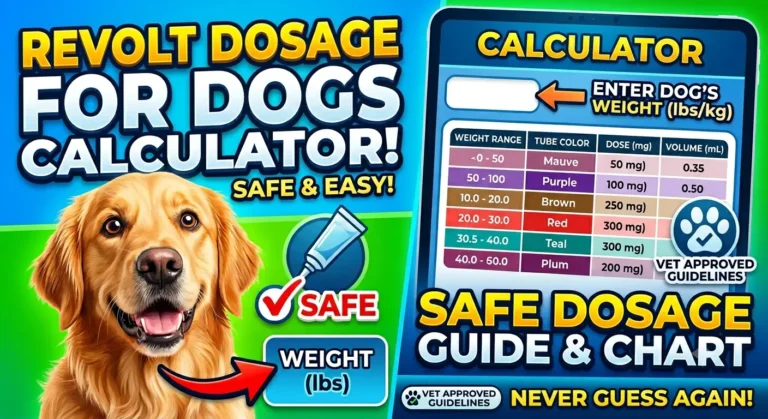
Milprazon Dosage Calculator for Dogs
Enter your dog’s weight to calculate the recommended Milprazon tablet dose.
Recommended Dosage


Paid Links - As an Amazon Associate, I earn from qualifying purchases.
- Administer orally with or after food to ensure optimal heartworm prevention and full absorption.
- Do not use in puppies weighing less than 0.5 kg (1.1 lb), regardless of age.
- Avoid use in dogs with known hypersensitivity to milbemycin oxime or praziquantel.
- Frequent or repeated use of anthelmintic drugs may lead to parasite resistance — consult your veterinarian for a treatment plan suited to local parasite risk.
- For best results, treat all pets in the household and consider flea and lice control to help prevent tapeworm reinfection.
- If you suspect your dog already has heartworm disease, have your veterinarian perform diagnostic testing first — Milprazon prevents heartworm but does not treat existing adult heartworm infections.
This calculator is provided for general reference only and does not replace professional veterinary advice. Always confirm dosing with your veterinarian before administering any medication.
You’ve got a box of Milprazon Dosage in one hand and a dog waiting for dinner in the other, and you’re not totally sure you’re giving the right amount. That’s a fair thing to double-check — Milprazon Dosage For Dogs comes in two tablet strengths that look alike but aren’t interchangeable, and mixing them up is the single easiest mistake to make with an otherwise very safe wormer.
This guide breaks down exactly how much to give, for both tablet strengths, in kilograms and pounds, straight from the manufacturer’s own dosing data. It also covers the few things actually worth checking before you dose — food, breed sensitivities, missed doses, and what a real overdose risk looks like versus what doesn’t.
Quick answer: Milprazon dog medication should be administered orally, once, at a rate of not less than 0,5 mg milbemycin oxime and 5 mg praziquantel per kilogram of body weight, with or after food. It comes in two tablet strengths — a small-dog/puppy tablet (2.5 mg/25 mg) for dogs 0.5–10 kg, and a standard tablet (12.5 mg/125 mg) for dogs 5–75 kg. Always weigh your dog and match the weight to the chart below rather than estimating.
Key takeaways
- Milprazon dose contains two active ingredients: Milbemycin Oxime (active against roundworms, hookworms, whipworms and prevents heartworm larvae) and Praziquantel (active against tapeworms).
- There are two strengths of tablets, and they can’t be used interchangeably (milligram for milligram) — make sure that you are using the correct chart that corresponds with the pack you purchased.
- Administer once a day, with or after food. No pre-preparatory fasting or laxative is required.
- The safety margin is smaller when using milbemycin oxime, so the recommended dose should be strictly adhered to, especially in collies and other herding dogs.
- Milprazon is a veterinary medicine that can only be sold in the UK/EU on prescription. The closest FDA approved product with the same 2 active ingredients in the US is Interceptor Plus.
What Is Milprazon For Dogs?

Milprazon for dogs is a prescription dewormer (anthelmintic) chewable for dogs that is manufactured by KRKA. It contains 2 active ingredients, milbemycin oxime and praziquantel, both in a flavored tablet, meaning that a single treatment will control both the roundworm-type parasites and the tapeworms.
In the UK and throughout the EU, it is classified as a POM-V medicine, just one that can only be dispensed with the authorisation of a veterinarian, who will ensure that it is suitable in terms of your dog’s weight, age and health.
Milprazon is available in two different tablet strengths, designed for different sized dogs:
| Tablet | Milbemycin oxime | Praziquantel | Labeled for |
| Small Dogs & Puppies | 2.5 mg | 25 mg | Dogs/puppies from 0.5 kg (1.1 lb) |
| Dogs | 12.5 mg | 125 mg | Dogs from 5 kg (11 lb) |
How Milprazon Works in Dogs

Milbemycin oxime is a macrocyclic lactone that is produced by fermentation. It interferes with the ability of susceptible parasites to take up chloride ions on the cell membranes of their nerve and muscle cells, causing the parasites to become paralyzed and die — that means that it gets rid of roundworms, hookworms, whipworms and immature heartworm larvae.
Praziquantel is a different type of drug: it increases the permeability of the cell membranes of a tapeworm to calcium ions and these result in contraction of the muscles of the tapeworm and breakdown of its outer tegument. The worm can’t attach itself to the intestine and it is expelled.
The two ingredients used together, fill the entire common worm list in a single tablet, not two.
Pharmacokinetics (how the body processes it, based on the manufacturer’s information): Milbemycin oxime has a peak blood level of 2-4 hours following an oral dose, with approximately 80% bioavailability, and is excreted primarily unchanged.
Praziquantel achieves very rapid peak blood levels (in 15 minutes to 2.5 hours), is approximately 80% plasma protein bound, is metabolized rapidly in the liver, and is completely eliminated from the plasma in approximately 2 days by urinary excretion.
What Does Milprazon Treat?

Milprazon dog dosage is used to treat an infection with adult cestodes (tapeworms) and nematodes (roundworm-type worms):
- Tapeworms: Dipylidium caninum (the flea tapeworm), Taenia species, Echinococcus species, Mesocestoides species
- Toxocara canis, Toxascaris leonina are examples of roundworms.
- Hookworms: Ancylostoma caninum
- Whipworms: Trichuris vulpis
- Lungworm: Crenosoma vulpis (causing a reduction in infection levels) and Angiostrongylus vasorum (causing a reduction in immature and adult burden — see special protocol below)
- Thelazia callipaeda (see special protocol below): Eyeworm
- Heartworm prevention: Dirofilaria immitis – Milprazon may be used for prevention of heartworm disease in cases where treatment for tapeworms is also warranted at the time of treatment. If your intention is to provide heartworm only prevention on an ongoing monthly basis, the manufacturer’s recommendation is to use a monovalent (Milbemycin Only) product, instead of Milprazon monthly.
Milprazon Dosage Chart for Dogs By Weight
The recommended recommended dose rate is 0.5 mg of milbemycin oxime + 5 mg of praziquantel per kg of body weight, as a single oral dose. The practical dose is calculated by whole or half numbers of tablets according to the weight band – the amount of tablets is not calculated to the exact milligram per dog due to the fixed strength of the tablets.


Paid Links - As an Amazon Associate, I earn from qualifying purchases.
Before giving to your dog, weigh the dog. The most frequent cause of under or over-dosing is from guessing weights.
Small Dogs & Puppies (2.5 mg milbemycin oxime / 25 mg praziquantel)
| Body weight (kg) | Body weight (lb) | Dose |
| 0.5–1 kg | 1.1–2.2 lb | ½ tablet |
| >1–5 kg | >2.2–11 lb | 1 tablet |
| >5–10 kg | >11–22 lb | 2 tablets |
Dogs (12.5 mg milbemycin oxime / 125 mg praziquantel)
| Body weight (kg) | Body weight (lb) | Dose |
| 5–25 kg | 11–55 lb | 1 tablet |
| >25–50 kg | >55–110 lb | 2 tablets |
| >50–75 kg | >110–165 lb | 3 tablets |
Which Pack Do I Need?
Technically, between 5kg and 10kg both packs work, as the required dose rate is the same number of milligrams for 2 of the small tablets as for 1 of the large, and for 1 of the small and 1 of the large. In practice, purchase the pack prescribed or dispensed by your vet, and follow the directions on the pack – don’t combine the different strength tablets in a single dose.
The rationale for the weight bands: The dose rate given on the label is the minimum. The dog at the bottom of the weight band gets more than the minimum per kg of weight, the dog at the top of the band gets nearly exactly the minimum per kg of weight. This is a standard approach of veterinary anthelmintics and is how bands can have a large weight range for the same number of tablets.
Can I Split a Milprazon Tablet?
Only the small dog/puppy tablet (2.5 mg/25 mg) is scored and designed to be divided into equal halves. The manufacturer does not describe the standard tablet (12.5 mg/125 mg) as being able to be split – use as a whole tablet dose only, do not split to “fine-tune” a dose between tablets.
How to Give Milprazon Correctly
- Always weigh your dog on a scale just before giving the dose; not by guess, particularly with a growing puppy.
- Match the weight with the appropriate chart for the tablet strength you have.
- Give with or after a meal. A little food is recommended to make sure that the dose is completely swallowed and absorbed.
- No pre-treatment fasting or laxative will be necessary.
- After giving the tablet to your dog, observe them for a few minutes to ensure that the tablet is chewed and swallowed and not spat out or dropped.
- If a part dose is lost or refused, it is considered to be a partial dose – consult with your veterinarian regarding re-dosing.
Special Dosing Schedules (Lungworm, Eyeworm, Heartworm)
Most worms are cleared with a single dose, but three parasites need a different schedule:
- Angiostrongylus vasorum (French heartworm/lungworm): for treatment, Milprazon mecicine is given four times, seven days apart. If a treatment for tapeworm is also required, the initial dose may be Milprazon, and the subsequent 3 doses should be Milbemycin only products (once every 7 days). If continual prevention is needed in a high-risk zone, 4 weekly doses will help to diminish the parasites.
- Thelazia callipaeda (eyeworm): twice, 7 days apart.
- Heartworm prevention (Dirofilaria immitis): 1 dose monthly during mosquito season generally for a dog at risk, usually beginning prior to the season and ending 1 month after the season has ended. A veterinarian should check for an existing heartworm infection before beginning treatment as treating an infected dog can cause a reaction (see Risks below).
Missed or Double Dose — What to Do
- Missed a dose (e.g. in a course of lungworm or heartworm prevention): restart as soon as remembered at the same dose and on the same schedule. Avoid doubling up to “catch up.
- Accidentally gave a double dose: the manufacturer’s safety studies did not identify any signs beyond those already seen at the normal recommended dose. However, contact your vet if your dog is a Collie-type breed or exhibits vomiting, shaking, wobbliness or drooling.
- Child swallowed a tablet: consult a medical professional ASAP and bring the child’s medication package/labeling.
Benefits of Milprazon
- Chewable tablet provides protection against roundworms, hookworms, whipworms, tapeworms and (when used correctly) lungworm, eyeworm and heartworm protection.
- Meat flavored and chewable – mostly easy to give
- Preparation with laxative is not necessary prior to the test; no fasting required.
- Can be used during breeding, pregnancy and lactation in bitches where clinically indicated.
- Scored small-dog tablet can be accurately split for very small puppies
- With a long established manufacturer (KRKA) and a published UK/EU regulatory datasheet.
Milprazon Side Effects in Dogs

Adverse reactions reported: Very rare in the manufacturer’s safety data, but may involve:
| Category | Signs |
| Hypersensitivity | Allergic-type reaction |
| Systemic | Lethargy |
| Neurological | Muscle tremors, ataxia (wobbliness/incoordination) |
| Digestive | Vomiting, diarrhea, reduced appetite, drooling |
If your dog exhibits any of these after taking the dose, especially shaking, wobbling, or multiple vomiting, reach out to your veterinarian. Dogs with a high circulating microfilarium count may be reacting to the effects of the dead microfilaria (pale gums, vomiting, tremors, excessive breathing, drooling) and not to the drug per se.
That’s why vets perform heartworm testing prior to beginning a heartworm prevention program.
Risks, Warnings & Contraindications
- Avoid use if hypersensitive to milbemycin oxime, praziquantel or any tablet excipient.
- Small-dog tablet: Not suitable for puppies younger than 2 weeks and/or less than 0.5 kg.
- Standard tablet: For dogs of more than 5 kg.
- Collie type breeds: studies demonstrate a smaller safety margin with milbemycin oxime in Collies and Collie types (this is the same well known MDR1/ABCB1 gene sensitivity of macrocyclic lactones in general for Collies and related breeds). Label dose should be adhered to and tolerance is not specifically studied in very young puppies of these breeds.
- Treatment is not recommended when microfilaremia (heartworm larvae in the bloodstream) is known or suspected, because of the above described hypersensitivity-reaction.
- Severely debilitated dogs or dogs with significant kidney or liver disease: Not specifically studied; use if judged by the veterinarian that the benefit outweighs the risk.
- Puppies less than 4 weeks of age: tapeworm infection is not common at this age therefore there is no need to use the combination product and this is why some websites state the ‘hard’ label age of 2 weeks/0.5kg for the small tablet.
- Echinococcus species are zoonotic (transmissible to humans) and may be a notifiable animal disease in some jurisdictions, if your dog has a confirmed Echinococcus infection then follow your vet’s and local health authority’s specific advice, rather than routine dosing.
- Store out of reach of children and other animals — the tablets are flavoured and animals may be tempted to eat them; store half tablets in the blister pack.
Drug Interactions
No interaction was seen when Milprazon dosage for dogs was combined with the recommended dose of selamectin (another macrocyclic lactone) in manufacturer studies. Production has also not been conducted with other macrocyclic lactones (such as those containing ivermectin or moxidectin), however, the manufacturer recommends that care be taken to avoid unnecessary duplication of drug class.
Before you begin giving Milprazon to your dog, always tell your vet about any other parasite-control product her dog is using, including flea/tick products.
Milprazon vs. Interceptor Plus vs. Milbemax vs. Drontal Plus
| Product | Active ingredients | Heartworm prevention | Tapeworm coverage | Manufacturer / typical region |
| Milprazon | Milbemycin oxime + praziquantel | Yes, when combined with cestode treatment | Yes | KRKA / UK, EU |
| Interceptor Plus | Milbemycin oxime + praziquantel (same actives, same 0.5 mg/kg + 5 mg/kg minimum dose rate) | Yes, monthly | Yes | Elanco / FDA-approved, US |
| Milbemax | Milbemycin oxime + praziquantel | Yes | Yes | Virbac / UK, EU — the original reference product that Milprazon is licensed alongside, generally in the same tablet strengths |
| Drontal Plus | Febantel + pyrantel embonate + praziquantel | No | Yes | Bayer/Elanco / widely available |
The bottom line: Milprazon and Interceptor Plus contain exactly the same two active ingredients, and they’re applied at the same minimum dose rate – they’re two different names for the same product in two different regulatory areas. Milbemax is the virtually identical reference product for which Milprazon medication for dogs is licensed in the UK/EU. Drontal Plus is effective for the same worm list as above, but lacks a macrocyclic lactone and is not effective against heartworm.
Pregnancy, Lactation & Puppies
Milprazon’s UK/EU labelling indicates that it can be used in breeding dogs as required, including pregnant and lactating bitches. As in all treatment during pregnancy or lactation, this should be a decision to be made with your veterinarian and is not one to be made on your own, especially if your dog has any other health issue.
Storage & Shelf Life
- Keep in original pack, protected from food, in a dry place out of direct sunlight, where children and animals cannot reach, at 5-25°C.
- Shelf life (unopened): 3 years.
- Tablets which have been halved: put the half tablet which has not been used back in the original blister and outer carton and use within 6 months, stored below 25°C.
Is Milprazon Available in the US? (Legal Status)
Milprazon is a prescription-only medicine (POM) in the UK and other EU member states, and can not be purchased off the shelf. The product is not an FDA-approved product in the United States and retail websites in the United States that sell the product to U.S. customers are often international/UK-based online pet pharmacies that ship across the border, and a prescription or veterinary authorization is still usually needed.
For those who reside in the United States and would like a domestically FDA-approved product that contains the same two active ingredients, consult your veterinarian about Interceptor Plus, an approved formula for dogs and puppies 6 weeks of age and older that weigh 2 lb or more.
Myth vs. Fact
Myth: “Since bigger dog, more tablets, whatever strength I have in the house.
Fact: The fact is that the two strengths cannot be substituted tablet for tablet. Always dose according to chart supplied with the pack received.
Myth: “My dog doesn’t appear to be sick, so why does she need to be dewormed on schedule?”
Fact: Tapeworms and roundworms, even the early infections, do not produce any noticeable symptoms.
Myth: “Milprazon dosage is not effective against fleas and ticks.
Fact: No – it is meant for an internal dewormer only. Fleas and ticks require a separate ectoparasite product, and even if Milprazon is effective, it will not cure Dipylidium caninum tapeworm since fleas are a reinfection source.
Myth: “Once Milprazon worked to prevent heartworm, it’s okay to continue to use it monthly for the long term rather than using a specific heartworm preventive.
Fact: Manufacturer’s own recommendation is to use Milprazon when a monthly tapeworm treatment is indicated, but use a monovalent (milbemycin-only) treatment for heartworm prevention.
Common Dosing Mistakes to Avoid
- Getting an estimate of your dog’s weight without weighing him/her
- Mixing the two strengths of tablets together
- Trying to cut the original (12.5 mg/125 mg) tablet, which is not intended to be cut in half
- Failure to follow a multi-dose treatment schedule for lungworm or eyeworm; skipping doses and allowing them to be administered as scheduled
- If there are multiple pets in a home, treating only one of them and allowing reinfection between the pets
- Failure to treat fleas simultaneously and failure to prevent reinfection with Dipylidium caninum on a treated dog.
- Administering on an empty stomach in contradiction to the instructions on the label
You May Also Like to Read:
- Mirtazapine Dosage For Dogs: Calculator, Chart & Safe Guide
- Mullein Dosage For Dogs: Calculator, Chart & Safe Guide
FAQs
For what is Milprazon used on dogs?
Milprazon medication is indicated for the treatment of canine mixed roundworm/tapeworm infections, which include hookworm and whipworm and (under certain conditions) lungworm and eyeworm; it can be used as part of a program for the prevention of heartworm disease when treatment for tapeworm is also required.
How much Milprazon do I give my dog?
The lowest dose is 0.5 mg/kg milbemycin oxime plus 5 mg/kg praziquantel, which is a whole or half tablet depending on your dog’s weight band – refer to the above charts for your tablet strength.
Is it ok to split a Milprazon tablet between two dogs?
The small dog/puppy tablet (2.5 mg/25 mg) is only available in the scored format. The standard tablet size is a 12.5 mg / 125 mg tablet, which should not be cut in half.
If my dog were to take too much Milprazon, what would happen?
Manufacturer safety studies showed no evidence of any additional effects over and above those observed at the recommended dose; however, if your dog is accidentally given more than the recommended dose, contact your veterinarian, particularly if your dog is a Collie-type breed.
Can Collies and herding dogs take Milprazon dosage?
May be used but Collies and related breeds are less tolerant to milbemycin oxime; the labeled dose should be carefully followed, and any reactions following the use reported to your veterinarian.
Is it okay to use Milprazon monthly to prevent heartworm?
It can be used when heartworm needs to be controlled in combination with a need to control tapeworms, but the manufacturer suggests using a milbemycin-only product for regular monthly heartworm control.
Is it necessary to feed Milprazon?
Yes — to be given with or after eating and not prior to food.
What are the side effects of Milprazon in dogs?
Uncommon, reported reactions include lethargy, muscle tremor, unsteadiness, vomiting, diarrhea, decreased appetite or drooling.
Is Milprazon safe for pregnant or lactating bitches?
It can be used in breeding, pregnant and lactating bitches where appropriate, as stated on the label – check with your vet in your dog’s case.
In what frequency should I provide my dog with Milprazon?
Typically, a single dose once a treatment cycle, as defined by your veterinarian’s worming schedule, is sufficient to treat tapeworms/roundworms. Different repeat schedules are required for the prevention of lungworm, eyeworm and heartworm – refer to the special dosing section, above.
Is it okay to divide a Milprazon tablet for use between weight bands?
The small-dog tablet is the only tablet scored for halving. Never cut down standard tablets and do not mix partial tablets of differing strengths.
If you forget to take a dose during a multiple dose treatment course, what should you do?
If a dose is missed, give as soon as possible and then follow the original dose regimen (not double).
Does Milprazon need a prescription?
In the UK and EU, it is regarded as POM-V (prescription only veterinarian).
What are the differences between Milprazon and Interceptor Plus?
They have the same two active ingredients and same minimum dose rate – Milprazon is the UK/EU-licensed brand (KRKA) and Interceptor Plus is the FDA approved equivalent sold in the US (Elanco).
Final Thoughts
Milprazon is effective because it’s simple: weigh your dog and use the correct tablet strength chart; add it to the food; follow the special multi-dose schedule if prescribed by your vet for lungworm, eyeworm or heartworm prevention. There are a few things to be considered, but they are all things your vet will be looking for when prescribing and not something you should overlook: Collie-type breed sensitivity, the need to confirm that there is no heartworm infection already in place before beginning heartworm prevention, and the need to not mix the two strengths of the tablet.
When in doubt, when it comes to your dog’s dose, breed, or reaction to treatment, it’s always best to call your vet, rather than guess.