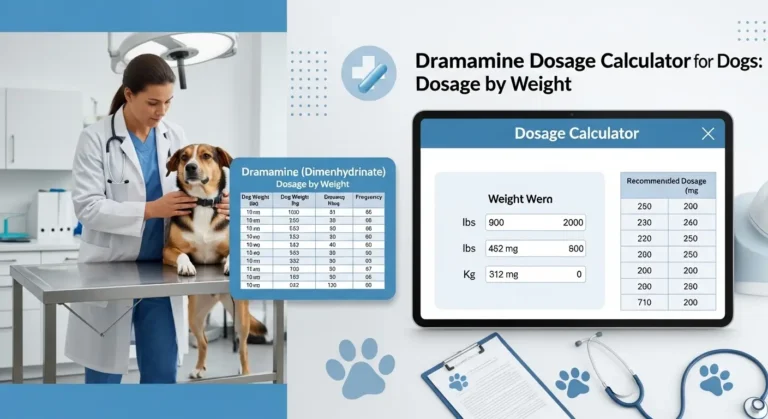
Gravol Dosage Calculator For Dogs By Weight
0 mg
0 mg
© medsdog.com
Like humans' canines also experience unpleasant moments such as motion sickness or nausea during visits to the vet, which can amplify the problem. Symptoms include vomiting, nausea, drooling, diarrhea, fidgetiness and travel anxiety.
If your dog drools, vomits, whines or appears stressed during road trips, boating or flying, it might have travel sickness. Gravol for dogs is most effective antihistamine medication used to prevent motion sickness and to treat nausea.
A popular drug mentioned to treat travel sickness is Gravol For Dogs (brand name for dimenhydrinate, such as Dramamine®). Gravol is an antihistamine that blocks the stimulation of the vestibular system in the ear, the part of the body that helps with balance and motion.


Paid Links - As an Amazon Associate, I earn from qualifying purchases.
Overstimulation of this system can lead to dizziness, nausea and motion sickness. Decreasing this stimulation may help avoid vomiting, drooling and car sickness.
While Gravol is over-the-counter for humans, it's not FDA-approved for dogs and should only be used with the advice of a veterinarian. The appropriate dose will vary for each dog, depending on weight, age, breed, health status and other drugs they may be taking.
In this comprehensive article, we'll explain how much Gravol dose is safe for dogs, what it does, potential side effects, the best time to administer it before a trip, and alternative options for a safe journey for your dog.
Disclaimer: This guide is for informational purposes only and is not a substitute for professional veterinary advice.
Always consult your veterinarian before giving Gravol or any medication to your dog.
Key Takeaways
- Dogs can be given Gravol (dimenhydrinate) dosage for dogs, an antihistamine, to treat nausea, vomiting, motion sickness and other symptoms associated with vestibular (inner ear balance) dysfunction.
- It can help to limit vomiting, dizziness, drooling, and motion sickness from travel in a vehicle or on other transportation.
- Sedation is the predominant side effect. Other side effects include dry mouth and inability to completely empty the bladder.
- Gravol Dosage For Dogs can be bought over the counter, but only with the advice of a veterinarian.
- Not all dogs should use Gravol, particularly those that have certain medical conditions or are taking other drugs.
- Overdoses or incorrect doses of Gravol can be dangerous, so check with your vet on the correct dose.
What Is Gravol Dosage for Dogs, and How Does It Work?
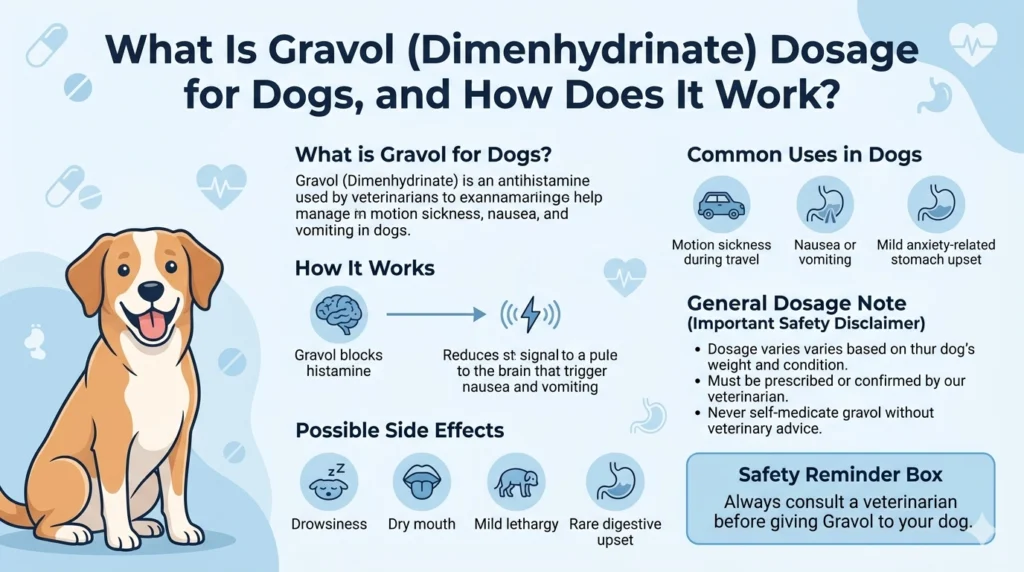
Gravol is a brand name for the OTC antihistamine dimenhydrinate, also known as Dramamine®, Travtabs®, Driminate®, and Triptone®. Off-label, Gravol can be used to treat motion sickness, vomiting, nausea and balance-related issues in dogs. “Off-label” means the drug is not FDA- or Health Canada-approved for use in dogs, but can be prescribed by veterinarians.
Gravol can be used to prevent motion sickness during car, boat or plane travel. Dogs with travel sickness may salivate, pace, vomit or become agitated. It can also be prescribed for some dogs with vestibular disease, where the inner ear is affected, which can lead to sudden loss of balance, dizziness and nausea, but it is not the preferred treatment.
Dimenhydrinate binds to histamine receptors in the brain and gut, reducing feelings of nausea and relieving the brain's balance centre. This can make dogs feel less wobbly, less dizzy and less nauseated. It can also have a calming effect, which can help with stressa
Gravol is the brand name of an over-the-counter antihistamine drug called dimenhydrinate, which is also marketed as Dramamine®, Travtabs®, Driminate®, and Triptone®.
Gravol medicatin for dogs is occasionally used off-label in veterinary practice to treat dogs with motion sickness, nausea, vomiting, and/or balance problems. “Off-label” refers to the fact the drug is not specifically labelled for use in dogs by the US FDA or Health Canada, but veterinarians can legally use it if needed.
Gravol dosage is most often used to treat motion sickness during travel by car, boat or plane. Signs of motion sickness in dogs include drooling, agitation, vomiting and anxiety. It can also be used in some dogs with vestibular disease, which is an ear problem that may cause loss of balance, dizziness and nausea, but is not always the first drug of choice.
The medication dimenhydrinate blocks the effects of histamine in the brain and the gut, which can reduce feelings of nausea and stabilise the part of the brain which controls balance. This may help them feel less wobbly, dizzy, and less likely to vomit. It can also have a calming effect, which helps some dogs cope with travel anxiety.
Some veterinarians may also use Gravol for its sedative effects, or to treat itchy allergies in some cases. It's generally thought to be helpful when dosed appropriately, but should only be administered with veterinarian advice as the dose, medical conditions, and drug interactions must be taken into consideration.
Gravol as a sedative or even for itchy allergies in some situations. It's generally regarded as beneficial when used appropriately but should only be used under veterinary supervision as dose, underlying conditions and drug interactions are important to consider.
Can Dogs Gave Gravol?
As a furry friend owner, you are probably wondering if Gravol is a safe and effective solution to your dog's motion sickness, travel anxiety, or vomiting. The short answer to this is, yes, it can be used but with caution and proper dosing.
Sometimes Gravol is allowed for dogs, but only under the proper guidance of a veterinarian. Gravol is a brand of dimenhydrinate which is an over the counter antihistamine that treats motion sickness, nausea and vomiting in humans and dogs.


Paid Links - As an Amazon Associate, I earn from qualifying purchases.
But not everything that is sold over-the-counter is safe for all dogs.
Gravol Dose For Dogs By Weight
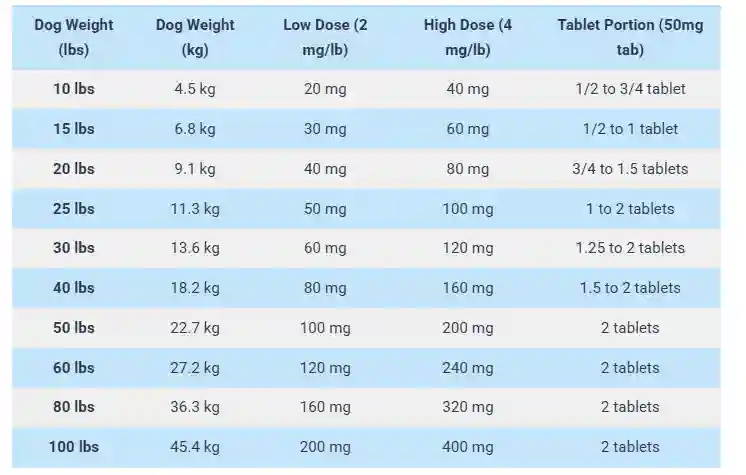
The ideal veterinarian-recommended Gravol dosage for dogs is 2 mg/lb to 4 mg/lb, using the standard 50 mg tablet strength.
What Is the Dosage of Gravol for Dogs, and How Is It Given?
The Gravol dosage for dogs by weight varies depending on the weight, age, health status and purpose of use, so it's important to check with your vet before using it.
Typical Gravol Dosing
- 2-4 mg per pound (lb) or 4.4–8.8 mg per kg (kg) of body weight every 8 hours.
- Do not exceed 3 doses in a 24-hour period.
- Doses should be spaced roughly 8 hours apart.
- Do not give more than 1 or 2 tablets at a time
- Particularly important to calculate doses for small dogs, less than 6 lbs
How Gravol Is Given
- Usually given by mouth
- Available as:
- Tablets
- Liquid oral form
- In practice, it can be administered by injection (if vomiting)
Best Time to Give Gravol
- For travel/ motion sickness, administer 30-60 minutes before travelling
- Starts working in 1-2 hours
With Food or Without Food?
- Can be taken with or without food
- If you have vomiting on an empty stomach, then give with food afterwards
Important Safety Tips
- Use products that contain dimenhydrinate only
- Avoid combination cold/flu medications
- Make sure fresh water is available when taking Gravol
- Measure liquid doses carefully
Use With Caution In Dogs With
- Glaucoma
- Seizure history
- Heart disease
- High blood pressure
- Enlarged prostate
- Urinary or intestinal blockage
- Respiratory disease
- Very young puppies
- Older or pregnant dogs
Final Note
Be sure to follow your veterinarian's advice and complete the course of treatment, while monitoring for side effects.
Gravol Dosage Chart for Dogs By Weight
Below is a detailed dosage reference table based on the standard veterinary guideline of 2 mg to 4 mg per pound of body weight, using the common 50 mg tablet as the baseline for portions.
| Dog Weight (lbs) | Dog Weight (kg) | Low Dose (2 mg/lb) | High Dose (4 mg/lb) | Tablet Portion (50mg tab) |
| 10 lbs | 4.5 kg | 20 mg | 40 mg | 1/2 to 3/4 tablet |
| 15 lbs | 6.8 kg | 30 mg | 60 mg | 1/2 to 1 tablet |
| 20 lbs | 9.1 kg | 40 mg | 80 mg | 3/4 to 1.5 tablets |
| 25 lbs | 11.3 kg | 50 mg | 100 mg | 1 to 2 tablets |
| 30 lbs | 13.6 kg | 60 mg | 120 mg | 1.25 to 2 tablets |
| 40 lbs | 18.2 kg | 80 mg | 160 mg | 1.5 to 2 tablets |
| 50 lbs | 22.7 kg | 100 mg | 200 mg | 2 tablets |
| 60 lbs | 27.2 kg | 120 mg | 240 mg | 2 tablets |
| 80 lbs | 36.3 kg | 160 mg | 320 mg | 2 tablets |
| 100 lbs | 45.4 kg | 200 mg | 400 mg | 2 tablets |
Critical Administration Guidelines for Dog Gravol
- Check the Label: Ensure the only active ingredient is Dimenhydrinate.
- ⚠️ Warning: Never use "Non-Drowsy" or "Ginger" formulas, as they often contain ingredients that are ineffective or toxic to dogs.
- ⚠️ Danger: Double-check that the product does not contain Xylitol (a common sweetener in chewables/liquids), which is deadly to dogs.
- Timing: Administer the dose 30 to 60 minutes before travel or the stress-inducing event.
- Frequency: Do not exceed 3 doses in a 24-hour period. Doses should be spaced roughly 8 hours apart.
- Health Precautions: Consult your vet before giving Gravol if your dog has glaucoma, heart disease, high blood pressure, or prostate issues.
Note: This table is for informational purposes. Because every dog's metabolism and health status are different, always have your veterinarian confirm the specific dosage for your pet's needs.
What Are the Common Side Effects of Gravol in Dogs?
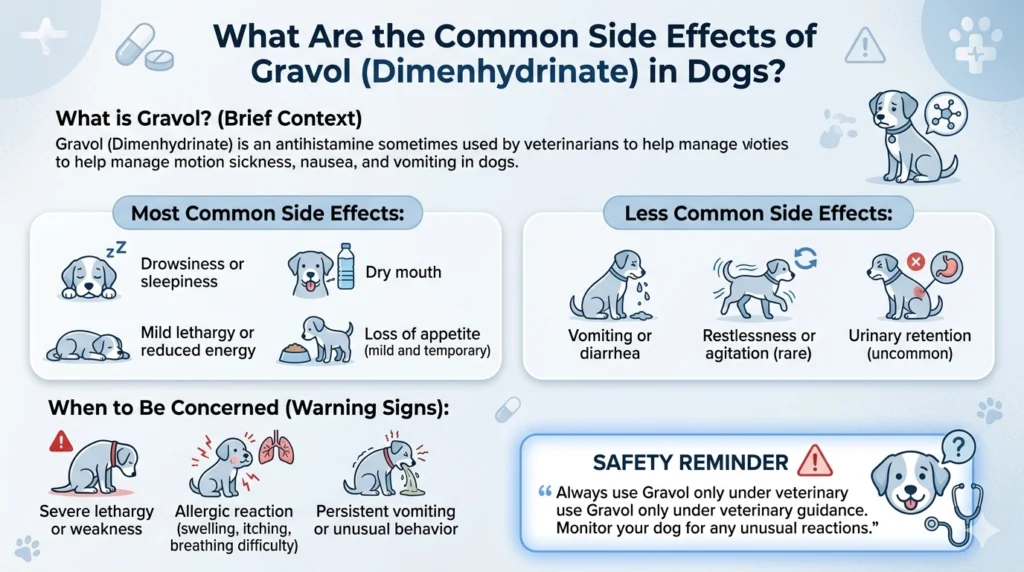
When given at the veterinary dose, Gravol (dimenhydrinate) is well tolerated but there can be side effects. Drowsiness or sedation is the most frequent side effect, and can be beneficial for car rides.
Gravol's Side Effects in Dogs
- Sleepiness / drowsiness
- Sedation or lethargy
- Reduced mental alertness
- Dry mouth
- Increased thirst
- Trouble urinating / urinating retention
- Upset stomach
- Vomiting
- Diarrhea
- Poor appetite / loss of appetite
Less Common Reactions
- Over-stimulation, fidgetiness or hyperactivity, particularly with high doses or repeated exposure
- Allergy reactions may occur with repeated doses, even if the drug wasn't a problem initially
Severe Side Effects or Overdose
If you see any of the following, stop using the medication and call your veterinarian:
- Seizures
- Hyperventilation
- Coma
- Severe weakness or collapse
- Any other new or rapidly progressing signs
Dogs That Need Extra Caution
Use Gravol with caution or with the supervision of a veterinarian in dogs with:
- Glaucoma
- Enlarged prostate
- Gastric or urinary obstruction
- Overactive thyroid
- Seizure disorders
- Heart disease
- High blood pressure
- Liver or kidney problems (can be longer acting)
Important Safety Tips
- Avoid if your dog is allergic to dimenhydrinate
- Inform your vet if your dog is taking any other drugs or supplements, particularly sedatives, tranquilizers or heparin
- If vomiting occurs, discontinue and contact your vet
- Do not use before training, or other activities where alertness is needed
Gravol is generally well tolerated in dogs, but should be used with caution.
Does Gravol Interact With Other Dog Medications?
Yes, Gravol (dimenhydrinate) can have drug interactions in dogs. It is an antihistamine that has sedative and anticholinergic properties, so its combination with other drugs can result in increased side effects (such as drowsiness, dry mouth, urinary retention, delayed reactions, etc.)
Drugs For Dogs That Interact With Gravol
- Other antihistamines (such as diphenhydramine)
- Benzodiazepines (diazepam, lorazepam)
- Opioid pain medications
- Muscle relaxants and drugs like gabapentin
- Trazodone anxiety medicine
- Antiseizure drugs (phenobarbital)
- Sedatives or anesthesia medications
- Anticholinergic drugs (atropine, glycopyrrolate)
- SSRI antidepressants (fluoxetine, sertraline)
- Tricyclic antidepressants (amitriptyline, clomipramine)
- Tramadol for canines
- Metoclopramide
- Levothyroxine
- Omeprazole and other proton pump inhibitors
- Prednisone
- Antihypertensive and other cardiovascular medications, such as beta blockers, diuretics and ACE inhibitors
- Allopurinol
Other Important Interactions
- Gravol can affect allergy skin tests, so should be avoided for at least 2 weeks prior to testing
- It may interact with vitamins, supplements, or herbs
Why Veterinary Guidance Matters
Before giving your dog Gravol, especially if they are on other medications, please talk to your veterinarian. They can take the full list of medications your dog is on, as well as other medical conditions and your dog's needs into account to avoid interactions and ensure the medication is safe to use.
Benefits of Gravol for Dogs
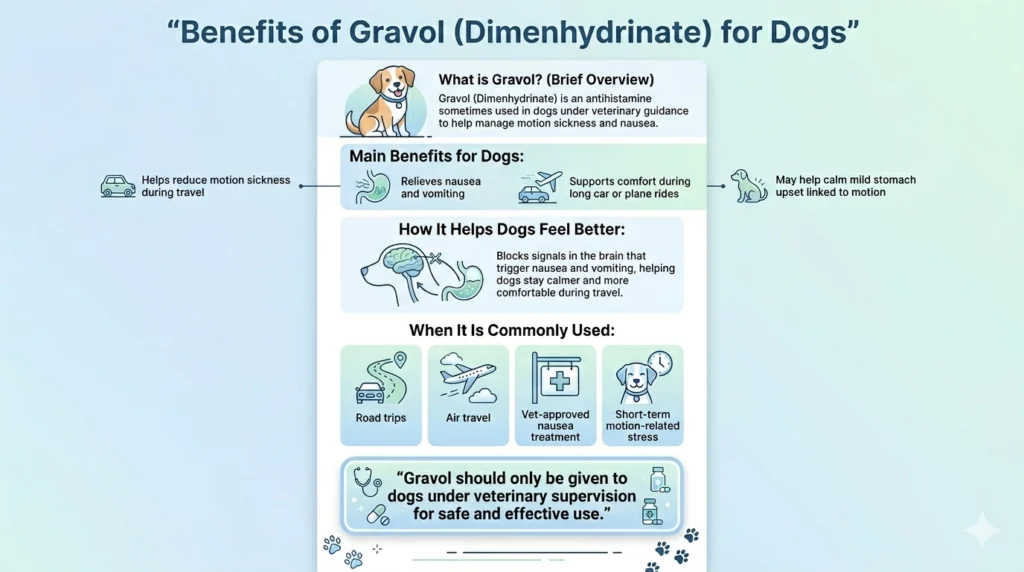
There are some benefits of using Gravol dosage for dogs, but only under the advice of a veterinarian.
Main Benefits
- Prevents motion sickness when travelling by car, boat or plane
- Prevents or stops vomiting or nausea from motion sickness
- Reduces excessive saliva due to motion sickness
- Reduces the dizziness of inner ear (vestibular) issues
- Offers some mild sedative effects to reduce travel anxiety
- Makes travelling easier and less stressful for dogs and owners
Additional Possible Uses
- Potentially relieves vestibular disease symptoms like nausea and dizziness
- May induce slight sedation, inducing a calm effect in some dogs when travelling
- May be used to alleviate itching or allergic symptoms in some cases, at the vet's discretion
Important Note
Gravol for pets may not be appropriate for all dogs and the dose varies depending on the dog's size, age, health status and other drugs being used. Always consult your veterinarian before use.
FAQs
Is Gravol safe for my dog's for motion sickness?
Yes, Gravol can be used to treat dogs with motion sickness, nausea, and vomiting due to travel. It can help prevent drooling, whining and nausea during trips in the car or with other modes of transport. But it should only be administered under veterinary supervision to check that it is safe.
How much Gravol can I give my dog?
Gravol dose varies based on the age, weight, breed, health and existing medications of your dog. The dose can vary, so you should ask your veterinarian for the appropriate dose.
When should I give Gravol dosage for dogs per pound or kg?
Many dogs will be dosed 30 to 60 minutes before their trip. That allows the drug to take effect and to prevent motion sickness from occurring.
How often can dogs take Gravol?
Dogs can be given Gravol every 8 hours, depending on the purpose and veterinarian's recommendations. Do not administer more than recommended or more often.
What are the side effects of Gravol in dogs?
These include drowsiness, dry mouth, thirstiness, vomiting, diarrhoea, not eating, or passing urine. Gravol is usually well tolerated but dogs should be closely monitored after they have it.
Does Gravol make dogs drowsy?
Yes, among the most common side effects of Gravol is sleepiness. This may actually help calm fidgety dogs during car rides.
Can puppies take Gravol dose?
Gravol should only be given to very young puppies if it's recommended by a veterinarian. Dogs can be especially sensitive to drugs and require dose adjustments.
Can I give my dog human Gravol?
Human Gravol containing only dimenhydrinate can be used in dogs. Products containing multiple cold, flu or other symptoms should not be used without veterinary approval.
What if I forget to give a dose?
If you forget to give a dose, give it as soon as you remember unless it's nearly time for the next dose. If the next dose is due soon, don't give it and give the next dose at the usual time. Do not double up the dose.
When should I call a veterinarian?
Contact a veterinarian immediately if your dog experiences any seizures, breathing problems, collapse, extreme weakness, severe vomiting, behavior changes or evidence of overdose following the administration of Gravol.
Final Thoughts
Dogs that suffer from motion sickness, vomiting and nausea while travelling can benefit from Gravol (dimenhydrinate). It is an over-the-counter human medicine that can be used in dogs, but must be used at the proper dose approved by your veterinarian for your dog's health.
When used appropriately, Gravol medication for dogs is generally well-tolerated in dogs and may help them enjoy trips in the car, on a boat, or even in the air. But some dogs may develop side effects including drowsiness, dry mouth, thirst and stomach upset.
Gravol can also have potential interactions with other drugs and may not be appropriate for dogs with certain medical conditions, so it's important to talk to your vet before administering it to your dogs. When used correctly, Gravol dosage for dogs can help make your dog's trip a more pleasant experience.