Sucralfate for Dogs, commonly sold under the brand name Carafate®, is a prescription gastrointestinal drug that is used commonly in veterinary medicine to treat and promote healing of ulcers in dogs. These painful lesions can appear anywhere in the digestive tract, ranging from mouth to oesophagus, stomach to intestines, and can be caused by a number of factors including some medicines (particularly NSAIDs or steroids), as well as long-term conditions, such as kidney disease, infection or other gastrointestinal diseases.
Dogs with ulcers or erosions may experience vomiting, loss of appetite, abdominal pain, and sometimes even bloody stools, so timely intervention is crucial. Sucralfate can be used as part of a larger treatment protocol after the veterinarian has determined the cause of the condition.
To be most effective, it is to be administered strictly on an empty stomach, as usual two to three times a day, without any food or other drugs being administered for at least two hours either before or after each dose. As a prescription drug, use of sucralfate should be directed by veterinary advice to determine the correct dosage and frequency for your dog’s condition and well-being.
Disclaimer: All information in this guide is provided for educational purposes only and should never replace professional veterinary advice. We discourage self-medication to dogs. Before administrating liquid Sucralfate make sure to check the ingredients and avoid if this contains any toxic ingredients such as Xylitol.
Sucralfate Dosage Calculator For Dogs By Weight
Accurate veterinary empirical dosage guidelines for dogs


Paid Links - As an Amazon Associate, I earn from qualifying purchases.
© medsdog.com
Key Takeaways
- Sucralfate dose is used in dogs (off-label/extra-label) to treat and to help prevent ulcers in the mouth, esophagus, stomach, and upper small intestine.
- It helps to protect the lining of the digestive tract and is helpful in healing tissues that are ulcerated.
- It is FDA approved for humans, but is used as a prescription drug for dogs when it is appropriate.
- It acts by creating a protective ‘bandage-like’ film on the ulcers.
- Tablets need to be dissolved in water before administering them to dogs.
- Consider giving it on an empty stomach every 6-12 hours.
- When using this drug, it is important to time the doses properly in relation to other drugs.
- In dogs, the only side effects reported are constipation.
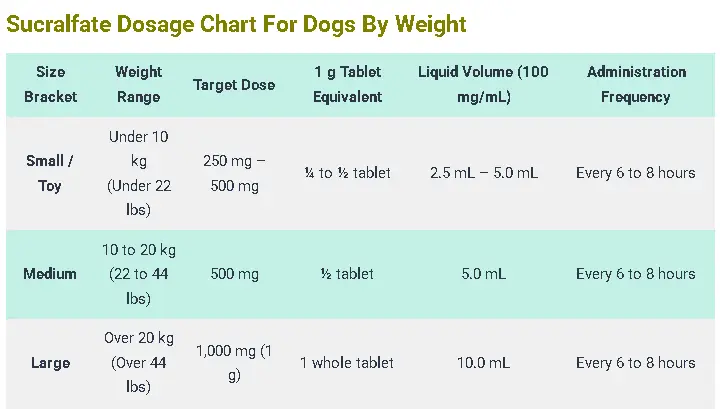
Sucralfate Dosage Chart For Dogs By Weight
| Size Bracket | Weight Range | Target Dose | 1 g Tablet Equivalent | Liquid Volume (100 mg/mL) | Administration Frequency |
| Small / Toy | Under 10 kg (Under 22 lbs) | 250 mg – 500 mg | ¼ to ½ tablet | 2.5 mL – 5.0 mL | Every 6 to 8 hours |
| Medium | 10 to 20 kg (22 to 44 lbs) | 500 mg | ½ tablet | 5.0 mL | Every 6 to 8 hours |
| Large | Over 20 kg (Over 44 lbs) | 1,000 mg (1 g) | 1 whole tablet | 10.0 mL | Every 6 to 8 hours |
Key Administration Rules
- Empty Stomach Required: For sucralfate to properly coat and protect the stomach lining, always administer it orally at least 1 hour before a meal or 2 hours after a meal.
- Local Action: This medication works topically within the gastrointestinal tract and is minimally absorbed into the bloodstream, which is why veterinarians rely on these broad size-bracket doses rather than precise per-kilogram calculations.
⚠️ Important Vet Notice: Always consult your veterinarian before starting your dog on a medication schedule to ensure the dosage matches their exact medical history.
What is Sucralfate for Dogs, and How Does It Work?
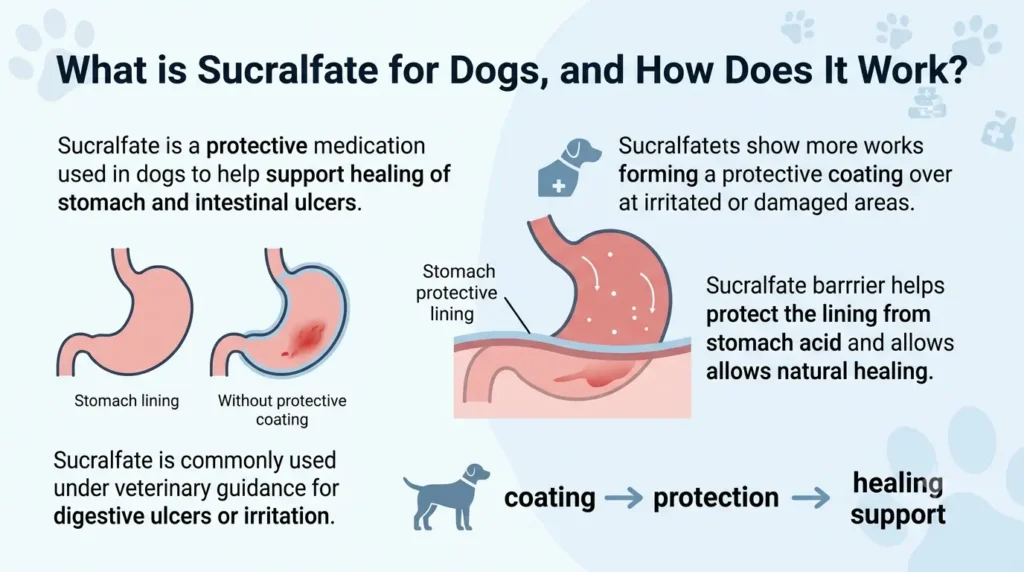
Sucralfate (Carafate®, Sulcrate®) is a prescription gastrointestinal (GI) protectant that is used in cats to treat and prevent ulcers and erosions of the gastrointestinal tract, such as the mouth, esophagus, stomach and upper small intestine. It is approved for human use, but used in veterinary medicine in an off label (extra-label) manner for dogs and other animals. It is commonly used by veterinarians due to its powerful protective properties on damaged GI tissue.
Sucralfate for dogs dosage acts by combining with the stomach acid and creating a protective paste that binds directly to the ulcerated area and acts like a “band aid” to help protect the damaged tissue from more irritation by stomach acid and digestive enzymes so that it can heal naturally. It is often used to treat (and prevent) ulcers of the stomach, intestines and upper digestive tract and is thought to be particularly effective when the condition of the digestive tract has been impaired.
Sucralfate’s Action in Dogs
Sucralfate is active in the stomach and is not absorbed to a significant degree into the blood stream. Instead, it works locally by forming a protective barrier:
- This becomes a thick, sticky gel when it passes through to the acidic stomach.
- This gel attaches to damaged areas in the GI lining where there are ulcers.
- Produces coating that prevents stomach acids, bile and digestive enzymes from damaging tissue.
- This protection will give the ulcerated area enough time to heal itself.
Beyond this barrier effect, sucralfate could have healing properties, such as increasing blood flow to the area and stimulation of the production of mucus and bicarbonate, which could strengthen the natural barrier of the digestive lining.
Its Use in dogs
Sucralfate is used by veterinarians for GI damage prevention and treatment for many different reasons including:
- Ulcers of the stomach, intestine or oesophagus
- Gastritis, inflammation of the gastrointestinal tract
- Acid reflux disease, or esophagitis
- Medication related irritations (particularly NSAIDs or aspirin)
- Severe diseases such as kidney disease, liver disease, cancer or IBD
- Stress-related/ critical conditions: shock, burn, sepsis, trauma
In Non-Technical Terms, what is Key Function?
- Works like a “protective bandage” within the gut
- Reduces irritation from stomach acid
- Promotes recovery of any tissue that has been ulcerated
- Helps to prevent new ulcers in dogs with high-risk of new ulceration
In summary, sucralfate is a GI protective drug that can be used to soothe, protect and promote healing of damaged GI tissue in dogs, and should be used with care and under veterinary guidance, considering timing and drug interactions.
What is the Dosage of Sucralfate for Dogs, and How Is It Given?
The dosage of sucrose in dogs depends on the severity of the condition, size, and veterinarian’s instructions. It is usually used at a dosage of between 250 mg and 1,000 mg every six to 12 hours.
The typical dosage for dogs is a 2.2 mg pill.
- Small dogs (and cats): ¼ to ½ gram every 6-8 hours.
- Medium to large dogs: ½ – 1 gram every 6-8 hours.
- The general range of dosage is 250 mg to 1,000 mg per dog.
Treatment should last for the duration of the condition and/or while the person is still having symptoms, regardless of whether they feel better or not.
How Sucralfate Is Given
Sucralfate is marketed as either a tablet or oral liquid, but the tablet form is more widely used in veterinary medicine.


Paid Links - As an Amazon Associate, I earn from qualifying purchases.
- Tablets should be crushed and given dissolved in lukewarm water
- Liquid form should be well shaken and measured carefully.
- Always give on an empty stomach by mouth
- Timing with food:
- 30-60 minutes prior to eating,
- 1–2 hours after feeding
Important Administration Rules
- Take at least 2 hours apart from other medication
- If necessary, higher strength formulations can be made at a compounding pharmacy.
- Please do not deviate from the exact dosage and instructions given by your veterinarian.
In what way is it fast acting?
- Starts working within 1–2 hours
- It can take days to weeks for the full healing effects to occur.
- Even if healing is taking place, there may be only gradual improvement.
In conclusion, when used to protect and heal gastrointestinal ulcers in dogs, sucralfate should be used with care and caution, and should be timed, prepared and administered properly.
What are the Common Side Effects of Sucralfate in Dogs?
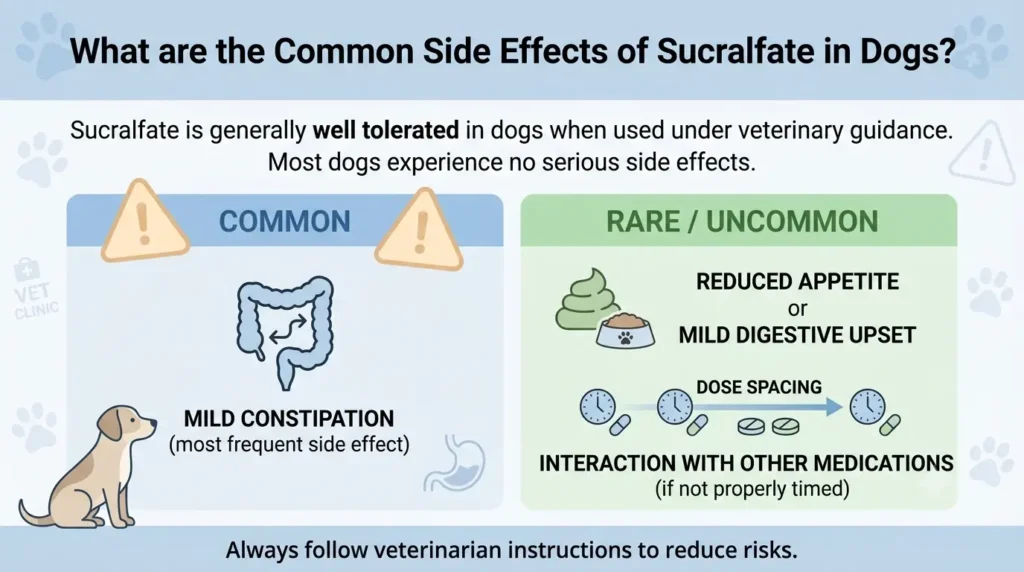
Sucralfate dosage for dogs by weight is a well tolerated gastrointestinal (GI) protectant in dogs and most pets don’t have any adverse effects while being administered it. Side effects are uncommon and if they do occur, they are mild, temporary and controllable under veterinary supervision.
Common Side Effects
Side effects are the most common and usual effects people experience:
- Constipation (most common)
- Sometimes vomiting (particularly in some animals)
- Drooling
- Diarrhea (may occur but is rare)
- Constipation or slow bowel movements/digestion
The most pressing worry is constipation, which is typically short-term. In some instances, dietary support (e.g. dietary fibre manipulation) may be recommended if necessary.
An unusual but significant response.
Though uncommon, some doggies will be more prone or show obviousa reactions:
- Allergic responses, including rash, hives, itching or swelling of the face
- Shortness of breath (see vet ASAP)
- Fever or drug sensitivity symptoms
- A decrease or increase in sensitivity with repeated doses.
A veterinarian should be notified of these reactions right away.
Risks and Cautions
Sucralfate is to be used with caution in some circumstances:
- Dogs who are already constipated (may be worsened)
- Individuals who have kidney disease (use caution)
- Dogs that are pregnant or lactating (safety has not been fully determined)
- Dogs that are known to be allergic or hypersensitive to sucralfate
It also can interact with the absorption of other medications (such as tetracycline, cimetidine, or digoxin), thus separation of doses is important.
Important Safety Notes
- Side effects are typically mild and reversible, and may improve within 24 hours of discontinuation.
- If a dog’s constipation continues or symptoms get worse, a veterinarian should be consulted.
- All serious reactions or suspected overdose should be treated by a veterinarian at once.
Generally, sucralfate is a safe and effective GI drug in dogs, and the side effect to watch for during treatment would be constipation.
Does Sucralfate Interact with Any Other Dog Medications?
Yes. In dogs, the absorption and activity of many oral drugs may be affected by the use of sucralfate; drugs must be administered at the proper time. It does this by coating the stomach so that it does not absorb the other drugs, or by binding to other drugs and preventing the stomach from absorbing them.
Key Interaction Concern
- Sucralfate can also reduce the absorption of other oral medications and thus their effectiveness if administered in close proximity.
- It is important to separate dosing to prevent failure of treatment
Medications that should not be mixed together.
Give these medications at least 2 hours before or after sucralfate:
- Antacids (such as Maalox and Mylanta)
- Antibiotics, such as tetracyclines (doxycycline), macrolides (azithromycin), and fluoroquinolones (ciprofloxacin)
- Medications for the heart (digoxin, furosemide)
- Thyroid medication (levothyroxine)
- Antifungals (ketoconazole)
- Seizure medication (phenytoin)
- Theophylline (for respiratory/cough conditions)
- Fat Soluble vitamins and supplements
- Medications that are used to treat cancer (such as alendronate)
Antacid-Specific Warning
- Aluminium, calcium or magnesium containing antacids can interfere with the effectiveness of sucralfate
- There is also the risk of increased absorption of aluminium in the presence of antacids that contain aluminium.
- Also these should be carefully spaced under veterinary supervision.
Important Safety Notes
- Let your veterinarian know if your dog is taking any other medicines, vitamins or herbal supplements.
- The timing of the dose is important to the effectiveness of sucralfate.
- This is not a comprehensive list – additional interactions may occur
In general, sucralfate can be used safely, provided it is used appropriately and there is some timing between it and other medications so that it does not diminish the effectiveness of those medications.
You May Also Like to Read:
- Spinosad Dosage For Dogs: Calculator, Chart & Safe Guide
- Dexmedetomidine Dosage For Dogs: Calculator & Safe Guide
FAQs
What if my dog forgets to get the sucralfate?
In case of missed dose, administer whenever remembered. If it is near to the next dose, skip the missed dose and resume the regular dose schedule. Never give twice the dose.
What are the effects of a dog overdosing on sucralfate?
Overdoses are rare and usually not serious. Symptoms can range from vomiting to drooling or constipation. If you think your pet may be having an overdose, call your veterinarian or an animal poison control center right away.
What is the recommended storage for sucralfate?
Keep in a dark, dry place at room temperature. The liquid form should not be frozen. Do not store any forms where children or pets are able to access them.
Is it OK to give sucralfate on an empty stomach?
Yes. Sucralfate is most effective on an empty stomach, and should be administered with water, and at least two hours before or after food and other drugs.
With dogs, does it matter if they eat after taking the sucralfate?
No, dogs should wait at least two hours after taking the Sucralfate dose before they eat so that it can function properly.
Does my dog need to be monitored while he takes the sucralfate?
Yes. Your veterinarian might watch your dog while he or she is being treated. At home, look for blood in stools or vomit, worsening signs or symptoms, or lack of improvement; report any concerns right away.
Do pet owners need to be concerned about safety?
Yes. Wash hands after administering the medication, store out of reach of children and pets, and don’t use if allergic to sucralfate.
What do I need to do in an emergency?
If you are not sure whether this is a serious reaction, or an overdose, see your veterinarian or an emergency clinic right away. Be prepared to give an idea of the weight of your dog, what symptoms you are seeing, and what medications your dog is taking.
Final Thoughts
The bottom line, is that off-label use of sucralfate Dosage for dogs is common in dogs to treat and help prevent gastric ulcers in the gastrointestinal tract, particularly dogs with gastric ulcers and/or at risk for them. It is generally regarded as safe, and side effects are uncommon with constipation being the most often reported side effect.
But, it should be used with caution in dogs that have ingested toxic materials or are already on other medications, because it might alter the absorption of those medicines. However, in some instances the veterinarian may wish to consider other treatments, and proton pump inhibitors (PPI) like omeprazole may be more effective for managing ulcers in some dogs.
Overall, sucralfate medication for dogs is a valuable protective drug, but one that is best selected and administered under veterinary supervision according to the circumstances in the dog.