Ligaplex Dosage Calculator For Dogs
Choose your product, enter your dog’s weight and get the recommended dose.
If your dog is stiff after naps, slow on stairs, or recovering from a ligament injury, there's a good chance your holistic vet or a pet supplement retailer has mentioned Ligaplex Medication. The tricky part is that Ligaplex dosage wasn't originally made for dogs at all - it's a human nutritional supplement from Standard Process that's become popular in veterinary and holistic-pet circles for off-label use.


Paid Links - As an Amazon Associate, I earn from qualifying purchases.
That gap between "made for people" and "commonly given to dogs" is exactly why so many pet owners search for a clear dosage chart before they open a bottle.
This guide gathers weight-based dosing guidelines from holistic vets, checks the manufacturer's label, and (most importantly) indicates where they differ, to help you decide what is best for your dog with your vet.
Quick Facts:
- Standard Process also manufactures two whole-food nutritional supplements for humans, Ligaplex I and Ligaplex II, which are used mainly for the support of connective-tissues.
- Both products are not FDA-approved or labelled for veterinary use; and the use of dosing for dogs is off-label and based on the practitioner's knowledge, not a manufacturer's published pet dose chart.
- The manufacturer has a simple human adult dosage on the label - two capsules per day - not a dog weight chart.
- Weight-based dosage charts for dogs that you can find on the internet are from individual holistic veterinarians and pet supplements retailers, rather than from Standard Process.
What Is Ligaplex, and Why Do Dog Owners Use It?
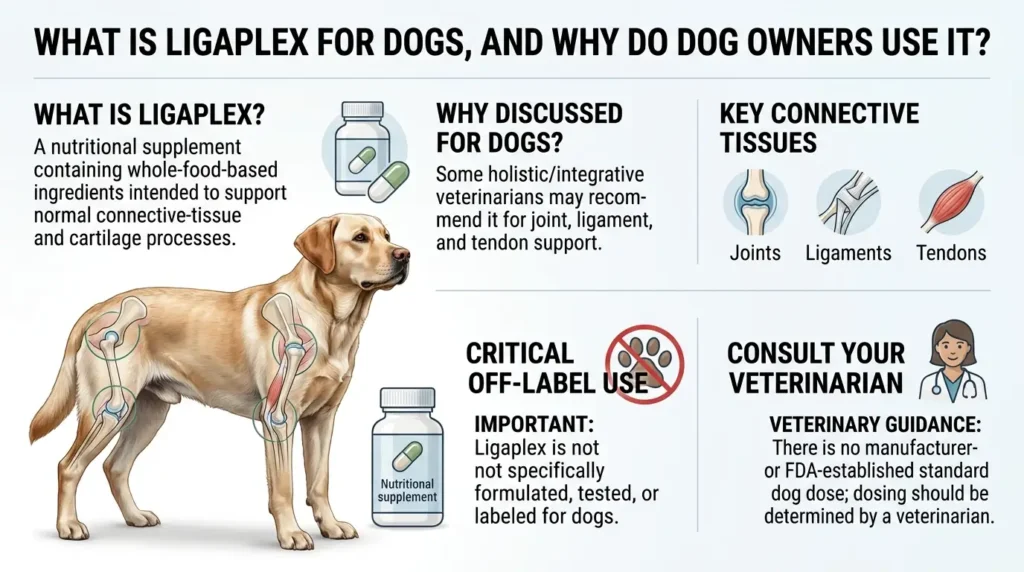
Ligaplex is a capsule supplement introduced in 1959 that contains the ingredients from a few other Standard Process supplements to aid in the body's normal processes for building connective tissue and cartilage. It was formulated to be a human supplement, not for retail sale.
As time passed, holistic and integrative veterinarians started to prescribe it off label for dogs, especially for support of the joints, ligaments and tendons. It's now a topic of conversation alongside the more traditional supplements of glucosamine and chondroitin, but its ingredient list is different, with whole food nutrient formulas instead of a standardized dose of glucosamine and chondroitin.
Important distinction: Ligaplex for dogs is not formulated, tested or labeled for use in dogs so that any indication provided for dogs is an extrapolation made off-label.
Does not necessarily mean that it is unsafe, however, it does mean that the "right" dose is a matter of veterinary judgment and practitioner experience and not a standard set by the FDA or a manufacturer.
Ligaplex I vs. Ligaplex II — What's the Difference?

Both products hit the connective tissue, but they are typically talked about in different situations:
- Ligaplex I is typically linked to acute cases, such as recent injuries, post-surgery recovery or short-term flare-ups.
- Ligaplex II is more commonly used for chronic or long-term conditions such as long-term arthritis or aging joints where a dog could be on the supplement for an extended period of time.
One useful tidbit to note, per a holistic vet store's product information: Ligaplex I is gluten free, Ligaplex II is not yet gluten-free. If this is already known about your dog, i.e., they have been diagnosed as being sensitive to grain or gluten, this is something to discuss with your vet prior to making a decision between the two.
There is no distinction between the two products on the label; “acute” and “chronic” are terms that practitioners use to describe how they use the two products in practice.
Ligaplex Dosage Chart for Dogs By Weight
The following pet dosage recommendations are from the most popular manufacturers' schedules shared by holistic veterinarians and pet supplement stores, as Ligaplex does not have its own chart. Use them as a starting point to discuss with your vet, but don't replace a vet visit.
Ligaplex I Standard Weight-Based Schedule
| Dog's Weight | Dose per Administration | Frequency | Total Daily Dose |
| Up to 15 lbs | 1/4 capsule | Twice daily | 1/2 capsule |
| 15–50 lbs | 1/2 capsule | Twice daily | 1 capsule |
| 50–100 lbs | 1 capsule | Twice daily | 2 capsules |
| Over 100 lbs | 2 capsules | Twice daily | 4 capsules |
Ligaplex II Dosage by Weight (Chronic Support)
| Dog's Weight | Total Daily Dose | Typical Split |
| Up to 20 lbs | 2 capsules | 1 capsule twice daily |
| 21–50 lbs | 4 capsules | 2 capsules twice daily |
| 51 lbs and over | 6 capsules | 3 capsules twice daily |
What are the reasons for the differences between the charts? The capsule quantities and weight bands will vary from source to source. This isn't a typo, it's a real contradiction in the information that's available.
This is a very clear indication that dog dosing for Ligaplex is practitioner-driven, as opposed to a single, standard protocol - another reason to double check with your own veterinarian instead of selecting the chart that gives the lowest dose.
What the Manufacturer's Label Actually Says
This is what most all competitive articles lack. Standard Process itself lists the suggested dosage of Ligaplex I to be "two capsules per day, or as directed" — no weight chart or instructions for dogs.
The label also includes the following general cautions: Pregnant, nursing women and persons with impaired liver function should consult a health care professional before using, and product not intended for extended use without guidance.


Paid Links - As an Amazon Associate, I earn from qualifying purchases.
That's all non-canine, and Standard Process doesn't list canine doses on the product page. That's the reason why weight-based written charts by individual practitioners have filled in the hole, but it also implies that each of the charts in this article (including the ones above) are one step away from the manufacturer's guidance.
The manufacturer's actual stance is "two capsules per day," for an average size, full-grown dog as confirmed by your vet.
How to Give Ligaplex Dosage to Your Dog
With small dogs, the doses are sometimes one fourth of a capsule, so how do you accurately measure that? The holistic practitioners recommend the following:
- Open capsule by gently separating the two halves of the capsule (made of gelatin).
- Split the powder to half or a quarter (as per dose) as evenly as possible.
- For unused powder, place in a small airtight container for the next dose.
- Add to food wet food, plain pumpkin puree, plain yoghurt are usually used to disguise the taste, and make it easier for picky eaters.
- Whole capsules can usually be given as a treat, mixed in soft food, or directly (depending on your dog's tolerance).
What Is Ligaplex Used For in Dogs?
According to a synthesis of the whole veterinary literature, Ligaplex for dogs dosage is most frequently mentioned in relation to:
- Ligament injuries such as ACL, CCL and MCL
- Luxating patellas
- Hip dysplasia, arthritis in general
- Post surgery recovery (such as TPLO or FHO surgery)
- Occasional lameness or stiffness after resting.
- Support for active or aging dogs, general joint, tendon and ligament support.
Worth repeating: these are conditions practitioners express using Ligaplex for — not FDA-evaluated treatment claims and Standard Process's own labelling says that its products are not designed to diagnose, treat, cure or prevent any disease.
If your dog has a diagnosed orthopedic condition, it is important to talk to your vet about adding Ligaplex to your dog's treatment plan.
Benefits Reported by Practitioners and Owners

According to holistic veterinary sources, the following whole-food ingredients used in the Ligaplex formulas and their possible roles are explained:
- Pea vine juice, which is said to contain vitamin E that helps maintain inflammation response and activity of cartilage cells.
- Natural source of vitamin A and B12 is bovine liver.
- Sunflower lecithin – digestive and circulatory support.
The owner and practitioner reports gathered by pet supplement retailers tell of results such as better mobility, decreased stiffness and ease of mobility after resting – usually reported after 2-4 weeks use of the supplement daily.
These are anecdotal and testimonial, but should be looked at as encouraging rather than proven, as they are not the result of controlled clinical trials.
Side Effects of Ligaplex in Dogs

Side effects that are reported are usually not serious. The most frequently reported problem is upset stomach—loose stools or a lack of appetite, particularly if a dog is introduced to the complete food at once and not introduced gradually.
It's common for practitioners to recommend transitioning from about half the desired dose for a week or so before moving on to the recommended dose.
Allergic reactions are infrequent but possible, as this recipe calls for so many whole food ingredients. Be alert for itching, swelling or breathing changes; discontinue the supplement and contact your veterinarian immediately if you notice any of these.
Is Ligaplex Safe for Dogs? Risks and Precautions
A few points worth weighing before you start:
- It's a human supplement which is used 'off-label'. No particular consideration was given to canine physiology in the manufacturing, the dosing or the safety testing.
- The primary concern for overdose is content of manganese. Manganese is one of the minerals in the Ligaplex formulas and most dogs can take the normal amounts without a problem, but it is the one mineral that vets have a problem with in overdoses.
- It's not a substitute for veterinary diagnosis. The stiffness / lameness may be caused by a number of factors, some of which may require imaging or medical treatment, which cannot be solved with a supplement alone.
- Long-term, unsupervised use isn't recommended. The human product label warns people not to use for an extended period of time without professional supervision.
What Happens If a Dog Eats Too Much Ligaplex?
An entire bottle in a pet's tummy is a very real situation people look up as pet owners—and a vet's real life answer is telling. One veterinarian reported that manganese was the primary ingredient of concern with one large dog ingesting a full bottle, while other vitamins in the formula would not be a concern, as any excess would be excreted.
The vet's down-to-earth advice was to keep the dog under close observation during the next several days for signs of vomiting, diarrhea, loss of appetite, lethargy or ataxia (uncoordinated gait) and should consider to have the liver values measured as a precaution.
If your dog gets into a bottle of Ligaplex:
- Record the approximate number of capsules that are missing and approximate time of when this occurred.
- Contact your veterinarian or the animal poison control poison hot line immediately, before any signs of symptoms, appear.
- If the ingestion took place recently (up to about an hour ago), your veterinarian might want to induce vomiting - and this should be done under the direction of your veterinarian and not by you.
- Be alert for vomiting, diarrhea, loss of appetite, lethargy or wobbliness for several days after your dog appears unaffected.
It is not a replacement for an emergency visit to the veterinarian or a call to a poison control hotline, rather it is information to help read what your veterinarian will be looking for.
Drug and Supplement Interactions
Publicly available formal drug-interaction studies of Ligaplex for dogs seem to be missing — no, don't blame me for making up the answer to that one. What they do report is that holistic practitioners often use Ligaplex dose for dogs in combination with other supplements and medications with no problems.
They all say the same thing, however, “do not discontinue or alter your prescribed medication or treatment on your own without reason because you are taking a supplement.”
If your dog is taking any other medication – particularly any other liver or joint/pain medication – then consult your veterinarian before introducing Ligaplex.
Ligaplex vs. Canine Flex Support: How Do They Compare?
If you prefer to use something that has been formulated and labeled specifically for dogs, Standard Process does offer a chewable wafer made primarily of glucosamine and chondroitin: Canine Flex Support.
| Ligaplex I / II | Canine Flex Support | |
| Formulated for | Humans (used off-label in dogs) | Dogs specifically |
| Form | Capsule | Chewable wafer |
| Core ingredients | Whole-food nutrient blends (varies by product) | Glucosamine sulfate, chondroitin sulfate, ginger root, honey, bovine liver, vitamin C, vitamin E, turmeric |
| Manufacturer dosing guidance | General human dose only; no canine chart | Weight-based: 1 wafer/day up to 25 lbs, 2 wafers/day for 26–50 lbs, 3 wafers/day for 51–80 lbs, 4 wafers/day over 80 lbs |
| Typical use case | Acute or chronic ligament/joint support (practitioner-driven) | General joint maintenance, especially for large breeds, performance dogs, and growing puppies |
The practical takeaway: Canine Flex Support provides you with a genuine manufacturer published dog dosage chart, eliminating any guesswork that might be involved when dosing Ligaplex off label. Ligaplex dose however has more experience with holistic practitioners for treating specific ligament and connective-tissue injuries.
That will depend on the specific joint issues you are dealing with, versus if you're recovering from a particular injury; a dialogue to have with your vet.
You May Also Like to Read:
- Metamizole Dosage For Dogs: Calculator, Chart & Safe Guide
- Methigel Dosage For Dogs: Calculator, Chart & Safe Guide
FAQs
What are the uses of Ligaplex Dosage for dogs?
Most frequently used Off Label for Connective tissue, Ligaments and Joints – especially with ligament injuries, arthritis, hip dysplasia and post surgical recovery.
What does "How much Ligaplex should I give my dog?" mean?
It will vary based on the product that you are using and your dog's weight. The following charts are a good reference point but be sure to check the specific dose with your veterinarian as there is no standard dose published by any manufacturer for dogs.
what is the difference between Ligaplex I and Ligaplex II?
Ligaplex I is more likely to be prescribed for something more acute, such as a recent injury, whereas Ligaplex II is more likely to be prescribed in a chronic, ongoing joint condition. Ligaplex I is also gluten free, Ligaplex II is not.
Is Ligaplex safe for dogs?
Reported use suggests it is well tolerated, with occasional disturbance of the digestive tract being the most frequent problem. However, due to it being a human supplement used off-label, it's safe to have your vet verify that you should use it for dogs, particularly with liver disease, pregnant or nursing dogs.
Can I give my dog Ligaplex with other medications?
Some dogs are taking Ligaplex with other supplements or medicines, but always refrain from stopping and/or changing a prescribed treatment without your vet's advice.
When will Ligaplex be effective in my dog?
Owners report that they typically see their dogs improve in just 2-4 weeks after use.
For how long should I give my dog Ligaplex?
A typical recovery timeline for injuries might be 4-6 months, post-reassessment some dogs (especially older dogs) may require longer to recover. However, the manufacturer's own label warns of the need for careful not to use for extended periods of time without guidance from a professional.
The Ligaplex supplement is similar to the glucosamine/chondroitin supplement?
No. Ligaplex medication is not a standardised glucosamine/chondroitin supplement such as Canine Flex Support, but a blend of whole food nutrients.
What happens if my dog eats too many of the Ligaplex capsules?
Call the vet or animal poison control line right away! If a large amount of manganese is taken accidentally, the manganese is the primary concern; monitor for vomiting, diarrhea, anorexia, lethargy or unsteady gait.
What are some of the side effects of Ligaplex in dogs?
The most common side effect is slight digestive upset, particularly if the entire dose is begun too rapidly. Rare, but possible allergic reactions.
Is it safe for puppies to take Ligaplex?
There are no age restrictions or puppy dosages given with public sources. This is not something that is to be taken for granted and should be discussed directly with your vet.
Does Ligaplex work for dogs?
No. It is not FDA approved or evaluated for any species and as per label instructions it is not intended for diagnosis, treatment, cure or prevention of disease.
What's a good alternative to Ligaplex medicine for dogs?
Also from Standard Process, Canine Flex Support is made and dosed specifically for dogs, not a whole-food blend, but instead, glucosamine and chondroitin.
Final Thoughts
Ligaplex for animals has gained a true following amongst holistic veterinarians with regard to joint and connective-tissue support in dogs - but with clear eyes. It's a human supplement being used off-label, the weight based dosing charts that are floating around online are from individual practitioners and not the manufacturer, and the weight based dosing charts aren't always the same.
All of that doesn't make Ligaplex unsafe to use responsibly. Does not necessarily mean that the best way to pick a number is to choose a number from a chart before you start - it means using the chart as a jumping off point in a conversation with your veterinarian who will use your dog's individual weight, health history and condition to determine the best starting point.