Itraconazole Dosage Calculator for Dogs
Calculated Dosage
Total Daily Dose: 0 mg
Equivalent in 100 mg Capsules: 0 capsule(s)
Note: Itraconazole is also available in liquid form for precise dosing in smaller dogs.
Disclaimer: This calculator is for informational purposes only and does not replace professional veterinary advice. Always consult a licensed veterinarian for exact diagnosis and prescription dosages.


Paid Links - As an Amazon Associate, I earn from qualifying purchases.
When your vet recently prescribed itraconazole Dosage for dogs, the most obvious question is most likely to be the following: how much do I really give? Itraconazole dosage in dogs is average of 5 mg-10 mg/kg, and is administered either in a single dose or divided into two portions 12 hours apart. However, the appropriate amount of medication to give your dog will depend on what you are treating, their response, and what your veterinarian advises.
This guide not only provided a breakdown of how itraconazole dosing works, but also provides a weight-based dosage chart and directs you to our free calculator to cross-reference your vet prescription in a matter of seconds.
Important lesson to learn: Itraconazole is not a recommended medication in dogs, rather vets are prescribing it off-label as is typical and legal in veterinary medicine, but also implies that dosing instructions may differ with what is printed on human packaging. It is advisable to consider the instructions of your vet when using any particular chart, not only this one.
What Is Itraconazole?

Itraconazole for dogs is an antifungal agent which is a triazole antifungal agent that is used to treat fungal diseases in dogs by preventing the fungus to synthesize ergosterol, a substance required to support the outer membrane of fungal cells. In its absence, the fungal cell wall is destroyed and the infection can not disseminate.
Its brand names, such as Sporanox and Itrafungol are sold, and it is being prescribed as a generic. Dogs normally absorb it in the form of a capsule or a tablet, although an oral liquid of 10 mg/mL can be used as well, and is more accurate to administer down the throat in a small dog.
What Is Itraconazole Used to Treat in Dogs?

Itraconazole is prescribed by vets to treat a variety of fungi, such as:
- Dermatophytosis (ringworm) — the most common reason it's prescribed
- Blastomycosis — a serious systemic fungal infection
- Histoplasmosis
- Coccidioidomycosis ("Valley fever")
- Cryptococcosis
- Sporotrichosis
- Malassezia (yeast) skin and ear infections
The infections may be deep in tissue or the respiratory system, thus treatment may take weeks (ringworm), and may take 60 days or more (systemic infections, such as blastomycosis).
Itraconazole Dosage for Dogs: The Standard Range
The standard dosage of itraconazole for dogs is:
5 mg/kg to 10 mg/kg of body weight, by mouth, once every 24 hours — or split into two doses 12 hours apart.
In some simple cases of ringworm, most vets begin at the bottom (around 5 mg/kg once per day). In case of systemic infections such as blastomycosis or histoplasmosis, dosing can be at the higher end of the range, and may persist two months or more. Developed in rare, difficult-to-treat cases, a vet can prescribe up to 10 to 15 mg/kg/day, but doses higher than 10 mg/kg have a significantly increased risk of side effects and are used sparingly.
Significant administration point: Capsules and tablets are to be administered during or after a rich meal, as a meal is known to increase the amount of the drug that your dog actually absorbs. The liquid formulation is different and can be administered with or without food- however, when your dog vomits with nothing in the stomach, a small meal with it tends to help.
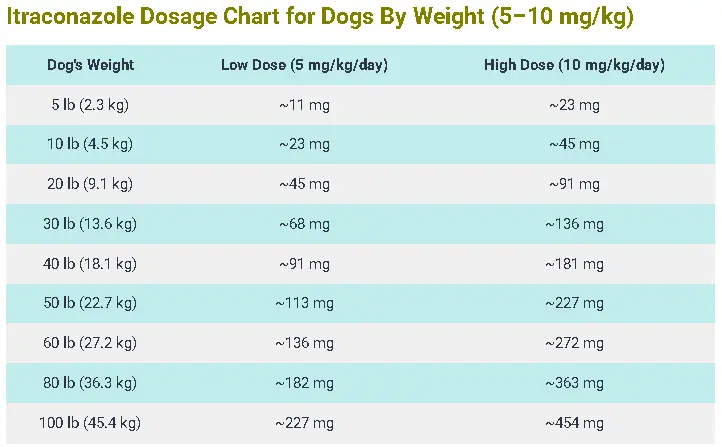
Itraconazole Dosage Chart for Dogs By Weight (5–10 mg/kg)
| Dog's Weight | Low Dose (5 mg/kg/day) | High Dose (10 mg/kg/day) |
| 5 lb (2.3 kg) | ~11 mg | ~23 mg |
| 10 lb (4.5 kg) | ~23 mg | ~45 mg |
| 20 lb (9.1 kg) | ~45 mg | ~91 mg |
| 30 lb (13.6 kg) | ~68 mg | ~136 mg |
| 40 lb (18.1 kg) | ~91 mg | ~181 mg |
| 50 lb (22.7 kg) | ~113 mg | ~227 mg |
| 60 lb (27.2 kg) | ~136 mg | ~272 mg |
| 80 lb (36.3 kg) | ~182 mg | ~363 mg |
| 100 lb (45.4 kg) | ~227 mg | ~454 mg |
These are aggregate daily amounts. When you are given a twice-a-day dosing by your vet, divide by half in each dose. This chart is a guide - never give it other than as prescribed by your veterinarian.
How Long Does It Take Itraconazole to Work in Dogs?
Itraconazole for dogs dosage doesn't work overnight. The improvement of most dogs is slow in the first few days or even a couple of weeks, though complete recovery, particularly in the systemic infections, may take a lot of time. Treatment of ringworm is typically 4-6 weeks, whereas systemic fungal infections such as blastomycosis are often treated 60 days or more, sometimes months, until a follow-up test shows the infection is clear.


Paid Links - As an Amazon Associate, I earn from qualifying purchases.
Do not discontinue treatment prematurely when the symptoms become better. Fungal infections have the tendency to relapse when medication is not taken until the infection is completely cured.
Itraconazole Side Effects in Dogs

Itraconazole is reasonably tolerated by most dogs, although side effects do occur, and increase in number with higher doses. Watch for:
Common, usually mild:
- Loss of appetite
- Vomiting
- Diarrhea
Less common but serious — contact your vet immediately if you notice:
- Jaundice (yellowing of the eyes, gums or skin) a symptom of liver toxicity.
- Continued or prolonged vomiting or diarrhea.
- Skin ulcers, sore, or leg swelling (associated with vasculitis, which occurs more frequently at doses higher than 10 mg/kg)
- Decreased activity or evident behavioural changes.
- Dark urine or loss of coordination.
The most severe side of itraconazole is liver toxicity. Most vets suggest routine bloodwork to check liver enzyme levels on long-term courses of medication, especially in dogs on higher doses or long-term treatment.
Risks and Precautions
Itraconazole dose must be utilized with caution - or not at all - in dogs that:
- Has pre-existing liver or kidney disease.
- Pregnant, nursing or planned to breed (it has been associated with birth defects in animals studies)
- Be hypersensitive to azole antifungal.
- Have low stomach acid (achlorhydria), since this affects absorption
To ensure that the liver can safely process the medication, your vet can commonly run baseline bloodwork prior to starting treatment, particularly in older dogs or dogs undergoing long-term therapy.
Drug Interactions to Watch For
Itraconazole is metabolized by liver enzymes which also break down many other drugs meaning that it can increase or decrease the levels of many common drugs. Some interactions to flag with your vet are:
- Antacids, H2 blockers (such as famotidine) and proton pump inhibitors - these decrease stomach acid, which decreases the absorption of itraconazole; they are usually best taken at least 2 hours before itraconazole.
- Cyclosporine -itraconazole has the potential to increase the blood levels.
- Digoxin (heart medication)
- Certain corticosteroids
- Cisapride
- Benzodiazepines and some of the sedatives.
- Ivermectin and drugs that are metabolized by CYP450.
Never start itraconazole without informing your vet about all the medications and supplements that your dog is taking at the moment, including over-the-counter products and other medications that your dog takes.
Itraconazole vs. Ketoconazole for Dogs
Both are azole antifungals, although itraconazole is widely regarded more potent, better tolerated and effective against a wider variety of fungi than ketoconazole. Ketoconazole has a higher likelihood of gastrointestinal adverse effects and a higher relative risk of liver-related adverse effects, which is one of the reasons why itraconazole has become a more popular choice of many vets in treating systemic fungal infections.
Can You Give a Dog Human Itraconazole Medicine?
Only with veterinary instruction. Pets prescribed Itraconazole are often produced by the same manufacturers as the human form, but the dose, formulation, and monitoring requirements vary. Do not give your dog left over itraconazole that has been prescribed to someone in the human family - the dosage is much lower, and the other inactive components or coating may be harmful. In case your pet dog accidentally eats human itraconazole, call your veterinarian or an animal poison control hotline immediately.
Myth vs. Fact
| Myth | Fact |
| "Itraconazole works fast, so I can stop once symptoms improve." | Fungal infections often need weeks to months of treatment even after symptoms improve, or they can relapse. |
| "It's the same as ketoconazole, so dosing is identical." | The two drugs have different potency and dosing; never substitute one for the other without vet guidance. |
| "Human itraconazole is fine for dogs if I adjust the dose myself." | Dosing math alone doesn't account for formulation differences and monitoring needs — this should always go through your vet. |
| "No side effects means it's not working." | Most dogs on appropriate doses show no side effects at all — that's normal, not a sign of ineffectiveness. |
You May Also Like to Read:
- Triamcinolone Acetonide Dosage For Dogs: Calculator & Safe Guide
- L-Carnitine Dosage For Dogs: Calculator, Chart & Handy Guide
FAQs
How much itraconazole do you give to dogs?
The average dose is 5 to 10 mg per kilogram of body weight, administered in a single dose or divided into two equal doses 12 hours apart, but the dose specific to the infection causing it must be used.
Is it possible to administer itraconazole to my dog with food?
Yes - the capsules and tablets ought to be administered with a high-fat meal to enhance the absorption. The oral liquid can be given with or without food.
What is the duration the dog should be on itraconazole?
It depends on the infection. Ringworm can easily clear in 4-6 weeks, whereas systemic infection such as blastomycosis can take up to 60 days or more.
What should I do in case of missed dose?
Missed dose should be given as soon as you can recall and then resume the normal schedule. Do not give two doses in one day to replace a missed dose - ask your veterinarian.
Can puppies be treated with itraconazole medication treatment?
Puppies can be administered under the supervision of a veterinary, though the administration and monitoring of these must be under the guidance of your veterinarian, as young dogs can have different metabolic processes regarding medications.
Does itraconazole cause liver damage in dogs?
Yes, the most severe risk known is liver toxicity, hence the reason why vets usually recommend regular blood tests during treatment, particularly with higher doses or extended treatment.
Is itraconazole Sporanox?
Itraconazole is known as Sporanox. Another brand is Itrafungol, which is FDA-approved to treat ringworm in cats.
What are the symptoms of itraconazole overdose in dogs?
Little information regarding acute overdose in dogs. Call your veterinarian or an animal poison control facility as soon as possible in case you believe your dog got an excessive amount.
Are there any long-term itraconazole doses available?
Yes, in chronic or systemic infection it is usually given months, and the vet should be checked regularly and have bloodwork to detect side effects.
Does itraconazole affect other pet drugs?
Yes - it is able to interact with the cyclosporine, digoxin, some steroids, antacids and other liver-metabolized drugs. Never leave out the entire medication history of your dog with your vet.
Why do you have my dog on itraconazole?
Bloodwork is also used to monitor the liver levels of the enzymes, as itraconazole is metabolized by the liver and may at times lead to liver toxicity particularly when it is used regularly.
Final Thoughts
Itraconazole dosage for dogs is a highly effective antifungal drug in veterinary medicine, though dose is important: too low will not eradicate the infection, whereas doses above the usual 10 mg/kg level significantly increase the likelihood of adverse effects such as liver toxicity and skin vasculitis. The 5 to 10 mg/kg is a good parameter to boot but always have your veterinarian as the last say as they are considering the exact infection, the health history of your dog and the progress of the treatment.
Whenever you are in doubt of a dose, or when you miss a dose, or you are just not sure of a symptom, do not guess, call your vet. The calculator provided above is a rough estimate, not a substitute to expert advice.