Fipronil Dosage Calculator for Dogs
Important Safety Consideration: Always check specific manufacturer instructions. Consult a veterinarian to determine the most appropriate product. Do not administer without prior veterinary consultation.
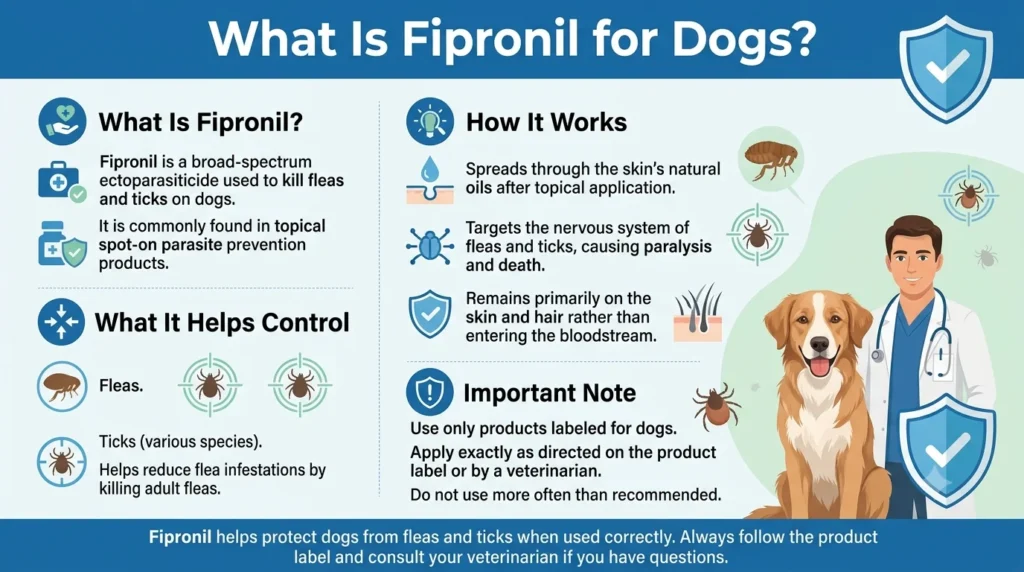
Fipronil Dosage For Dogs is a phenylpyrazole ectoparasiticide, and is the active ingredient in popular flea and tick products like Frontline®, Effipro, combination products like Certifect. It’s mainly a dog flea, tick and chewing lice killer and works to protect from parasites every month.
Fipronil Dosage blocks the GABA-gated chloride channels in insects and ticks, leading to hyperexcitation, paralysis and death. It has a very low affinity for the mammalian GABA receptor providing a very wide safety margin in use following the label instructions.
Fipronil for dogs is a topical spot-on medicine that works by spreading through the portion of the skin that produces oil (the sebaceous layer) and through the hair follicles—unlike oral medicines, which treat parasites in the mouth. Does not enter the blood stream and is distributed throughout the body in about 24 hours. Fleas and ticks typically do not need to bite the dog before they die, as they are lethal when they come into contact with the dog.
Fipronil works against a number of species of ticks, including Ixodes, Rhipicephalus and Dermacentor, but has limited activity against mites and internal worms. There are different medicines for conditions like demodectic mange and sarcoptic mange.
Use only veterinary recommended products containing fipronil that are permitted for use on dogs. Never apply large-animal or horticultural products containing fipronil to pets. Newly treated dogs should be kept away from cats to be groomed until the product has dried, cat-to-dog exposure could cause hypersalivation. Fipronil is also extremely toxic to fish, aquatic invertebrates and rabbits upon oral administration. When applied according to instructions, reliably protects against common external parasites in dogs for one month.
Key Takeaways
- Fipronil is a phenylpyrazole topical ectoparasiticide which kills adult fleas, ticks and chewing lice in dogs.
- Used as an active ingredient in products like Frontline® and Effipro.
- Fipronil Dosage For Dogs acts by interfering with the function of the GABA-gated chloride channels in parasites leading to their paralysis and death.
- The medication is effective on contact, meaning that fleas and ticks don’t necessarily need to bite your dog.
- It is not absorbed into the bloodstream and is spread by the natural oils in the skin and hair follicles.
- Fipronil Medication is distributed throughout the body in approximately 24 hours after application.
- The product has up to 30 days efficacy against fleas and ticks.
- Dogs may bathe or swim after the application, but should not be shampooed for 48 hours.
- Other medicines may be necessary to control mites as fipronil is not effective against internal worms or most mites.
- Only use veterinary approved fipronil products that are labelled for dogs and do not allow treated dogs near cats until the product has dried.
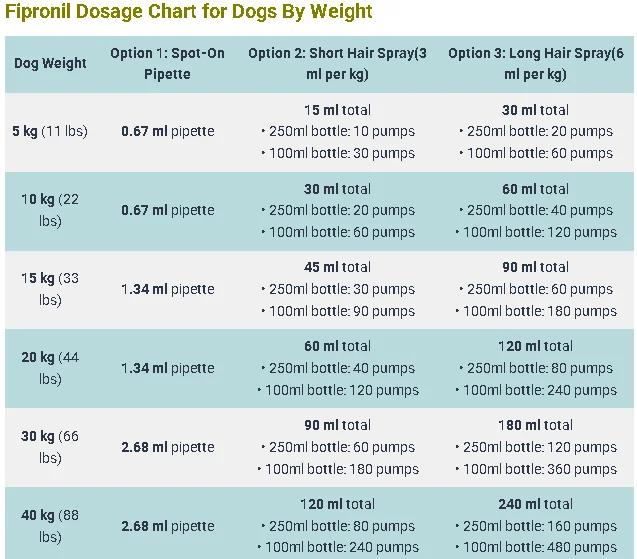
Fipronil Dosage Chart for Dogs By Weight
Here is the accurate Fipronil dosage reference table for dogs based on the corrected weight-to-volume multipliers and pump conversion rates.
| Dog Weight | Option 1: Spot-On Pipette | Option 2: Short Hair Spray(3 ml per kg) | Option 3: Long Hair Spray(6 ml per kg) |
| 5 kg (11 lbs) | 0.67 ml pipette | 15 ml total • 250ml bottle: 10 pumps • 100ml bottle: 30 pumps | 30 ml total • 250ml bottle: 20 pumps • 100ml bottle: 60 pumps |
| 10 kg (22 lbs) | 0.67 ml pipette | 30 ml total • 250ml bottle: 20 pumps • 100ml bottle: 60 pumps | 60 ml total • 250ml bottle: 40 pumps • 100ml bottle: 120 pumps |
| 15 kg (33 lbs) | 1.34 ml pipette | 45 ml total • 250ml bottle: 30 pumps • 100ml bottle: 90 pumps | 90 ml total • 250ml bottle: 60 pumps • 100ml bottle: 180 pumps |
| 20 kg (44 lbs) | 1.34 ml pipette | 60 ml total • 250ml bottle: 40 pumps • 100ml bottle: 120 pumps | 120 ml total • 250ml bottle: 80 pumps • 100ml bottle: 240 pumps |
| 30 kg (66 lbs) | 2.68 ml pipette | 90 ml total • 250ml bottle: 60 pumps • 100ml bottle: 180 pumps | 180 ml total • 250ml bottle: 120 pumps • 100ml bottle: 360 pumps |
| 40 kg (88 lbs) | 2.68 ml pipette | 120 ml total • 250ml bottle: 80 pumps • 100ml bottle: 240 pumps | 240 ml total • 250ml bottle: 160 pumps • 100ml bottle: 480 pumps |
| 50 kg (110 lbs) | 4.0 ml pipette | 150 ml total • 250ml bottle: 100 pumps • 100ml bottle: 300 pumps | 300 ml total • 250ml bottle: 200 pumps • 100ml bottle: 600 pumps |
Quick Formula Reminder:
- Short Hair Spray: Dog’s weight in kg × 3 = Total ml volume needed.
- Long Hair Spray: Dog’s weight in kg × 6 = Total ml volume needed.
- Pump Calibration: 250 ml bottles dispense 1.5 ml per single pump. 100 ml bottles dispense 0.5 ml per single pump.
What Is Fipronil for Dogs?
Fipronil Dosage For Dogs By Weight is an active ingredient in numerous popular dog flea and tick control products, such as Frontline®, Effipro®, PetArmor®, Sentry Fiproguard®, Barricade®, Easyspot®, Parastar®, Pronyl OTC® and Spectra Sure®.
Used mainly to treat and prevent flea, tick and chewing lice infestations in dogs. Fipronil is also used in some situations as an extra tool for the treatment of other external parasites like chiggers, sarcoptic mange, cheyletiellosis or otoacariasis which are often treated with other products for general parasites.
The use of fipronil in veterinary medicine, in some instances, is considered off-label (extra-label), meaning that it is being used in a manner that is not specified on the label. Off-label use is a frequent occurrence in veterinary medicine, and is always best used as prescribed by your veterinarian so you can be assured that your pet is receiving safe and effective care.
Uses of Fipronil for Dogs
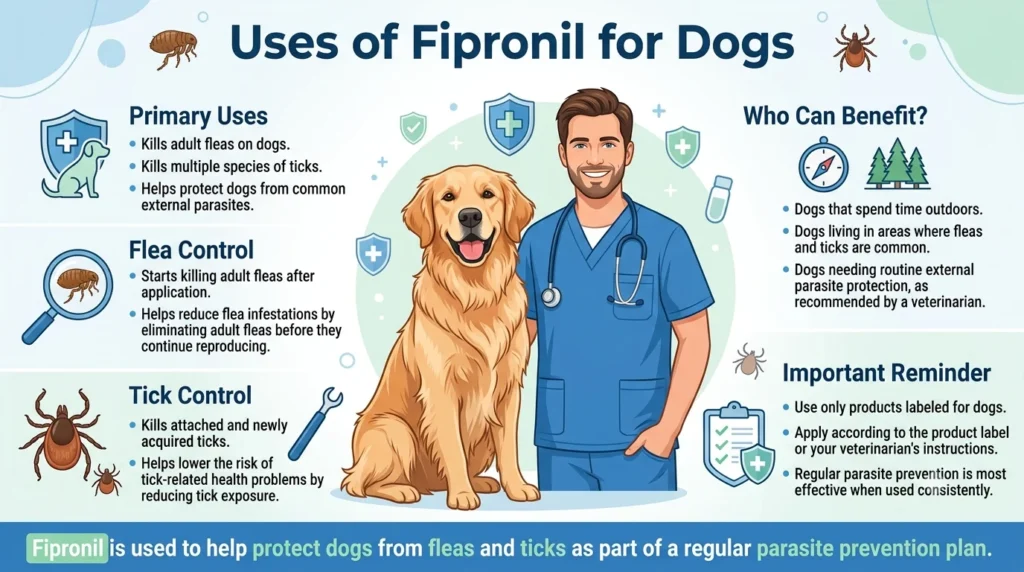
Fipronil For Dogs Dosage is a topical broad-spectrum ectoparasiticide that treats and prevents several external parasites of dogs. It is most often used as a monthly spot-on flea/tick treatment that is very effective, and is also used as a component of treatment for some skin diseases caused by parasites.
Main Uses of Fipronil
- Effectively treats and prevents adult flea infestations
- Controls Ticks including Ixodes, Rhipicephalus, Dermacentor and Amblyomma (regionally specific)
- Treats chewing, (biting) lice in dogs and puppies
- Manages flea allergy dermatitis (FAD) by decreasing exposure to fleas
- May help control sarcoptic mange (under veterinary advice)
- May be used as part of the treatment for Cheyletiellosis (walking dandruff mite) with other treatments and environmental control measures
Some fipronil products contain (S)-methoprene, another active ingredient that is an insect growth regulator to help interrupt the flea life cycle by inhibiting flea development at the egg, larval, and pupal stages for better long-term control!


Paid Links - As an Amazon Associate, I earn from qualifying purchases.
Limitations
For most types of mites, such as demodectic mange and ear mites (Otodectes), drugs other than fipronil are usually used. Also, only a veterinary-approved product containing fipronil that is labeled for use on dogs should be used, as other formulations for agriculture, or for large animals, should not be used on pets.
How Is Fipronil Given to Dogs?
Fipronil is a topical product that can be applied to your dog’s skin or coat, and comes in the form of spot-on drops or spray. Always use the product as directed by your veterinarian or product label.
Using Fipronil
- Spot on drops: Divide the hair between the shoulder blades and at the base of the neck, apply the tip of the applicator straight to the skin and squeeze out.
- Spray: Ruffle coat and evenly spray skin and hair. Avoid spraying directly on the head and face. To do this, spray on a gloved hand and rub the product onto the hair around the head.
Important Application Tips
- Do not allow the product to get into your dog’s eyes or mouth.
- Avoid applying to damaged or irritated skin.
- If spraying, do so in a well-ventilated area.
- Do not shampoo for 48 hours after using.
- The best is to keep your dog’s coat dry as well as avoid the sun for the first 24 hours after treatment.
- Be sure to wear protective gloves during application and do not touch the area on your dog after application until it is dry.
- In case of contact with skin, wash with soap and water.
When does it start working?
The average flea death time is 4-8 hours after application. It takes 12 hours or longer for ticks to die and drop off, and symptoms improve as the tick is removed.
Potential Side Effects & Risk Factors of Fipronil for Dogs
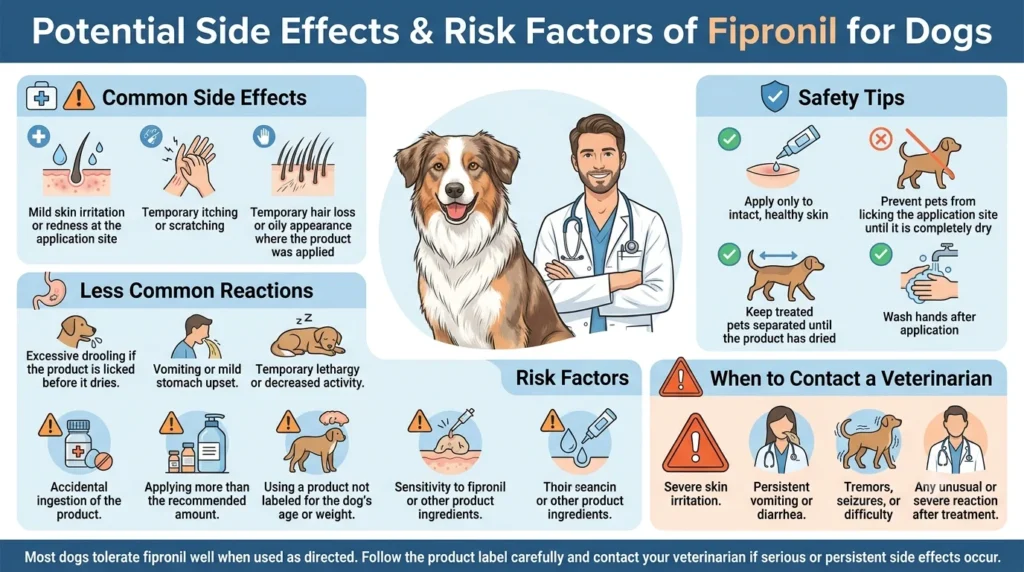
Fipronil does not seem to be particularly toxic to dogs and other animals and has an excellent safety margin when used as directed. Most side effects are mild and temporary and at the site of application. Serious reactions are rare and there have been no reports of ill effects resulting from overdose even when five times the recommended dose was taken.
Possible Side Effects
- Irritation at the site of application (most common, but temporary)
- Itching, mild discomfort or redness (erythema).
- Loss of temporary hair (alopecia) at the application site
- Oily or wet appearance of the coat up to 24 hours after application.
- If licked or accidentally eaten, causes vomiting
- Extra salivation around the treated area
- Uncommon allergic skin reactions
- Rare: Frightened or depressed
- Very rare: Tremors or seizures (at label doses)
Risk Factors and Precautions
Avoid use of fipronil in:
- Dogs that are known to be allergic or sensitive to fipronil
- Puppies less than 8 weeks of age
- As fipronil is highly toxic to rabbits,
Beware of:
- Older dogs and those that are sick, debilitated or frail.
- Other drugs should not be used in dogs on these medications, as drug interaction may occur—check with your veterinarian before using.
Important Safety Notes
- Use on the exterior only—NEVER let your dog lick or eat the product.
- Do not let your dog lick the treated area until this is dry.
- For use only as directed and in accordance with your veterinarian’s advice.
- Fipronil is highly toxic to aquatic life, bees and some invertebrates, do not contaminate waterways or the environment with the product.
Are There Any Drug Interactions with Fipronil for Dogs?
No specific drug interactions are known and systemic drug interactions are considered to be uncommon as very little fipronil is absorbed through unbroken skin. Before using fipronil, you should always let your veterinarian know if the dog is taking any other medications, vitamins, supplements, herbal products or treatments.
Be careful to not use more than one topical parasite-control product at a time unless directed to do so by your veterinarian. Multiple topical ectoparasiticides (without advice from a professional) may be associated with an increased risk of skin reactions or other side effects.
You May Also Like to Read:
- Moxidectin Dosage For Dogs: Calculator, Chart & Safe Guide
- Comfor-Trate Dosage For Dogs: Calculator & Safe Guide
FAQs
What is the recommended dosage of fipronil for dogs By Weight?
The majority of products containing fipronil should be used every 30 days. If a monthly application is missed, make up for it as soon as possible and start a new monthly application plan from the date made up. Do not use at the same time.
Does my dog need any monitoring during her use of fipronil?
Typically no specific monitoring is necessary. Your veterinarian may, however, periodically check your dog to make sure that the treatment is effective and that no side effects have occurred.
Where can I store fipronil Medication?
Keep fipronil in the original package in a cool, dry place at less than 30°C (86°F), and away from light. Avoid contact with heat, sparks, and open flames; flammable.
If I forget to take a dose what should I do?
If the dose is missed, give the dose as soon as possible and then give the rest of the doses at the appropriate time after the new date. Avoid additional doses or doubling up on the dose if one was missed. If you are not sure what to do, then you should contact your veterinarian.
What are the symptoms of fipronil poisoning in dogs?
Accidental ingestion, or improper application can cause signs of toxicity such as tremors, seizures, convulsions, muscle twitching, incoordination (ataxia), hyperreactivity, vomiting, loss of appetite, weakness, abdominal pain, dizziness, agitation, and excessive salivation if the treated area is licked.
If my dog has an overdose or a bad reaction, what should I do?
Call your veterinarian right away if you think an overdose has occurred, or if your pet experiences unusual symptoms following treatment. If your veterinarian isn’t available, follow their directions for contacting the nearest emergency veterinary facility.
After the application of fipronil, can my dog lick the area?
No, don’t let your dog lick the spot that the application covered until it has fully dried. Excessive salivation may occur temporarily after licking and may result in more adverse effects if larger amounts are licked.
Final Thoughts
When applied as directed by a vet, fipronil Dosage for Dogs is a tried and trusted topical treatment that safeguards dogs from fleas, ticks and chewing lice. It is a popular choice for parasite control because of its long-lasting monthly protection, contact-killing activity and generally good safety record. For optimal effects, use the right application, follow suggested use rates and only use products labeled for use on dogs.
If your dog experiences any unusual side effects, skips a dose, or if you accidentally give them too much, call your veterinarian immediately for instructions. When used properly, fipronil can help keep your dog comfortable, healthy and free from common external parasites year-round.