Levetiracetam Dosage For Dogs Calculator
Estimate a levetiracetam dose based on your dog’s weight. Always confirm with your veterinarian before administering.
Estimated Dosing Result
This calculator is for general reference only and is not a substitute for veterinary advice. Dosing must be confirmed by a licensed veterinarian before use.
Levetiracetam Dosage For Dogs is a prescription-only drug that can be used by veterinarians off-label for dogs and cats. It acts by assisting to reduce abnormal electrical activity in the brain that helps to decrease the frequency and severity of seizures, although its mechanism of action is not well understood. Among its most important strengths is its positive safety profile: it is generally well tolerated, is poorly liver metabolized, does not depend on the cytochrome P450 system and has no known significant drug interactions.
This renders it a viable choice to dogs with liver problems or those that are already on various drugs. It is absorbed quickly when taken orally, and the maximum effects are produced in a period of approximately two hours.


Paid Links - As an Amazon Associate, I earn from qualifying purchases.
It is used in dogs as immediate-release tablets or liquid, although in dogs it is most often used as immediate-release tablets or liquid. One interesting factor to be noted when levetiracetam is used to manage epilepsy in dogs is that it has a high dose frequency, which is normally three times a day; this can be inconvenient to some dog owners. Dosage is personalized according to the weight and condition of the dog and close adherence to the directives of the veterinarian is vital in effective seizure management.
Generally, levetiracetam for dogs is considered to be safe, and side effects are rare and typically mild. When they do, they might be drowsiness, slight sedation, loss of coordination (ataxia), loss of appetite, or in rare cases, vomiting. In some cases, veterinarians may also use levetiracetam as a “pulse therapy” during cluster seizures to help quickly reduce seizure episodes.
Levetiracetam (Keppra®) has turned out to be an interesting addition to the arsenal of veterinary neurology thanks to its efficacy, safety profile, and flexibility in combination therapy. The identification of the appropriate dosage of levetiracetam in dogs and the way in which it can be part of a larger seizure control plan is crucial in ensuring that there can be better long-term results and the quality of life of dogs living with epilepsy can be improved.
Disclaimer: This guide is for informational purposes only and is not a substitute for professional veterinary advice.
Always consult your veterinarian before giving Levetiracetam or any Medication to your dog.
Key Takeaways
- Keppra (Levetiracetam, Keppra)dosage fo dogs is an anticonvulsant drug, used to control the occurrence of seizures in dogs and cats.
- It may be administered alone or in combination with other seizure medications like phenobarbital and potassium bromide, particularly when used with single-drug therapy that is not effective.
- Initially as an add-on therapy, it has also recently become a commonly used primary choice in treating seizure in veterinary medicine.
- It is a generic off-label prescription of a human-grade generic medication not approved by the FDA to be used in animals.
- Levetiracetam is a type of anticonvulsant drug which operates by decreasing excessive neuron excitability within the brain although its mechanism is not fully understood.
- After oral intake, it is quickly absorbed and peaks in effect approximately 2 hours.
- These are available in immediate-release and extended-release tablets, liquid formulations.
- Certain types of tablets can be broken and combined with food, and some are to be swallowed as a whole.
- One of the major limitations is that it requires frequent dosing, normally three times a day which may be inconvenient.
- This was once an issue of cost, however, generic versions have made it more affordable.
- It can be used in combination with phenobarbital to potentially use lower doses of phenobarbital.
- Dogs do not often experience side effects, which are typically mild.
- Side effects may include sedation, lethargy, clumsiness and a wobbly or unsteady gait.
- Some dogs may also experience temporary behavior changes.
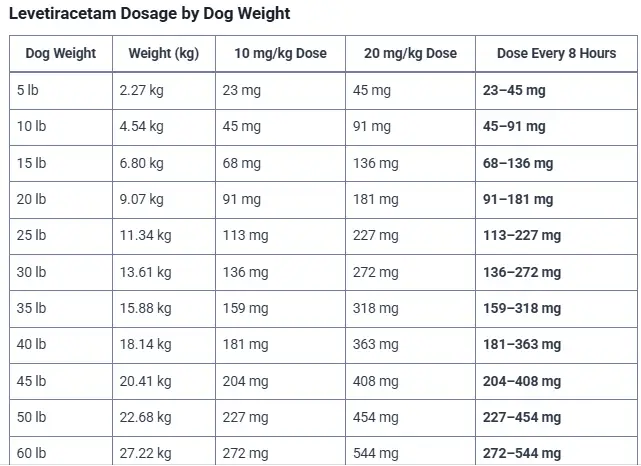
Levetiracetam Dosage Chart For Dogs By Weight
To maintain high accuracy and safety, this table is based on the standard 10-20 mg/kg dosage (most common starting point) and the 30 mg/kg dosage using common tablet strengths (250mg, 500mg, 750mg).
Levetiracetam Dosage by Dog Weight
| Dog Weight | Weight (kg) | 10 mg/kg Dose | 20 mg/kg Dose | Dose Every 8 Hours |
|---|---|---|---|---|
| 5 lb | 2.27 kg | 23 mg | 45 mg | 23–45 mg |
| 10 lb | 4.54 kg | 45 mg | 91 mg | 45–91 mg |
| 15 lb | 6.80 kg | 68 mg | 136 mg | 68–136 mg |
| 20 lb | 9.07 kg | 91 mg | 181 mg | 91–181 mg |
| 25 lb | 11.34 kg | 113 mg | 227 mg | 113–227 mg |
| 30 lb | 13.61 kg | 136 mg | 272 mg | 136–272 mg |
| 35 lb | 15.88 kg | 159 mg | 318 mg | 159–318 mg |
| 40 lb | 18.14 kg | 181 mg | 363 mg | 181–363 mg |
| 45 lb | 20.41 kg | 204 mg | 408 mg | 204–408 mg |
| 50 lb | 22.68 kg | 227 mg | 454 mg | 227–454 mg |
| 60 lb | 27.22 kg | 272 mg | 544 mg | 272–544 mg |
| 70 lb | 31.75 kg | 318 mg | 635 mg | 318–635 mg |
| 80 lb | 36.29 kg | 363 mg | 726 mg | 363–726 mg |
| 90 lb | 40.82 kg | 408 mg | 816 mg | 408–816 mg |
| 100 lb | 45.36 kg | 454 mg | 907 mg | 454–907 mg |
| 110 lb | 49.90 kg | 499 mg | 998 mg | 499–998 mg |
| 120 lb | 54.43 kg | 544 mg | 1,089 mg | 544–1,089 mg |
Important Administration Guidelines
- Standard Release (IR): Usually administered every 8 hours (3 times a day) because the drug is processed quickly by the canine liver.
- Extended Release (Keppra XR): Usually administered every 12 hours (2 times a day).
- The “Whole Tablet” Rule: Because Levetiracetam has a wide safety margin, vets often round to the nearest half or whole tablet to ensure ease of administration.
- ER Warning: If you are using the Extended Release (XR/ER) version, do not cut or crush the tablets. If the calculated dose is 1.3 tablets of an ER version, you must speak to your vet about whether to give 1 or 2 whole tablets, as breaking the coating destroys the “extended release” mechanism.
Disclaimer: This table provides mathematical estimates. Your veterinarian may adjust these doses based on your dog’s specific seizure history, kidney function, and concurrent medications (like Phenobarbital, which can increase the speed at which Levetiracetam is cleared).
What is Levetiracetam Dosage for Dogs, and What is it Used For?
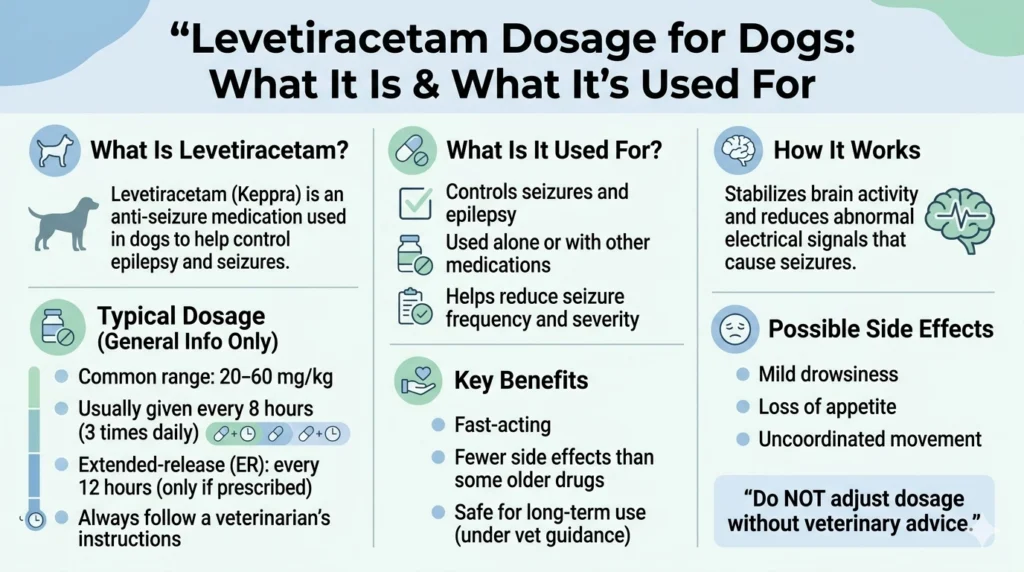
Levetiracetam or keppra dosage for dogs by weight is an anticonvulsant drug to treat, or prevent, seizures in dogs. It is not well understood how it works but it is believed that it reduces seizures by disrupting the release of neurotransmitters and by decreasing abnormal brain activity. It is commonly employed in veterinary medicine as one of the standard protocols of seizure treatment, although it is not approved by the FDA to be used in animals.
Levetiracetam medication, originally approved as a human drug to treat partial-onset seizures, myoclonic seizures and primary generalized tonic-clonic seizures, is now widely prescribed by veterinarians to treat dogs with seizure disorders. It is believed to be particularly helpful in situations where dogs fail to respond satisfactorily to conventional seizure medications like phenobarbital or other anticonvulsants. It is also often used as a combination therapy to enhance overall seizure control or as an alternative in the event that other drugs are not suitable due to underlying health conditions.
Levetiracetam may be used either as a single drug (monotherapy) or in combination with other anticonvulsants, such as phenobarbital or zonisamide. It can be used in short term use when there is an increase in seizure activity or in a long-term seizure management program. In other cases it is also used in the dogs that resist to the other treatments of seizures, although they may develop resistance to levetiracetam itself over time, and may also need dose adjustments or even extra drugs.
In some cases, levetiracetam dose can also be utilized to help stop an active seizure although other drugs like diazepam are more widely used as emergency control. In such a form, it can be given under veterinary supervision by rectal or injectable route and the prescript must be adhered to strictly.
Levetiracetam is mostly well-tolerated in dogs and is often rapid acting. Side effects are normally slight, and regular checking of the blood level is normally not necessary and thus makes it a convenient option as a long-term seizure management method in most patients.
Levetiracetam Dosage for Dogs and How It Is Given
Levetiracetam for dogs dosage is an off label anticonvulsant drug often used by veterinarians to aid in the management and prevention of seizures in dogs. The right dosage is determined by weight of the dog, severity of seizures, formulation used and how the dog responds to treatment. It comes in immediate release and extended release (ER) form and dosing should never be made without guidance of a veterinarian so that it is safe and effective.
Levetiracetam dose for dogs is usually administered orally and the dosage schedule differs with the kind of the medicine taken. Levetiracetam immediate-release is typically initiated at 20 mg/kg every 8 hours (3-4 times a day), and may be raised up to 60 mg/kg every 8 hours as needed. Levetiracetam, an extended-release (ER) form of levetiracetam is typically given at 30 mg/kg every 12 hours (three times a day) with potential increases up to 60 mg/kg every 12 hours. Depending on the effectiveness of the drug in controlling the seizures and the other anticonvulsant drugs used like phenobarbital or potassium bromide.
- Immediate-release dosage: 10mg/kg every 8hours.
- Extended-release dose: 20mg/kg at 12-hour intervals.
- Adjustment factor: The gradual increase is dependent on the reaction and physician advice.
- Combination therapy: Can have increased doses on combination with other seizure medication.
- Small dogs consideration: It is generally only prescribed in immediate-release form (ER is often too large)
Levetiracetam dosage for pets is administered orally and the route of administration is determined with the type of formulation. Compounded Immediate-release tablet A compounded immediate-release tablet is easy to administer since it can be crushed and mixed with food or given as a flavoured liquid.
Extended-release tablets should be administered in their entirety and cannot be crushed or split since they are designed to release slowly in a controlled manner by a slow-release coating. Tablets may be concealed in such foodstuffs as cheese or peanut butter, or be administered with a pill pocket or a pill dispenser. Both types may be used in conjunction with food to enhance acceptability.
Effective seizure control requires proper dose and administration, and only a veterinarian should change the dosage.


Paid Links - As an Amazon Associate, I earn from qualifying purchases.
Common Side Effects of Levetiracetam in Dogs
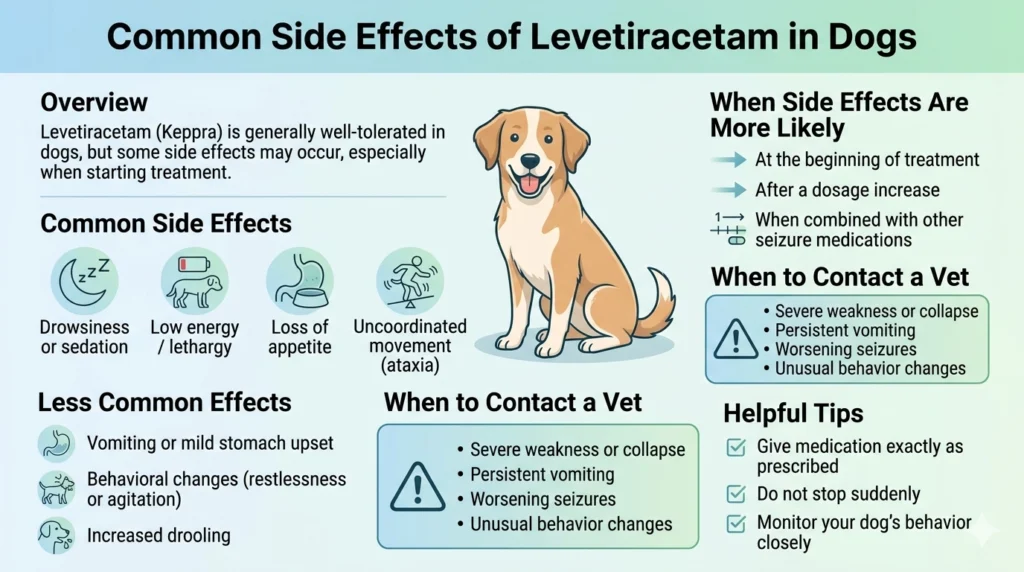
Generally, levetiracetam dosage is deemed as a safe and well tolerated anticonvulsant medication in dogs and the side effects are rare as compared to most other anticonvulsant drugs. In their occurrence, they tend to be mild, temporary and usually get better as the dog gets used to the medication. In other instances though, more noticeable or serious reactions may occur and need to be treated by a veterinarian.
Mild neurological and gastrointestinal effects are the most frequently reported side effects in dogs. These are normally not severe effects but must be closely observed especially where the treatment is being newly administered or the dose being increased or reduced.
- Sedation or drowsiness (sleepiness)
- Stilted or wobbly walk (ataxia/wobbliness)
- Mild vomiting, gastrointestinal upset (nausea, loss of appetite)
- Temporary changes in behavior (irritability, anxiety, aggression, or personality changes)
- Loss of appetite or slight lethargy.
These effects are in most cases short term and with further administration, these effects will improve. Veterinary medicine It is commonly used in veterinary medicine because it is largely metabolized extraliverally, and is generally well tolerated, even in dogs with liver disease.
Less common, but still possible, are more significant side effects, and may need veterinary attention, particularly when persistent or severe. These can be a powerful behavior change, walking difficulty or repeating vomiting every time you take a dose.
- Extreme sedation or severe lethargy.
- Dramatic changes in behavior (aggression, confusion, anxiety, or mood swings)
- Inability to walk or a severe decrease in coordination.
- Nausea and vomiting following each dose or persistent gastrointestinal discomfort.
There are also some rare yet serious reactions reported and should be regarded as urgent. These may be severe changes in the nervous system, uncontrolled movements, more severe seizures, or even indications of a general illness such as fever or extreme weakness.
- Severe neurological or coordination problems
- Worsening or withdrawal seizures.
- Abnormal or uncontrolled movements of the body.
- Symptoms of acute disease (high fever, extreme weakness or collapse)
In general, levetiracetam dosage for dogs is a popular anticonvulsant in dogs because it is more likely to cause fewer and milder side effects than most other anticonvulsants. Nevertheless, any new or worrisome symptoms will always be reported to a veterinarian in a timely manner so as to achieve safe and effective seizure control.
Most Serious Risks of Levetiracetam for Dogs
Levetiracetam drugs is usually regarded as one of the safest anticonvulsant medication used in dogs, and has a low risk of severe adverse effects when compared to many other seizure-reducing drugs. Nevertheless, although serious medical complications are unlikely, there are still important risks and precautions of which dog owners must be aware before and during treatment.
The greatest issue that is linked with the use of levetiracetam in dogs is the possible occurrence of behavioral changes. Even though these changes will not be life-threatening in the majority of cases, they may become serious enough to impact the quality of life of the dog, as well as the human-animal bond. They can also in certain circumstances augment the threat of harm or material harm.
Risks (most evident concern) in terms of behavior:
- Increased anxiety
- Low mood or depression.
- Aggression
- Attention-seeking behavior
- Hapless or weird pattern of behavior.
- Exacerbation of already existing behavioral issues.
Although not inherent to all dogs, these changes could be very important in the affected individuals and might warrant a reassessment of the treatment plan by the veterinarian.
Besides such effects of behavior, there are also significant medical precautions concerning particular health issues and drug interactions.
- Pregnancy risk:
In lab studies, levetiracetam has been linked to greater embryonic and fetal mortality. Pregnant dogs should only be put under the use of this only when the benefits of using it are clearly outweighing the dangers caused by the medication to the dog. - Kidney function caution:
Care must also be taken with the drug in dogs whose renal function is reduced since a reduction in dose or dosing frequency may be required to maintain safe excretion of the drug. - Withdrawal risk:
Levetiracetam should not be abruptly discontinued as this could raise the chance of withdrawal seizures. This is the reason why it must always be tapered slowly under the watch of the veterinary instead of being suddenly stopped.
All in all, although levetiracetam is a relatively safe seizure medication in dogs, it should be carefully monitored, particularly when it comes to behavioral changes, kidney disease patients, or when changing treatment or discontinuing.
Does Levetiracetam Interact with Other Dog Medications?
In dogs, levetiracetam is usually thought to have minimal drug interactions and this makes it an orally popular anticonvulsant in veterinary medicine. Nevertheless, interactions are still possible with some medications, and in some instances, dosage adjustments or monitoring might be necessary to achieve safe and effective medication.
Some commonly used veterinary and human drugs may interact with levetiracetam. Such interactions do not necessarily preclude combined use, but they can affect efficacy or risk of side effects, and thus veterinary supervision is required.
Drugs that can interact with levetiracetam in dogs:
- Antihistamines (e.g., diphenhydramine/Benadryl)
- Benzodiazepine (e.g., midazolam, alprazolam)
- Gabapentin
- Opioids (e.g., butorphanol)
- Methotrexate
- Non-steroidal anti-inflammatory drugs (NSAIDs) like carprofen (Rimadyl) and deracoxib (Deramaxx).
- Carbamazepine
- Ginkgo supplements
- Orlistat
- Calcifediol
When phenobarbital is used with levetiracetam, which is the most common combination of phenobarbital and levetiracetam, it might need special consideration. In dogs, phenobarbital can speed up the clearance of levetiracetam in the body which may reduce its efficacy. When this happens, the veterinarians can increase the levetiracetam dose to ensure that the seizures are kept at bay. Nevertheless, although the two drugs interact, they are often combined as part of a combination therapy.
It should be mentioned that not every interaction is negative and prohibitive. In other instances the use of medications may still be used in combination provided the benefits outweigh the risks but dose adjustments or increased supervision may be necessary.
Since levetiracetam dose can potentially interact with all the drugs that your dog is taking, in addition to any prescription or over-the-counter drugs, as well as any supplements (including vitamins and herbal products), it is vital to inform your veterinarian about everything your dog is taking before starting treatment. This will guarantee safe combination therapy and help to avoid undesired effects or decreased seizure control.
Safety Tips for Giving Levetiracetam to Dogs
In general, levetiracetam is safe in dogs, but it is necessary to administer it properly to achieve its effectiveness and minimize risks. Adherence to important safety recommendations may prevent the development of such complications as breakthrough seizures, side effects, or accidental overdose.
- Extended-release pills should not be crushed or split because this can influence the release of the medication in the body.
- Take the medicine with the same time every day to keep the levels of the drug in the blood constant.
- Doses should never be missed because this can cause breakthrough seizures.
- When your dog is vomiting you can attempt to give levetiracetam with food to help it tolerate it.
- Make sure that your dog has a good healthy kidney functioning before you start taking medication and this may influence the amount of drug to be administered.
- To prevent drug interactions, always make your veterinarian aware of all the other medications or supplements that your dog is taking.
- Keep the medication locked up and keep it beyond the reach of your dog so as to avoid the risk of inadvertent overdose.
- Do not change the dosage or discontinue the medication without consulting your veterinarian.
You May Also Like to Read:
- BPC-157 Dosage For Dogs Calculator: Safe Dosage Guide & Chart
- Lasix Dosage For Dogs Calculator: Safe Dosage Chart & Guide
FAQs
What to do in case my dog misses a dose of levetiracetam?
Administer the dose that was missed as soon as you remember it, after which you resume administration of the subsequent dose 8 hours later. Do not take two doses to compensate the one that is missed.
Would it be possible to administer two doses simultaneously in case of forgetting one of them?
No, never increase the dosage, because this may add to the possibility of adverse effects.
Why is it important to give levetiracetam on time?
The drug is only effective as long as it is in the body. Breakthrough seizures can be caused by missing doses.
What should I do in case of a dose omission?
Skipping a dose may increase your dog’s risk of having a seizure, especially if the medication level drops too low.
What can I do to forget to take doses?
Take medications at the same time and regularly Use a medication schedule, alarms, reminders, to remind you to take medications at the right time and in the correct manner.
Is it possible to change the time following a missed dose?
Yes, following the dose that has been missed, just proceed with the schedule, administering the next dose 8 hours later.
Does levetiracetam dosage for dogs per pound work when not administered on a regular basis?
No, irregular dosing has the potential to decrease its efficacy and risk of poor seizure control.
What would you suggest in case I often forget the doses?
Talk to your veterinarian about possible solutions, such as adjusting the schedule or considering alternative formulations.
Final Thoughts
Levetiracetam (Keppra®) is a common anticonvulsant used in dogs to treat seizures, and is often administered together with other anticonvulsants or in their place when alternative treatments are not applicable. It is usually administered in tablet form, and in most cases, requires three times a day administration, although an extended-release (ER) form has been developed that offers a more convenient, two-dose-a-day schedule to owners who find frequent administration difficult.
It is a human prescription drug that is used off-label in veterinary medicine to help treat canine epilepsy. It is mostly believed to be safe, effective, and well tolerated, with a low-risk of side effects when compared to some of the other seizure medications. Nevertheless, regular dosing is important in ensuring that seizures are under control.
The pet owners should at all times follow the instructions of the veterinarian. Do not raise or lower the dosage, miss doses or double up on medication without professional advice. Communication with your vet as often as possible is the best way to ensure the best possible outcome and help keep your dog safe, stable, and seizure-free.