Vetsulin Dosage For Dogs Calculator By Weight: Safe Guide
Vetsulin Dosage Calculator For Dogs
Once-Daily Dose: – IU
Twice-Daily Dose: – IU
Note: Always use U-40 syringes. Consult your veterinarian before changing your dog’s insulin dose.


© medsdog.com
Treatment of canine diabetes may be intimidating, but knowing how to apply insulin treatment is the initial step to maintaining health and normal weight of your dog. Vetsulin Dosage For Dogs is an injectable insulin that is specially designed to help manage high blood sugar (hyperglycemia) in dogs with diabetes mellitus and is available as dosage of Vetsulin (porcine insulin zinc suspension).
It is a sterile aqueous suspension of purified porcine insulin and is intended to be similar to the natural insulin of a dog so that glucose levels can be well maintained and side effects of diabetes such as excessive thirst, urination and weight loss, are minimized.
Vetsulin is FDA-approved insulin to be used in dogs and cats, is one of the most recommended insulin products by the American Animal Hospital Association (AAHA), and has a long history of use over 25 years around the world (as Caninsulin 400 IU in non-U.S. markets).
It is fast acting and offers extended glucose control, which helps in enhancing the overall quality of life of your pet. The 40 IU of insulin (U-40) is contained in each milliliter, so one must use insulin syring with a U-40 concentration, or the VetPen ®, to accurately dose the insulin - using an incorrect syringe may be fatal.
In contrast to a lot of other insulin products, Vetsulin for dogs dosage is not to be shaken vigorously, but rather shaken gently to mix the amorphous and crystalline components of the product prior to injection. It is important to ensure that this medicine is administered in the exact volume and manner as prescribed by your veterinarian because correct administration and dosing has a direct effect on the safety and efficacy of the medication.


Also, dogs that are in severe conditions like diabetic ketoacidosis, dehydrated, vomited, lethargic, or anorexia need to be first stabilized using short acting insulin and supportive care before beginning to take the Vetsulin therapy.
Read this comprehensive manual to dosing Vetsulin in a dog, and you will understand how it works, dosing, safety concerns, and how to make sure your dog derives maximum benefit of this proven remedy to diabetes.
Disclaimer: This guide is for informational purposes only and is not a substitute for professional veterinary advice.
Always consult your veterinarian before giving Vetsulin or any medication to your dog.
Key Takeaways
- Vetsulin® (porcine insulin zinc suspension) dosage for dogs is a veterinary injected insulin that is used to treat hyperglycemia in diabetic dogs.
- Developed specifically to suit dogs and very similar to natural insulin to enable good glucose regulation.
- Quick-acting and prolonged in keeping the blood sugar levels constant.
- The insulin that is approved by FDA firstly on dogs and secondly on cats.
- Extensively used (sold as Caninsulin 25 years internationally) with a long history of use worldwide.
- Recommended by the American Animal Hospital Association (AAHA)
- Demonstrated as safe and effective in treating diabetes and decreasing clinical signs.
- Helps decrease symptoms such as excessive thirst, urination and weight loss.
- Comprised of 40 IU/mL (U-40), that must be used only with U-40 syringes or VetPen 40 U.
- There is a risk of dangerous dosing in case incorrect syringes are used.
- Should be shaken softly prior to application in order to mix components.
- Injectable suspension that is not to be used unless prescribed by a veterinarian.
- When dogs have severe conditions (ketoacidosis, dehydration, vomiting, lethargy, anorexia) they should be stabilized first.
- Needs short-acting insulin and supportive care prior to initiating Vetsulin in severe cases.
- Regular inspection and veterinary care are the keys to effective and safe treatment.
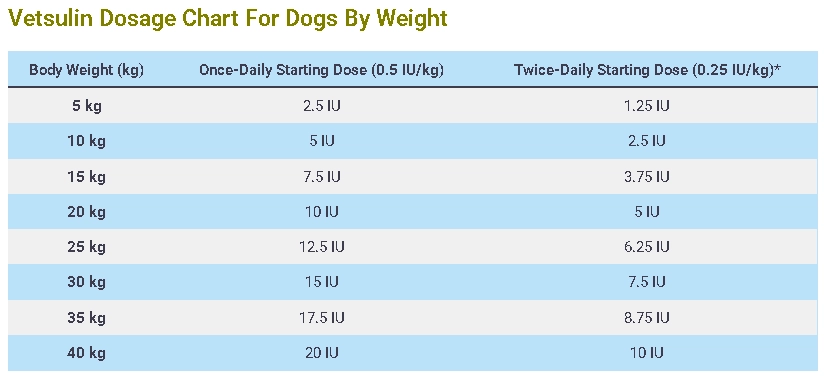
Vetsulin Dosage Chart For Dogs By Weight
The following Chart provides the initial starting dose guidelines for Vetsulin in dogs based on the standard clinical recommendation of 0.5 IU/kg.
| Body Weight (kg) | Once-Daily Starting Dose (0.5 IU/kg) | Twice-Daily Starting Dose (0.25 IU/kg)* |
| 5 kg | 2.5 IU | 1.25 IU |
| 10 kg | 5 IU | 2.5 IU |
| 15 kg | 7.5 IU | 3.75 IU |
| 20 kg | 10 IU | 5 IU |
| 25 kg | 12.5 IU | 6.25 IU |
| 30 kg | 15 IU | 7.5 IU |
| 35 kg | 17.5 IU | 8.75 IU |
| 40 kg | 20 IU | 10 IU |
Note: Many veterinarians start with once-daily dosing. If a twice-daily protocol is initiated, the total daily dose is typically reduced by 25% compared to the once-daily requirement. Always confirm the specific protocol with your veterinarian.
Critical Safety Rules for Dosage
- Round Down Weight: The body weight of the dog should always be rounded down to the nearest kilogram and then compute. To illustrate, a 12.9 kg dog needs to be dosed as a 12 kg dog.
- Apply U-40 Syringes: Vetsulin is an insulin that is U-40. You need to apply U-40 syringes so that the units indicated on the syringe are corresponding to the dose. A U-100 syringe will cause overdose that is life threatening.
- Veterinary Oversight: This table is for informational purposes. The dosage of Insulin is very individualized according to glucose curves and clinical appearances. Always follow the prescriptions of your veterinarian when changing the insulin dosage of your dog.
- Overweight Dogs: When a dog is grossly overweight, veterinarians tend to take the target weight of the dog instead of its current weight to ensure that they do not overdose them.
What Is Vetsulin Dosage for Dogs?
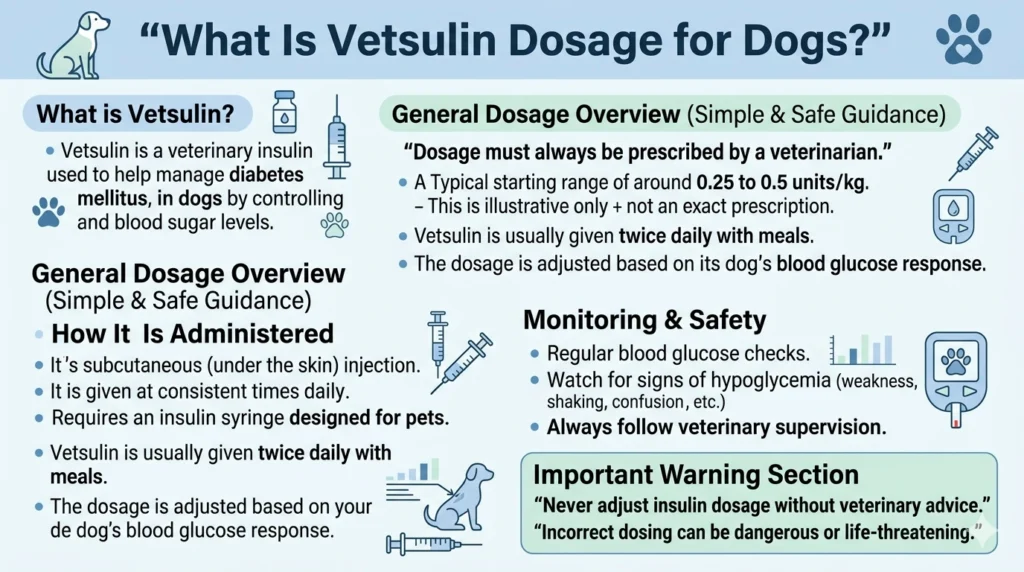
Vetsulin® (porcine insulin zinc suspension) Dosage is an injectable type of insulin designed to treat diabetes mellitus in dogs by lowering the levels of high blood sugar (hyperglycemia) and clinical symptoms. Being a sterile aqueous suspension of purified porcine insulin, it is more or less like natural insulin that is effective in controlling the glucose levels in the body.


It is rapid, long-acting, and the first FDA-approved insulin in dogs and cats, and has proven safety and efficacy and more than 25 years of worldwide usage (marketed as Caninsulin® outside the United States).
Vetsulin is highly recommended, even by the American Animal Hospital Association (AAHA), and it will help control the level of glucose in the blood and will decrease the symptoms of diabetes. One mL of each mL has 40 IU (U-40), and should only be used with U-40 syringes or VetPen, as the use of other syringes may lead to dosing errors.
It has to be shaken softly before use unlike many other insulin products, to mix its 35% amorphous and 65% crystalline components adequately. In case of diabetes treatment, this injectable suspension is only to be given as instructed by a veterinarian to ensure safe and effective treatment.
How Vetsulin® Dosage Works
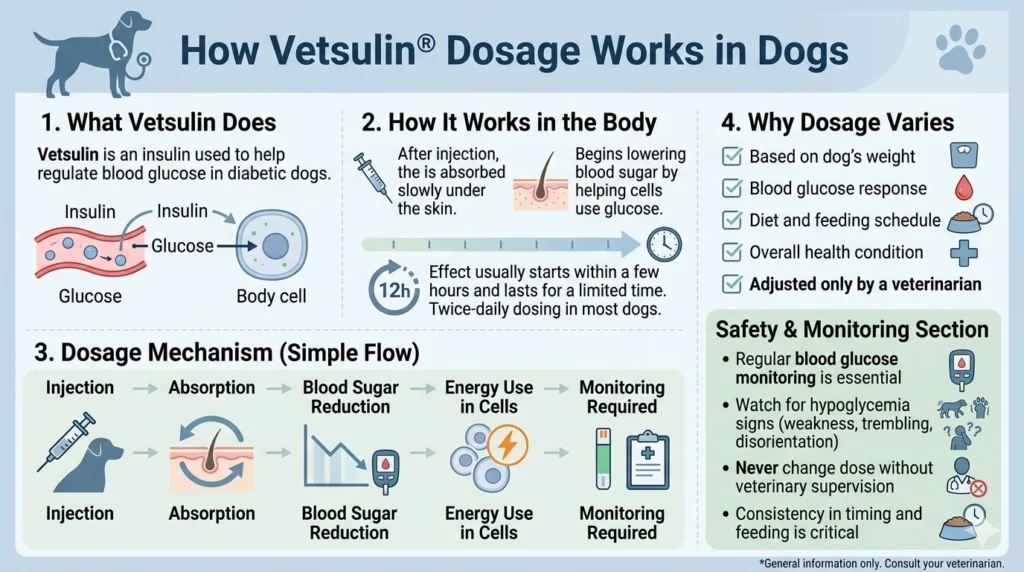
The mechanism of action of Vetsulin medication for dogs is that it is a combination of purified porcine insulin with crystalline zinc using recombinant DNA technology which produces a middle-acting insulin that would offer rapid onset and prolonged duration.
This special formulation enables it to begin to reduce blood glucose levels rapidly whilst having longer lasting effects over many other insulin types, which can aid in sustaining normal levels of diabetes in dogs.
Vetsulin® dosage by weight for dogs takes about 4-8 hours after administration to cause its maximum impact on blood sugar levels, and lasts about 14-24 hours.
This ratio of rapid activity and long-term regulation makes it effective to stabilize the glucose levels in diabetic dogs with diabetes mellitus in case of their use according to veterinarian directions.
- Makes purified porcine insulin with crystalline zinc by the use of recombinant DNA technology.
- In the group of intermediate-acting insulin.
- Works fast upon injection.
- Improvement in performance in 4-8 hours.
- Lasts approximately 14–24 hours
- Gives diabetic dogs normal blood sugar levels.
Vetsulin® Directions for Dogs
To maintain safe and effective diabetes management, it is important to follow Vetsulin dose directions as given by your veterinarian. The first dose and the dosing schedule depends on the weight of your dog, usually, the first dosage is once a day injection before or after a meal.
Twice-daily dosage may be necessary in case of the inadequacy in blood glucose control. It is important to have regular timings of feeding and insulin injection, and veterinary check-up should be taken regularly to check the progress, and change dosage when needed.
Vetsulin® insulin for dogs is an insulin with a U-40 concentration (40 units/mL) and thus should be administered exclusively with U-40 syringes to prevent potentially harmful cases of overdosing.
The vial should be shaken (not rolled) until it is a uniform milky color before every use. Foam must be left to settle, and the product must not be utilized in case of a clump or white particles after a good mixing.
Vetsulin dosage for dogs is also offered in the form of VetPen Vetsulin, an insulin pen that allows it to be used in the form of an insulin pen that does not require the use of a vial to deliver the required doses.
It consumes insulin cartridges which minimize waste and only compatible pen needles as indicated by the manufacturer should be used.
- Take as per veterinarian prescriptions and schedule.
- Initial dose is normally once a day with or without meals.
- When necessary, twice-daily dosage might be necessary to control glucose.
- Regular feeding and dosing time is necessary.
- Frequent veterinary check-up and dose changes necessary.
- Vetsulin with a concentration of 40 U/mL should only be used with U-40 syringes.
- The wrong syringes may lead to severe errors in dosing.
- Shake vial: shake vial until milky, but not rolled.
- Wait to draw dose when foam settles.
- Shake to dissolve: do not use when clumps or white particles are left.
- VetPen ® version can be used to provide precise, convenient dosing.
- VetPen has cartridges and particular compatible pen needles.
Vetsulin® Medication Possible Side Effects in Dogs
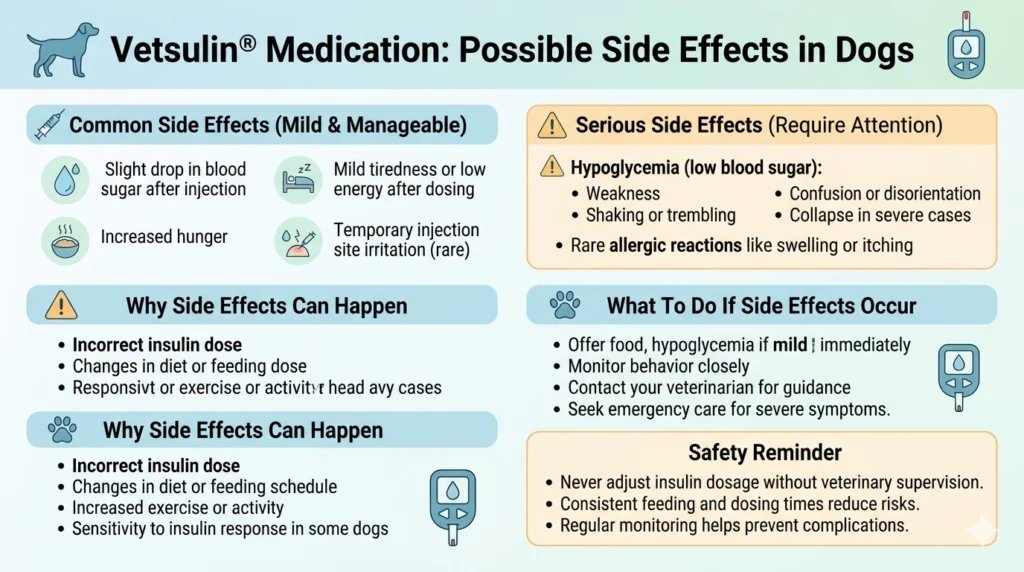
The most widespread and dangerous side effect of Vetsulin® (porcine insulin zinc suspension) dose is hypoglycemia (low blood sugar), and it may manifest itself abruptly and be life threatening unless it is treated immediately. Since insulin reduces the blood glucose level, improper dosing or sensitivity may cause unhealthy levels of sugar in diabetic dogs.
With mild hypoglycemia, symptoms tend to develop early and can rapidly progress. These are weakness, stumbling, falling, shaking, head tilt, lethargy and hunger. As the level of sugar in the blood keeps decreasing, there can be moderate symptoms like disorientation, vomiting and collapse.
Extreme hypoglycemia is a health emergency and may cause seizures, coma or even death unless immediate treatment is administered.
Dogs can also in certain situations have general diabetes-related complications or chronic blood sugar imbalance that can also lead to seizures, coma or life threatening conditions. A dog that passes out unconscious or has seizures should be taken to the veterinary immediately.
Some pets, such as lumps or thickening of the skin, have also been reported to have injection site reactions. Local reactions can be minimized by rotating the location of injection.
Owners of pets must always have a quick access to a source of sugar (food or oral dextrose) to resolve the early symptoms of hypoglycemia and call a veterinarian in case of the symptoms.
- Hypoglycemia (low blood sugar) is most frequently seen as a side effect.
- Mild: weakness, stumbling, shaking, head tilt, lethargy, hunger.
- Moderate symptoms: loss of consciousness, vomiting, stumbling.
- Serious symptoms: convulsions, unconsciousness, death.
- Hypoglycemia can occur suddenly and be life-threatening
- Care needed in case of seizures or unconsciousness.
- The chronic imbalance of glucose can also result in serious complications.
- Reactions can be found at the injection sites (lumps or thickening of the skin)
- Local reactions could be avoided by using rotating injection sites.
- Have a ready source of sugar (food, or oral dextrose) available.
- Seek the advice of a veterinarian, whenever there are side effects or persistent side effects.
Vetsulin Overdose Information in Dogs: Signs, Risks & Emergency Actions
The most common side effects of Vetsulin dosage for dogs are hypoglycemia (dangerously low blood sugar) and these side effects may be caused by insufficient levels of insulin when too much of the drug is provided or by the drug being given twice by mistake. This disorder may arise quickly and might be life threatening unless it is treated promptly.
Symptoms may be either mild or severe in case of an overdose suspected. In some cases, mild cases can be treated by means of food at home; however, more severe signs need a doctor in a hospital. Fast response is a must to avoid complications.
Signs and Management of Overdose of Vetsulin
- Most frequent outcome: Hypoglycemia (low blood sugar)
- Due to over dosage or a mistake of taking two doses.
- Mild cases of hypoglycemia can be treated by providing an extra meal.
- Middle to severe cases necessitate emergency treatment in the veterinary hospitals.
- The symptoms are related to hypoglycemia (low blood sugar).
Emergency Actions
- Call your veterinarian in case of suspicion of an overdose.
- Immediately consult the veterinary in case of serious symptoms.
- Contact an animal poison control center (may have a charge).
- It is important to stabilize blood sugar and avoid life-threatening outcomes, which can be achieved by immediate response.
You May Also Like to Read:
- Terbinafine Dosage For Dogs Calculator: Safe Guide & Chart
- Sotalol Dosage For Dogs Calculator: Safe Dosage Guide & Chart
FAQs
What is Vetsulin® Dosage used for in dogs?
Vetsulin dosage is an insulin injected into dogs to manage diabetes mellitus that helps maintain normal blood sugar levels (hyperglycemia) and prevents such symptoms as excessive thirst, urination and weight loss.
What is the storage of Vetsulin medication?
Keep Vetsulin Store refrigerator at 36°F to 46°F (2°C to 8°C) standing on its side. Should not be frozen or kept at high temperatures (higher than 77F) and should not be subjected to light. Make sure to keep it above the reach of children and pets.
What is the maximum time Vetsulin dose for dogs by weight can be used once opened?
Vetsulin 42 days (6 weeks) should be used after initial puncture. Once this has occurred then it must be discarded appropriately even where insulin is left.
How can I take missed dose?
In case of a missed dose, administer the dose immediately unless it is approximately the next dose. In case of a missed dose, omit the missed dose in case it is nearly the next dose. Never give a double dose.
What will occur when I administer excessive Vetsulin?
Hypoglycemia (low blood sugar) can result as an overdose and this can be fatal. Mild cases can be treated using food but most severe symptoms need emergency treatment by the veterinary.
What are the symptoms of low sugar in dogs?
Symptoms of hypoglycemia are weakness, shaking, stumbling, loss of direction, collapsing, vomiting, seizures and in severe cases coma or death. Severe symptoms are to be treated with immediate veterinary attention.
What are the requirements of preparing Vetsulin® to be injected?
Vetsulin dosage for dogs per pound or kg dosashould be shaken (not rolled) till it becomes milky. Shake well before using, do not use when clumps or particles are left. Always fill syringes or VetPen® U-40 syringes.
What is the significance of supervising my dog on Vetsulin®?
Very important. Vetsulin® dogs should be closely monitored with regards to blood sugar, eating habits, thirst, urination, and weight. Periodic blood tests, urinalysis, or other diagnostic test could also be prescribed by your veterinarian to safely modify treatment.
Final Thoughts
Treatment of dogs on Vetsulin® Medication should be regular, closely supervised and strictly with the guidance of the veterinary.
Vetsulin Medication is an approved FDA insulin which has been proven to help manage blood sugar levels, decrease diabetic symptoms and increase overall quality of life of diabetic dogs when used properly.
Its effectiveness and safety, however, rely on a lot on how it is handled and administered. Taking the right dosages with the help of proper U-40 syringes, keeping strict dosing schedules, proper storage of insulin and observing signs of hypoglycemia are all crucial steps that will lead to successful treatment.
Even minor mistakes in dosing or omissions in monitoring may cause severe complications, and it is of utmost importance that the veterinary personnel check their animals regularly.
Although Vetsulin® for dogs is an effective aid in the control of diabetes, it cannot be used alone. The most important thing to ensure that your dog is stable and healthy in the long-term is maintaining a balanced diet, regular use of insulin, and regular health check-ups.
Treatment should always be adapted as needed, in line with your veterinarians, to have the best possible outcome with your pet.