Bedinvetmab (Librela) Dosage Calculator For Dogs By Weight
© medsdog.com
Disclaimer: Medication dosing for animals is complex and depends on precise weight, current health status, and potential interactions with other treatments. Incorrect dosing or improper subcutaneous injection techniques can lead to ineffective treatment, adverse reactions, or physical injury to the animal. Additionally, because this medication is a monoclonal antibody, specific handling and storage requirements must be met to maintain its safety and efficacy. For the health and safety of the animal, it is essential to consult with a veterinary professional for all dosing calculations and administration.
Bedinvetmab (Librela®) is the first and only monthly injection anti-nerve growth factor (NGF) monoclonal antibody specifically labeled for the control of OA pain in dogs. Librela dose is different from traditional pain medications because it does not work on pain, it works on NGF, a protein which is crucial to the transmission of pain and reduces the pain in the affected dogs and thus improved mobility.


Librela (bedinvetmab injection) is vet-administered once a month, and based on a dog’s body weight. A new biologic drug that is a canine monoclonal antibody manufactured with recombinant DNA technology that binds to NGF, which reduces its ability to cause pain. Bedinvetmab can alleviate the pain caused by osteoarthritis, allowing dogs to move more comfortably and enjoy a better quality of life.
Osteoarthritis is a common joint disease that can be seen in any size, breed, or age of dog—not necessarily senior dogs. As the disease advances, the dog might start to limp or stiff, get up slowly after lying down, show less interest in playing, show reduced muscle tone, or walk with a “bunny hop” gait (lifted hind legs). If not managed, arthritis pain can have a major effect on a dog’s ability to enjoy their everyday life and quality of life.
This guide will answer all your questions about bedinvetmab dosage for dogs by weight, administration instructions, suggested dosing intervals, effectiveness, safety, side effects, and more. From initial introduction to detailed dosage instructions, this comprehensive resource will help you understand how this breakthrough osteoarthritis treatment is used in veterinary medicine.
Key Takwaways
- Librela (bedinvetmab) dosage is a medication for injection given once a month to help control and decrease pain associated with osteoarthritis (arthritis) in dogs.
- Bedinvetmab is the active ingredient, which is a type of medicine known as a monoclonal antibody that blocks pain signals linked to arthritis to help ease discomfort and improve mobility.
- Librela can only be obtained from licensed veterinarians and must only be administered by a veterinarian or qualified veterinary technician, once per month.
Bedinvetmab (Librela) Dosage Chart For Dogs By Weight
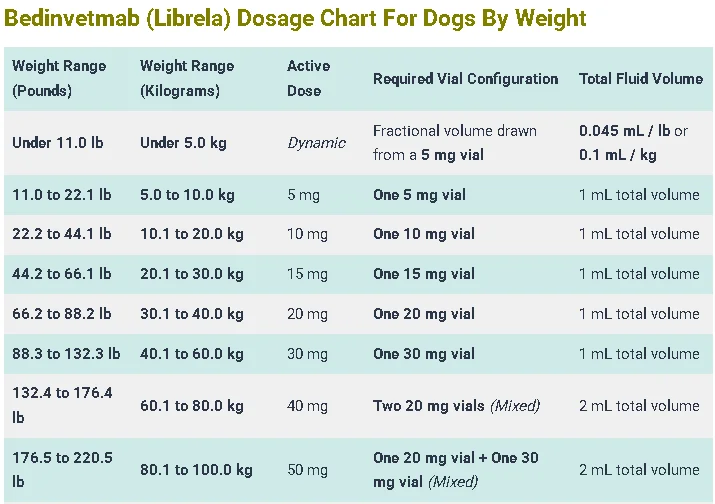
Here is the full, comprehensive Bedinvetmab (Librela) dosing reference table based on the standard clinical guidelines. It outlines exactly how the configuration scales from toy breeds up to giant breed tiers.
| Weight Range (Pounds) | Weight Range (Kilograms) | Active Dose | Required Vial Configuration | Total Fluid Volume |
| Under 11.0 lb | Under 5.0 kg | Dynamic | Fractional volume drawn from a 5 mg vial | 0.045 mL / lb or 0.1 mL / kg |
| 11.0 to 22.1 lb | 5.0 to 10.0 kg | 5 mg | One 5 mg vial | 1 mL total volume |
| 22.2 to 44.1 lb | 10.1 to 20.0 kg | 10 mg | One 10 mg vial | 1 mL total volume |
| 44.2 to 66.1 lb | 20.1 to 30.0 kg | 15 mg | One 15 mg vial | 1 mL total volume |
| 66.2 to 88.2 lb | 30.1 to 40.0 kg | 20 mg | One 20 mg vial | 1 mL total volume |
| 88.3 to 132.3 lb | 40.1 to 60.0 kg | 30 mg | One 30 mg vial | 1 mL total volume |
| 132.4 to 176.4 lb | 60.1 to 80.0 kg | 40 mg | Two 20 mg vials (Mixed) | 2 mL total volume |
| 176.5 to 220.5 lb | 80.1 to 100.0 kg | 50 mg | One 20 mg vial + One 30 mg vial (Mixed) | 2 mL total volume |
| 220.6 to 264.6 lb | 100.1 to 120.0 kg | 60 mg | Two 30 mg vials (Mixed) | 2 mL total volume |
Important Administration Protocol: For the final three tiers (dogs weighing over 132.3 lb / 60 kg), the full 1 mL contents of both specified vials must be drawn into the exact same syringe sequentially and administered altogether as a single subcutaneous injection once every 28 to 30 days.
What Is Bedinvetmab?
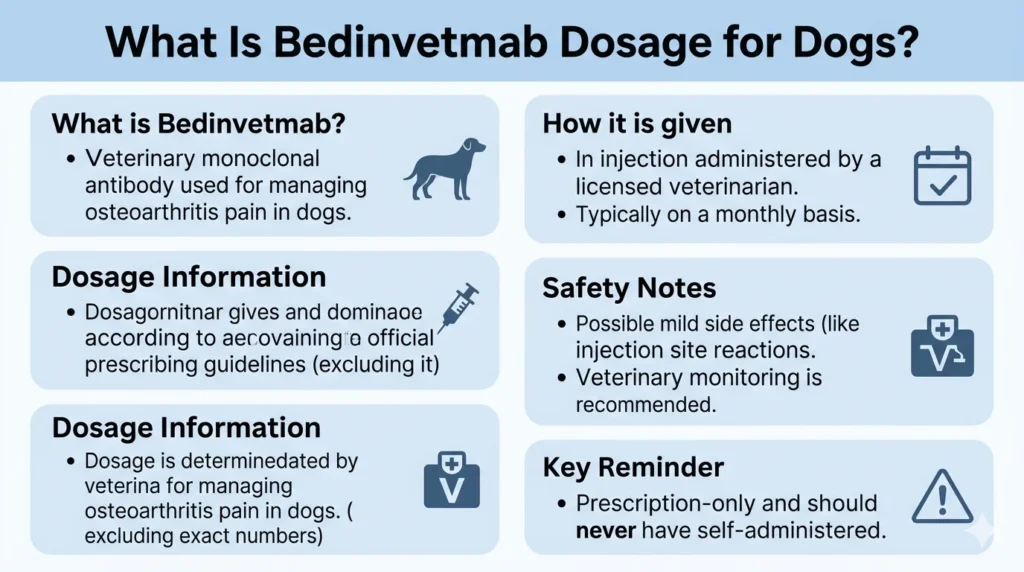
Bedinvetmab (brand name Librela®, Barensa in Australia) is a prescription injectable biologic drug specifically for dogs to manage and control pain from osteoarthritis (OA). Bedinvetmab is a canine anti-nerve growth factor (NGF) monoclonal antibody for dogs 12 months or older that targets one of the main causes of arthritis pain.
Bedinvetmab dosage for dogs per pound or kg is a protein-based biologic (monoclonal antibody) therapy, which is different than traditional medications used for treating mange. It binds to and neutralizes a protein known as nerve growth factor (NGF), which carries the pain signals from arthritic joints to the central nervous system. Bedinvetmab significantly diminishes the impact of NGF, which in turn lowers the pain and discomfort, increases mobility and enhances the quality of life for a dog with osteoarthritis.


Librela is injected in a veterinary clinic and is one of a range of treatments in an osteoarthritis management program. Some dogs will improve after initial treatment but large benefits can be seen after 2-3 months of treatment. Many dogs find that as their pain subsides, they move more easily, are more active, and are more inclined to want to run, jump, play and engage in their daily activities. As osteoarthritis is an incurable, chronic condition, controlling pain is a key goal and bedinvetmab is a valuable treatment for dogs with the condition.
How Is Bedinvetmab Used?
Bedinvetmab for dogs, the active ingredient in Librela, is a prescription injectable medicine for the control of chronic osteoarthritis (OA) pain in dogs. It is injected under the skin, by a veterinarian or trained veterinary professional, and is usually repeated every 30 days to maintain pain relief.
Bedinvetmab (Librela) is the first FDA approved monoclonal antibody treatments for chronic arthritis pain in dogs. Bedinvetmab for pets is a laboratory-made protein that specifically binds to a chemical messenger called nerve growth factor (NGF), which is involved in the transmission of pain signals from arthritic joints to the brain.
How Bedinvetmab Works
As the dog’s arthritis progresses over time, the cartilage in the joint erodes and the bone surfaces rub against each other, causing pain, stiffness and limited mobility.
Bedinvetmab can alleviate this discomfort by:


- Binding to and neutralizing nerve growth factor (NGF)
- Preventing pain signals from getting to the brain
- Decreasing the awareness of pain in arthritic joints
- Improving affected dogs’ comfort and mobility
- Important Administration Information
- Bedinvetmab should only be administered by a licensed veterinary professional.
- Once a month (every 30 days)
- Treatment should be continued according to your veterinarian’s recommendations
- Make sure to tell your veterinarian if your dog has been taking other medications, vitamins, supplements or herbal products.
- If any treatment is prescribed, consult with your veterinarian prior to discontinuation or alteration.
Bedinvetmab offers a targeted solution for managing pain associated with OA and enhancing quality of life in dogs, by working at the root cause of pain signal.
What Are the Benefits of Bedinvetmab?

Bedinvetmab (Librela) is a unique treatment for the pain associated with osteoarthritis (OA) and can help make a dog more comfortable, mobile and improve their quality of life. It is the first and only once monthly monoclonal antibody injection for long term canine OA pain control; it offers a different method of pain control in dogs.
Bedinvetmab offers several important benefits:
- Approved by the FDA for dogs that suffer from osteoarthritis pain.
- Helps to manage OA pain with just one injection a month.
- May start to offer pain relief from first dose and up to a month
- Inhibits a substance called nerve growth factor (NGF) which is known to play an important role in the pain associated with arthritis
- It acts in a different manner than nonsteroidal anti-inflammatory drugs (NSAIDs) that have the effect of decreasing the pain signal mediated by NGF
- Helps minimize the discomfort of arthritis and increase activity levels
- Helps to ease mobility, comfort and quality of life
- Does not require owners to give daily medication at home, only veterinary professional gives injections
- Has similar metabolism and excretion patterns to those of naturally occurring antibodies, involving minimal liver and kidney metabolism and excretion
- Has been proven in clinical trials to decrease canine OA pain and increase daily function and activity
Bedinvetmab dosage for dogs has changed the way long-lasting pain control is provided to dogs on a monthly basis and has become an important part of the treatment arsenal in controlling the source of pain signaling, especially for canines that suffer from osteoarthritis.
Does Bedinvetmab Have Warnings or Side Effects?
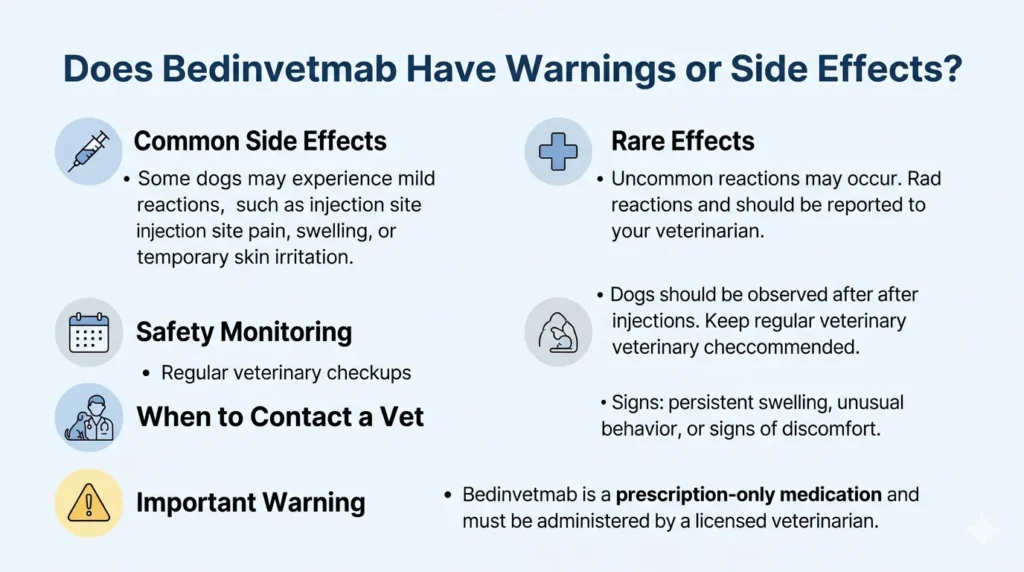
As with any drug, there are some important notes and potential side effects to be aware of before using bedinvetmab (Librela) with your dog. Librela is well tolerated, but it is possible to experience side effects, which may be mild, such as reactions at the site where the needle is given, or rare and severe.
Warns and Precautions
Avoid using Bedinvetmab in:
- Dogs that are known to be allergic or hypersensitive to bedinvetmab.
- Breeding dogs
- Pregnant dogs
- Lactating (nursing) dogs
- Dogs under 12 months old
Use caution in:
- Large-breed dogs whose bone growth is not yet complete
- Dogs that were treated with other monoclonal antibody treatments
- Dogs taking NSAIDs
- Dogs with some underlying diseases such as balance disorders, seizures, standing or other urinary issues
- Dogs with new or changing health issues
When bedinvetmab is given the same day as vaccines, all vaccines and bedinvetmab must be given at a different location on the dog’s body.
Additionally, over time some dogs may form antibodies against bedinvetmab, making it less effective.
Common Side Effects
Any side effects, if they do occur, are usually noticed within days of the injection and can include:
- Pain, swelling, redness, heat or irritation at the injection site.
- Urinary tract infection (UTI)
- Urinary accidents and inappropriate urination
- Increased urination
- Increased thirst
- Skin inflammation (dermatitis)
- Bacterial skin infections
- Vomiting
- Diarrhea
- Decreased appetite or loss of appetite
- Weight loss
- Tiredness (lethargy)
- Excessive sleepiness
- High levels of blood urea nitrogen (BUN).
Serious and Rare Side Effects
Though rare, severe side effects have occurred, such as:
- Severe allergic reaction (anaphylaxis).
- Kidney-related problems
- Neurological issues
- Loss of coordination/balance (ataxia)
- Wobbly gait
- Muscle weakness
- Tremors
- Paresis (weakness)
- Paralysis
- Seizures
- Trouble standing up or getting up from sitting or lying down
- Defects in proprioception (knuckling of the paws)
- Urinary incontinence
- Straining to urinate
- Tissues at the injection site become swollen or develop a tumor.
- Immune-mediated disorders like hemolytic anemia and thrombocytopenia (which occurs very rarely).
- Some serious adverse events have been reported leading to death or euthanasia.
Additional Safety Information
- The long term effects of taking for longer than 9 months have not been assessed.
- It may have serious side effects that could happen suddenly or without much warning.
- Blood tests may be recommended before or during treatment to keep track of kidney function and BUN levels by some veterinarians.
- If your dog exhibits some strange signs following bedinvetmab treatment, please reach out to your veterinarian right away.
Human Safety Warning
- Use Bedinvetmab only on dogs, not humans.
- Do not let children get hold of the medicine.
- Hypersensitivity reactions, including anaphylaxis, may occur with accidental self-injection.
- Pregnant women, women attempting to become pregnant, and women who are breastfeeding should take special care to avoid accidental exposure and should promptly consult a physician should accidental self-injection occur.
Each dog is unique, so discuss the possible pros and cons of bedinvetmab with your veterinarian to see if it will work for your dog.
Does Bedinvetmab Interact With Other Medicines?
Being a relatively new medication used to help treat canine osteoarthritis pain, there is limited information on potential drug interactions with bedinvetmab (Librela). There are no known drug interactions at this time, although the study of it with many other drugs is limited.
What are the Current State of Knowledge on Drug Interactions?
- Bedinvetmab has been used safely with short-term nonsteroidal anti-inflammatory drugs (NSAIDs) in dogs.
- There is limited experience of the safety of long-term NSAID use combined with bedinvetmab.
- Most of the other medications have not been studied in formal interaction studies.
- Because limited data is available on interactions with other treatments for pain, veterinary practitioners should be extra cautious when using Librela with other such treatments.
- Considerations for Vaccines
Librela’s effects when given at the same time as vaccines have not been studied. For this reason, some vets might decide to administer Librela and vaccinations on different visits.
Crucial Pet Owner Info
Please let your veterinarian know about any products your pet is using prior to administration of Bedinvetmab, such as:
- Prescription medications
- Over-the-counter (OTC) medicines
- NSAIDs and other medicine for pain
- Vitamins and minerals
- Nutritional supplements
- Herbal products & therapies
Your veterinarian will be able to come up with the best and safest treatment plan for your dog’s OA by having a full medication history.
NSAID-Related Considerations
In human trials of anti-NGF monoclonal antibody treatments, some individuals treated with anti-NGF antibodies who were also taking NSAIDs, developed rapidly progressing osteoarthritis (RPOA). But this has not occurred in dogs treated with bedinvetmab.
Knowledge of possible drug interactions is constantly growing, so always adhere to your veterinarian’s recommendations and consult your veterinarian prior to beginning, ending, or mixing any treatment with bedinvetmab.
You May Also Like to Read:
- Loperamide Dosage For Dogs: Calculator, Chart & Safe Guide
- Bismuth Subsalicylate Dosage For Dogs: Calculator & Safe Guide
Are there any Safety Issues for Dog Owners?
Since bedinvetmab (Librela) medication is given by a veterinarian or a trained veterinary professional, generally there are no safety issues to consider for dog owners. The drug is handled and administered in a veterinary clinic, thus reducing the chance of accidental exposure.
What if my Dog misses a Librela injection?
If your dog doesn’t receive their monthly injection of Librela drugs for dogs on schedule, please call your veterinarian to make an appointment as soon as possible. Once a month treatment is enough to keep the symptoms of osteoarthritis away and to keep the pain relief effective. Your vet may also evaluate how much pain your dog is in, how well she moves around, and then resume the treatment plan.
Is Bedinvetmab a Drug for a Dog that Can Overdose?
Overdose is not likely to occur since bedinvetmab is given by a veterinary professional. Call your vet or an emergency veterinary clinic immediately if you feel that your dog may have received an overdose of medication, or an unusual dose of medication, or if you notice any unusual reactions following any medication. Have details about your dog’s weight, symptoms and treatment history on hand.
Is it necessary to monitor during Bedinvetmab treatment?
Yes. Your veterinarian may suggest checking your pet’s blood and urine levels prior to the beginning of treatment. Periodic blood tests, urine tests and follow-up examinations might be required during long-term use to monitor your dog’s overall well-being and make sure that the pain caused by the osteoarthritis is well controlled. Owners should also monitor for side effects at home and report them if they have any concerns.
Will Bedinvetmab lose its effectiveness over time?
In some dogs, repeated use of bedinvetmab may be less effective, as drug antibodies against the treatment may be formed within the body. If symptoms of arthritis start to reappear, or pain is less controlled, your veterinarian can assess if changes to the treatment are necessary.
Do Dogs Exercise differently after taking Librela?
When a dog’s pain subsides, they tend to be more active and mobile. This is a good sign, but after feeling better, some dogs will overexert themselves. Gradually increasing exercise and activity levels can help reduce the risk of injury. Your veterinarian can help you create a safe exercise program for your dog depending on his condition.
How Bedinvetmab is Stored?
Bedinvetmab is kept in veterinary clinics in the refrigerator between 35°F and 46°F (2°C and 8°C). Medicines should be kept from freezing and from direct light, and from being handled so much that they are shaken or foamed. Vials are for use once only and after use are disposed of locally.
Does Librela Have any Effect on the Kidneys?
In some dogs, Librela may alter some laboratory parameters of kidney function. In particular, elevated blood urea nitrogen (BUN) levels have been reported and could be linked to renal issues. For this reason, some vets suggest regular blood tests to keep an eye on kidney function during treatment.
Dogs that should not receive Librela:
Do not use Librela in dogs less than 12 months of age, in breeding dogs or in pregnant or nursing dogs. Further, there are no studies assessing the long-term effects of Librela in dogs with heart disease. Veterinarians may want to be extra careful when considering treatment of a dog with an underlying heart disease since NGF is involved in the cardiovascular system.
Other Therapies that can be used to Support Osteoarthritis in Dogs.
Librela is effective in managing the pain associated with osteoarthritis, but it is usually part of a comprehensive or holistic management plan for arthritis. Veterinarians may also prescribe and recommend other pain medications, joint supplements, weight management, controlled exercise programs, physical rehabilitation, massage therapy, laser therapy, acupuncture, or other supportive therapies depending on the dog’s needs to improve their mobility and quality of life.
Final Thoughts
Bedinvetmab (Librela) medication for dogs is the first FDA-approved monoclonal antibody therapy that was specifically developed to help control pain in dogs suffering from osteoarthritis. Once a month injection in the body, it is administered by veterinary, and should be given by a licensed veterinarian.
Most dogs tolerate this treatment well, and it can be effective in treating arthritis-related pain. Some dogs, however, may have reactions at the site of the injection or skin reactions. In some instances, it may take a few weeks to a couple of months of regular treatment for noticeable improvement.
Bedinvetmab dose is a relatively new step in the world of doggie arthritis treatment, providing long-term pain relief for dogs suffering with OA. It should never be used without a veterinarian’s approval, as there are individual health considerations and needs.