Claritin For Dogs Dosage Chart Calculator & Safe Dosage Guide
🐕 Claritin Dosage Calculator for Dogs
Patient Information
Recommended Dosage
Liquid Claritin Dosage by Weight
Alternative Dosing Methods
Contains pseudoephedrine – TOXIC to dogs. Even one tablet can cause seizures, heart rate changes, and death.
Critical Safety Information
⚠️ Do NOT use in dogs with:
- Liver disease or kidney disease
- Dry eye (keratoconjunctivitis sicca)
- Known allergy to loratadine
- Pregnancy or nursing
- Puppies under 12 weeks (consult vet first)
⚠️ Drug Interactions: Avoid with cimetidine, erythromycin, ketoconazole, or other antihistamines.

⚠️ Possible Side Effects: Dry mouth, drowsiness (less common), vomiting, diarrhea, lethargy, decreased tear production.
ALWAYS consult your veterinarian before administering any medication. This calculator provides general guidelines only.
© medsdog.com
Will you administer Claritin For Dogs Dosage? The answer to this question is yes but only so long as you are sure of the right amount to leave.
This is a full-blown guide that has dosage schedules endorsed by veterinarians, a weigh-based Claritin For Dogs Dosage Char & calculator, and all that you require to know regarding the safe usage of loratadine in your dog friend.
Key Takeaways: What You'll Learn in This Guide
| Question | Quick Answer |
|---|---|
| Can dogs take Claritin? | Yes, but ONLY regular Claritin (loratadine). Never Claritin-D. |
| Safe dosage range | 0.1–0.5 mg per pound, once daily (or 0.2–1.1 mg per kg) |
| Typical dose for 30 lb dog | 5–10 mg once daily |
| Onset of action | 1–2 hours |
| Duration | 12–24 hours |
| Common uses | Seasonal allergies, environmental allergens, mild skin reactions |
| Most important warning | Check for xylitol in chewable tablets—toxic to dogs |
Medical Disclaimer: I am not a pet parent, researcher and a veterinarian. This is a guide with a veterinary consensus and pharmacology information though each dog is different. You must never give your veterinarian new medication without consulting him.


Can I Give My Dog Claritin? Loratadine in Dogs: what you need to know.
When your dog is scratching and sneezing as well as Britney Spears and poorly watery eyed even when spring comes, you may be considering the possibility of applying the same antihistamine you grab to them.
The simple fact, then, is that (loratadine) Claritin For Dogs Dosage is thought to be safe in dogs who are administered properly, and there is also a good deal of consensus that the drug should be used to treat minor seasonal allergens. But here, there is a catch--and a very large one.
Claritin-D Dosage is in no way safe in dogs:
The D is decongestant that is pseudoephedrine that is very toxic to dogs. Even minimal doses may result in life-threatening levels of heart rate, seizures and in more severe instances, death. Is all you do is to give your dog plain loratadine.
How Loratadine Works in Dogs
Loratadine is an antihistamine of the second generation. Loratadine selectively acts on peripheral H1 receptors whereas the first-generation antihistamines such as Benadryl (diphenhydramine) do not selectively interact with peripheral H1 receptors but instead enter the brain triggering drowsiness.


This implies that it will prevent histamine at the point of allergic reaction in the skin, nasal passages, respiratory tract, without drying out your dog.
This discriminatory move makes Claritin an attraction to the dogs that require their allergy remedy without the hangover effect during the day.
hen Vets Recommend Claritin Dosage For Dogs
Loratadine could be recommended by your doctor to treat:
- Environmental allergies (pollen, grass, mold, dust mites) Seasonal.
- Mild atopic dermatitis ( scratching on the skin caused by airborne allergens)
- Chronic hives (urticaria)
- Mild side effects of vaccines (with supposition of veterinary recommendation)
- Histamine-mediated symptoms: mast cell tumor supportive care.
What it will not do: Claritin will not be helpful with food allergies and skin infections caused by bacteria, as well as severe inflammations that necessitate steroids or the use of prescription immunomodulators.
Claritin For Dogs Weight Calculator of dosage
This is the part that you are here to read. Both pound and kilogram dosing charts are seen below. Note: it is important to keep in mind that you should only begin with the lowest dosage range and see what happens to your dog.
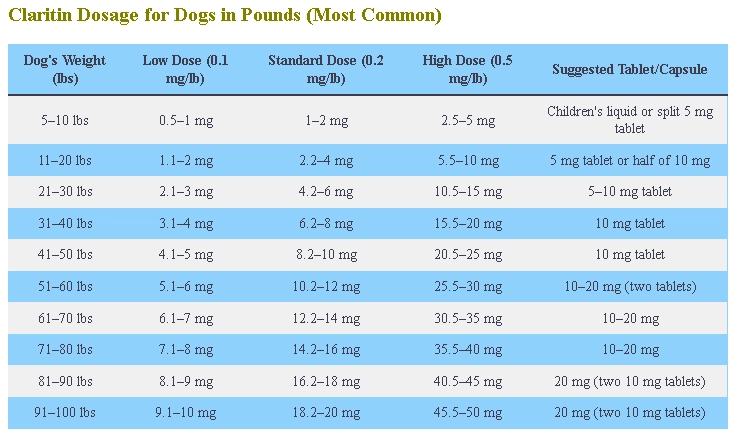
Claritin Dosage for Dogs in Pounds (Most Common)
| Dog's Weight (lbs) | Low Dose (0.1 mg/lb) | Standard Dose (0.2 mg/lb) | High Dose (0.5 mg/lb) | Suggested Tablet/Capsule |
|---|---|---|---|---|
| 5–10 lbs | 0.5–1 mg | 1–2 mg | 2.5–5 mg | Children's liquid or split 5 mg tablet |
| 11–20 lbs | 1.1–2 mg | 2.2–4 mg | 5.5–10 mg | 5 mg tablet or half of 10 mg |
| 21–30 lbs | 2.1–3 mg | 4.2–6 mg | 10.5–15 mg | 5–10 mg tablet |
| 31–40 lbs | 3.1–4 mg | 6.2–8 mg | 15.5–20 mg | 10 mg tablet |
| 41–50 lbs | 4.1–5 mg | 8.2–10 mg | 20.5–25 mg | 10 mg tablet |
| 51–60 lbs | 5.1–6 mg | 10.2–12 mg | 25.5–30 mg | 10–20 mg (two tablets) |
| 61–70 lbs | 6.1–7 mg | 12.2–14 mg | 30.5–35 mg | 10–20 mg |
| 71–80 lbs | 7.1–8 mg | 14.2–16 mg | 35.5–40 mg | 10–20 mg |
| 81–90 lbs | 8.1–9 mg | 16.2–18 mg | 40.5–45 mg | 20 mg (two 10 mg tablets) |
| 91–100 lbs | 9.1–10 mg | 18.2–20 mg | 45.5–50 mg | 20 mg (two 10 mg tablets) |
Important: The "suggested tablet" column represents the closest practical dose. A 22 lb dog might get half of a 10 mg tablet (5 mg), which falls within the 0.2 mg/lb range (4.4 mg).
Claritin Dosage for Dogs in Kilograms (International Standard)
| Dog's Weight (kg) | Low Dose (0.2 mg/kg) | Standard Dose (0.5 mg/kg) | High Dose (1.1 mg/kg) |
|---|---|---|---|
| 2–5 kg | 0.4–1 mg | 1–2.5 mg | 2.2–5.5 mg |
| 6–10 kg | 1.2–2 mg | 3–5 mg | 6.6–11 mg |
| 11–15 kg | 2.2–3 mg | 5.5–7.5 mg | 12.1–16.5 mg |
| 16–20 kg | 3.2–4 mg | 8–10 mg | 17.6–22 mg |
| 21–25 kg | 4.2–5 mg | 10.5–12.5 mg | 23.1–27.5 mg |
| 26–30 kg | 5.2–6 mg | 13–15 mg | 28.6–33 mg |
| 31–35 kg | 6.2–7 mg | 15.5–17.5 mg | 34.1–38.5 mg |
| 36–40 kg | 7.2–8 mg | 18–20 mg | 39.6–44 mg |
| 41–45 kg | 8.2–9 mg | 20.5–22.5 mg | 45.1–49.5 mg |
The Right Way to Find the Exact Dose of your Dog
The Claritin brand of dogs dosage calculator is not a complex formula. This is the formula mad-vets use:
Pounds weight x 0.2 = milligrams dose per day.
KGs x 0.5=mg dose /day.
Real-World Examples:
Example 1: Cooper, the 28 lb Beagle
28 lbs/0.2= 5.6 mg/4/2= 5 mg (half a 10 mg tablet)
Examples 2: and 3 are Luna and Gogol, who are 9 lb Chihuahuas.
9 lbs x 0.2 = 1.8mg = 2.5mg (half of 5 mg tablet /.5 ml of 5mg/5 ml liquid)
Example 3: The Golden Retriever, 65lb. Rocky.
65 lbs × 0.2 = 13 mg → Give 10 mg (one tablet). This is slightly less than the calculated dose, and safe, and usually effective.
Higher range (0.5mg/lb): The veterinarians can prescribe higher doses to dogs who do not respond to standard dosing especially in the case of mast cell tumor support. Should not surpass 0.5mg per pound without veterinary confirmation.
Claritin vs. Zyrtec vs. Benadryl Which Antihistamine to use on dogs?
The common antihistamines used are often subject to enquiries regarding the differences between them. Here's the honest comparison:
| Medication | Claritin (Loratadine) | Zyrtec (Cetirizine) | Benadryl (Diphenhydramine) |
|---|---|---|---|
| Generation | Second | Second | First |
| Dosing frequency | Once daily | Once daily | 2-3 times daily |
| Sedation risk | Very low | Low | High |
| Onset of action | 1-2 hours | 1 hour | 30-60 minutes |
| Duration | 24 hours | 24 hours | 4-6 hours |
| Typical dose | 0.2 mg/lb | 0.5 mg/lb | 1 mg/lb |
| Best for | Daytime allergies, long-term use | Moderate-severe itching, hives | Acute reactions, motion sickness |
| Veterinary preference | Growing preference | Preferred by many dermatologists | Traditional, still widely used |
The veterinarian dermatologist opinion: Zyrtec (cetirizine) has become a favorite of many veterinary dermatologists as compared to Claritin and Benadryl due to its power and once-a-day dosage.
Claritin is however, also a good option when the dog is sensitive even to slight sedation, or even gastro-intestial sensitive.
The Critical Safety Information: What your vet wants you to know
The Xylitol Epidemic
This may not be exaggerated enough: A range of over-the-counter chewable antihistamines such as some preparations of Claritin are sweetened with xylitol.
This sugar alcohol is harmless to human beings but produces rapid severe hypoglycemia and liver failure in dogs. Within hours of ingestion, death may happen.
There should be a confirmation of inactive ingredients. You should never put xylitol on the label on your dog, that is all.
Claritin-D: A very Bad Blunder:
Pseudoephedrine toxicity in dogs occurs as:
- Lack of concentration and restlessness.
- Rapid breathing and increased cardiac rate.
- Tremors and seizures
- Severe hypertension
In case of an accident, when you give your dog Claritin-D, call an emergency veterinarian or call a pet poison control.
Side Effects: Claritin Contraindications.
loratadine ought to be inhibited in dogs with:
- Hepal pathology (loratadine is metabolized by the liver)
- Kidney failure (reduced removal of the drug)
- Antihistamine hypersensitivity.
- Pregnancy or breastfeeding (safety has not been established; use other options)
Drug Interactions
Claritin can interact with:
- Ketoconazole (antifungal) - is a potential drug that interacts with loratadine.
- Erythromycin (antibiotic) - might interact with loratadine by increasing its levels.
- Cimetidine (acid reducer) - has the potential to elevate the levels of loratadine.
- Anxiolytics/sedatives - possible synergies.
Incidents Your Dog Could Use Allergy Medicine
Always make sure that your dog has allergies before you grab the antihistamines; that is not another disease that has similar symptoms.
The typical allergic symptoms that could be treated with Claritin:
- Scratching seasonal (victims along spring/summer worse).
- Itchy paws (this is too much the Licking between toes)
- Several red inflamed belly and armpit skin.
- Chronic ear infections (which tend to be as a result of allergies)
- Unchanged color change of runny eyes.
- Sneezing is appropriate, particularly on the outside.
Red flags: Claritin will fail them:
- Bacterial oozing, yellow hot spots.
- Circular baldness (which may be a result of a ringworm or mange).
- Malaise, risqué (wholesale sickness), nausea (general condition).
- gastrointestinal emergency Bloody diarrhea or vomiting
- Swelling on the face (anaphylaxis -EMERGENCY)
How to administer Claritin to your dog
1. Verify Your Product
Flip the box. Confirm:
- Active ingredient: Loratadine 5 mg or 10mg ONLY.
- No congestant (no pseudoephedrine)
- inactive ingredients No xylitol.
- Chewable? Check sweeteners carefully
2. Weigh Your Dog Accurately
Dosing of veterinary is weight-based. A small dog or veterinary scale in a kitchen is the best scale to use. When the weight of a 15 lb dog was guessed to be 20 lbs, this would overdose by 33%.
3. Calculate the Starting Dose
Begin with 0.1–0.2 mg per pound. This avoids tolerance, you can test tolerance and then proceed to the entire therapeutic dose.
4. Administer with Food
Although the drug does not need to be administered with food to be absorbed, taking medicine with a small meal minimizes the chances of having gastrointestinal upset. Hide the tablet in:
- A pill pocket treat
- Definitely not plenty, but some peanut butter (xylitol-free!).
- Cream cheese
- A slice of deli meat
5. Observe for 2 Hours
Watch for:
- The rare adverse effect of loratadine is excessive sedation.
- Hyperactivity (paradoxical reaction)
- Vomiting or diarrhea
- Swelling on the face (allergy towards the drug itself-infrequent)
6. Evaluate Effectiveness 3-5 Days
Antihistamines do not act immediately when dealing with chronic allergies. Allow almost a week of regular dosage before deciding it does not work.
Natural Care of Dogs that have seasonal allergy
Although antihistamines prevent the reaction caused by histamine, the following supplementary methods treat the inflammation and immune system:
Quercetin: This is commonly called nature Benadryl, and it is a flavonoid in the plant that helps to stabilize the mast cells and decrease the release of histamine. Dosage: 5-15mg/lb, in two doses per day.
Omega-3 Fatty Acids: Fish oil EPA/DHA lowers the general inflammation. Dosage: 75-100 mg/kg combined EPA/DHA.
Spirulina: This blue-green algae is promising in the allergic rhinitis in humans and animals. Dosage: 50-100 mg per 10 lbs.
Local honey: Although this is not tested in dogs, some of the owners report improvement with seasonal pollen allergy. Dosage: 0.5 tsp/lbs of raw, local, unfiltered (1).
Notable: These are neither substitutes nor replacements of veterinary assistance. It may be severe allergies and be treated with prescription drugs.
You May Also Like to Read:
- Furosemide Dosage For Dogs with Heart Failure Calculator
- Fish Oil Dosage Calculator For Dogs and Safe Dosage Guide
FAQs
Should I put my dog Claritin on daily?
Claritin can be taken on a daily basis at the time of allergy season or chronically at the time of environmental allergies. Its long-term management is made convenient by the single daily dose. Nevertheless, when your dog needs daily antihistamines, over 3-4 months every year, talk to your veterinarian about prescription costs- maybe they would be better and cheaper.
The time of action of Claritin for dogs?
Peak effects of administration should be observed in 1-3 hours. In chronic cases, it can take 3-5 days of regular dosage before you can be fully cured. Antihistamines do not act as overnight as steroids do.
What will become of me should I overfeed my dog Claritin?
Loratadine is of very large margin of safety yet may be overdosed. The symptoms are enlarged pupils, tachypnea, hyperactivity, and thirst. Very extreme overdose can lead to urinary retention and tachycardia. The symptoms of overdose should be suspected and your veterinarian or pet poison control contacted.
Does loratadine (as generic) prove safe to dogs?
Yes, generic Loratadine is the same as brand name Claritin and much cheaper. The same thing, just basic loratadine no decongestants, no xylitol.
Does Claritin put my dog to sleep?
The second-generation antihistamines such as loratadine are not intended to enter the blood-brain barrier and thus cause no sedation likely. Yet, each dog is unique, some will become slightly sleepy, others will not demonstrate any changes in their behavior at all. In case your dog appears to be sedated, administer the drug in the evening.
My dog won't swallow pills. Can I use liquid Claritin?
Loratadine liquid in children is also a good alternative in small animals. Check the concentration (usually 5mg per 5 ml) and make sure that the liquid does not include xylitol, alcohol and artificial sweeteners. Dosage: 0.5ml/5 lbs body weight.
Final Thoughts
Claritin is a semi-safe, less sedating, but in many cases, weaker substitute to Benadryl in the treatment of allergy in dogs. It is a great place to start in case of dogs having mild-to-moderate seasonal allergies, as they require daily relief with no drowsiness.
However, this is what I would like you to remember: There is no universal antihistamine. A dog belonging to your neighbor may respond well to Claritin and yours responds to Zyrtec.
The dog you had as a child would have been fine on Benadryl and your new dog requires prescription strength medicine.Listen to your dog. Observe. Adjust. And have your veterinarian in the loop.
Your planned research on dosage charts, options, and focus on the safety of your pet makes me sure that you are the type of a pet parent our furry friends are supposed to have. You've got this.
Were these allergies of your dog treated with Claritin? I would be glad to know what you thought of that in the comments section. All dogs are unique and your experience may make another owner identify what works with his or her pup.