Fluoxetine For Dogs Dosage Calculator, Chart & Safe Guide
Fluoxetine For Dogs Dosage Calculator
• Tablets/Capsules: 10mg, 20mg, 40mg
• Reconcile®: 8mg, 16mg, 32mg, 64mg
© medsdog.com
Disclaimer: This guide is for informational purposes only and is not a substitute for professional veterinary advice.
Always consult your veterinarian before giving Fluoxetine or any medication to your dog.
This comprehensive guide gives you a detailed fluoxetine for dogs dosage chart & Calculator, as well as a practical, calculator approach and all you need to know about safely and effectively using a fluoxetine for dogs dosage chart under veterinary guidance.
If you’ve noticed your dog pacing incessantly when you grab your car keys, chewing up household furnishings when you’re at work, or popularly tail chasing causing problems that he never seems to have any use for and never seems able to stop, you’re not alone.
Behavioural problems such as separation anxiety affect a good number of dogs and determining the right treatment can be overwhelming.
Fluoxetine Dosage For Dogs better known as Prozac brand has become one of the most trusted vet prescriptions for canine anxiety disorders. But getting the dosage right is so absolutely critical.
Fluoxetine Dosage For Dogs
Fluoxetine dosage for dogs should always be prescribed and monitored by a licensed veterinarian, as it depends on the dog’s weight, medical history, and behavioral condition.
Commonly used to treat separation anxiety, aggression, and compulsive disorders, fluoxetine (a selective serotonin reuptake inhibitor, SSRI) is typically dosed at around 1–2 mg per kg of body weight once daily, though adjustments may be needed.
It may take 3 to 6 weeks to see noticeable behavioral improvements. Consistent daily administration is important, and doses should never be changed abruptly.
Possible side effects include decreased appetite, lethargy, or gastrointestinal upset. Regular veterinary follow-ups help ensure safety and effectiveness.
Never give human medication to dogs without professional guidance.
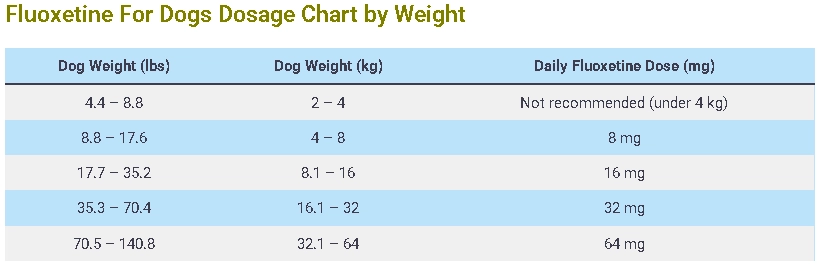
Fluoxetine For Dogs Dosage Chart by Weight
The standard dosage of fluoxetine that is recommended for dogs is 1 to 2 mg/kg (0.5 to 0.9 mg/lb) of body weight, one time daily.
The dosage table below is based on approximate dosages for weight.
Remember: your veterinarian will determine how much medicine your dog needs to take based on your dog’s individual health status, the condition being treated and other individual factors.
| Dog Weight (lbs) | Dog Weight (kg) | Daily Fluoxetine Dose (mg) |
|---|---|---|
| 4.4 – 8.8 | 2 – 4 | Not recommended (under 4 kg) |
| 8.8 – 17.6 | 4 – 8 | 8 mg |
| 17.7 – 35.2 | 8.1 – 16 | 16 mg |
| 35.3 – 70.4 | 16.1 – 32 | 32 mg |
| 70.5 – 140.8 | 32.1 – 64 | 64 mg |
Key Takeaways
Before delving to the details here are the most important things to keep in mind about fluoxetine for dogs:
- Prescription Required: Fluoxetine For Dogs Dosage is a prescription only drug. Never administer human Prozac to your dog without vet approval.
- Standard Dosage: The recommended dosage is 1 to 2 milligrams per kilogram (about 0.5 to 0.9mg per pound) of body weight, one time per day.
- FDA-Approved Use: Reconcile is the FDA veterinarian-approved divaloxetine in a formulation to use in the treatment of canine separation anxiety.
- Patience Is Essential: Unlike sedatives that are immediate, fluoxetine takes 3 to 4 weeks to show any noticeable improvement with the full effects of treatment sometimes lasting up to 8 weeks.
- Not for All Dogs: Fluoxetine For Dogs Dosage is contraindicated in dogs with seizures and a history of seizures, and should not be used in dogs less than 6 months of age, and less than 4 kg. in weight.
- Combined Approach Works Best: Medication is most effective when combined with a behavior modification plan; it is helpful to use medication to make your dog more receptive to learning, but you must train new coping skills.
- Weight Loss Is Common: Many of the dogs will lose some weight during treatment, generally about 5 – 10% of their initial body weight and should be monitored.
What Is Fluoxetine Dosage?
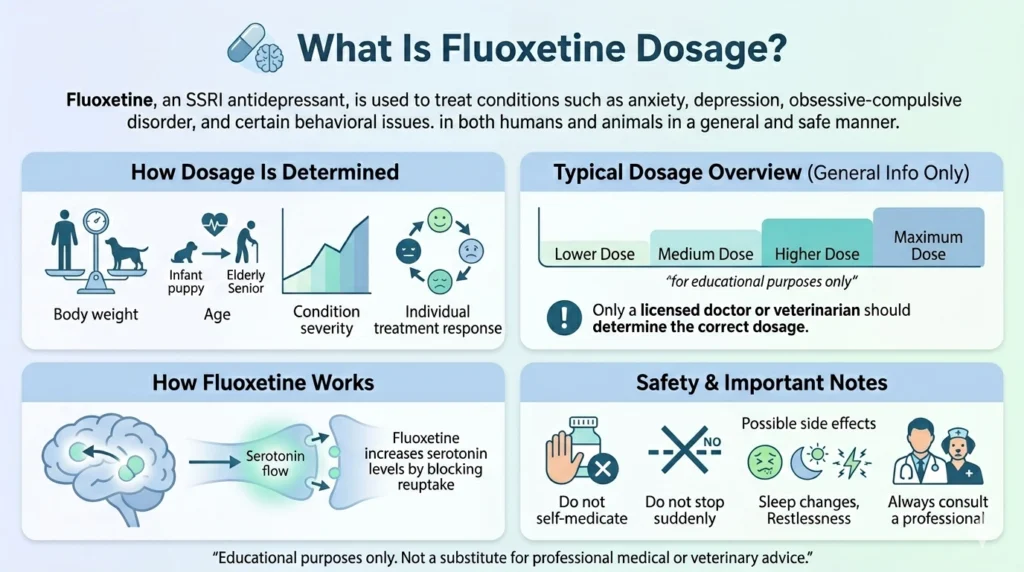
Fluoxetine Dose For Dogs is a selective (effective only on the designated target) serotonin reuptake inhibitor – a class of medication that increase the availability of serotonin in the brain.
Serotonin is a neurotransmitter that plays a very important role in the regulation of mood, sleep, stress response and overall emotional stability.
In the case of dogs with anxiety disorders, the serotonin signaling may be affected, and they are not able to handle stress in a normal way.
Think of it this way – the neurotransmitter serotonin is like a messenger carrying “calm down” messages from one brain cell to another.
In anxious dogs, these messages are reabsorbed too fast before they can take effect. Fluoxetine For Dogs Dosage inhibits that re-absorption from happening causing serotonin to remain active longer and amplifying those signals that calm and relax.
The veterinary specific formulation, Reconcile, is available in chewable flavored tablets which is well accepted by most dogs.
It was approved by FDA in 2007 to treat separation anxiety in dogs. However, veterinarians often prescribe fluoxetine “off-label” for other behavioral conditions in which there is clinical evidence of its effectiveness.
How Fluoxetine is Different from Sedatives
It’s important to understand that fluoxetine is not sedative.
Medications such as trazodone or alprazolam are fast acting and provide quick relief to calm down a dog in a particular stressful situation-they’re the equivalent of taking a deep breath when in a state of panic.
Fluoxetine by contrast works slowly to alter the underlying brain chemistry which made the dog prone to anxiety in the first place.
This distinction is important as follows:
- Situational use: Sedatives are used for situational purposes (fire works, vet visits, thunder storms)
- Fluoxetine For Dogs Dosage is for continuing treatment of daily anxiety that impacts quality of life
Uses of Fluoxetine Dosage For Dogs
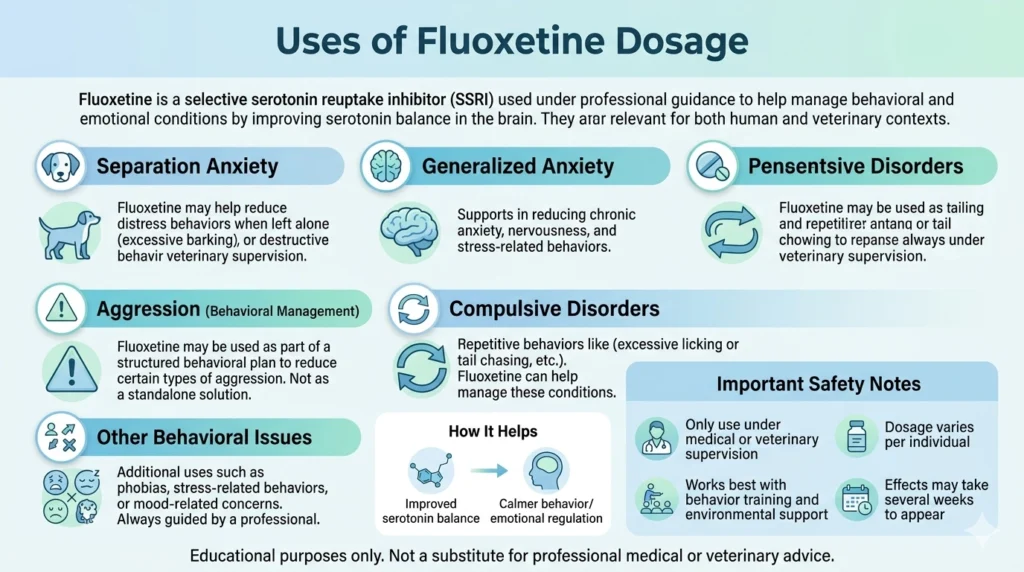
Veterinarians prescribe fluoxetine for a variety of behavioral disorders, mostly disorders that originate from anxiety.
The FDA approved indication is for separation anxiety, but clinical experience and research support its use for a number of other conditions.
Separation Anxiety
This is the best researched use for Fluoxetine For Dogs Dosage in dogs. Dogs with separation anxiety often show their distress in 15 to 30 minutes of their owner’s absence.
Common signs include:
- Excessive barking, howling, whining when left alone
- Destructive behaviour that was focussed around exit point such as doors and windows
- Inappropriate toileting or defecation within the home (even though he or she has been house-trained)
- Pacing around, panting and becoming restless when the owner is leaving
- Excessive excitement or clinginess from the return of the owner
In clinical studies, a significant number of dogs treated with fluoxetine had significant improvement compared to dogs treated with behavior modification alone.
Generalized Anxiety
Some dogs suffer from persistent anxiety that is not caused by anything in particular. They may seem to be always on the edge, easily startled, unable to calm down or avoid things in everyday life.
Aggression
Fluoxetine For Dogs Dosage by Weight may be useful in the reduction of some forms of aggression, especially fear-based aggression and conflict-related aggression.
By lowering the underlying anxiety, the medication is able to lower the dog’s reactivity threshold. However, Reconcile specifically is not indicated for the treatment of aggression as a primary indication.
This is still left up to the professional discretion of the veterinarian.
Compulsive Disorders
Dogs can develop compulsive behavior that is similar to obsessive compulsive behavior in humans.
These may include:
- Excessive tail-chasing
- Fly-snapping (snapping at invisible objects)
- Acral lick dermatitis ( Honeybees licked on a particular spot, usually on a paw, leg)
- Setting a pace in balanced repetitive patterns
- Spinning
Fluoxetine by treatment of underlying neurochemical imbalance can help in breaking the above cycles.
Other Behavioral Issues
Veterinarians may also prescribe: Frontal cortex, also called fluoxetine, for:
- Noise phobias e.g thunderstorms or firework if the fear is persistent and not situational
- Hyperactivity or impulsive behavior
- Excessive vocalization
- Territorial marking in some of the cases
How Does Fluoxetine for Dogs Dosage work?
Understanding the mechanism helps us to understand why it takes patience with this medication and why it is not going to happen all that quickly.
The brain is a chemical communication center using chemical messengers known as neurotransmitters. One of the most important messengers in the regulation of mood is serotonin.
In the normal communication process:
- A Neuron releases Serotonin into the Synapse (the gap between Neurons)
- Serotonin attaches to the receptors in the receiving neuron, sending a relaxing message
- The sending neuron then reabsorbs (reuptakes) the remaining serotonin in order to recycle it
In anxious dogs, this reuptake process may occur too quickly and too much serotonin is not left in the synapse to ensure effective signaling.
Fluxetine Dosage For Dogs works at that reuptake system and blocks that reuptake, keeping the serotonin in the synapse longer, it keeps activating the receptors for longer.
The result is a better mood stability, as well as, less anxiety.
Because this process requires a gradual increase in serotonin availability and people’s brains to adapt to these changes, clinical effects don’t come overnight.
Most dogs demonstrate initial improvement within 3 to 4 weeks with continued improvement for 8 weeks or more.
Important Dosage Notes
- Minimum Weight: Fluoxetine is not recommended for dogs less than 4kg (about 9 pounds).
- Age Restriction: Safety has not been established in dogs less than 6 months of age.
- Once-Daily Dosing: The medication is administered once a day, usually at the same time every single day in order to keep blood levels of the medication consistent.
- With or Without Food: Fluoxetine dose can be given to be taken with or without food. However, if your dog is suffering from stomach upset, feeding him or her with a small meal may help.
Adjusting the Dose
Some dogs may only respond well to the lower end of the dosage range (1mg/kg), others require the higher end of the dosage range (2mg/kg) and have adequate control of their symptoms.
Your veterinarian will watch to see how your dog is doing and may adjust your dog’s dose accordingly.
In some cases, a veterinarian may test reducing the amount for a short period of time if the dog suffers from side effects and then gradually increase back to the therapeutic level when the dog has adjusted to it.
How To Use Fluxetine for dogs dosage Calculator
A fluoxetine for dogs dosage calculator by dog weight is useful to pet owners who want to know what dosage their dog is likely to receive based on weight.
However, calculators are educational tools only – they do not replace the veterinary prescribing.
How to Calculate the Dose
To follow this step to calculate the dose range per day:
- Denote the weight of your dog in kilograms [divide pounds by 2.2]
- Weight x 1 mg (lower end) x 2 mg (higher end)
For example, a 15 kg (33 lb) dog:
- Lower dose: 15 × 1 mg = 15 mg daily
- Higher dose: 15 × 2 mg = 30 mg daily
Using the Reconcile System of Tablets
There is a simplified dosing system in the veterinary formulation Reconcile based upon tablet strengths:
- 8 mg tablets for dogs 4–8 kg
- 16 mg tablets for dogs 8–16 kg
- 32 mg tablets for dogs 16–32 kg
- 64 mg tablets for dogs 32–64 kg
This system can be used with most dogs to give one pill a day in order to ensure we are accurately dosing our dogs.
When You Need Calculation Professionals
There are a number of factors that may necessitate dosage adjustments in addition to simple calculations based on weight:
- Dogs with liver disease process fluoxetine more slowly
- Dogs suffering from diabetes need careful monitoring
- Concurrent medications – may affect the levels of fluoxetine
- Age and general health level are determining factors
Always have your veterinarian do the final calculation of the quantity to give and give the prescription.
How to Administer Fluoxetine Dose to Your Dog
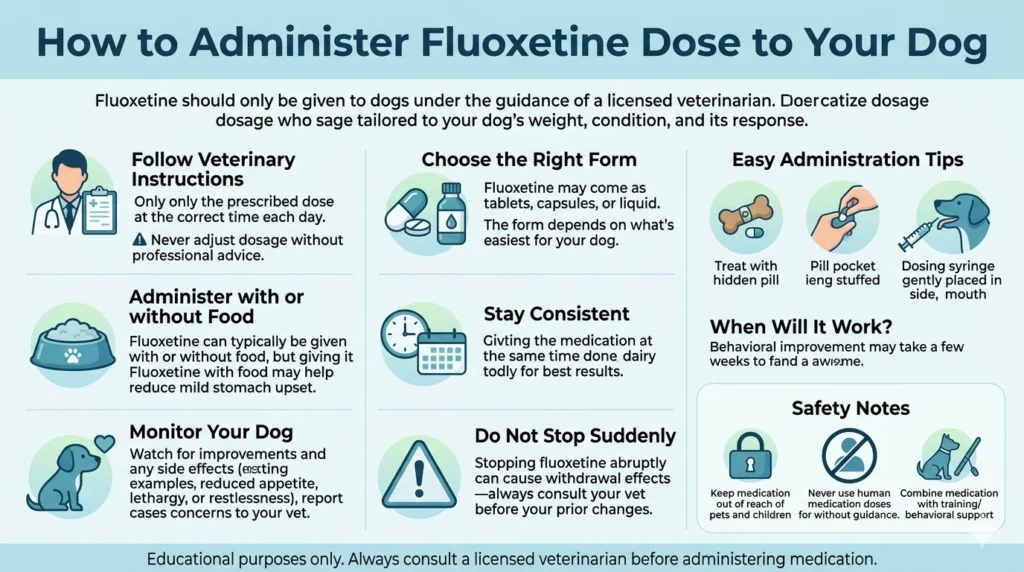
Proper administration helps to ensure your dog gets the full benefit of the medication with as little stress to the dog and you as possible.
Forms of Fluoxetine
Fluoxetine is available to dogs in a number of forms:
| Form | Description | Best For |
|---|---|---|
| Chewable tablets (Reconcile) | Flavored, FDA-approved veterinary formulation | Most dogs; they usually accept readily |
| Capsules (generic fluoxetine) | Human formulation, can be opened and sprinkled on food | Dogs who won’t take tablets |
| Oral liquid | Compounded by pharmacies, can be flavored | Small dogs or those needing precise dosing |
| Compounded tablets | Custom strengths prepared by pharmacy | Dogs requiring non-standard doses |
Step-by-Step Administration
- Establish a routine: Give the medication at the same time daily. Often the morning administration works well.
- Offer with or without food: If your dog is prone to nausea, you can give the medication with a small meal in order to minimize nausea.
- Use pill pockets, if necessary: For capsules or tablets that are not taken readily, the commercial pill pockets or something like a small amount of soft food can mask the medicine.
- Avoid aged cheese: Some types of cheese, such as cheddar, gouda, provolone, and Swiss, contain tyramine and will react with fluoxetine. Do not use cheese as a disguise for the pill.
- Handle with care: If administering the medication by hand, wash your hands after administering the medication. In case of inadvertent ingestion by man, consult a physician right away.
What to Do About Missed Doses
If you forget to give a dose, give it as soon as you remember. However, if it’s close to the time for the next scheduled dose, oxytocin Cove injectism missed dose and do with the regular schedule.
Never administer two doses at the same time in order to compensate for a missed dose.
Discontinuing Fluoxetine
Unlike many other medications taken for behavior, fluoxetine does not need to be slowly tapered at the end of treatment because of its long half life.
However, if your dog is on the meds for more than 8 weeks, your vet may still advise you to try reducing the amount given to your dog gradually to minimize any possible withdrawal effects.
Never stop the meds abruptly without consulting your vetti.
Side Effects of Fluoxetine in Dogs
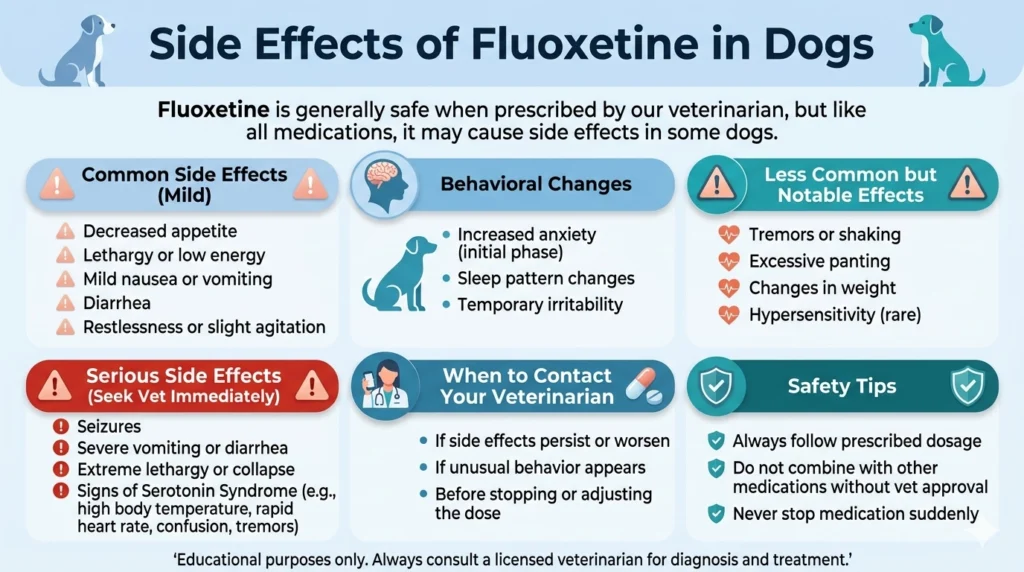
Like all drugs, fluoxetine Dosage may produce some side effects in Dogs. Most are mild and temporary and pass once the body is used to the medication.
Comprehension of what to find enables you to effectively check your pet dog and to understand improved on when to contact your veterinarian.
Common Side Effects
These effects tend to occur quite often, and tend to be mild:
| Side Effect | Frequency | Notes |
|---|---|---|
| Decreased appetite / anorexia | Very common | Often improves within 1-2 weeks |
| Lethargy / sleepiness | Very common | May be more noticeable initially |
| Weight loss | Common | Typically 5-10% of body weight |
| Vomiting | Common | Giving with food may help |
| Diarrhea | Common | Usually temporary |
| Restlessness | Common | May improve as treatment continues |
| Panting | Common | Often related to anxiety reduction |
| Shaking / shivering / tremor | Common | Usually mild |
Less Common Side Effects
These are much more rare but are to be looked out for:
- Lack of coordination/disorientation
- Excessive urinary issues such as incontinence or retention
- Over vocalization i.e. whining
- Constipation
- Dilated pupils
Serious Side effects (Require Immediate Veterinary Attention)
While uncommon, serious side effects can occur.
As soon as you notice, Contact your veterinarian right away if you notice:
- Seizures: Fluoxetine is contraindicated in dogs with a history of seizures however seizures may occur in dogs without a seizure disorder.
- Increased aggression: Some dogs can be paradoxically more aggressive when they are being treated.
- Severe weight loss: More than 15% reduction of the initial body weight, weight loss needs to be evaluated.
- Serotonin syndrome: This is a potentially life-threatening condition that occurs when the level of serotonin gets too high, normally when used in combination with fluoxetine and other serotonergic medications.
Serotonin Syndrome: What to Watch For
Serotonin syndrome symptoms include:
- Vomiting and diarrhea
- Muscle tremors or rigidity
- Agitation or restlessness
- Rapid heart rate
- Dilated pupils
- Incoordination
- Hyperactivity
- Confusion or disorientation
- Seizures
Serotonin syndrome is rare but is severe If you suspect it is get your pet off to the emergency vet immediately.
Precautionary and Contraindications
Not all dogs are eligible for fluoxetine. Your veterinarian will take into consideration your dog’s complete health history before prescribing.
Absolute Contraindications
Fluoxetine is not recommended for use in dogs with:
- Epilepsy or History of Seizures (Even 1 previous seizure)
- Known influenced by Fluoxetine or other types of SSRIs
- Dogs that are smaller than 4kg. or 9 lbs.
- Dogs younger than 6 months of age (safety not established)
Conditions Where Caution is Necessary
Veterinarians may still prescribe fluoxetine for dogs suffering from these conditions but will pay closer attention to:
- Diabetes mellitus (fluoxetine – may have an effect on blood glucose)
- Liver disease (impacts in the way of drug metabolism)
- Dogs that are breeding, pregnant or nursing (safety not established)
Drug Interactions
Fluoxetine Dose For Dogs interacts with several classes of medication. It’s important to inform your veterinarian of all the medications and supplements your dog is taking.
which include:
| Drug Class | Examples | Interaction Risk |
|---|---|---|
| MAOIs (monoamine oxidase inhibitors) | Selegiline, amitraz | Serotonin syndrome |
| Other SSRIs | Sertraline, paroxetine | Excessive serotonin accumulation |
| TCAs (tricyclic antidepressants) | Amitriptyline, clomipramine | Increased side effects |
| Phenothiazines | Acepromazine, chlorpromazine | Lowered seizure threshold |
| Benzodiazepines | Diazepam, alprazolam | Potential for increased sedation |
| NSAIDs | Aspirin, carprofen | Increased bleeding risk (caution advised) |
| Tramadol | Tramadol | Serotonin syndrome risk |
A 6-week washout period must be observed with discontinuation of fluoxetine Dosage before taking any medication that may interact with fluoxetine due to its long half-life of its active metabolite, norfluoxetine.
How Long Does Fluoxetine Dosage Take to Work?
One of the most common questions that owners of pets have is, “When will I see improvement?” It is good to understand the timeline as a way of being realistic in your expectations.
Week 1-2
Some dogs may begin development of clinical improvement in 1 to 2 weeks. However, during this initial period of time, side effects such as lethargy or loss of appetite may be the most apparent.
Week 3-4
Most dogs show definite improvement with symptoms of anxiety by 3 to 4 weeks. You may find there is less destructive behaviour, there is less pacing or your pet is in a better place to settle when left alone.
Week 8 and Beyond
Full therapeutic benefits are usually obtained with 8 weeks of regular treatment. In clinical studies, beneficial responses were demonstrated with up to 8 weeks of therapy with fluoxetine.
If no improvement is found within 4 to 8 weeks of time your veterinarian will have to re-evaluate the treatment plan.
This may involve changing the dose, trying a different medication and/or increasing behavior modification techniques.
Combining Fluoxetine with Behavior modification
Fluoxetine is most successful if used as part of a comprehensive treatment plan including behavior modification. The medication doesn’t teach new behaviors – it creates the neurological conditions to make it possible.
Why Behaviour Modification is Important
Anxious dogs often are unable to learn well because their brains are on a continual state of high alert.
Fluoxetine reduces this baseline of anxiety level allowing the dog to:
- Focus on training exercises
- Maintain and synthesize new skills
- Respond to rewards do not respond with fear
- Make positive associations with formerly stressful situations
Components to a Good Behavior Plan
A behavior modification scheme should be developed with the help of a veterinarian or certified animal behaviorist.
Common elements include:
- Counter-conditioning: Teaching the dog to associate things that they previously feared with positive things
- Desensitization: Slowly exposing the dog to triggers at low levels at which the dog does not respond fearfully
- Routine establishment: Establishing predictable schedules in which there is less uncertainty
- Independence training: Gradually training the dog to be OK on his own
- Reward based training: Rewarding quiet behaviors (appropriate behaviors)
The Importance of Professional Advices
Working with a veterinary behaviorist or a certified professional dog trainer that works with positive reinforcement methods yields much better results.
Your vet is able to provide referral to qualified people in your area.
You May Also Like to Read:
- Quercetin Dosage For Dogs Per Day Calculator: Chart & Guide
- Clonidine Dosage For Dogs Calculator: Chart & Safe Guide
FAQs
Can I give my dog human Prozac?
While human Prozac contains the same active ingredient (fluoxetine), without vet approval, you should never give your dog human meds.
Veterinary formulations, such as Reconcile, are available in the correct strength and palatable form and your veterinarian will know what dose is necessary for your dog based upon their specific needs. Human dosages usually are higher and may be toxic to dogs.
How long can the dog be on the fluoxetine For Dogs Dosage?
Fluoxetine is believed to be safe when taken for long periods of time in recommended dosages. Some dogs may require treatment for many months and years.
Your veterinarian will periodically determine the ongoing need for treatment and possible changes in dosage based on the response of your dog.
Does fluoxetine cause my dog to vary earlier on getting more anxious?
Some dogs temporarily increase in anxiety, restlessness, or agitation within the first few weeks of treatment. This often disappears as the dog’s system adjusts. If increased anxiety is severe or persists for longer than 2-3 weeks contact your veterinarian.
Is weight loss a concern?
Weight reduction is a side effect for many – in clinical studies with many dogs treated as a treatment, most dogs lost 5% or more of their initial body weight.
Most weight loss will occur during the first few weeks and plateau. Monitor your dog’s weight and appetite and report solid or constant weight loss to your veterinarian.
What should I Do if My Dog has a Seizure?
Seizures are a very important and serious adverse event. If your pet dog does have a seizure, call your veterinarian or emergency animal hospital immediately. Fluoxetine should be discontinued in dogs who experience seizures during the therapy.
Can I use Fluoxetine for Situational Anxiety Situation Anxiety such as thunderstorms?
Fluoxetine is not typically employed in the treatment of situational fears such as thunderstorms or fireworks because of the weeks before full effect is reached.
For these acute situations, veterinarians often will prescribe fast-acting drugs, such as tracerone or alprazolam for use as needed.
Does Fluoxetine interact with flea & tick?
Some flea and tick collars may pass through fluoxetine. Know what type of flea prevention your dog is being used, i.e. collars, topical and oral drugs, and report them to your veterinarian.
Can dogs that areested/brecd patients take fluoxetine?
The safety of fluoxetine in pregnant and lactating dogs has not been determined and its use during pregnancy and lactation is not recommended.
Final Thoughts
Fluoxetine For Dogs Dosage By Weight can be a life-changing drug for dogs with anxiety, compulsive disorders and related behavioral problems.
Prescribed appropriately and used in concert with behavior modification, it is useful in changing countless dogs to a state of better emotional stability and quality of life.
The key to being successful is three principles:
- Proper Veterinary Guidance: including proper diagnosis, dosing, and constant monitoring
- Patience with the process: it takes 4-8 weeks before full effects are experienced
- Comprehensive approach: medication + behavior modification (sustainable change)
If you believe your dog may benefit from fluoxetine, ask your veterinarian. They can perform a full evaluation, rule out possible medical causes of behavioral symptoms and create a treatment plan based on the specific needs of your dog.