Pimobendan Dosage For Dogs Calculator
💊 Available tablet strengths: 1.25 mg, 2.5 mg, 5 mg, 10 mg (scored, can be split).
✨ Suggested combination: For 2.5 mg dose → one 2.5 mg tablet (or half of 5 mg).
• Give on an empty stomach, ideally 1 hour before a meal.
• Administer twice daily ~12 hours apart.
• Can be crushed or given with/without food (best consistency: empty stomach).
• Always confirm final dose with your veterinarian. Dosage range 0.2–0.6 mg/kg/day may apply.
⚖️ Step-by-step: Weight (kg) × 0.5 = total mg/day → divide by 2 = individual dose.
🔁 lb conversion: weight(lb) ÷ 2.2 = weight(kg) before calculation.
© medsdog.com
Disclaimer: This guide is for informational purposes only and is not a substitute for professional veterinary advice.
Always consult your veterinarian before giving Pimobendan or any medication to your dog.
If your dog has been diagnosed with congestive heart failure, then you have probably heard your veterinarian use a name you have never heard before, pimobendan.
As a dog owner, it’s important that you understand this medication because it plays an important role in the management of your beloved pet’s heart condition.
Pimobendan, or by its more familiar brand name of Vetmedin, is not just another heart drug, it is a breakthrough drug that has been scientifically proven to increase both the quality of life and life expectancy in dogs with certain types of heart failure.
This ultimate guide will guide you through everything you need to know about pimobendan dosage for dogs, including detailed calculator instructions, weight-based dosage charts, administration tips, and safety considerations to help you confidently manage your dog’s treatment.
Pimobendan Dosage For Dogs
Pimobendan for dogs dosage is carefully prescribed by veterinarians to treat heart conditions such as congestive heart failure and dilated cardiomyopathy.
The usual dose is from 0.1 to 0.3 mg per kilogram of body weight, twice a day, about 1 hour before feeding time for best absorption.
This medication functions as an inodilator with both effects of improving the contractibility of the heart and decreasing the workload on the heart.
Pimobendan dosage is often sold under brand names such as Vetmedin, and should only be used with the guidance of a professional.
Dog owners need to take the exact dose as prescribed or incorrect usage can cause serious complications. Regular veterinary check-ups are needed to monitor the heart function and adjust the dosage if necessary.
Possible side effects may include mild gastrointestinal upset but are usually well tolerated by most dogs. Always refrain from self-medicating and talk to your vet before starting or adjusting any dosage.
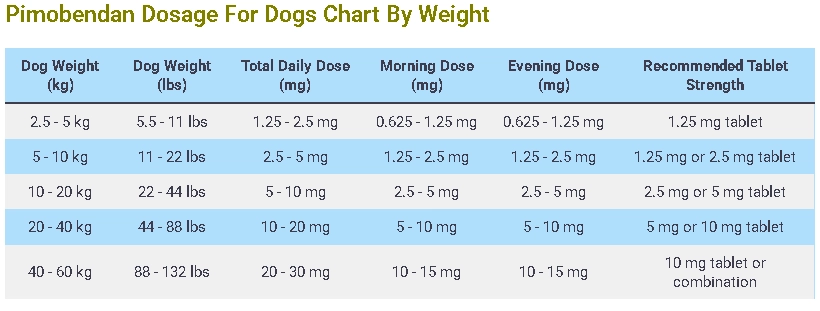
Pimobendan Dosage For Dogs Chart By Weight
The following table gives the normal twice daily doses for dogs of various weights using the most common tablet strengths.
Remember that your veterinarian may change these doses within the approved range of 0.2 to 0.6 mg/kg/day depending on your dog’s individual response.
| Dog Weight (kg) | Dog Weight (lbs) | Total Daily Dose (mg) | Morning Dose (mg) | Evening Dose (mg) | Recommended Tablet Strength |
|---|---|---|---|---|---|
| 2.5 – 5 kg | 5.5 – 11 lbs | 1.25 – 2.5 mg | 0.625 – 1.25 mg | 0.625 – 1.25 mg | 1.25 mg tablet |
| 5 – 10 kg | 11 – 22 lbs | 2.5 – 5 mg | 1.25 – 2.5 mg | 1.25 – 2.5 mg | 1.25 mg or 2.5 mg tablet |
| 10 – 20 kg | 22 – 44 lbs | 5 – 10 mg | 2.5 – 5 mg | 2.5 – 5 mg | 2.5 mg or 5 mg tablet |
| 20 – 40 kg | 44 – 88 lbs | 10 – 20 mg | 5 – 10 mg | 5 – 10 mg | 5 mg or 10 mg tablet |
| 40 – 60 kg | 88 – 132 lbs | 20 – 30 mg | 10 – 15 mg | 10 – 15 mg | 10 mg tablet or combination |
For example: a 10kg dog would get 2.5mg in the morning, and 2.5mg in the evening. This may be given as a single 2.5mg chewable tablet twice daily or 2 tablets 1.25mg twice daily
Key Takeaways
Before delving into the details, here are some of the most important things you need to know about pimobendan in dogs:
| Key Point | Summary |
|---|---|
| Purpose | Treats congestive heart failure caused by mitral valve disease or dilated cardiomyopathy |
| Dosage Range | 0.2 mg to 0.6 mg per kg of body weight total daily, divided into two doses |
| Standard Dose | 0.5 mg/kg/day (0.25 mg/kg twice daily) |
| Administration | Give approximately 12 hours apart, about one hour before feeding |
| Forms Available | Chewable tablets, capsules, and oral liquid solution |
| Common Side Effects | Poor appetite, lethargy, diarrhea, vomiting (usually mild and temporary) |
| Important Warning | Not for use in dogs with hypertrophic cardiomyopathy or aortic stenosis |
What Is Pimobendan for Dogs, and How Does It Work?
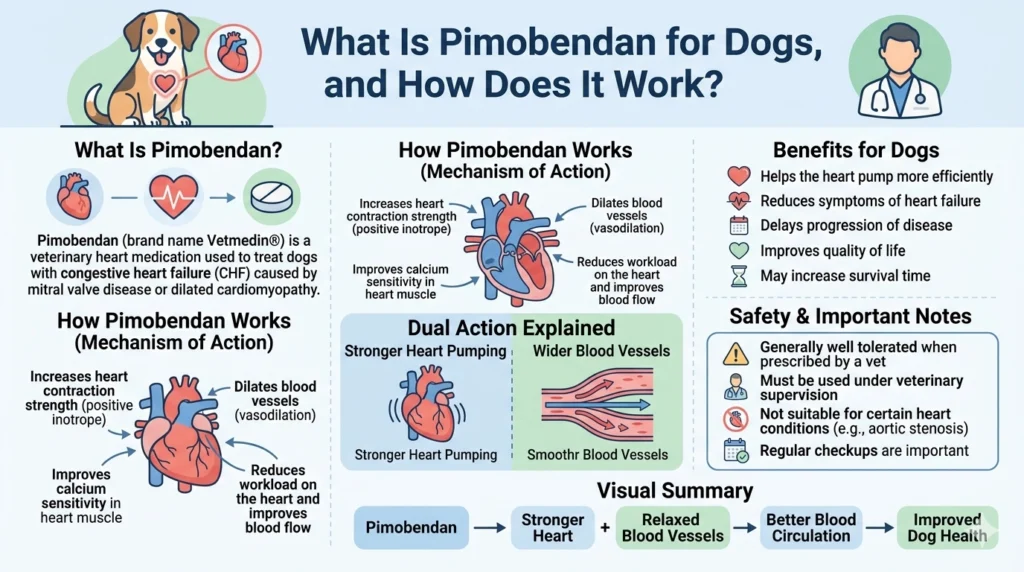
Pimobendan is part of a class of medicines called inodilators – medicines that do two things: strengthen the heart’s pumping action and open up the blood vessels.
In order to understand why this is important, I thought I would explain how a healthy heart functions, and how heart failure occurs.
In an affected dog with congestive heart failure, the heart muscle becomes weakened and has difficulty pumping blood effectively.
This causes a buildup of fluid in the lungs (causing coughing and a hard time breathing) or the abdomen (causing a swollen belly).
Pimobendan treats these issues with a dual mechanism of action:
First, it increases the sensitivity of the cells of the heart muscle to calcium. Think of calcium as the fuel that instructs heart muscles to pump.
By making the heart more sensitive to the existing levels of calcium, pimobendan makes each heartbeat stronger without requiring the heart to work harder or to use more oxygen.
Second, it inhibits an enzyme called phosphodiesterase type III. This action causes the blood vessels to widen or dilate and reduce the resistance against which the heart must pump.
When blood vessels are more relaxed, the heart can push the blood forward more easily.
The combination of these two effects mean that pimobendan helps a failing heart do its job more efficiently – like giving a tired worker both more strength and lighter work as well as giving it a lighter job.
Unlike some other heart medications, pimobendan does not make the heart work harder for oxygen so it is especially safe for weak hearts.
What Is Pimobendan Dosage Used For In Dogs?
Pimobendan is approved by the US Food and Drug Administration for use in dogs with certain types of heart conditions.
Understanding if your dog’s condition can be covered by these approved uses is important for you to set realistic expectations about treatment outcomes.
Main Uses & Benefits of Pimobendan in Dogs
- Myxomatous Mitral Valve Disease (MMVD)
This is the most common heart disease in dogs, making up about 75 percent of all canine heart disease.
It occurs when the mitral valve – the door in between the left upper and left lower chambers of the heart – gradually degenerates and starts to leak.
Small and medium breeds including Cavalier King Charles Spaniels, Chihuahuas, Dachshunds and Miniature Poodles are most at risk.
When MMVD progresses to congestive heart failure, pimobendan has been shown to improve quality of life and increase length of life when taken in conjunction with diuretics such as furosemide.
In dogs with preclinical MMVD (meaning dogs have a heart murmur and enlarged heart but do not have heart failure symptoms yet), pimobendan can delay the onset of heart failure symptoms.
- Dilated Cardiomyopathy (DCM)
This is a condition that affects the heart muscle itself, causing it to become thin, weak and enlarged. DCM is more common in large and giant breeds, including Doberman Pinschers, Great Danes, Boxers and Irish Wolfhounds.
The heart becomes less effective at pumping blood and one becomes weak, collapses and accumulates fluid.
For dogs with DCM, pimobendan used in conjunction with other heart medications such as furosemide/enalapril/digoxin has been shown to improve quality of life and increase survival.
In Doberman Pinschers with preclinical DCM (asymptomatic but with echocardiographic evidence of heart enlargement) pimobendan significantly delays the time to the onset of heart failure or sudden death.
- Preclinical Heart Disease
One of the most important current developments is the use of pimobendan in dogs with early-stage heart disease before the dog has any signs of heart failure.
In Doberman Pinschers with preclinical DCM and in dogs with advanced preclinical MMVD (Stage B2), pimobendan has been shown to delay the onset of congestive heart failure.
Pimobendan Dosage & Administration
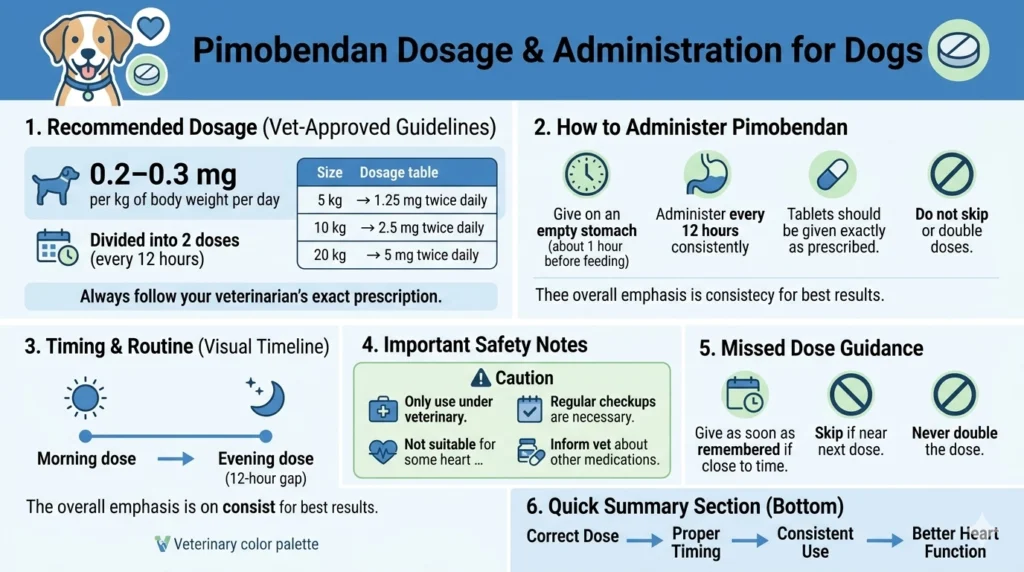
Now let us get to the meat and potatoes, however: determining the right pimobendan dose for your dog.
This section includes detailed dosage directions, a weight-based chart and step-by-step directions for administration.
Pimobendan Dosage Instructions
The standard recommended dosage of pimobendan in dogs is based on these principles:
| Parameter | Value |
|---|---|
| Total Daily Dose | 0.2 mg to 0.6 mg per kg of body weight |
| Preferred Total Daily Dose | 0.5 mg per kg of body weight |
| Individual Dose | Half the total daily dose, given twice daily |
| Dosing Interval | Approximately 12 hours apart |
This means that for a dog receiving the standard dose of 0.5 mg/kg/day, each individual dose is 0.25 mg per kg of body weight.
Pimobendan Liquid Dosage Calculator
For those dogs with swallowing tablet difficulties, pimobendan is also available as an oral solution. The liquid form, Vetmedin Solution, has 1.5 mg of pimobendan per mL.
The dosage syringe that comes with the drug is gauged to the dog’s weight in pounds, so administering the drug is simple.
For liquid formulations the standard dose is 0.25 mg/kg twice a day, this works out to roughly 0.17mL of solution per kg of body weight per dose.
How To Give Pimobendan
Proper administration is required for the medication to work well. Here are the key steps:
Timing is Critical: Pimobendan should be administered on an empty stomach about an hour before feeding.
Food really slows down the absorption of pimobendan and reduces how well your pet’s body absorbs it, which may make it less effective.
Twice-Daily Dosing The total daily dose will need to be divided into two equal doses and administered approximately 12 hours apart (usually morning and evening).
This helps to keep levels of the medication the same in your dog’s system all throughout the day.
Handling the Medication Pimobendan Dose tablets are scored, and may be split along the score line when a half-tablet dose is called for.
For the oral solution, use the syringe provided, and do not shake the bottle to prevent foaming. After each use, clean the syringe off the syringe with a dry tissue.
What If You Miss a Dose? If you do forget and miss a dose, give it as soon as you remember. However, if it’s almost time for the next dose, miss the dose and take the regular schedule.
Never give two doses at once to make up for one that was missed
What Does Pimobendan do to the Heart?
To really appreciate how pimobendan works, it helps to understand what it’s doing inside the heart of a failing heart.
When a dog experiences congestive heart failure due to conditions such as mitral valve disease or dilated cardiomyopathy, the heart experiences a number of detrimental changes.
The heart attempts to make up for its weakened state by becoming bigger and beating faster. While these adaptations work at the beginning to keep blood flowing, in the long run these adaptations become counterproductive.
The enlarged heart demands more oxygen and energy to function and the increased heart rate may lead to dangerous arrhythmias.
Pimobendan stops this vicious cycle by two distinct mechanisms:
Increased Contractility: By sensitizing the heart muscle fibers to calcium, pimobendan is able to strengthen each contraction.
This helps the heart to pump out more blood per beat without needing to grow any larger or have to beat faster.
Studies performed in normal dogs instrumented with pressure transducers found that pimobendan increased a measure of contractility (LV dP/dtmax) in a dose-dependent manner with effects lasting up to eight hours after dosing.
Vasodilation: By inhibiting phosphodiesterase type III, pimobendan causes the smooth muscle in the walls of the blood vessels to relax.
This lowers the resistance against which the heart needs to pump – it’s equivalent to pull a partially closed door open so that it swings more easily. The effect this has is the heart pushes more blood forward with less effort.
What is so valuable about pimobendan is that it accomplishes these benefits without actually driving up the amount of oxygen required by the heart, as is the case with some of the other inotropic drugs.
aboratory studies also suggest that repeated administration does not lead to tachyphylaxis-that is, that the medication does not become less effective over time.
Potential Side Effects of Pimobendan
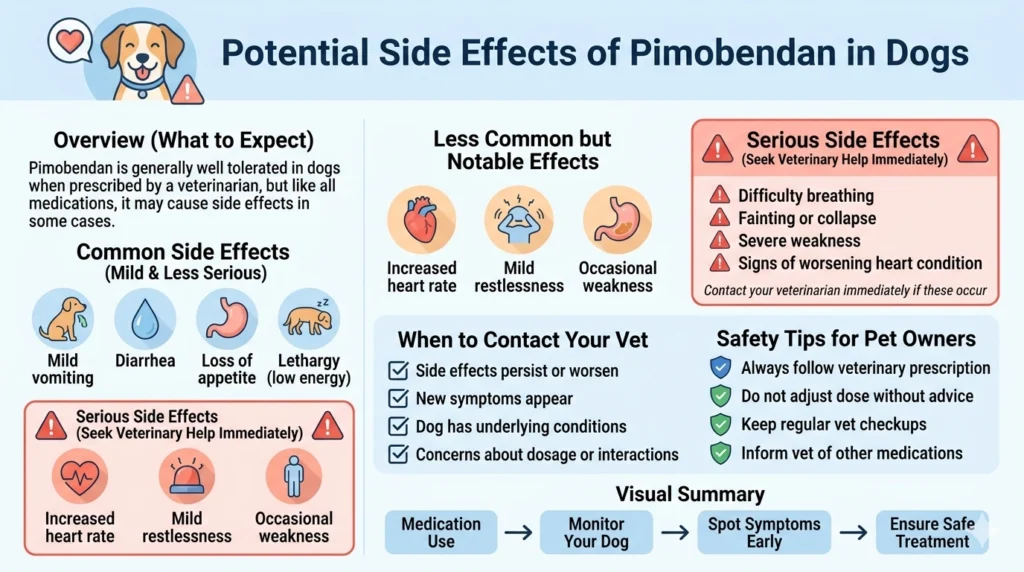
Pimobendan is well tolerated by most dogs, but as with all medications, may have side effects in some patients.
Understanding what to look out for helps you keep an effective watch over your dog.
Common Side Effects
The most common reported adverse effects are gastrointestinal in nature and usually mild and temporary:
| Side Effect | Frequency | Notes |
|---|---|---|
| Poor appetite | Up to 38% | Usually resolves as the dog adjusts to the medication |
| Lethargy | Up to 33% | Often improves within the first few weeks |
| Diarrhea | Up to 30% | Typically mild and self-limiting |
| Vomiting | Rare | Dose-dependent; may improve with dose reduction |
In clinical studies of dogs with congestive heart failure, similar rates of these side effects have been seen in dogs treated with pimobendan compared with dogs treated with other types of heart medicine.
Less Common But Important Side Effects
Some dogs may have more concerning effects that require veterinary attention:
- Increased heart rate: There may be a positive chronotropic effect (mild and dose dependent). If you’re concerned that your dog’s resting heart rate is unusually fast, reach out to your veterinarian!
- Ataxia or weakness: Some dogs may seem unsteady on their feet or be unusually weak.
- Syncope (fainting): Fainting episodes should be reported to your veterinarian as soon as possible.
- Bleeding tendencies: Rare reports of mucosal petechiae or subcutaneous hemorrhage have been reported. While there has not been a clear relationship to pimobendan established, these signs resolve when withdrawal of treatment is initiated.
When to Contact Your Veterinarian
You should call your veterinarian if you see:
- Severe or prolonged vomiting or diarrhea
- Significant decrease in appetite for longer than a day or two
- Sudden weakness or collapse
- Difficulty breathing or more coughing
- Any signs of bleeding, such as unusual bruising, or small red spots on the gums
Serious Risks and Warnings
Pimobendan should never be used in dogs with certain types of heart disease in which increasing cardiac output may be detrimental.
These include:
- Hypertrophic cardiomyopathy: In this condition, the heart muscle is abnormally thick and increasing contractility can increase obstruction
- Aortic stenosis: Narrowing of the aortic valve means that the heart is already struggling to pump blood out, pimobendan could make this worse
- Other outflow obstructions: Any condition in which blood cannot flow easily out of the heart
Additionally, pimobendan should be used cautiously in dogs with severe liver impairment as this drug is metabolized primarily in the liver.
Drug Interactions and Overlapping Drugs
Pimobendan Dosage for Dogs is frequently administered in conjunction with other heart drugs, and it is important to understand possible interactions so you can be sure of safe treatment.
Compatible Medications
Pimobendan can be safely used with:
- Diuretics (furosemide, torasemide): These drain the excess fluid from the lungs and abdomen
- ACE inhibitors (enalapril): These also help widen the blood vessels and lower the amount of fluid in the body
- Digoxin: A cardiac glycoside used to control the heart rate and strengthen the heart’s contractions
In clinical studies, dogs who received pimobendan in combination with furosemide, enalapril and digoxin, demonstrated an increased quality of life and prolonged survival.
Medications That May Reduce Effectiveness
The positive inotropic effect of pimobendan may be reduced with use of:
- Beta-blockers like propranolol or atenolol
- Calcium channel blockers, like verapamil or diltiazem
If your dog is taking these medications, your veterinarian will carefully consider the risks and benefits before prescribing pimobendan.
Special Considerations for Dogs with Diabetes
Pimobendan dosage for dogs may have an impact on blood glucose levels. In the case of dogs with known diabetes mellitus, blood sugar should be monitored frequently throughout treatment.
Pimobendan Form and Availability
Pimobendan comes in various formulations to meet the needs of various dog sizes and preferences and ease of administration.
| Form | Strengths | Key Features |
|---|---|---|
| Chewable Tablets | 1.25 mg, 2.5 mg, 5 mg, 10 mg | Flavored; dogs often take them voluntarily; scored for splitting |
| Hard Capsules | 1.25 mg, 2.5 mg, 5 mg | For dogs that prefer capsules; can be opened and contents mixed with a small amount of food |
| Oral Solution | 1.5 mg/mL | Calibrated syringe for weight-based dosing; ideal for very small dogs or those that resist tablets |
FDA-Approved vs. Compounded
The FDA strongly encourages veterinarians to use FDA-approved pimobendan products over compounded pimobendan formulations.
Approved products have been tested and proven safe and effective, and we know the bioavailability of the product.
Compounded formulations on the other hand may have unknown / variable absorption, and adverse events are not subject to mandatory reporting.
You May Also Like to Read:
- Melatonin For Dogs Dosage Calculator & Chart by Weight
- Cefdinir Dosage Calculator For Dogs: Safe Guide & Chart
FAQs
How long does pimobendan take to take effect?
Many dogs show an improvement within the first week of treatment. If a definite response cannot be seen within one week, your veterinarian may adjust the dosage within the approved range.
Can pimobendan dosage for dogs be fed with food?
No, pimobendan should be fed on an empty stomach about 1 hour before feeding. Food dramatically cuts down on the absorption of the medication, possibly making it less effective.
What should I do if my dog vomits after taking pimobendan?
If there is vomiting, contact your veterinarian. In some cases the dose may need to be reduced, as vomiting is a dose dependent effect which can often be avoided by reducing the dose.
Is pimobendan safe for dogs that are pregnant or nursing?
The safety of pimobendan dosage for dogs has not been determined in pregnant or lactating bitches. While studies in rats and rabbits revealed no teratogenic effects, embryotoxic effects occurred at maternally toxic doses, and pimobendan is secreted into milk.
The medication should be used only in pregnant or nursing dogs if the potential benefits outweigh the potential risks.
Can pimobendan dose be used on puppies?
The safety of pimobendan has not been evaluated in dogs younger than 6 months of age.
How long my dog will need to take pimobendan dose?
Pimobendan is most commonly a lifelong drug for dogs with heart failure. Discontinuation of the medication can result in rapid worsening of the heart function.
What does pimobendan dosage cost?
Costs vary with the formulation, dosage and pharmacy. Generic versions of pimobendan have been approved, which may provide for cost savings as compared to brand-name Vetmedin.
Can I divide tablets of pimobendan?
Yes, the chewable tablets are scored, and can be halved on the score line to achieve the proper dosage. Unused half-tablets should be stored properly and be used for the next dose.
Final Thoughts
Pimobendan for dogs dosage is a giant step forward in the treatment of congestive heart failure in dogs.
By improving heart pumping forces and dilating blood vessels, this will help dogs with mitral valve disease and dilated cardiomyopathy to live longer and more comfortable lives.
The standard dosage for pimobendan in dogs is based on a simple formula weighted for body weight (0.25 mg/kg body weight twice daily, 12 hours apart, on an empty stomach).
While pimobendan is generally safe and well tolerated, it is a prescription medication that requires veterinary supervision to use.
Your veterinarian will decide on the dose your dog needs based on their weight, condition and response to treatment and will monitor your dog regularly to ensure the best possible outcome.
If your dog has been prescribed pimobendan, you have a crucial role in them.
By giving the medication appropriately at the appropriate times, monitoring for adverse side effects and getting regular veterinary check-ups, you can help your beloved companion live as best as possible with their heart condition.