Furosemide Dosage Calculator for Dogs with Heart Failure
Calculate approximate furosemide dosage based on veterinary guidelines. Always consult with your veterinarian before administration.
Veterinary dosing is calculated in mg/kg, not mg/lb. This calculator uses the correct standard of 1-2 mg per kilogram of body weight. The lb equivalents shown are for reference only. Your veterinarian will determine the exact dose based on examination, diagnostic tests, and your dog’s specific condition.
Recommended Dosage & Administration
• Canine Congestive Heart Failure: 1-2 mg/kg PO q12-24h initially
• Severe Pulmonary Edema: 2-4 mg/kg IV/IM/PO q8-12h (hospital setting)
• Maintenance Therapy: Lowest effective dose, often 0.5-1 mg/kg q12-24h
• Refractory Cases: May increase to 4-6 mg/kg/day in divided doses
• Monitoring Required: Serum electrolytes, BUN, creatinine, hydration status
Critical Warnings & Precautions
- CORRECT DOSING IS CRITICAL: Furosemide must be dosed in mg/kg, not mg/lb. Incorrect dosing can cause severe dehydration or toxicity.
- CONTRAINDICATIONS: Anuria, severe electrolyte depletion, hypersensitivity to furosemide
- MONITORING REQUIRED: Regular blood tests for electrolytes (especially potassium), BUN, creatinine
- COMMON SIDE EFFECTS: Increased thirst/urination, dehydration, electrolyte imbalances
- DRUG INTERACTIONS: Use cautiously with aminoglycosides, digoxin, corticosteroids
- RENAL FUNCTION: Dose adjustment required in patients with kidney impairment
Important: This calculator provides estimates only. Your veterinarian will determine the exact dosage based on physical examination, diagnostic imaging (X-rays), blood work, and your dog’s specific response to therapy.
⚠️ MEDICAL DISCLAIMER: This calculator provides educational estimates only based on standard veterinary guidelines. It is not a substitute for professional veterinary care. Furosemide is a prescription medication that requires veterinary supervision. Always consult your veterinarian for diagnosis, treatment, and exact dosage determination. Never adjust medication without veterinary guidance.
© medsdog.com – For educational purposes only
Presumably, you are reading this because your dog has already been diagnosed with the congestive heart failure (CHF) and you want to calculate Furosemide Dosage For Dogs , and your vet has prescribed furosemide.
To begin with, I want to say this: I can tell how incredible and intimidating this moment is. It is devastating to see your close person having a hard time breathing, coughing, or lacking energy.
You want unblurred, dependable facts so as to carry you along this treacherous route and you have found the proper place.
This full-fledged guide is created to make you equipped with information regarding the dosage rate of furosemide in dogs with heart failure, the way your veterinarian determines the dosage, the importance of an accurate dosage you can easily calculate using our furosemide dosage calculator for dogs, and the ways to become the best advocate of your dog.
We are going to discuss all the issues related to how this crucial medicine should perform to the symptoms that may indicate that the dose should be changed.
We do not substitute your veterinarian instructions with educational charts and information, although we do it. Consider it to be your reference guide, which will enable you to pose the correct questions and learn the reason why your vet was prescribing you the treatment plan.
Key Takeaways: What Every Dog Owner Should Know
- Furosemide is the diuretic, also known as a water pill, which assists in lowering the amount of water in the lungs and the body, which is a common and very harmful symptom of congestive heart failure.
- There is no such thing as one size fits all dosage. It is carefully determined on the basis of size of your dog, level of heart attack, kidney levels and reaction of the dog.
- Monitoring is crucial. You will be required to monitor the amount of water that a dog consumes, its urination behavior, appetite, and its breathing and report this to the veterinarian.
- This drug belongs to a combination. Furosemide is virtually never used independently of other cardiac agents such as pimobendan (vetmedin) and an ACE inhibitor (e.g. enalapril) to ensure complete control.
- Frequent check-ups of the vets are not negotiable. To be used safely and in the long term, blood tests to check kidney function and electrolytes are necessary.
The mechanism of action of Furosemide: The Fluid Shift Lifesaver
We need to know what you are giving and the reasons before we get down to the dosage details.
CHF is an abbreviation that means that your dog does not have a pumping heart. Or imagine it is a feeble pump in a complicated plumbing system.
When the pump (the heart) fails, the fluid will stagnate in the system. This fluid tends to accumulate in the lungs (pulmonary edema) and give that typical cough and difficult breathing or in the abdomen (ascites) and give the belly a swollen look.
Furosemide is a drug of the loop diuretic type and is referred to as Lasix. It acts in the kidney to inhibit sodium and chloride reabsorption.
Where there is sodium, water takes its trail. Furosemide pulls these electrolytes into your urine which causes excess fluid to leave your dog body by urinating.
This has a direct effect of relieving the load on the lungs and heart and as such, your dog will breathe easily and in most cases have been dramatically relieved within hours.
Furosemide Dosage: How to Calculate the Right Dosage of Furosemide to Your Dog
It is here we deal with the substance of your search. No commonplace calculator in which you enter how much weight, and receive a safe dose.
The medicine of the veterinary profession is more delicate. Nevertheless, by knowing the normal values and mode of calculations, you can interpret the prescriptions of your vet.
Normal Range of Veterinary Dosage
The dosage of furosemide is determined by veterinarians mainly depending on the weight of your dog (kg). In case you are aware of the weight of your dog in pounds, then divide it by 2.2 to get kilograms.
Oral Dosage of Furosemide /Divergence in oral dosages in dogs with CHF:
- Initial/Maintenance Dose: 1 - 2mg/kg of body weight, one per 12 -24 hours.
- Hospitalized or Severe Cases: In a crisis, the vets can use a more significant dose (up to 4-6 mg/kg) intravenously in a hospital to produce a quick fluid loss.
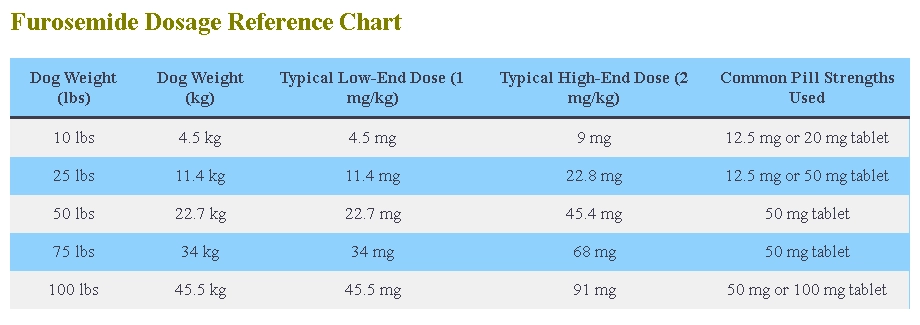
Furosemide Dosage Reference Chart
The correlation between weight and a more or less dosage range is demonstrated in the table below. This is an amount that is given under specific dosage of your veterinarian alone.
| Dog Weight (lbs) | Dog Weight (kg) | Typical Low-End Dose (1 mg/kg) | Typical High-End Dose (2 mg/kg) | Common Pill Strengths Used |
|---|---|---|---|---|
| 10 lbs | 4.5 kg | 4.5 mg | 9 mg | 12.5 mg or 20 mg tablet |
| 25 lbs | 11.4 kg | 11.4 mg | 22.8 mg | 12.5 mg or 50 mg tablet |
| 50 lbs | 22.7 kg | 22.7 mg | 45.4 mg | 50 mg tablet |
| 75 lbs | 34 kg | 34 mg | 68 mg | 50 mg tablet |
| 100 lbs | 45.5 kg | 45.5 mg | 91 mg | 50 mg or 100 mg tablet |
Pills are frequently split or compounded: The type of pill will specify the right level of strength. Breaking pills by halves uninstructed.
The Dose-Influencing Factors of Your Dog
The choice of your vet on the beginning of that range will be determined by:
- Stage of Heart Disease: A dog with a mild case of heart failure can begin its treatment in the lower end, whereas a dog in crisis requires more vigorous treatment.
- Kidney Function (Crucial!): The kidneys act on furosemide. It is necessary to conduct baseline blood work to make sure that they are comfortable with the medication.
- Other Medications: It is possible to increase or decrease the dose in case your dog takes other medications which influence the activity of kidneys or potassium levels.
- Individual Response: Once you have taken the medication, your vet will evaluate the breathing of your dog, the X-rays of his chest and his hydration in order to set the dose more precisely.
The critical Importance of Surveillance and Veterinary Association
Treatment of CHF by use of furosemide is a dynamic exercise. What you have seen at home is the priceless information to your vet.
What You Should Be Watching at Home:
- Breathing: Learn to count the number of breaths per minute when you are resting (should be less than 30-35). The returning fluid can be indicated by the growing rate.
- Intake of water and Urination: Increased thirst and increased urination are expected. Record whether either of them is excessive or abruptly reduced.
- Eating habits and Energy: Does your dog eat well? Are they nicer and more illuminated?
- Gum Color: This is good; now, on the other hand, gums that are pale, bluish, or brick among others should be an emergency call to the veterinarian.
The Significance of the Blood Work follow- up:
Furosemide may have an impact on electrolytes, especially potassium and sodium, and strain the kidney. Routine blood tests (typically every 3-6 months, or more frequently in case of increasing doses) are obligatory, not just during long-term management, but their basis.
Furosemide Full Treatment Plan: It Alone
Furosemide is hardly ever administered alone. One of its major team players:
- Pimobendan ( Vetmedin): a strengthener of the heart muscle and vasodilator. This is the other foundation of contemporary CHF management.
- ACE Inhibitors (Enalapril, Benazepril): ACE inhibitors assist in dilation of blood vessels and decreases the workload on the heart.
- Special Diets: Low-sodium prescription (e.g. Hill h/d, Royal Canin Cardiac) diets are crucial to aid in medication.
- Supplemental Oxygen and Thoracentesis: these types of in-hospital procedures are required in severe cases to be used together with the medication.
Medical Disclaimer: The information provided regarding furosemide dosage for canine heart failure is strictly for educational purposes. It is not veterinary medical advice and does not substitute for a professional diagnosis or treatment plan. A safe, effective diuretic dosage is highly specific to your dog's unique health status and must be determined solely by your licensed veterinarian. Never adjust medication without their direct guidance. If your pet is in distress, seek emergency veterinary care immediately.
You May Also Like to Read:
- Fish Oil Dosage Calculator For Dogs and Safe Dosage Guide
- Safeguard Dosage Calculator for Dogs and Safe Dosing Chart
FAQs
Is it possible to calculate a human dose of furosemide and apply it to a dog?
Absolutely not. Parameters of human dosing, metabolism and drug sensitivities are entirely different. To give your dog medicine, it is risky to use a human calculator, either overdose it to death or waste the time. It has to be your prescription by the veterinarian.
What will occur in case of an oversight of a dosage of furosemide?
Remember to take the dose that you have missed within a few hours. In case it is almost time of taking the next dose, do not take the missed dose, resume taking the regular doses. Do not double dose. Report to your veterinarian during the following examination. Stability is critical towards controlling fluid balance.
What will be my original indication that the dosage should be raised?
This decision will be based on the interplay of factors as follows: your reported observations at home (e.g. coughing has returned, breathing rate is increased) and dictated by physical examination (where the lung sounds are) or potentially repeat X-rays (fluid is present again). Do not make the increase on your own.
Is it only when my dog can be off furosemide?
Generally, no. CHF is a progressive and a controlled disorder, and not a curable one. Furosemide treats one of the critical symptoms (retention of fluid). The cessation would probably permit the fluid to quickly re-accumulate, with the result of respiratory distress. Improving the quality of dogs is to determine the least effective dose that benefits your dog.
Final Thoughts
The process of living with heart failure as a dog owner requires a partnership walk; one with your veterinary staff, and one with your dog.
Knowing the principles on which the furosemide dosing is based will give you the necessary power to offer the best care. Now, you are informed of how this critical medication functions, why it is critical to properly calculate weight, and what symptoms to watch out.
It should be remembered that any online chart figure is only the beginning point of debate. The actual calculator is the experience of your veterinarian, along with your observations of your dog, in his everyday life.
Trust that partnership. Love, proper medical care and careful management of love has seen many dogs with CHF live a much better life months and even years to come.
Last and the most significant Disclaimer: This article is an educational and informational article. Neither is it medical advice as a veterinarian.
Never increase or decrease treatment regimen or dosage without your licensed veterinarian directing you to do so. Alter medication without their directives.