Cefdinir Dosage Calculator For Dogs
© medsdog.com
Disclaimer: This guide is for informational purposes only and is not a substitute for professional veterinary advice.
Always consult your veterinarian before giving Cefdinir or any medication to your dog.
As a pet parent, there is no stress worse than watching your dog fight off a bacterial infection. You want to be relieved and you want to be relieved quickly.
When a veterinarian gives an antibiotic such as cefdinir, perhaps your first instinct is to double-check the math. Is it the right amount? Have I done my calculation right? You are not alone.
Searching for a good cefdinir dosage calculator for dogs is one of the most common steps taken by owners to assure the safety of their furry family member.
Cefdinir is a very strong third generation cephalosporin antibiotic. It works great against a number of bacteria, but it is not a medication to take lightly.
Getting the dosage wrong – even by a few milligrams – can result in ineffective treatment, or worse, toxicity.
This guide offers a complete cefdinir dosage calculator for dogs by weight, along with a full chart and instructions, to help you safely administer this medication, as you should always follow the guidance of your veterinarian.
Cefdinir Dosage For Dogs
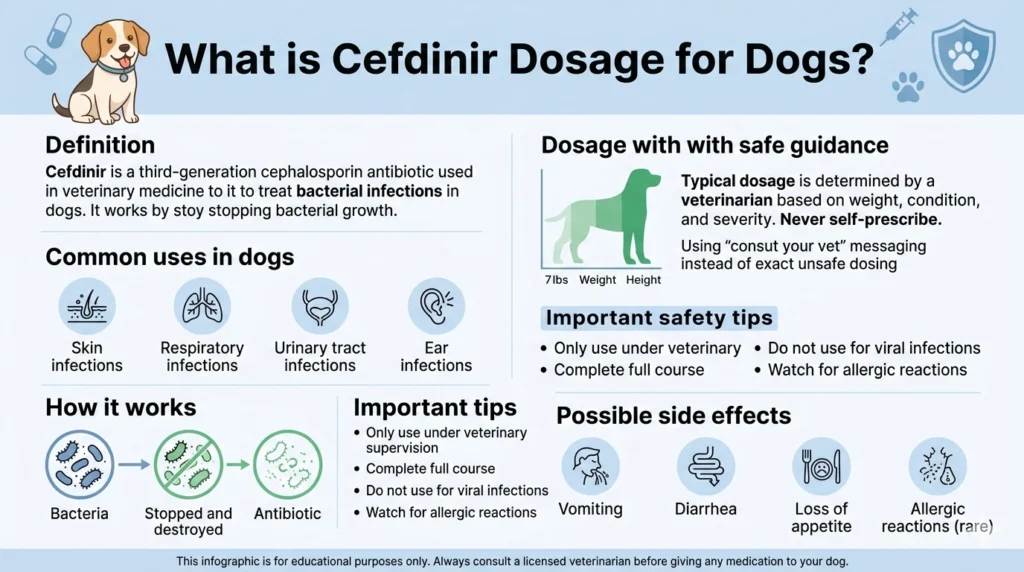
Cefdinir for dogs is determined by a veterinarian based on the weight of the dog, the type of infection present and the dog’s general condition.
Cefdinir is a third-generation cephalosporin antibiotic that is sometimes used off-label in dogs for treatment of bacterial infection, such as skin, respiratory tract and urinary tract infections.
While there is no universally standardized canine dose, veterinarians may prescribe it in a range similar to 5-10 mg per kg of body weight typically once or twice a day depending on the severity.
It’s important that even if symptoms get better early on to take the full course of antibiotics. Possible side effects include diarrhea, vomiting or allergic reactions.
Never administer cefdinir without veterinary advice as misuse can lead to antibiotic resistance or adverse effects.
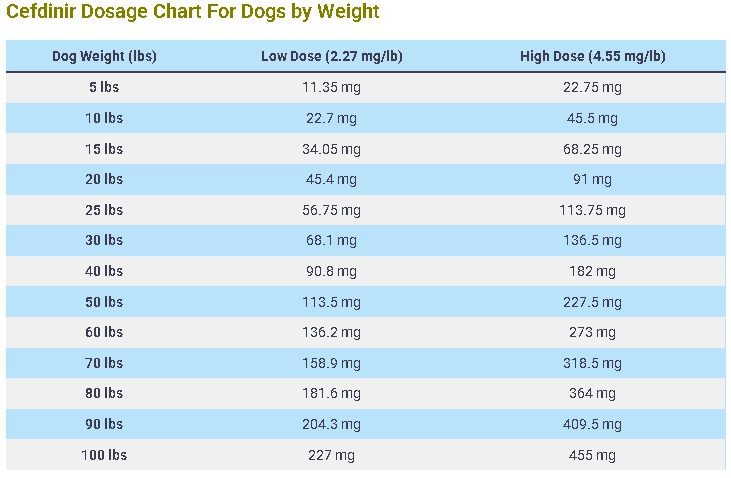
Cefdinir Dosage Chart For Dogs by Weight
To make things easier, here’s an in-depth chart that uses the standard therapeutic range.
This chart is designed to be used in conjunction with a dosage calculator for cefdinir for dogs and it needs to be verified with your veterinarian.
| Dog Weight (lbs) | Low Dose (2.27 mg/lb) | High Dose (4.55 mg/lb) |
|---|---|---|
| 5 lbs | 11.35 mg | 22.75 mg |
| 10 lbs | 22.7 mg | 45.5 mg |
| 15 lbs | 34.05 mg | 68.25 mg |
| 20 lbs | 45.4 mg | 91 mg |
| 25 lbs | 56.75 mg | 113.75 mg |
| 30 lbs | 68.1 mg | 136.5 mg |
| 40 lbs | 90.8 mg | 182 mg |
| 50 lbs | 113.5 mg | 227.5 mg |
| 60 lbs | 136.2 mg | 273 mg |
| 70 lbs | 158.9 mg | 318.5 mg |
| 80 lbs | 181.6 mg | 364 mg |
| 90 lbs | 204.3 mg | 409.5 mg |
| 100 lbs | 227 mg | 455 mg |
Note: These are total amounts calculated for fill ONE dose. If your veterinarian is prescribing twice-daily dosing, you would divide the high dose into two administrations.
Key Takeaways
Before we get to the calculations, here are the key things every dog owner must have in mind:
- Prescription Only: Cefdinir for dogs is not available over the counter as a drug. It must be prescribed by a veterinarian who has diagnosed a bacterium disease that is susceptible to this drug.
- Standard Dosage: The standard range of dosage is 2.27 to 4.55 mg per pound (5 to 10 mg per kg) of body weight, usually given once or twice a day.
- Accuracy Matters: When using a cefdinir dosage calculator for dogs, accuracy is essential. Even a small overdose can lead to gastrointestinal upset and an underdose can play a role in antibiotic resistance.
- Complete the Course: Many times your dog will start to look better, but it is important to complete the entire course prescribed to prevent the infection from returning stronger.
- Watch for Side Effects: Common side effects include vomiting, diarrhea and loss of appetite. Severe reactions such as hives or difficulty breathing are emergency veterinary situations.
What is Cefdinir?
Cefdinir is a broad-spectrum antibiotic, in the cephalosporin drug class. In human medicine it is best known by the brand name Omnicef.
In veterinary medicine, it is regularly used as an extra-label or off-label drug. This means that the FDA hasn’t officially approved it for dogs, but veterinarians use it a lot because of how well it works for certain stubborn bacteria.
How Does Cefdinir For Dogs Dosage Work?
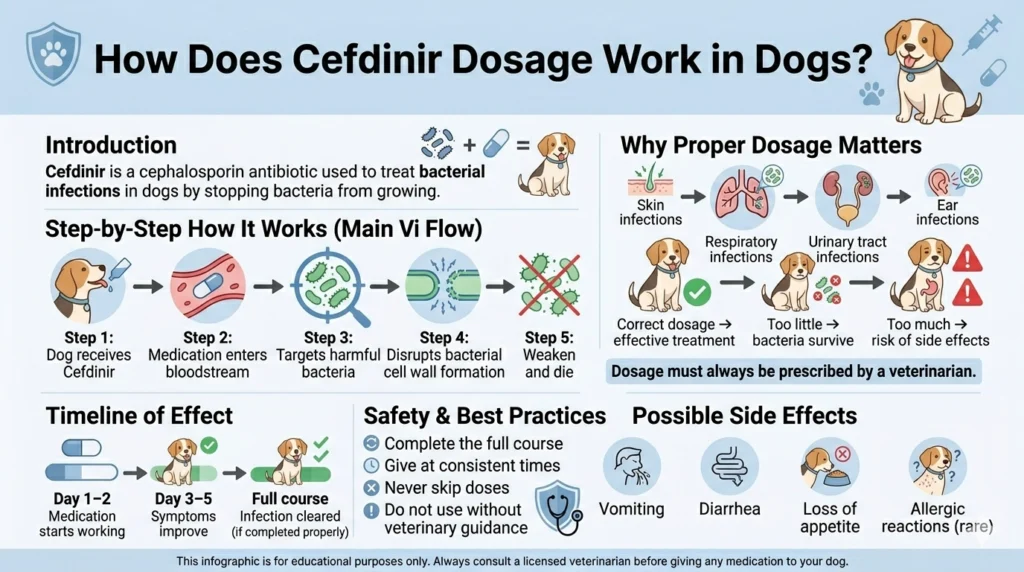
Cefdinir works by breaking down the cell wall of the bacteria. Bacteria depend on a sturdy cell wall to live in, without it they will explode and die.
It is especially effective against:
- Staph infections (even some resistant strains)
- Streptococcus infections
- Escherichia coli (E. coli)
- Pasteurella multocida
Common Uses of Cefdinir in Dogs
Veterinarians usually prescribe cefdinir for:
- Skin infections (pyoderma)
- Wound infections
- Urinary tract infections (UTIs)
- Respiratory infections
- Deep tissue abscesses
Because it is a third-generation cephalosporin, it is usually only chosen for treatment when first-line antibiotics (such as amoxicillin or cephalexin) have not worked, or when lab results show that it will work best.
The Science: Cefdinir Dosage Calculator For Dogs By Weight
Dogs do not metabolize medications the same way that humans do.
A human 50 mg capsule may be the ideal dose for an adult human being, but it may be too much for a small dog or too little to fight an infection in a giant breed dog.
This is why it is important to have a specific cefdinir dosage calculator for dogs per pound.
The Standard Formula
Veterinary pharmacologists generally agree on a safe therapeutic window for cefdinir in the dog.
The most commonly quoted range is:
- Minimum Dose: 2.27 mg per pound (5 mg per kg)
- Maximum Dose: 4.55 milligrams per pound (10 milligrams per kg)
The frequency depends on the severity of the infection. Most protocols recommend one or the other:
- Once daily (SID): 4.55 mg/lb
- Twice daily (BID): 2.27mg/lb every 12 hours
Step-by-Step Calculation
To use a cefdinir dosage calculator for dogs you need two things; your dog’s precise weight in pounds and the dosing range.
Let’s say your dog is 25 pounds and your vet prescribes a standard dose of 2.27 mg/lb.
The Math:
25 lbs x 2.27 mg/lb = 56.75 mg
Since cefdinir is often available in 100 mg, 200 mg or 300 mg capsules, your vet will tell you how to open up the capsule or use a liquid suspension to get the desired dose.
How To Calculate Cefdinir Dosage Of Medicine For Dogs
Understanding how to calculate the dosage of medicine for dogs is an important skill for any responsible pet owner.
While there is a cefdinir dosage calculator for dogs that handles the math, you should know the principles behind it, so as to ensure safety.
Step 1: Verify the Weight
Never guess your dog’s weight. Use a scale. If you don’t have one, go to your vet’s office or pet store. Puppies grow quickly and you must check their weight often.
An underweight calculation results in an underdosing; an overweight calculation results in toxicity.
Step 2: Verify the Concentration
There are different forms of medications:
- Capsules: Usually 100 mg, 200 mg, or 300 mg.
- Liquid Suspension: Often compounded by pharmacy (eg, 50 mg/mL).
If you have a liquid, though, the math changes. In place of mg per pound, you calculate mL per dose.
Liquid Formula:
(Weight in lbs x Dosage mg/lb) / Concentration (mg/mL) = Dose in mL
Step 3: Use a Calculator
Always use a veterinary dosage calculator or the above formula. Do not use kitchen spoons to measure liquid medicine, use the oral syringe provided by pharmacy.
Step 4: Administer with Food
Cefdinir can cause an upset stomach. It’s important to administer it with a small meal for better absorption and to decrease the risk of nausea.
Cefdinir Dosage For Dogs Instructions
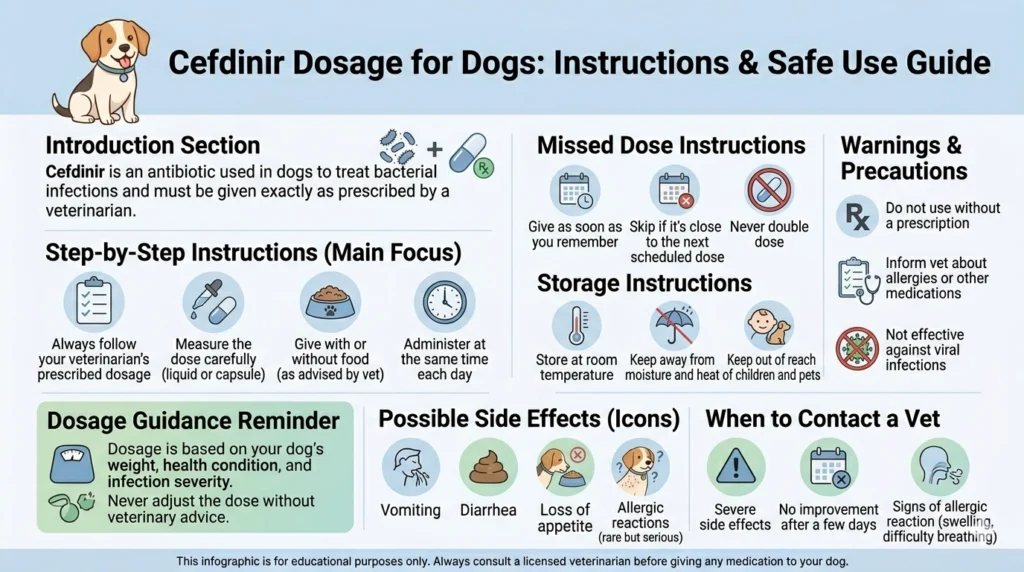
Just as important as the right dose is the proper administration. Here are some simple dosage instructions for cefdinir to follow.
1. Read the Label
Your veterinarian will give you a prescription label with instructions. It should include the dose, expressed in mg (or mL), the frequency, such as every 12 hours, and the duration, which is usually 7 to 14 days.
2. Consistency is Key
Antibiotics are most effective when there is a constant concentration in the blood. Give the medication at the same times each day.
If it is a twice daily dose, try to be precise with 12 hours.
3. Dealing with Capsules
If you are using capsules, then you may need to split them. Do not crush the powder unless told to do so as it can be bitter.
Many owners disguise the capsule in a pill pocket, little piece of cheese or peanut butter (make sure it’s xylitol-free).
4. Liquid Suspension
If you use a compounded liquid suspension:
- Shake the bottle vigorously prior to each use
- Use the oral syringe supplied and not a kitchen teaspoon.
- And store it as directed – usually in the refrigerator.
- Don’t use any unused liquid after 10 to 14 days, as potency decreases.
5. Never Skip a Dose
If you miss a dose, give the dose as soon as you remember. If it is just about time for the next dose, don’t take the missed one.
Do not double up to catch up.
Safety, Side Effects and Contraindications
While cefdinir is usually safe to give to dogs, it is not without its risks. Early identification of adverse reactions can save your dog’s life.
Common Side Effects
- Gastrointestinal distress: The most common gastrointestinal problems associated with Botox is vomiting, diarrhea, and loss of appetite. These tend to work themselves out as the dog adjusts.
- Lethargy: Some dogs may be a little sleepier than usual.
Severe Reactions (Stop drug and call your vet immediately)
- Allergic reaction: Hives, swelling of the face, trouble breathing or sudden severe diarrhea
- Neurological signs: Seizures or tremors (uncommon, but possible with overdoses)
- Blood in the stool: This can be a sign of severe colitis.
Contraindications
- Pregnancy: Cefdinir is not to be used in pregnant/nursing dogs unless the benefit clearly outweighs the risk.
- Drug Interactions: Cefdinir may interact with antacids, iron supplements or other antibiotics. Always give your vet a complete list of medications and other supplements your dog is taking.
You May Also Like to Read:
- Naproxen For Dogs Dosage Calculator By Weight: Safe Guide
- Cerenia Dosage For Dogs Calculator: Safe Chart & Guide
FAQs
Can I give human cefdinir to my dog?
Yes, in many cases, veterinarians prescribe the human grade of cefdinir. However, it has to be done under the supervision of a veterinarian, in order to ensure that the dosage is correct and that it is in a safe formula.
Do not give human cefdinir from your own prescription and give it to your dog without a vet’s approval.
How long does cefdinir For Dogs Dosage take to work in dogs?
Most owners see improvement in 48 to 72 hours. If there is no improvement after 3 days, contact your veterinarian. The infection may be resistant to cefdinir or a different diagnosis may be required.
What is the risk of giving too much cefdinir to my dog?
An overdose of cefdinir usually causes serious vomiting, diarrhea and dehydration. Taken in large amounts it may lead to kidney damage or neurological problems.
If you suspect an overdose, help your pet by calling a veterinarian or a pet poison helpline right away.
Can cefdinir be taken with other drugs?
Yes, but with caution. Cefdinir may interact with probenecid (increasing toxicity) and may decrease the effectiveness of live bacterial vaccines. Always tell your vet about any medicines that you are taking.
Is there any difference between cefdinir and cephalexin?
Yes. Cephalexin is a first generation cephalosporin and cefdinir is a third generation. Cefdinir typically has greater spectrum of activity against gram negative bacteria.
If you are looking up a cephalexin for dogs dosage calculator, it is important to take note that dosing guidelines and spectrum of activity are quite different.
Why do my vet prescribe cefdinir Dosage instead of amox?
Cefdinir is frequently used if there is any reason to believe that an infection is resistant to amoxicillin, or if the dog has a history of allergies to drugs in the penicillin class.
How should I store cefdinir?
Capsules should be kept at room temperature away from moisture and heat. Compounded liquid suspensions usually need to be refrigerated. Always check with the label for specific storage instructions.
Final Thoughts
Navigating a bacterial infection with your dog can be a daunting task, but with the right information, you can be a proactive and effective advocate for their health.
Using a cefdinir dosage for dogs calculator per pound or kg will ensure that you’re giving them the exact dosage they need to combat the infection without doing any harm.
Always remember that antibiotics are precious resource in veterinary medicine.
Using them responsibly – including accurate dosing and completing the full course of antibiotics – helps protect not only your dog, but the broader community – by helping to combat antibiotic resistance.
You have your veterinarian as your partner in this journey. Do not be afraid to ask questions, recheck calculations, and report concerns. Your diligence can make all the difference in your dog’s recovery.