(SMZ-TMP) Sulfamethoxazole Dosage For Dogs Calculator & Safe Guide
(SMZ-TMP) Sulfamethoxazole Dosage Calculator for Dogs
© medsdog.com
In cases when you need a good antibiotic to treat your dog, (SMZ) Sulfamethoxazole Dosage For Dogs, otherwise referred to as co-trimoxazole, TMS, Tribrissen dosage for dogs, or Bactrim, is commonly the antibiotic of choice among veterinarians.
This wide-spectrum combination is the combination of two antibiotics: sulfamethoxazole, a sulfonamide that inhibits production of folic acid in bacteria and trimethoprim, which inhibits replication of bacteria by denying them the necessary nucleotides.


The combination forms a potent barrier against many different types of infections, such as respiratory diseases (such as pneumonia and kennel cough), infections of the urinary tract, prostatitis, otitis externa (ear infections), skin infections, bronchitis, and some gastrointestinal diseases, such as bacterial diarrhea.
Since SMZ-TMP dosage for dogs is a long-acting, potent antimicrobial, it is important to make sure the correct dose is administered. Underspending might not lead to control of the infection and can lead to resistance, whereas excess spending can heighten the risk of adverse effects.
Although this drug is generally safe, it has side effects like loss of appetite, nausea, diarrhea, fever, anemia, allergic reactions (including hives), dry eye and in a few cases, a seizure. It is contraindicated in dogs allergic to sulfonamide, those with liver, kidney or blood disorders and is contraindicated in pregnant and nursing animals.
Also, (SMZ-TMP) Sulfamethoxazole Dosage For Dogs can interact with drugs such as methotrexate, phenylbutazone, salicylates, and anticoagulants and hence a complete medical history must be taken prior to treatment. It is also important to keep your dog supplied with the fresh water at all times in the course of therapy to be safe.
In this guide you will get to know the right dosage of sulfamethoxazole for dogs, how to compute an accurate dosage, and how to safely administer them in order to make your dog recover without any problems and eliminate risks that can be avoided.
Disclaimer: This guide is for informational purposes only and is not a substitute for professional veterinary advice.
Always consult your veterinarian before giving Sulfamethoxazole (SMZ-TMP) or any medication to your dog.
Key Takeaways
- Sulfamethoxazole dose is an antibiotic that is usually used with trimethoprim (SMZ-TMP) to treat bacterial infections in dogs, such as respiratory, urinary tract, skin, ear, and gastrointestinal diseases.
- It operates by blocking the synthesis of folic acid by the bacteria which is vital in the synthesis of DNA as well as growth in bacteria.
- It works synergistically with trimethoprim, and together, they are more effective in treatment of diverse infections.
- Precise dosing is essential- wrong dosing may result to failure in treatment or higher chances of side effects.
- It comes in varying levels and thus dose calculations should be done with caution and normally calculations are made using the trimethoprim component of the combination products.
- The main side effects are loss of appetite, nausea, diarrhea, fever, anemia, allergic reactions (including hives), dry eyes and in some uncommon cases, seizures.
- It is contraindicated in dogs with allergies to sulfonamides, liver, kidney or blood diseases.
- Pregnant or nursing dogs not thought to be safe.
- Interacts with drugs such as methotrexate, phenylbutazone, salicylates, and anticoagulants, which means that he or she should be consulted with the veterinarian.
- Dogs should not be denied access to fresh drinking water at all times throughout treatment to aid in safety and effectiveness.
- Take only under the supervision of a veterinarian to know the right dosage and reduce the possibility of health effects.
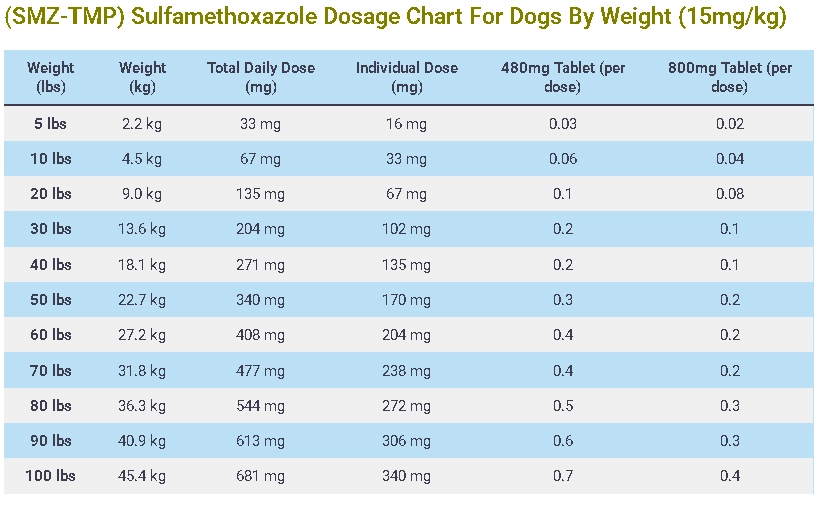
(SMZ-TMP) Sulfamethoxazole Dosage Chart For Dogs By Weight (15mg/kg)
This dosage table is designed for Sulfamethoxazole/Trimethoprim (SMZ-TMP) medication using a standard conservative dosage rate of 15mg/kg. Following your safety protocol, all final mg and tablet values have been rounded down to the nearest tenth or quarter-tablet where appropriate.


Calculated for twice-daily (every 12 hours) administration.
| Weight (lbs) | Weight (kg) | Total Daily Dose (mg) | Individual Dose (mg) | 480mg Tablet (per dose) | 800mg Tablet (per dose) |
| 5 lbs | 2.2 kg | 33 mg | 16 mg | 0.03 | 0.02 |
| 10 lbs | 4.5 kg | 67 mg | 33 mg | 0.06 | 0.04 |
| 20 lbs | 9.0 kg | 135 mg | 67 mg | 0.1 | 0.08 |
| 30 lbs | 13.6 kg | 204 mg | 102 mg | 0.2 | 0.1 |
| 40 lbs | 18.1 kg | 271 mg | 135 mg | 0.2 | 0.1 |
| 50 lbs | 22.7 kg | 340 mg | 170 mg | 0.3 | 0.2 |
| 60 lbs | 27.2 kg | 408 mg | 204 mg | 0.4 | 0.2 |
| 70 lbs | 31.8 kg | 477 mg | 238 mg | 0.4 | 0.2 |
| 80 lbs | 36.3 kg | 544 mg | 272 mg | 0.5 | 0.3 |
| 90 lbs | 40.9 kg | 613 mg | 306 mg | 0.6 | 0.3 |
| 100 lbs | 45.4 kg | 681 mg | 340 mg | 0.7 | 0.4 |
Key Reminders:
- Rounding: All calculations in this table are rounded down to the nearest conservative value to prioritize safety.
- Water Intake: This medication can cause crystals in the urine if the dog is dehydrated. Ensure the dog drinks plenty of water throughout the treatment.
- Breed Sensitivity: Use extreme caution and professional veterinary oversight when dosing Doberman Pinschers, Samoyeds, and Miniature Schnauzers, as they are statistically more prone to sulfa-drug reactions.
- Side Effects: Monitor for "Dry Eye" (Keratoconjunctivitis Sicca). If your dog begins squinting or has thick discharge, contact a vet immediately.
Note: This table is for educational purposes. The exact dosage rate (15mg/kg vs 30mg/kg) should be determined by a veterinarian based on the severity of the infection.
How Trimethoprim and Sulfamethoxazole Dosage Work
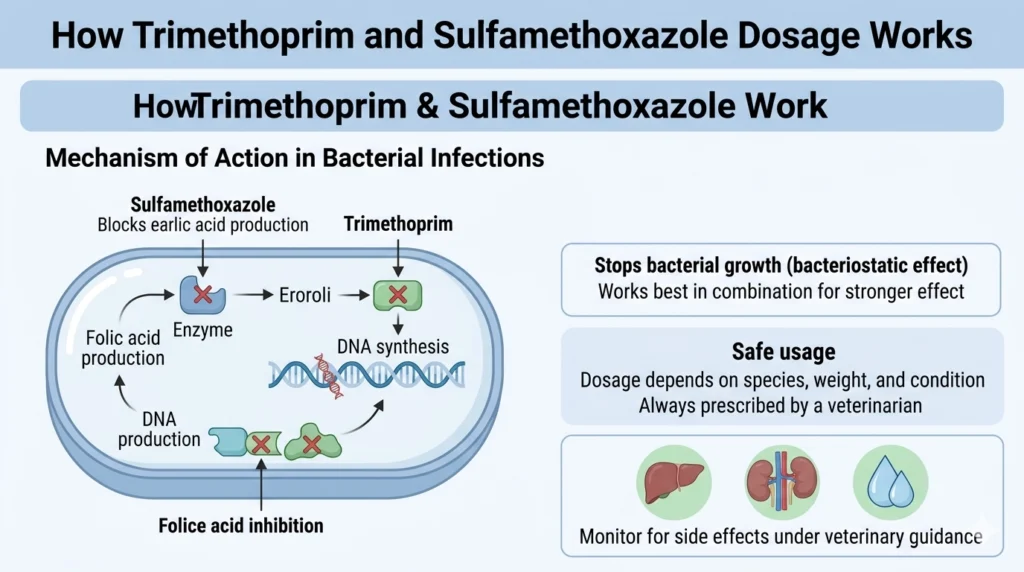
The combination of trimethoprim and sulfamethoxazole medication for dogs is a potent combination to inhibit two critical stages of bacterial folic acid production, which is needed in bacterial survival and growth. Such a two-fold action mechanism greatly increases the effectiveness of the combination of the two drugs because each acts individually.
A sulfonamide antibiotic, sulfamethoxazole, acts by suppressing the production of dihydrofolic acid. It achieves this by competing with para-aminobenzoic acid (PABA) which is one of the components that bacteria require to make folic acid. Sulfamethoxazole inhibits growth and replication of bacteria by interfering with this process.
The next step is targeted by trimethoprim, which attaches to and inhibits the activity of the enzyme, dihydrofolate reductase, inhibiting the transformation of dihydrofolic acid into tetrahydrofolic acid.


This is a very important step in the manufacture of nucleic acids and proteins. It is important to note that, trimethoprim attaches itself to bacterial enzymes far better than mammalian enzymes hence it selectively act on bacteria.
Combined, these drugs prevent sequential stages of the bacterial lifecycle in effect starving bacteria of the nucleotides needed to replicate DNA and make proteins. This will create a powerful anti-bacterial effect that will aid in the elimination of infections effectively.
Sulfamethoxazole and trimethoprim are prescription drugs and should be administered solely with the advice of a veterinarian to have a safe and effective treatment.
Uses of Trimethoprim and Sulfamethoxazole for Dogs
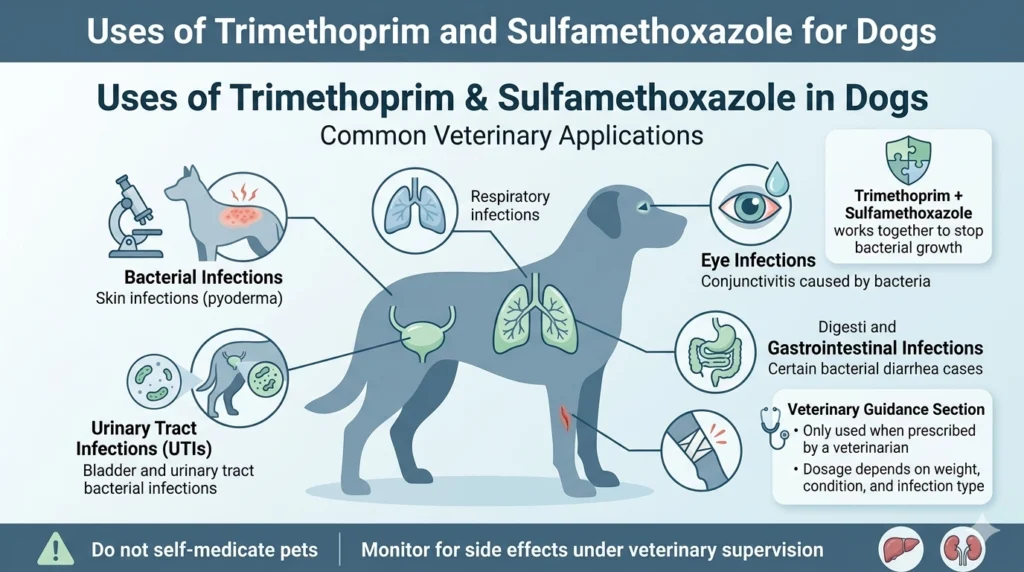
In dogs (and cats), trimethoprim and sulfamethoxazole dose are used to treat a large variety of bacterial and protozoan infections. It is a widely used veterinary medicine as it combats a variety of susceptible organisms with a broad spectrum.
Common uses include:
- UTIs due to E. coli, Klebsiella and Enterobacter species.
- Enteritis (gastrointestinal infections) due to Shigella.
- Lung diseases, such as pneumonia and kennel cough (Bordetella bronchiseptica)
- Ear infection (otitis media)
- Prostatitis
- Skin infections, in particular, those that occur as a result of Staphylococcal bacteria.
- Protozoal infections e.g. coccidiosis.
This is a combination antibiotic, which is prescribed depending on the infection, and should be taken strictly under veterinary advice, to be treated successfully and safely.
Potential Side Effects of Trimethoprim and Sulfamethoxazole (SMZ–TMP) in Dogs
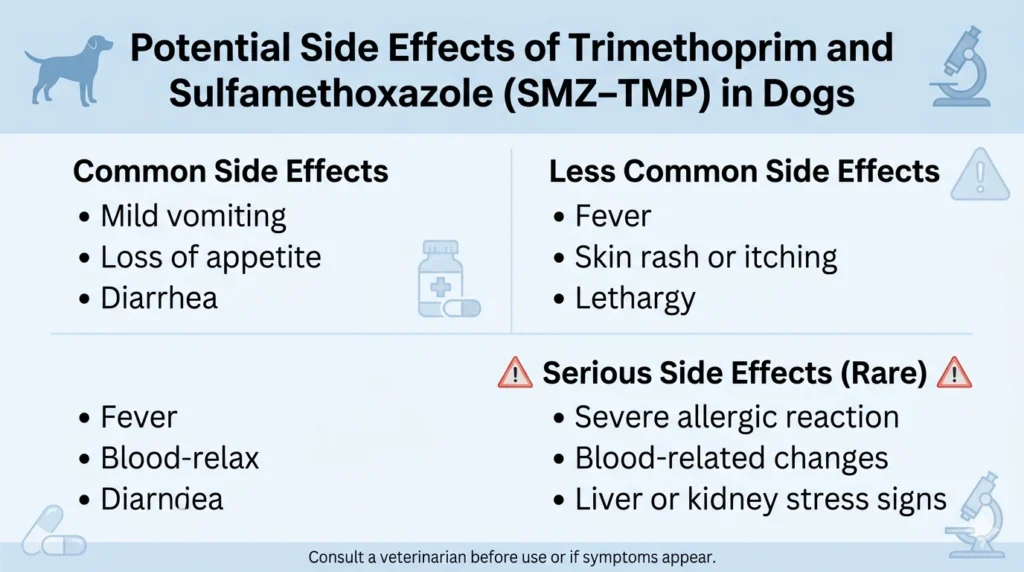
Trimethoprim and sulfamethoxazole drugs for dogs are safe when given by a veterinarian in most cases, although they may have numerous side effects, particularly when used long-term or in sensitive animals.
Pregnant or nursing animals should not be given this drug and pets with known allergies to sulfonamides (sulfa drugs). Always make sure that pets get plenty of fresh water and watch them carefully when receiving treatment.
Frequent and mild Side Effects:
- GIT problems: nausea, vomiting, diarrhea, abdominal pains, loss of appetite.
- General symptoms: weakness, lethargy, dizziness, fatigue, slight sedation.
- Sensitivity to sunlight (photosensitivity): redness, sensitized reaction of the skin to sunlight.
- Urine: crystals of sulfa in urine (not harmful, but typically, well hydrated)
Eye-Related Effects:
- Keratoconjunctivitis sicca (KCS / dry eye) on chronic use- the symptoms include redness of the eye, discharge and squinting.
Allergies (Seek Immediate Veterinary Care):
- Breathing problems, face/lips/tongue swelling, hives.
- Serious skin reactions like rashes, ulcers, exfoliative dermatitis or epidermal necrolysis.
- Fever, allergies to drugs or generalized skin eruptions.
Blood (Hematologic) Disorders:
- Anemia (pale gums, tiredness), leukopenia, neutropenia.
- Thrombocytopenia (increased bleeding or bruising)
- Bone marrow suppressions and other severe blood defects.
Liver and renal effects:
- Damage of the liver (hepatitis, jaundice, high enzymes)
- Renal damage (kidney failure, thirsty/urinating more often, crystals in the urine)
Neurologic and Behavioral Effects:
- Convulsions, ataxia, vertigo, headache.
- Depression, anxiety, apathy
Metabolic and Endocrine Effects:
- Electrolyte disorders (hyperkalemia, hyponatremia)
- Lower levels of thyroid hormone (potential hypothyroidism in the long term of use)
- Possible interactions with some diuretics and hypoglycemic medication.
Musculoskeletal: No known issues. Respiratory: No known issues.
- Synovitis (joint pain, arthralgia), muscle Pains (myalgia), lameness.
- Cough, breathing problems, lung alterations.
Other Important Warnings:
- May can lead to abnormal bleeding or bruising, yellow skin/eyes (jaundice) or extreme weakness- get to the veterinary as soon as possible.
- Should not spend too much time in the sun when being treated.
- Notice your veterinarian about any undue or persistent side effects.
To prevent adverse and dangerous use of SMZ-TMP in dogs it is crucial to monitor its use careful and under veterinary advice.
Drug Interactions of Trimethoprim and Sulfamethoxazole (SMZ–TMP) in Dogs
Sulfamethoxazole and trimethoprim for dogs dosage have the potential to interact with several drugs, and thus, should not be used without veterinary advice. Drug interactions can result in a change in drug efficacy or risk of severe side effects.
Key Drug Interactions:
- Anticoagulants (e.g., warfarin, aspirin): risk of increased bleeding and a longer clotting time.
- Phenytoin: suppressed metabolism in the liver, resulting in an increase in the level of the drug.
- Methotrexate: loss of protein binding sites, which results in an increase in toxicity.
- Cyclosporine: decreasing efficacy of therapy.
- Diuretics: high chances of thrombocytopenia and potential electrolyte disturbance (e.g. high potassium)
- Sulfonylureas: increased hypoglycemic (low blood sugar risk)
- Zidovudine: elevated levels in the serum.
Additional Precautions:
- Do not mix with drugs that can interfere with the liver, kidneys or bone marrow, because of the risk of toxicity.
- When injectable forms are mixed with other drugs, they can be incompatible.
- Should be used with care or should not be used in pregnant or nursing animals, or those with liver or kidney disease unless prescribed by a veterinarian.
To avoid such negative interactions and safe treatment of your dog, it is necessary to monitor and completely reveal the medications to make sure that these drugs do not interact with each other negatively.
How Trimethoprim & Sulfamethoxazole (SMZ–TMP) Is Supplied
Both human and veterinary formulations of trimethoprim and sulfamethoxazole have a variety of dosage forms, to meet various treatment requirements.
Human Preparations:
- Tablets:
- 400 mg sulfamethoxazole / 80 mg trimethoprim.
- 160 mg trimethoprim / 800mg sulfamethoxazole.
- Oral suspension:
- At a ratio of 40 mg/ 200 mg of trimethoprim / sulfamethoxazole per 5 mL.
- Injectable solutions:
- Trimethoprim 6 mg/mL + sulfamethoxazole 80mg/ mL (in 5mL)
- 80mg/mL trimethoprim + 400 mg/mL sulfamethoxazole (per 5 mL)
- Powder form:
- 67 mg trimethoprim / 333mg sulfamethoxazole per gram.
Veterinary Preparations:
- Tablets:
- 5 mg / 25 mg
- 20 mg / 100 mg
- 80 mg / 400 mg
- 160 mg / 800 mg (trimethoprim/sulfamethoxazole)
- Oral paste (mainly used on horses):
- 67mg trimethoprim / 333mg sulfamethoxazole.
- Injection (for horses):
- 100 mL of 48% solution.
The different formulations enable the flexibility in dosing and administration based on the species, condition and veterinary recommendation.
Trimethoprim & Sulfamethoxazole (SMZ–TMP) Dosing for Dogs
The dosages of trimethoprim/Sulfamethoxazole Dosage For Dogs (SMZ–TMP) dosage in dogs can be different based on the kind and intensity of infection being treated, the response of a specific individual to curement.
It is estimated that about 12.5-50 mg/kg (25- 100 mg/kg) in a single dose is appropriate once a day, or about 30-45 mg/kg/day, which is usually administered in two doses every 12 hours.
Another method of conservative dosing can also involve approximately 15mg/kg with the quantities of the tablet rounded off to achieve safety and precision where necessary.
The drug is available as oral, subcutaneous, intramuscular and intravenous, depending on clinical circumstances, but in home-based therapy most frequently as an oral.
SMZ-TMP dosage for dogs by weight comes in scored tablet forms: 400/80 mg and 800/160 mg and it can be administered with or without food. It is also possible to crush tablets and blend them with soft food when necessary to enhance adherence in hard to medicate dogs.
The length of treatment depends on the ailment under treatment:
- UTIs: the average is 7-14 days, which last 2-3 days once urine normalization occurs.
- Infections of the skin and respiratory systems: 10-21 days, depending on the clinical response.
- Chronic infections (e.g. prostatitis): can be treated by long-term or even lifelong treatment.
The entire course is required to be taken despite an improvement in symptoms early on to avoid relapse and decrease the chances of resistance to antibiotics. Early withdrawal of treatment may result in inadequate control of infections.
Under no circumstances should SMZ -TMP be given outside the supervision of the veterinarian because the dosage should be adjusted to the kind of infection, the state of the patient and the chances of adverse effects.
Key Benefits of Trimethoprim and Sulfamethoxazole (SMZ–TMP) for Dogs
The combination of trimethoprim and sulfamethoxazole has a number of therapeutic benefits because of the synergistic effect, and the wide antimicrobial spectrum.
- Broad-spectrum activity: Covers a great number of bacterial and protozoal infections, and thus it is a useful antibiotic agent in veterinary care.
- Multi-system infection control: Typically used to treat infections of the respiratory tract, urinary tract, skin and gastrointestinal system among other prone conditions.
- Synergistic dual action synergistic formula: Trimethoprim and sulfamethoxazole are synergies that increase the effectiveness of antibiotics to achieve better results than their individual effects.
- Multipurpose clinical application: Assists in the treatment of various types of infections using one drug, which is helpful in developing more effective treatment plans in dogs.
Directions for Using (SMZ–TMP)
Sulfamethoxazole Dosage For Dogs and trimethoprim (SMZ–TMP) is a broad-spectrum prescription antibiotic that is commonly used in dogs and cats to treat several different types of organisms causing respiratory diseases, urinary tract diseases, skin diseases, ear diseases, gastrointestinal diseases and some forms of diarrhea.
Although it is very popular in veterinary practice, it should be mentioned that it is not approved by FDA to be used in veterinary practice, however it is an accepted treatment, and is frequently prescribed by veterinarians.
This medicine should never be used incorrectly without a licensed veterinarian because the dosage and the time of using this medicine varies according to the kind of infection and the reaction of the animal to the medication. The average dosage of both dogs and cats is about 13mg/kg body weight (or 25-100 mg/kg/day).
This maximum daily dose is normally broken down into two equal doses taken 12 hours apart. Tablets can be crushed and put in food, when needed and pets must always have access to a lot of fresh water when taking medication.
SMZ-TMP (Sulfamethoxazole Dosage For Dogs) comes in a variety of formulations (tablet, 80/400 mg and 160/800mg) and oral suspension (40/200mg). It can also be given through subcutaneous, intramuscular or intravenous route in certain instances, as directed by the veterinarians and clinical requirements.
Treatment usually lasts 1-2 weeks although it can be longer depending on the intensity of infection and reaction of the patient.
It is imperative to take the entire treatment plan, even in case of early improvement of symptoms since premature termination of the drug may result in the resurgence or relapse.
You May Also Like to Read:
- Fluconazole Dosage For Dogs Calculator: Safe Guide & Chart
- Promethazine Dosage For Dogs: Calculator, Chart & Safe Guide
FAQs
Is sulfamethoxazole and trimethoprim safe for dogs?
Sulfamethoxazole Dosage For Dogs and trimethoprim are antibiotics that are used in veterinary practice to treat bacterial infections of the urinary tract, respiratory tract and the skin. Nonetheless, they are not safe in all dogs.
They are contraindicated in dogs that have liver damage, blood cell disorders, dehydration, risks of developing urinary stones, or are allergic to sulfonamides, as well as those with a history of adverse reactions. They are even not safe in pregnant or nursing animals.
What is the use of sulfamethoxazole dosage?
Sulfamethoxazole for dogs dose is an antibiotic based on sulfonamide, which prevents the growth of bacteria by preventing the production of folic acid. It has been used in the treatment of respiratory, urinary, skin, soft tissue and gastrointestinal system infections, and is commonly used together with trimethoprim to increase effectiveness.
Does sulfamethoxazole medication make a good antibiotic?
Sulfamethoxazole dosage for dogs per pound or kg can be regarded as an intermediate to a potent broad-spectrum antibiotic that is applicable against a great number of gram-positive and gram-negative organisms. Nonetheless, the effect is dependent on the type of bacteria, dose and duration of treatment and there are bacteria that are resistant.
Sulfamethoxazole or amoxicillin?
No. Sulfamethoxazole (sulfonamide) and amoxicillin (penicillin-type antibiotic) are dissimilar drugs whose action mechanisms are dissimilar. They cannot be interchanged and are chosen depending on the type of infection undergoing treatment.
Is SMZ–TMP effective in treating UTIs?
Yes. It is usually used to treat urinary tract infections in dogs and cats that are brought about by sensitive bacteria.
Is it to be administered with food?
Yes. SMZ-TMP may be administered with or without food, although administration with food could be beneficial in preventing stomach upsets.
What in case of a dose omission?
Take the skipped dose as soon as possible but not within 24 hours of the next dose. Do not increase the dosage.
What is the reason behind continuing the treatment when the symptoms are improved?
Early discontinuation can cause a recurrence of infection and be a cause of antibiotic resistance. The entire course is necessary to eliminate all bacteria.
Is it possible to treat my dog with horse SMZ?
One should never use any medication without the advice of the veterinary. Although dosing may sometimes be calculated by weight (approximately 13 mg/kg/day) it may result in overdose, underdose, or severe side effects when doses are determined at home or using horse formulations. Supervision by the veterinary is vital in proper dosing and safety.
Final Thoughts
Sulfamethoxazole dose for dogs & trimethoprim (SMZ-TMP) is a common combination of widespread antibiotic that is used in treating numerous bacterial infections in dogs including urinary tract infections, respiratory infections, skin infections, ear infections, and gastrointestinal tract infections.
Its dual mechanism of action enables it to be effective in many of the susceptible bacteria when taken accordingly.
Nonetheless, there are significant responsibilities associated with its benefits. To maintain safety, prevent relapse, and minimize chances of antibiotic resistance, it is necessary to administer the correct dosage, complete the whole course and closely monitor the treatment by a veterinarian.
Since SMZ-TMP may lead to side effects and have interactions with other drugs, one should never take it without a doctor.
Properly applied, SMZ-TMP may be a very useful form of treatment that would assist in the recovery and would help in restoring your dog to health in a safe and effective manner.